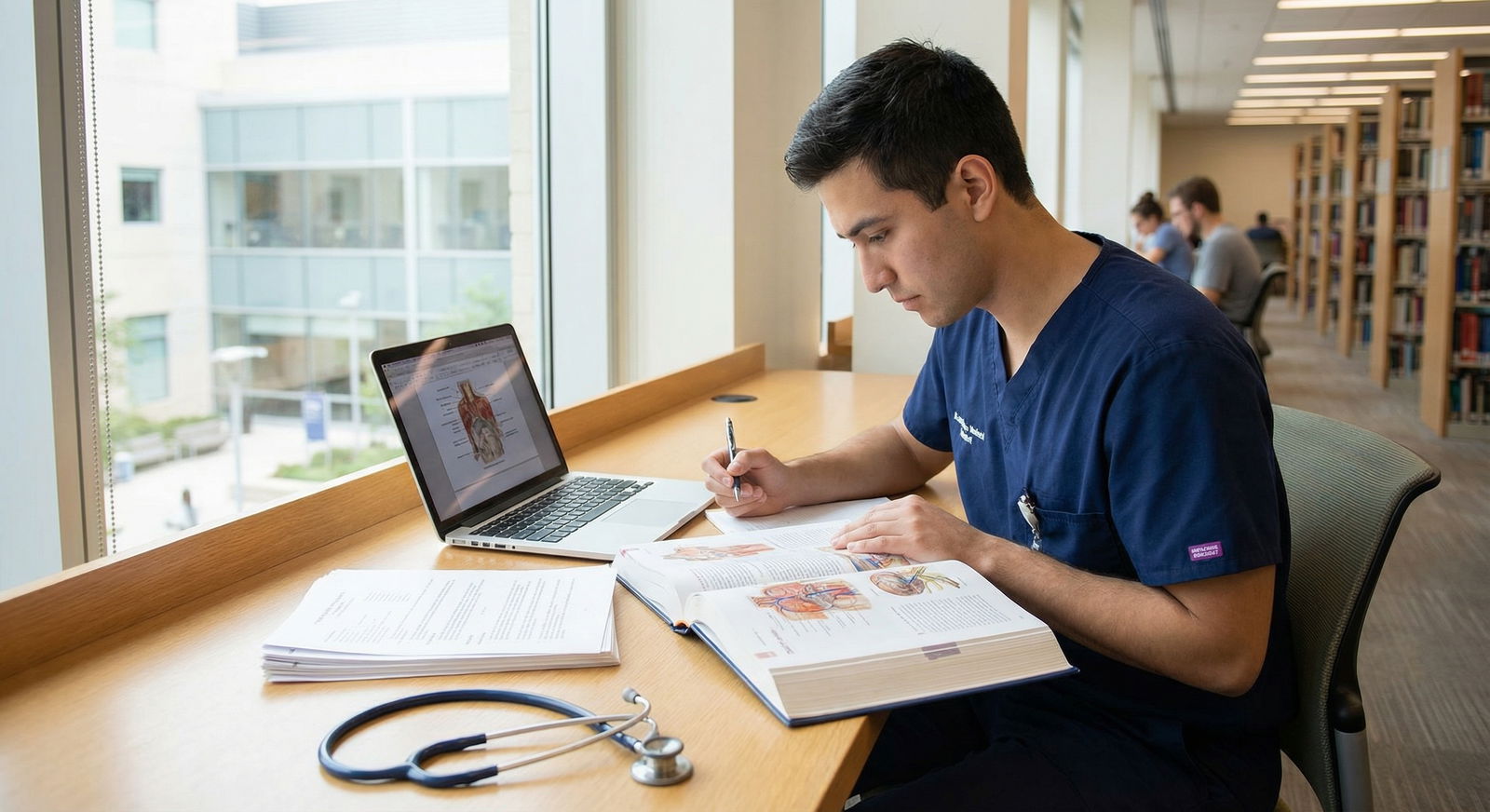
Maximize Learning in Residency: Best Practices for Efficient Medical Study Habits
Medical education does not slow down once you graduate from medical school—in many ways, it accelerates. As a resident, you’re expected to integrate massive amounts of new information, manage complex clinical scenarios, and maintain your own Wellness, all while working long hours and navigating a steep learning curve.
Efficient study habits become survival tools. They determine not only how well you perform on in-training exams and boards, but also how confidently and safely you care for patients. This guide reframes and expands the original principles for the residency context, providing practical, evidence-informed strategies to help you build sustainable, high-yield study routines during one of the most demanding phases of your Medical Education.
Understanding How Residents Learn: From Theory to Bedside
Residency is where “learning about medicine” becomes “learning to practice medicine.” Your study habits must evolve to match that shift.
Cumulative, Integrated Learning
Medicine is profoundly cumulative:
- Anatomy and physiology underlie pathophysiology
- Pathophysiology informs diagnosis
- Diagnosis guides management and procedures
In residency, this cascade occurs in real time—often under pressure. You are no longer just learning facts; you’re learning:
- Clinical reasoning and pattern recognition
- Risk–benefit analysis and decision-making under uncertainty
- Interprofessional communication and systems-based practice
Effective Study Techniques help you integrate these layers, not just memorize them.
Cognitive Load and the Need for Efficiency
Residency is a perfect storm of:
- High cognitive load (new patients, new protocols, new workflows)
- Limited time and energy
- Emotional stress and sleep disruption
Without a strategy, you will default to:
- Last-minute cramming before call or exams
- Passive reading when exhausted
- Fragmented, inconsistent learning
Intentional Time Management and structured Active Learning allow you to:
- “Chunk” complex topics into manageable pieces
- Connect new cases with foundational knowledge
- Reinforce what you see on the wards in a systematic way
Your goal is not to study more hours—it’s to make every limited minute of study count.
Building a Structured, Realistic Study System for Residency
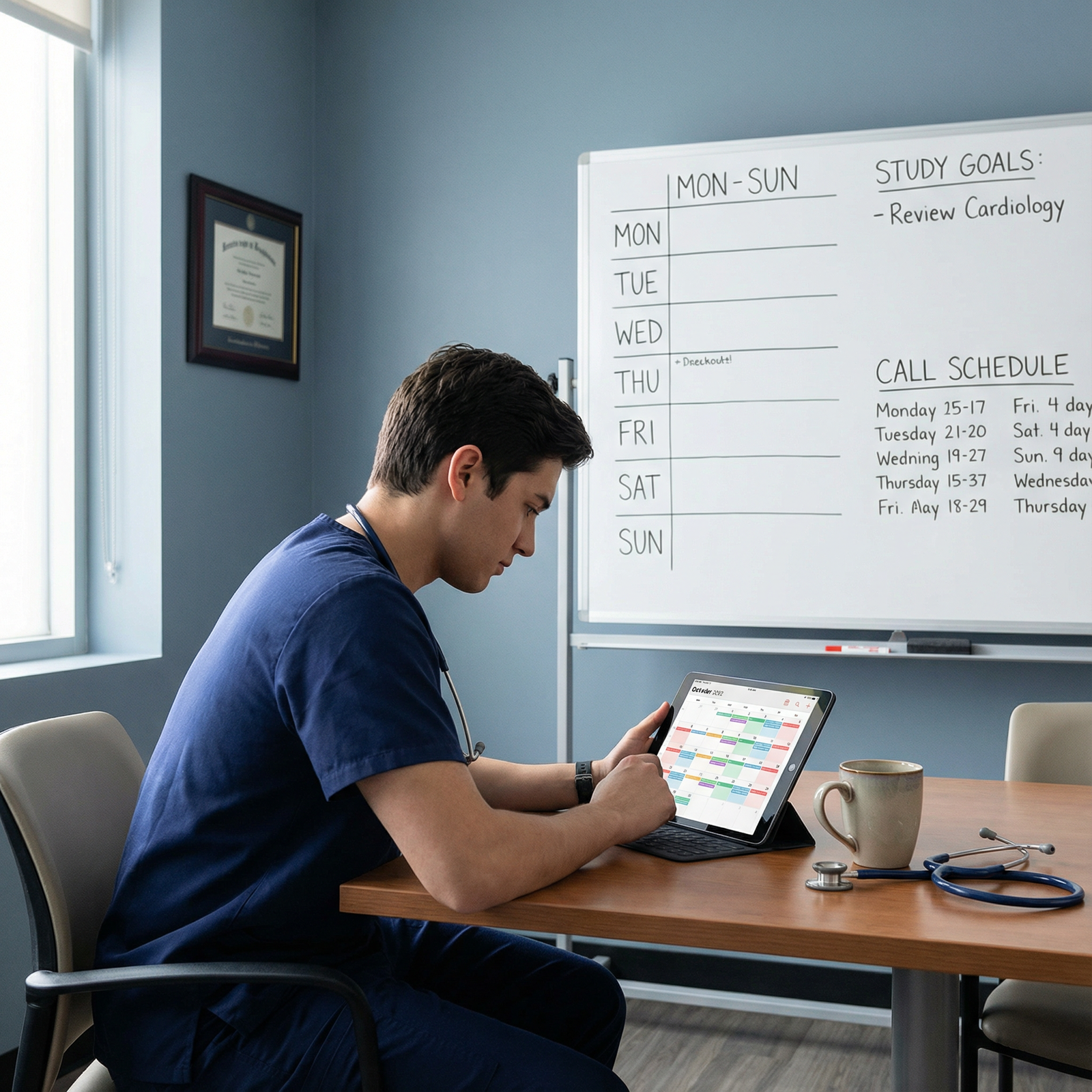
1. Design a Flexible but Intentional Study Schedule
Rigid daily schedules often fail in residency because your days are unpredictable. Instead, build a framework that respects your rotation demands and personal physiology.
Align Study with Your Shifts and Energy
- Identify your realistic windows
- On lighter rotations (e.g., electives, outpatient): aim for 1–2 hours of focused study most days.
- On heavy inpatient or ICU months: you may only manage 20–40 minutes on post-call days and 45–60 minutes on others—and that’s okay.
- Match tasks to energy levels
- High-energy times (early morning, pre-shift for some; late evening for others): practice questions, case reviews, or complex reading.
- Low-energy times (post-call, after long shifts): flashcards, audio content, brief guideline reviews.
Use Time-Blocking with Realistic Goals
Rather than vague goals like “study cardiology this week,” try:
- “30 minutes of cardiology board questions daily, review explanations thoroughly”
- “3 mornings this week: 20 minutes of Anki spaced repetition”
- “One weekend half-day: deep dive into sepsis, including guidelines and protocols”
This combines Time Management with specificity and accountability.
2. Prioritize High-Yield Topics and Rotation-Relevant Content
Residency is not the time to read entire textbooks cover to cover.
Anchor Your Learning to Your Current Rotation
For example:
- On internal medicine wards:
- Focus on common admitting diagnoses: chest pain, dyspnea, fever, acute kidney injury, sepsis, electrolyte disturbances.
- Use the day’s admissions to define your study topics that evening.
- On surgery:
- Pre-read about tomorrow’s cases: indications, anatomy, key steps, common complications.
- Learn postoperative management protocols you are actually using.
- On pediatrics:
- Prioritize developmental milestones, vaccine schedules, fever workups, and common outpatient complaints.
This “just-in-time” learning makes information stick because you immediately apply it to patient care.
Link Daily Cases to Structured Reading
For each notable case, ask:
- What did I understand well?
- Where did I feel uncertain?
- What complications or decisions made me uncomfortable?
Use those answers to guide that day’s 20–40 minutes of targeted reading or questions.
Active Learning Strategies That Actually Work for Residents
Passive reading rarely survives post-call fatigue. Active Learning keeps you engaged, improves long-term retention, and better translates to clinical performance.
1. Question-Based Learning as Your Primary Tool
Question banks are not just exam prep—they are high-yield learning tools during residency.
- Use in-training exam (ITE) or board-style question banks aligned with your specialty.
- Approach each question as a mini case conference:
- Before checking the answer, articulate your differential and reasoning.
- Afterward, read the full explanation—not just correct/incorrect.
- Note patterns: what do you repeatedly miss? Which guidelines keep appearing?
Example:
- You repeatedly miss questions on anticoagulation in atrial fibrillation in CKD.
- Action plan:
- 30–45 minutes that week reviewing guideline tables and institutional protocols.
- Summarize in a quick-reference note or flashcard set you can review on your phone.
2. Use Concept Maps and Clinical Algorithms
For complex systems (e.g., shock, acute respiratory failure, chest pain workup):
- Draw concept maps showing:
- Etiologies → Pathophysiology → Clinical features → Diagnostics → Management
- Convert protocols into simplified algorithms you can mentally rehearse:
- “If hypotensive + tachycardic + warm vs. cold → next steps…”
- “If suspected PE but hemodynamically unstable → bedside echo, etc.”
Put these in a notebook or digital file you can review rapidly before or after rounds.
3. Learn by Teaching—Even in Brief Moments
Teaching is one of the most powerful Study Techniques and a core part of residency.
- Teach medical students, interns, or even patients:
- Short “two-minute talks” on the wards:
- Example: “Here’s how I approach hyponatremia” or “How to interpret a basic ABG.”
- Short “two-minute talks” on the wards:
- Present at morning reports or case conferences:
- Volunteer to present interesting cases and build a mini teaching script—this forces you to clarify your own understanding.
If you cannot explain a topic clearly in simple language, that’s a cue to revisit the underlying concepts.
Making the Most of Diverse Learning Resources
Residency limits your time but expands your access to real patients and teaching attendings. The key is to balance clinical, digital, and traditional resources.
1. Core Texts and Guidelines for Depth
You may not read entire textbooks, but you do need:
- A few trusted core references in your specialty
- Familiarity with major guidelines: ACC/AHA, IDSA, ACOG, NCCN, etc., depending on your field
Actionable tips:
- Keep a digital or physical “go-to list” of guideline PDFs and bookmarks.
- When you see a case that clearly relates to a major guideline (e.g., STEMI, PE, sepsis), read the key recommendation tables that same day.
2. Online Videos, FOAMed, and Apps—With Caution
- Video platforms and FOAMed (Free Open Access Medical Education) can be excellent for:
- Procedures (e.g., central line placement, LP, airway management)
- ECG interpretation, radiology basics, POCUS tutorials
- Evidence-based apps (UpToDate, DynaMed, MDCalc, guideline apps) are invaluable at the bedside.
Use them:
- Before a procedure (watch a 5–10 minute video)
- After rounds (review one key topic you struggled with)
- During downtime (short podcasts on clinical reasoning, specialty updates)
Always check the date and source—ensure alignment with contemporary guidelines and your institution’s protocols.
3. Audio Learning During Commutes or Workouts
Residency rarely leaves large uninterrupted study blocks, but micro-learning adds up:
- Listen to clinical podcasts during commutes or while exercising.
- Use audio summaries of board review content.
- Review flashcards with text-to-speech if available.
This should supplement, not replace, your deliberate study, but it can turn “dead time” into incremental gains.
Spaced Repetition, Review Systems, and On-the-Job Learning
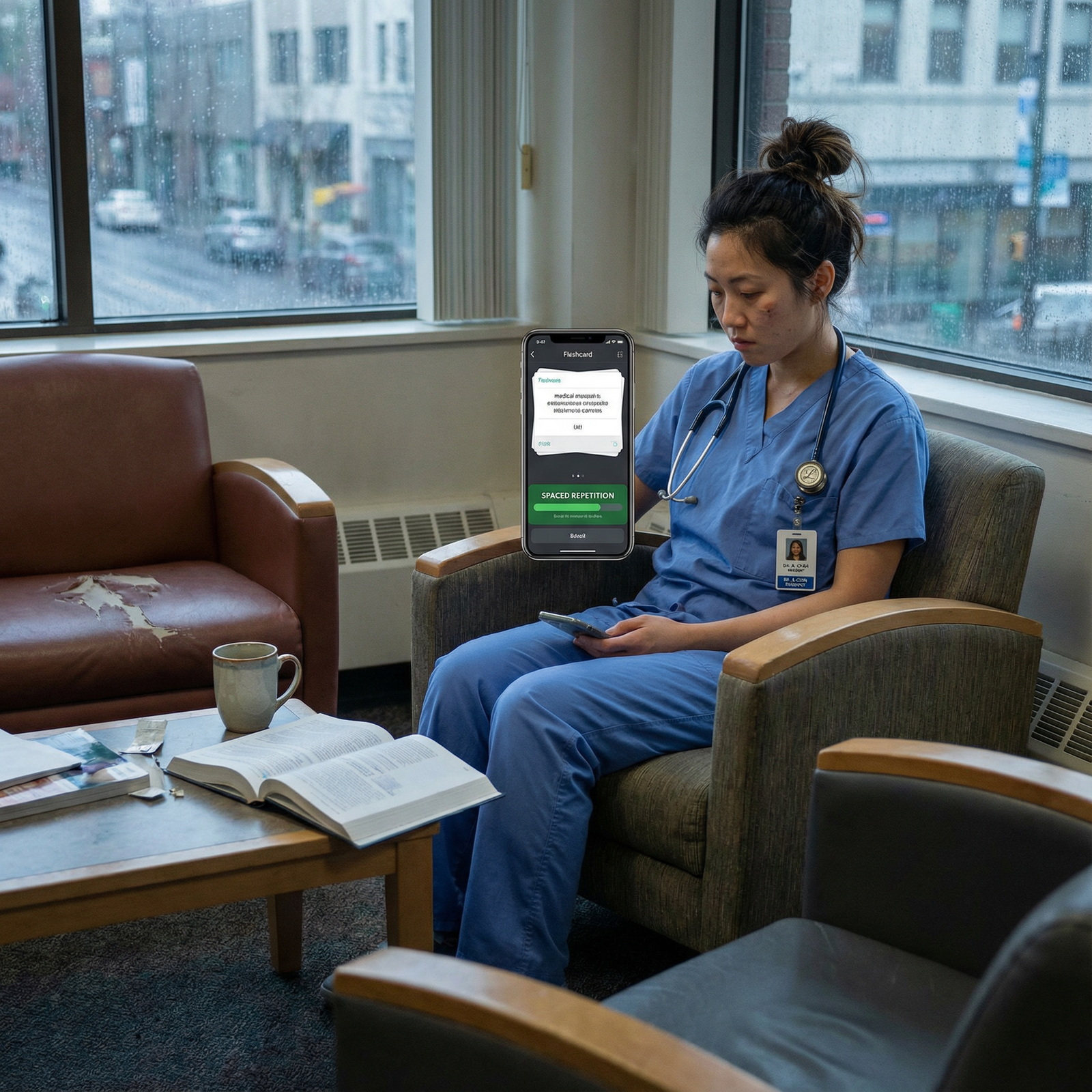
1. Spaced Repetition Tailored to Residency
Spaced repetition (SRS) is one of the most powerful memory tools, especially for dense factual material.
- Use platforms like Anki or other SRS apps to:
- Reinforce diagnoses, drug names, mechanisms, and management algorithms
- Retain rare but critical “can’t-miss” conditions
- Keep decks small and targeted:
- Cards based on patients you’ve seen (“52-year-old with NSTEMI…”)
- Cards based on questions you missed
- High-yield images (ECGs, rashes, imaging patterns)
Daily goal: even 10–20 minutes of flashcards can yield substantial long-term retention.
2. Structured Weekly and Monthly Reviews
Avoid the “I used to know this” problem by planning regular review:
- Weekly
- 30–60 minutes to revisit:
- Topics encountered on the wards
- Notes from conferences or morning report
- Missed questions from the week
- 30–60 minutes to revisit:
- Monthly
- Identify 2–3 “big rocks” (e.g., sepsis, heart failure, diabetes) and do a deeper review:
- Guidelines
- Algorithms
- Common pitfalls from your own practice
- Identify 2–3 “big rocks” (e.g., sepsis, heart failure, diabetes) and do a deeper review:
Treat these reviews as non-negotiable appointments with your future board-exam-passing, competent-attending self.
3. Use Every Patient as a Learning Opportunity
Residency is the best time to build robust clinical reasoning.
For each challenging patient:
- After sign-out or later that day, ask yourself:
- Did I fully understand the pathophysiology?
- Would I make the same decisions again? Why?
- What did my senior or attending do that I wouldn’t have thought of?
- Read one focused article or guideline section specifically about that case.
This “case-based reflection” transforms daily work into a continuous Active Learning experience.
Group Learning, Mentorship, and the Study Environment in Residency
1. Smart Use of Group Study and Peer Support
You may not have time for long group study sessions, but peer learning still matters.
Brief, High-Yield Group Sessions
- Post-call debriefs:
- “What was the toughest case last night?” → 10–15 minutes of discussion.
- Short weekly sessions with co-residents:
- Choose a single topic (e.g., ARDS management)
- One person prepares a 10-minute overview; then do 5–10 board-style questions together.
These interactions boost understanding, morale, and accountability.
Accountability Partners
Pair with a co-resident and agree to:
- Share weekly learning goals (“20 GI questions, 1 sepsis guideline review”).
- Send a quick check-in message or screenshot at week’s end.
- Celebrate progress, not perfection.
2. Crafting a Conducive Study Environment—Even on Call
Your environment heavily influences focus and productivity.
- At home:
- Keep a designated study space if possible, even if it’s just a small corner.
- Minimize visual clutter; organize your physical and digital materials.
- At the hospital:
- Identify “study-friendly” spots: an empty conference room, a quiet corner in the call room.
- Use noise-canceling headphones or earplugs if needed.
Use distraction-limiting tools:
- Website blockers or focus apps (e.g., Forest, Focus@Will) for short, intense sessions.
- Turn off nonessential notifications during your 20–40 minute focused work blocks.
Wellness, Boundaries, and Sustainable Learning in Residency
Efficient Medical Education during residency is inseparable from Wellness. Burnout erodes memory, focus, compassion, and performance.
1. Protecting Your Physical Health
You do not need a perfect fitness regimen—but you do need consistency.
Sleep Hygiene
- Aim for as close to 7–8 hours as your schedule allows.
- On night float:
- Use blackout curtains/eye masks and white noise.
- Avoid heavy meals and caffeine close to your “bedtime,” even if it’s 9 a.m.
Movement
- Short, regular exercise (10–20 minutes) can:
- Improve mood and attention
- Reduce stress and anxiety
- Consider body-weight workouts at home, brisk walks, or stairs at the hospital.
- Short, regular exercise (10–20 minutes) can:
Nutrition
- Keep quick, healthy snacks available (nuts, yogurt, fruit) to avoid relying solely on vending machines.
- Hydrate—cognitive performance drops with even mild dehydration.
2. Mental Health, Mindfulness, and Boundaries
Residency is emotionally heavy; ignoring that impacts your learning as much as your life.
Mindfulness and relaxation techniques
- 5–10 minutes of daily meditation, breathing exercises, or quiet reflection can lower stress and improve focus.
- Use apps if helpful, or simply sit quietly and practice slow, intentional breaths.
Boundaries
- Protect at least one regular, non-negotiable off-duty block each week where you:
- Do not study
- Spend time with family/friends or on hobbies
- Allow your brain to rest and reset
- Protect at least one regular, non-negotiable off-duty block each week where you:
This is not laziness—it’s maintenance of the cognitive machinery you rely on.
3. Recognizing When You Need Help
If you notice:
- Persistent loss of motivation
- Chronic exhaustion despite days off
- Difficulty concentrating, remembering, or caring
- Anxiety or depressive symptoms
Reach out early:
- Program leadership
- Employee assistance programs
- Counseling or mental health resources
You cannot learn or care for patients effectively when you are depleted. Seeking help is a professional strength, not a weakness.
FAQs: Efficient Study Habits and Success in Residency
1. How much should I realistically study during residency?
There is no single number, but many residents find success with:
- Light rotations: 1–2 hours most days
- Heavy rotations: 20–60 minutes on non–post-call days, minimal on post-call days
The key is consistency and quality, not total hours. Even 30 focused minutes of questions plus brief review can outperform 3 hours of unfocused reading.
2. How can I balance clinical duties, studying, and personal life without burning out?
Use a layered approach:
- Time Management: Schedule short, high-yield study blocks around shifts.
- Prioritization: Focus on topics directly related to your rotation and in-training exam goals.
- Wellness: Protect sleep, maintain basic exercise and nutrition, and schedule non-negotiable downtime.
Be honest about your limits—some weeks, “survival mode” with minimal studying is appropriate. Balance over months, not days.
3. What’s the best way to use question banks during residency?
Integrate them into daily learning:
- Do small sets regularly (10–20 questions), not huge blocks once a month.
- Review explanations thoroughly, especially for missed or guessed questions.
- Track your weak areas and target those topics with spaced repetition and brief readings.
- Time yourself occasionally to practice exam pacing, especially in the year before boards.
4. Is group study still useful during residency, or is it a waste of time?
When done intentionally, it can be very valuable:
- Keep sessions short (30–60 minutes) and focused on a specific topic or question set.
- Use them to clarify complex concepts, practice clinical reasoning, and learn different approaches from peers.
- Avoid unstructured, chat-heavy sessions that drift off-topic—those are what feel like a waste.
5. How can I effectively use spaced repetition (like Anki) without it taking over my life?
- Start small: 50–100 highly curated cards can be more effective than thousands of low-yield ones.
- Create cards only for:
- Missed questions
- Critical guidelines and algorithms
- Memorable or rare but important patient cases
- Set a daily review limit (e.g., 10–20 minutes). If you can’t maintain it on heavy rotations, temporarily pause adding new cards and just do brief reviews.
Efficient, sustainable study habits during residency are not about perfection; they are about deliberate, high-yield choices made consistently over time. By combining structured Time Management, Active Learning strategies, thoughtful use of resources, and genuine attention to your Wellness, you can not only pass exams—you can grow into a confident, competent, and resilient physician whose learning continues for a lifetime.