
The worst retirement mistake dual-physician couples make is pretending they’re one person with one timeline. You are not. You’re two careers, two benefit systems, two call schedules, and usually two very different levels of burnout—and if you don’t plan this chronologically and explicitly, you’ll end up with a mess of mismatched retirement dates and unpredictable cash flow.
Let’s lay out what you should be doing year-by-year, then month-by-month as you close in on retirement, and finally what the week-by-week looks like in the final stretch.
8–10 Years Before Retirement: Set the Joint Timeline Foundation
At this point you should stop thinking “we’ll retire around 60–65” and start putting actual numbers and years on the board for each of you.
Step 1: Define two retirement ages, not one
Sit down and answer, separately:
- “If I were single and didn’t have to coordinate, when would I retire from full-time work?”
- “What’s my absolute latest ‘I refuse to still be doing call’ age?”
Then compare.
Common pattern I see:
- Partner A (hospitalist, EM, surgery): “I want out of full call by 60.”
- Partner B (outpatient, academic, telemed-capable): “I’m fine going to 65 if needed.”
At this point you should:
- Write down three ages for each of you:
- Ideal full retirement age
- “Step-down” age (leave call, cut to 0.6–0.8 FTE)
- Absolute latest age you’re willing to work
That gives you a working framework instead of vague hope.
Step 2: Inventory every income and benefit stream—by person
Do this separately for each of you. No “our 401(k)” handwaving. Split it out.
At this point you should list, for each spouse:
- Employer retirement:
- 401(k)/403(b)/457(b) balances and annual contributions
- Defined benefit pension (if any): vesting date, projected benefit at 60/62/65
- Personal accounts:
- Traditional IRA / Roth IRA balances
- Taxable brokerage accounts
- Practice-related:
- Partnership buyout, stock, or deferred comp
- Any non-qualified plans
- Insurance:
- Own-occupation disability policies (benefit amounts, end age)
- Term life policies and expiration dates
- Healthcare:
- Who carries the family health insurance now?
- Access to retiree health or subsidized COBRA?
Put it into a simple matrix. Something like this:
| Item | Physician A | Physician B |
|---|---|---|
| 401(k)/403(b) Balance | Yes | Yes |
| 457(b) Balance | Yes | No |
| Defined Benefit Pension | No | Yes |
| Partnership Buyout | Yes | No |
| Retiree Health Option | No | Yes |
This isn’t busywork. This is how you avoid discovering—right before retirement—that one pension is cut in half if you leave at 61 instead of 62.
Step 3: Decide whether your target is “same day” or “staggered”
At this point you should make a provisional decision:
- Aim for same-year or even same-month retirement?
- Or plan for 1–5 years of staggered work where one of you is still earning?
My bias: staggered is usually better for dual-physician couples. Why?
- Extends employer-sponsored health insurance.
- Reduces sequence-of-returns risk because income continues.
- Allows more strategic Roth conversions and tax planning.
- Lets one of you decompress earlier while the other pads the nest egg.
You can change your mind later. But you need a working hypothesis now because all the next steps depend on it.
5 Years Before First Retirement: Nail Down Dates and Big Levers
Five years out is when “we’ll retire someday” becomes “on or about July 1, 2031.”
At this point you should:
1. Lock in “official” retirement and step-down dates
For each of you, choose:
- Planned step-down date (e.g., from 1.0 FTE to 0.6 FTE)
- Planned full retirement date from clinical work
Put them on a calendar. Literally.
Then run through this scenario check:
- Who hits Medicare at 65 first?
- Who carries health insurance in which years?
- Any children still in college and needing support?
- Large liabilities still outstanding (mortgage, practice loan)?
2. Forecast your cash flow year-by-year
You’re doctors, not actuaries, but you need a clear picture.
At this point you should build a simple year-by-year cash flow projection from “now” to at least age 75.
Rows: calendar years.
Columns: income and key expenses.
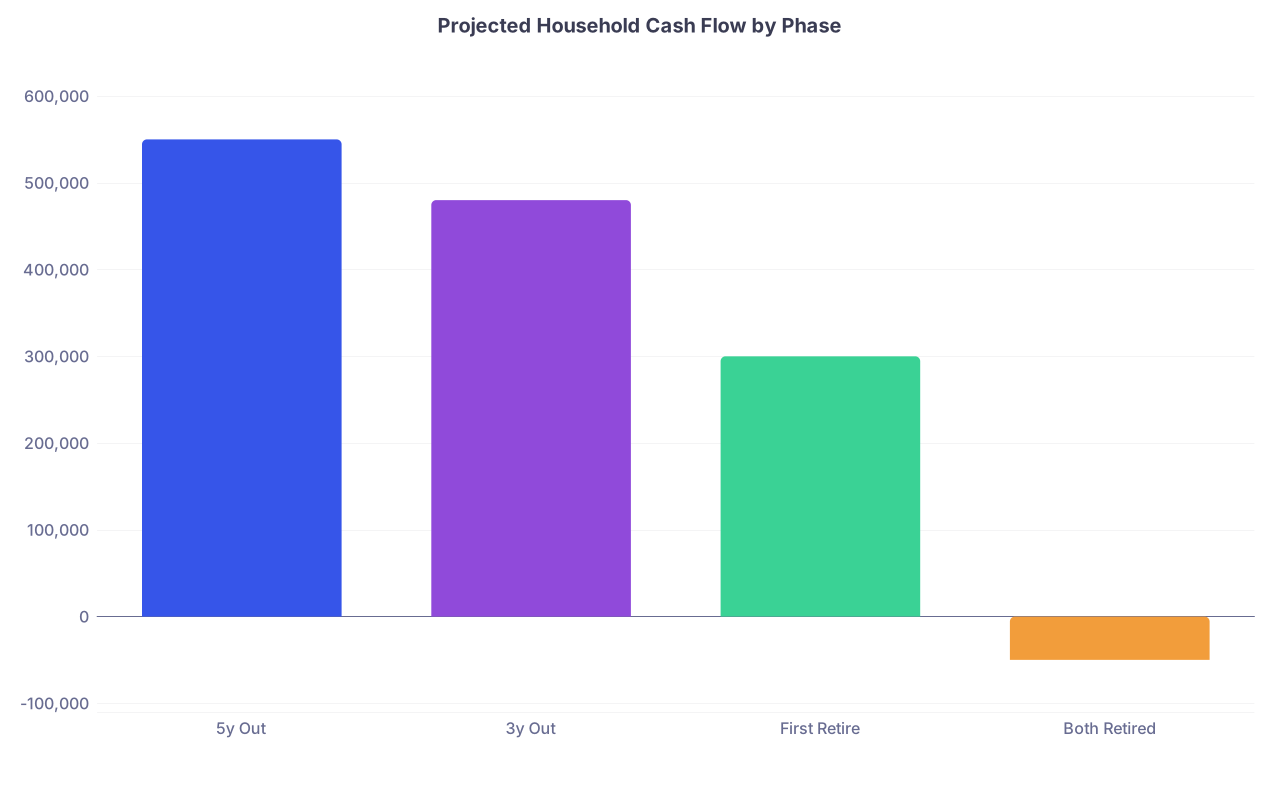
| Category | Value |
|---|---|
| 5y Out | 550000 |
| 3y Out | 480000 |
| First Retire | 300000 |
| Both Retired | -50000 |
Example structure for each year:
Income:
- Physician A salary / 1099 income
- Physician B salary / 1099 income
- Pension payments start?
- Expected portfolio withdrawals?
- Social Security (later)
Expenses:
- Core living expenses
- Health insurance premiums (if not employer-covered)
- College support / other major obligations
- Taxes (rough estimate is fine now)
At this point you should identify:
- Years with surplus while at least one of you works
- Years with deficit once both are out
Those deficit years are your “cash flow gap” years where portfolio withdrawals or other strategies need to cover you.
3. Clarify health insurance handoff
For dual-physician couples, health coverage timing is usually the single biggest coordination issue.
At this point you should answer, by year:
- Between the first retirement and Medicare, whose employer plan will you be on?
- If the younger spouse retires first, how will you bridge their gap?
- COBRA?
- ACA marketplace (with income planning to qualify for subsidies)?
- How will coverage work between 62 and 65 if both of you retire early?
This is exactly where staggered retirement earns its keep. One of you working until both hit Medicare simplifies the whole puzzle.
3 Years Before First Retirement: Tighten the Numbers, Start Trial Runs
Now you’re close enough that vague assumptions are dangerous.
At this point you should:
1. Get precise benefit projections
For each of you, request or calculate:
- Pension estimates at specific dates:
- If applicable, ask HR for benefit at, say, 60, 62, 65.
- Social Security statements (mySSA.gov):
- Check PIA and benefits at 62 / FRA / 70.
- Practice buyout details:
- When exactly are payouts?
- Over how many years?
- Tax treatment?
2. Coordinate retirement dates around “cliff” benefits
Physicians get hammered here when they retire 6 months too early out of ignorance.
At this point you should identify any “if you stay until X date, you get Y” situations:
- Pension multiplier increases at 60 versus 59.5
- Vesting dates for employer contributions
- Last bonus or RVU true-up timing
- Sabbatical or PTO cash-out rules
If one of you can work an extra 6–12 months and permanently increase a pension or secure a large buyout, that can easily be worth six figures over your lifetime. That might shift the coordination plan.
3. Do a one-year “practice budget”
Before either of you retires, you need to road-test your future lifestyle.
At this point you should:
- Decide what your “both retired” spending target will be (monthly).
- For the next 12 months, live on that number even while you’re both still earning.
- Invest the excess aggressively into taxable accounts or paying down targeted debt.
This is your stress test. If you can’t stand that budget while you’re still working, you will hate it when there’s no paycheck.
18–24 Months Before First Retirement: Sequence the Moves
Now we’re getting into month-by-month territory for the first retiring spouse.
At this point you should:
1. Decide who retires first and who carries health coverage
Usually one of three patterns:
- Higher-income spouse keeps working, carries health insurance
- Spouse with better retiree health benefits retires later
- Burned-out spouse steps down first but not fully, to preserve partial benefits
You’re optimizing across:
- Income stability
- Health insurance continuity
- Personal burnout / career satisfaction
2. Map out Roth conversions and tax brackets
Between first retirement and RMD age (or both retiring plus Social Security), you may have “low-income” years—especially if you stagger and the higher earner retires first while the other still works moderately.
At this point you should:
- Project taxable income:
- Scenario A: One spouse working, one retired
- Scenario B: Both retired, no Social Security yet
- Identify years where your marginal tax bracket drops (e.g., from 35% to 22%).
Those are prime Roth conversion years. You can pull from pre-tax accounts (401(k)/IRA), convert to Roth, pay taxes at a lower rate, and smooth future RMDs.
3. Decide on Social Security ages strategically
Dual-physician couples often oversimplify: “We’ll both file at 70.” Sometimes that’s right, often it’s lazy.
At this point you should consider:
- Having the higher earner delay to 70 (maximizes survivor benefit).
- Lower earner filing earlier (62–67) to bring some guaranteed income while the other still works part-time.
- Coordinate with your desired cash flow:
- If both retire early (before 65), you may want to delay SS and use portfolio/part-time work instead.
12 Months Before First Retirement: Operational Checklist
Now we switch to a clear month-by-month sequence around the first retirement.
12–9 Months Out
At this point you should:
- Inform leadership (if appropriate) of your intended retirement/step-down date.
- Clarify:
- Final RVU or bonus structure
- Vacation payout
- Call schedule tapering
- Meet with HR:
- Confirm last date of benefits
- COBRA details
- Retiree health options, if any
Run a fresh detailed cash flow plan for:
- Year 1: One retired, one working
- Year 2: Same
- And a projection for when the second retires
9–6 Months Out
At this point you should:
- Build your “bridge cash” plan:
- Which accounts will provide income for the newly retired spouse?
- Taxable?
- 457(b)?
- Partial pension?
- Which accounts will provide income for the newly retired spouse?
- Decide annuity or lump-sum election for any pension (if offered).
- Re-quote disability and life insurance needs:
- The retired spouse may not need full disability coverage anymore.
- Life insurance may be reduced or repurposed.
Also, decide lifestyle boundaries:
- How much will the retired spouse actually cut spending vs. just having more free time?
- Who covers which household roles once one of you is off the call schedule?
3 Months Before First Retirement: Week-by-Week Setup
At this point you should be getting tactical.
12–8 Weeks Out
- Finalize exact last day of clinical work.
- Set up direct deposit or bank linkages from the accounts you’ll withdraw from.
- Confirm pension start date (if applicable).
- If using COBRA:
- Understand timing and documentation requirements.
- Align end of employer plan and start of COBRA or new coverage.
8–4 Weeks Out
At this point you should:
- Do a tax projection for the current year:
- How many months of salary will the first retiree earn?
- Any big bonuses or buyouts this year?
- Adjust withholdings or estimated payments accordingly.
- Create a first-year “cash flow calendar”:
- Mark when each income source will hit (spouse salary dates, pension, withdrawals).
- Schedule monthly or quarterly transfers from investment accounts to checking.
Final 4 Weeks
- Confirm final paystub, PTO payout, bonus schedule.
- Double-check:
- Benefits termination date
- New insurance cards
- Pension or retirement plan distribution paperwork is completed
At this point you should have:
- One spouse retired or stepped down.
- One spouse still working according to your plan.
- Clear, predictable monthly cash coming in.
Coordinating the Second Retirement: Avoiding the Income Cliff
Now the real coordination test: transitioning from “one working, one retired” to “both retired and fully dependent on portfolio + pensions + Social Security.”
24–18 Months Before Second Retirement
At this point you should:
- Re-run your retirement projections with updated real numbers:
- Actual spending since first retirement
- Actual portfolio returns, not just assumptions
- Decide if the second spouse’s date needs to move:
- Forward if you’re more than secure
- Backward if market returns were poor or spending was higher than expected
18–12 Months Out
This mirrors the first retirement, but now cash flow risk is higher.
At this point you should:
- Build a detailed withdrawal plan:
- Order of withdrawals: taxable → IRA → Roth (usually, but not always).
- How you’ll adapt withdrawals in bad market years.
- Finalize Social Security decisions:
- Especially if you’ve delayed both so far.
- Coordinate start dates to avoid a sudden huge tax jump in the same year as big RMDs later.
12–6 Months Out
- Confirm:
- Second spouse’s final work date
- Last year’s retirement contributions
- Fine-tune your “retirement paycheck”:
- Decide a fixed monthly withdrawal amount for year 1 of both being retired.
- Align it with your tested spending level.
6–0 Months Out
At this point you should:
- Set up:
- Automatic monthly transfers from your chosen investment account(s).
- Tax withholding on pension and Social Security (so you do not get ambushed in April).
- Reassess risk tolerance and asset allocation:
- This is often when you move from aggressive accumulation to a more balanced, preservation-focused mix.
First 12 Months With Both Retired: Monitor and Adjust
Once both of you are out, the work is not done. It just changes shape.
At this point you should:
Months 1–3
- Treat the first 90 days like a pilot phase:
- Track every expense (yes, every one).
- Compare actual to your “intended” retirement budget.
- Confirm all income flows are working as intended:
- Pensions hitting on time?
- Social Security (if started) correct?
- Withdrawal mechanics smooth?
Months 4–6
If spending is higher than planned (it often is early):
- Decide whether this is a “go-go years” intentional choice or a structural problem.
- If structural:
- Cut predictable fixed costs first (housing, insurance, subscriptions).
- Avoid knee-jerk portfolio risk increases to “make up” for it.
Months 7–12
At this point you should:
- Do a one-year post-retirement review:
- Actual spending vs plan
- Actual withdrawal rate (total withdrawals ÷ portfolio size)
- If you’re consistently above a 4–4.5% withdrawal rate and both of you expect a 30+ year retirement:
- Consider course corrections: partial consulting, locums, or delayed Social Security.
Summary: The Real Sequence for Dual-Physician Retirement
You coordinate dual-physician retirement dates and cash flow by treating it like a staged, multi-year procedure:
- 8–10 years out – Define two separate timelines and a working pattern (synchronized vs staggered).
- 5 years out – Turn vague dates into explicit years and build a year-by-year cash flow map.
- 3 years out – Optimize around pensions, benefits cliffs, and Roth conversion windows.
- 2 years before first retirement – Decide who retires first and who carries health coverage.
- 12 months before first retirement – Execute operationally: HR, benefits, withdrawal logistics.
- 2–3 years later – Repeat a tighter version of the process for the second retirement.
- First year with both retired – Monitor spending and withdrawals aggressively; adjust early.
Do not treat this as one big decision. It’s a series of decisions at specific times.
Today’s next step is simple:
Sit down together and independently write your ideal, step-down, and latest acceptable retirement ages on paper. Then put them on a shared calendar and see where they clash. That’s the real starting point for everything else.