
It is 18 months before you want the first patient on your schedule.
You are finishing residency or grinding through your first attending job, and you have decided: you want your own practice. Not “someday.” On a specific date.
If you wait until 6 months out to take this seriously, you will either delay your opening or open under-prepared and bleed cash. This runway matters.
Here is your timeline. Month by month. With concrete “at this point you should…” steps.
Months 18–16: Decide What You Are Actually Building
At this point you should not be touring office space. You are too early for that. Right now is strategy and positioning.
Define your practice model (Month 18)
Sit down for 2–3 hours, no distractions, and answer these in writing:
- What EXACT services will you offer in the first 12 months?
- Target patients:
- Age range
- Insurance type (commercial, Medicare, Medicaid, self-pay)
- Geography (driving radius in miles, not just “my city”)
- Visit types:
- New vs established ratios
- Procedures vs E/M
- Volume target:
- Year 1: How many patients per day by Month 12?
- Year 2: What is “full” for you?
If you cannot answer that with numbers, you are not ready for space or staffing conversations.
At this point you should:
- Decide your core model:
- Insurance-based traditional
- Direct care / membership
- Hybrid: insurance + limited membership add-on
- Pick a tentative opening month (not a vague season).
Avoid the fantasy. For example: A new outpatient psych practice that “wants to be 80% private pay” in a heavily Medicaid area but will not market aggressively. I have seen this crash. Be honest about your market.
Market and competition scan (Month 18–17)
You are not doing a PhD thesis. You are doing a focused scan:
- List 10–20 local competitors close to your desired area.
- For each, look at:
- Website: services, pricing if visible, tone
- Online reviews: common complaints, praise patterns
- New patient wait times (call as a “prospective patient”)
- Accepted insurances
Then map out:
- Is there obvious demand? (e.g., 3–6 month waits for new rheumatology / psych / derm / endocrine)
- Is the area already saturated for your specialty? Be honest.
At this point you should:
- Identify 1–2 clear differentiators:
- Same-week access for certain visit types
- Extended hours twice per week
- Telehealth for specific conditions
- Subspecialty focus (e.g., ADHD in adults, perinatal psych, sports endocrine)
Write those differentiators in plain language you could put on your website home page.
High-level financial picture (Month 17–16)
You are not doing line-item budgets yet. But you must stop daydreaming and look at real numbers.
At this point you should:
- Pull current salary and benefits from your employed job.
- Decide:
- Are you planning to moonlight / locums around opening?
- Can you live on 50–70% of current income for 12–18 months?
- Estimate rough startup bundle:
- Build-out contribution (if any)
- Security deposit + first month’s rent
- Basic furniture + equipment
- EHR / billing setup
- Legal + accounting fees
- Opening marketing
Use a conservative total. Many decent outpatient, low-tech practices land in the $80k–$250k startup range depending on specialty and location. If that number scares you, good. Better now than after you sign a lease.
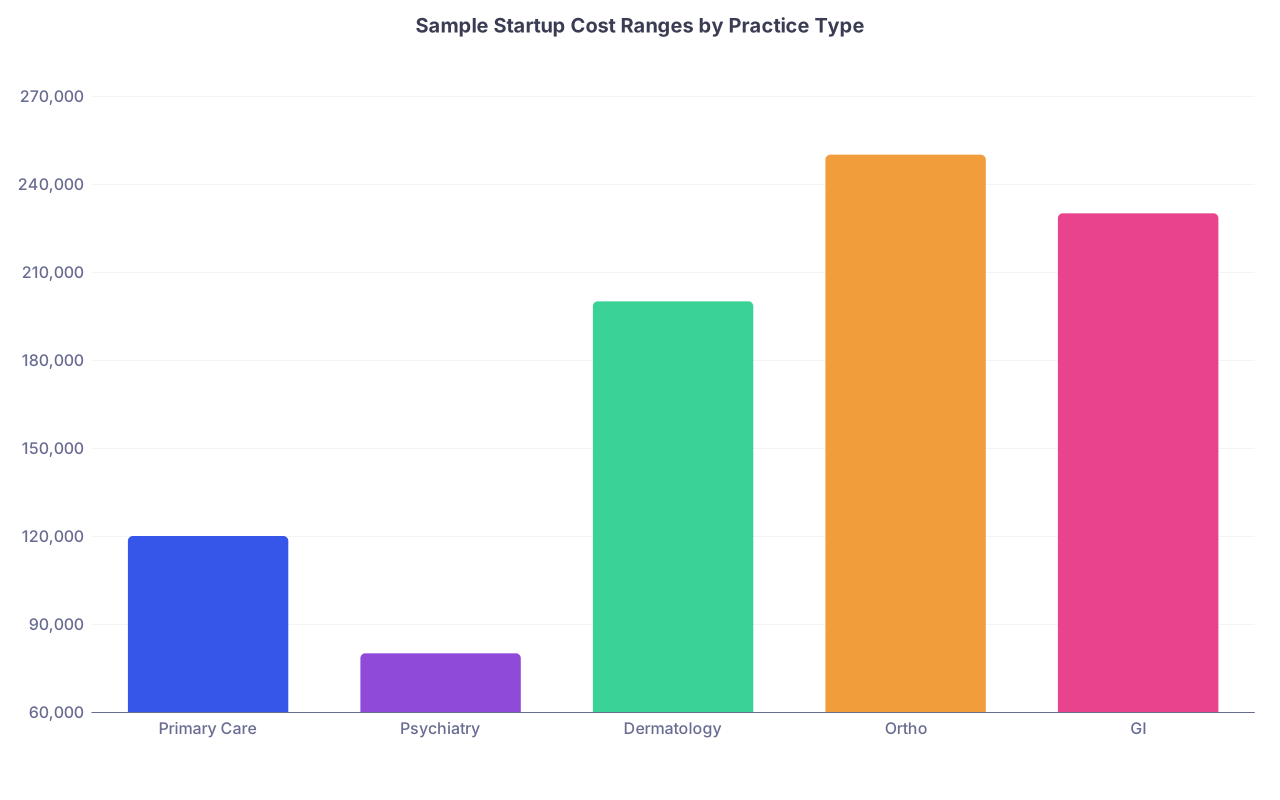
| Category | Value |
|---|---|
| Primary Care | 120000 |
| Psychiatry | 80000 |
| Dermatology | 200000 |
| Ortho | 250000 |
| GI | 230000 |
You are not committing to these exact numbers yet. You are stress-testing your tolerance.
Months 15–13: Legal, Structure, and Money Infrastructure
At this point you should be building the skeleton: entity, legal, risk, and basic finance. No, you cannot “just get to that later.”
Choose entity and get a real healthcare attorney (Month 15)
Stop googling LLC vs S-Corp at 2 a.m. Get an attorney who routinely sets up medical practices in your state.
At this point you should:
- Decide:
- Professional Corporation (PC / PLLC) vs LLC (state dependent)
- Tax election (S-Corp vs default) with input from both attorney and CPA
- Form the entity:
- File articles of incorporation / organization
- Get EIN from the IRS
- Register with state:
- Professional license-linked registrations
- Any required professional corporation paperwork
You want this done early because:
- You will put this entity name on:
- Lease documents
- Vendor contracts
- Bank accounts
- Malpractice policy
Malpractice coverage strategy (Month 15–14)
Do not wait until 3 months before opening. You may have tail coverage issues from your current job.
At this point you should:
- Pull your current malpractice policy and:
- Identify occurrence vs claims-made
- Determine tail coverage cost if you leave
- Talk with a broker about:
- New practice policy options
- Shared limits vs individual
- Coverage start date (can time to opening minus a bit)
If you are in a high-risk specialty (OB, neurosurg, etc.), this is not negotiable. Plan it now.
Banking and accounting backbone (Month 14–13)
You need clean separation from day one. No “just using my personal card until things pick up.”
At this point you should:
- Open:
- Business checking account
- Business savings or “tax savings” account
- (Optional but wise) business credit card for expenses
- Hire or retain:
- A CPA with medical practice clients
- With the CPA, set up:
- Basic chart of accounts
- Payroll approach (for when you pay yourself)
- Estimated quarterly tax planning
Have them sanity-check your initial revenue and cost estimates. If they shrug and say “looks fine” without any pushback, that is a red flag. Good CPAs ask annoying questions.
Months 12–10: Location, Lease, and Infrastructure Decisions
Now you move from strategy to real-world commitments. This is where physicians either make smart, lean choices or sign a five-year lease that suffocates them.
Space search and criteria (Month 12)
At this point you should:
- Define your minimum requirements:
- Square footage: typically
- 800–1200 sq ft for solo, low-procedure practice
- 1500–2500 sq ft for multi-room, procedure-heavy
- Rooms:
- 1–2 exam/consult rooms to start
- 1 reception / check-in area
- 1 tiny admin / office space
- Parking expectations
- Ground floor vs upper floor
- Square footage: typically
- Set your max acceptable rent + NNN combined (per month).
Then contact a commercial broker who has done medical leases before. Not your cousin who sells houses.
Evaluate 2–4 viable spaces (Month 12–11)
Tour each with a simple checklist:
- Visibility:
- Signage potential
- Ease of patient access from main roads
- Build-out needs:
- Existing exam rooms and sinks?
- ADA compliance?
- Restrooms accessible?
- Infrastructure:
- Internet options
- Electrical capacity if you have equipment
- Landlord expectations:
- Improvements allowance?
- Length of lease and renewal options?
At this point you should:
- Narrow to your top 1–2 spaces.
- Get rough contractor input on build-out costs before signing anything.

Lease negotiation (Month 11–10)
Do not handle this alone. A good attorney here can save you six figures over a lease term.
At this point you should:
- Have your attorney review:
- Personal guarantee terms
- Use clause (broad enough for your current and future services)
- Assignment/sublease flexibility (in case you sell or merge)
- Tenant improvement allowance specifics
- Responsibility for HVAC / structural systems
- Push back on:
- Excessive personal guarantee duration
- Automatic steep rent escalations
- Weird non-compete radius restrictions on you as a tenant
Timeline wise, aim to sign the lease around Month 10–9 before opening. That gives:
- Build-out: 3–4 months
- Furnishing and setup: 1–2 months
- Soft opening and test systems: 1–2 months
Months 9–7: Systems, Payers, and Workflow Design
At this point you should be putting the plumbing in place: EHR, practice management, phone, payers. None of this is sexy, but it is exactly what makes or breaks your first 90 days.
EHR and practice management decision (Month 9)
Do not chase shiny features. You are looking for:
- Strong scheduling and template control
- Clean superbill / E&M and procedure code support for your specialty
- Solid claims management and denial tracking
- Integrated e-prescribing
- Portal (if you will use it)
At this point you should:
- Shortlist 2–3 systems that:
- Have multiple existing clients in your specialty
- Are cloud-based (for most outpatient practices, this is simpler)
- Do real demos, using:
- A typical new visit scenario
- A follow-up visit
- A simple procedure if applicable
Decide: in-house billing vs outsourced.
- In-house:
- More control, but you must invest in a good biller and training
- Outsourced:
- Typically 4–7% of collections
- Less training overhead, but variable quality
Pick a lane now. Waffling for months only delays payer enrollment and workflow building.
Payer enrollment and contracting (Month 9–7)
This is the slow, annoying part. That is exactly why you start it early.
At this point you should:
- Decide which insurers you will pursue:
- Big 3–5 commercial in your area
- Medicare (if you will see that population)
- Medicaid (if truly aligned with your model – do not casually add this)
- Confirm:
- Your CAQH profile is complete, accurate, and unlocked
- NPI-1 and NPI-2 are correctly linked to your entity
- Begin credentialing:
- Some insurers may take 90–180+ days
- Track every submission and follow-up
| Payer Type | Typical Range (Days) |
|---|---|
| Large Commercial A | 90–120 |
| Large Commercial B | 120–150 |
| Medicare | 60–90 |
| Medicaid | 120–210 |
| Major HMO Panel | 150–180 |
At this point you should assume:
- You will not be in-network with all desired payers on day one.
- You will need:
- A clear self-pay pricing structure for the interim
- Scripts for staff explaining out-of-network and superbills
Phone, fax, and communication stack (Month 8–7)
Boring, but critical.
At this point you should:
- Choose:
- VOIP system with:
- Call recording
- Voicemail to email or app
- Simple call routing
- Secure e-fax solution
- VOIP system with:
- Define:
- Office hours and phone hours (not necessarily the same)
- Protocol for after-hours (answering service vs direct coverage vs cross-coverage)
Write a 1-page “Communication Policy” you will later give to patients and staff. Nothing fancy. Just clear rules.
Months 6–4: Brand, Website, and Pre-Launch Marketing
You do not need a national brand campaign. You do need to exist online in a professional, findable way.
Name, brand basics, and web domain (Month 6)
If you are still debating your practice name at 6 months out, decide within a week. Perfectionism here is a waste of energy.
At this point you should:
- Lock in:
- Practice name that:
- Is pronounceable
- Does not lock you into one tiny niche unless you want that
- Has an available domain (ideally .com, but .health / .clinic can work)
- Practice name that:
- Buy:
- Domain(s) for practice and generic doctor name variations if reasonable
- Set up:
- Professional email (not Gmail) on your domain
You do not need a $10k logo. A clean wordmark and consistent colors are enough for year one.
Website build and core content (Month 6–5)
At this point you should:
- Hire a modest but competent healthcare-focused web designer OR use a professional template-based service.
- Ensure your website has:
- Clear homepage with:
- Who you treat
- What problems you solve
- How to become a new patient
- Provider bio page
- Services page (with plain-language descriptions)
- Insurance / pricing page
- Contact and location page with embedded map
- Clear homepage with:
- Make sure:
- Your site is mobile-optimized
- Loading speed is decent (slow sites hurt you more than ugly sites)
Launch a basic version by Month 5 so search engines can start indexing it.
Local relationship-building and referral groundwork (Month 5–4)
This is where you do what most doctors are weirdly hesitant to do: talk to other doctors and therapists like a business owner.
At this point you should:
- Make a list of:
- 15–30 potential referral sources:
- PCPs
- Specialists
- Therapists / counselors
- Community health centers
- 15–30 potential referral sources:
- Reach out with:
- Short, targeted emails or calls:
- Who you are
- Your planned opening date
- What kinds of patients you are particularly good at handling
- Short, targeted emails or calls:
- Offer:
- To be a “fast access” option for specific cases (e.g., “I can see your uncontrolled diabetics within 1–2 weeks when I open”)
Create a simple 1-page referral sheet you can later print and share.
Months 3–2: Build-Out, Equipment, and Staff
Now it gets real. Money starts going out. A lot of it.
Oversee build-out and furnishings (Month 3)
At this point you should:
- Walk the space weekly:
- Confirm exam room layouts
- Check outlets and data ports locations
- Make sure sinks, lighting, and door swings match your workflow
- Finalize furniture and equipment orders:
- Exam tables, chairs
- Desks and storage
- Basic medical equipment specific to your specialty
- Avoid:
- Over-equipping things you might “use someday”
- Buying three times the seating capacity you actually need
Most new attendings overbuy fancy equipment and underinvest in process. Reverse that.
Hire initial staff (Month 3–2)
For many solo starts, minimal team is enough:
- 1 front desk / admin who can:
- Answer phones
- Check patients in/out
- Collect copays
- Handle basic prior auth follow-up
- 1 MA / nurse (depending on specialty and visit volume)
At this point you should:
- Write clear roles:
- Who does what from 8 a.m. to 5 p.m.
- Decide:
- Will they start full-time or part-time?
- Exact start date (usually 4–6 weeks before opening, not the day before)
Do working interviews when possible. Watch how they communicate. You can train skills. You cannot train attitude and basic professionalism.
Final 6 Weeks: Test Systems and Soft Launch
This is where you turn on the engine without going full speed.
Dry runs and workflow simulation (Week -6 to -4)
At this point you should:
- Sit down as a team and run:
- A full simulated patient day:
- New patient call
- Insurance verification
- Appointment scheduling
- Check-in
- Rooming
- Charting
- Checkout and payment
- Claim submission
- A full simulated patient day:
- Identify:
- Where staff are guessing
- Where your EHR templates are clunky
- Where communication fails
Fix those now. Not with real patients in the waiting room.
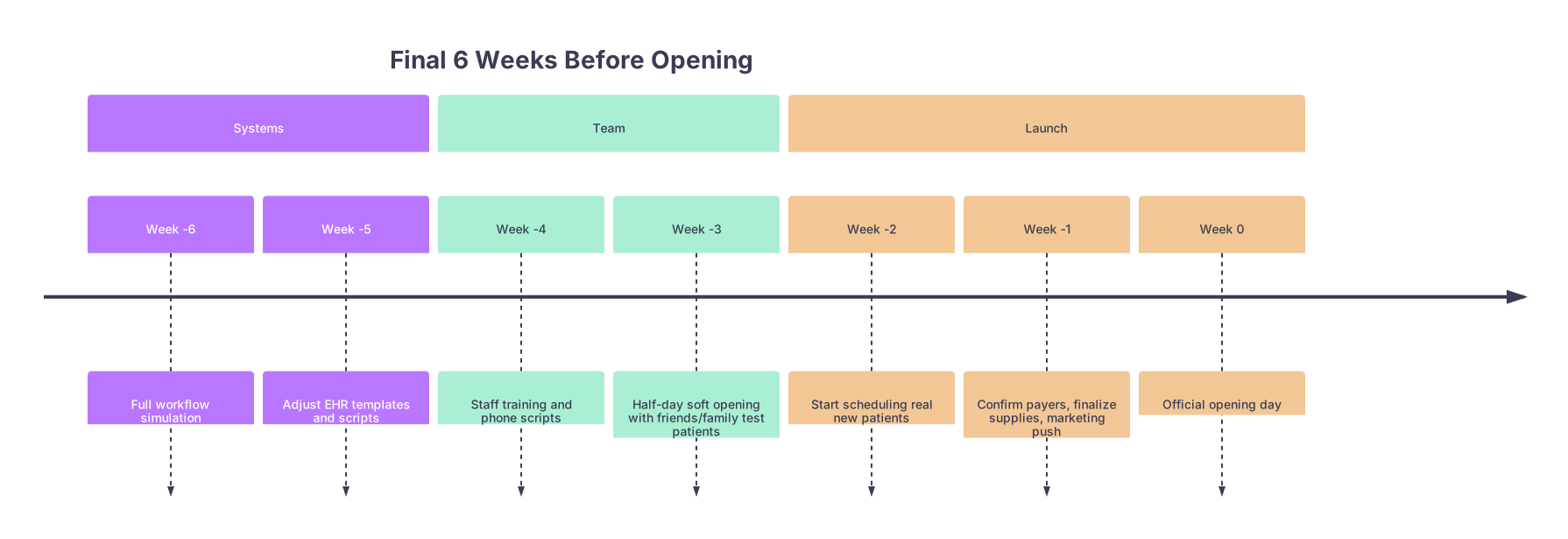
| Period | Event |
|---|---|
| Systems - Week -6 | Full workflow simulation |
| Systems - Week -5 | Adjust EHR templates and scripts |
| Team - Week -4 | Staff training and phone scripts |
| Team - Week -3 | Half-day soft opening with friends/family test patients |
| Launch - Week -2 | Start scheduling real new patients |
| Launch - Week -1 | Confirm payers, finalize supplies, marketing push |
| Launch - Week 0 | Official opening day |
Refine scripts and policies (Week -5 to -3)
At this point you should:
- Create short, written scripts for:
- Answering new patient calls
- Explaining out-of-network or “pending credentialing” status
- Late / no-show policy
- Payment expectations
- Finalize:
- New patient paperwork (digital or paper)
- Privacy and consent forms (with legal counsel blessing)
Do not let staff “wing it.” That is how you get inconsistent patient experiences and lost revenue.
Soft opening (Week -3 to -2)
If possible:
- Start with:
- 1–2 half days per week
- Former patients (if permitted), acquaintances, or staff friends as “first wave”
- Use those visits to:
- Test room flow and timing
- Adjust schedule templates (visit lengths, buffer slots)
- Give staff repetition without full volume
At this point you should open your online review channels and claim your listings:
- Google Business Profile
- Healthgrades, Vitals, etc., as appropriate
- Practice Facebook page / LinkedIn if you will actually use them
Ask early satisfied patients to leave reviews. Do not script their words; just ask.
Final Week and Opening Day
You will feel both unprepared and over-prepared. That is normal.
At this point you should in the final week:
- Confirm:
- Phone routing, voicemail message, and after-hours instructions
- EHR access for all staff
- Supply levels for at least 4–6 weeks
- Double-check:
- Payer participation status in your practice management system
- Correct tax IDs and NPIs on claims setup
- Push:
- Final reminder emails / posts to your referral sources about your opening
On opening day, your job is simple:
- Take care of the small number of patients on the schedule.
- Watch:
- How your staff handle check-in and check-out
- How your templates feel in live use
- Where things slow down
Make notes. Fix them that night or that week. Do not wait for the mythical “later.”
The Three Big Takeaways
- Decide the model and money early. By Month 16 you should know what you are building and what you can afford. Vague plans destroy timelines.
- Start payers, systems, and space earlier than feels comfortable. Credentialing, leasing, and EHR setup move slowly and will not care about your desired opening date.
- Use the last 6–8 weeks for testing, not building. By then, your job is to rehearse and refine, not to be signing leases or choosing software.