
It’s 10:47 p.m. Your first week in your brand‑new clinic just ended. You should be asleep. Instead, you’re refreshing Google over and over, staring at your shiny new business profile… and that one 2‑star review from a patient who waited 35 minutes and now thinks you’re “unorganized and uncaring.”
Your chest drops. You start doing mental math:
“One bad review = no one will book = clinic fails = I can’t pay my loans = I have to go back and be an employed physician forever.”
Yeah. I know that spiral.
Let’s talk honestly about how much bad online reviews can actually hurt a new clinic, what’s just anxiety magnifying things, and where the real danger lines are.
How Much Do Reviews Really Matter For A New Clinic?
Short answer: they matter a lot for first impressions, but one or two bad reviews will not end your clinic. A pattern of bad reviews that you ignore? That’s where things get ugly.
Think of online reviews like vitals. One random high BP reading when the patient is stressed? Not ideal, but not the whole story. Repeated high readings over time that you don’t address? Problem.
Here’s the annoying part: patients do look at reviews before booking, especially for a new practice where nobody’s heard of you.
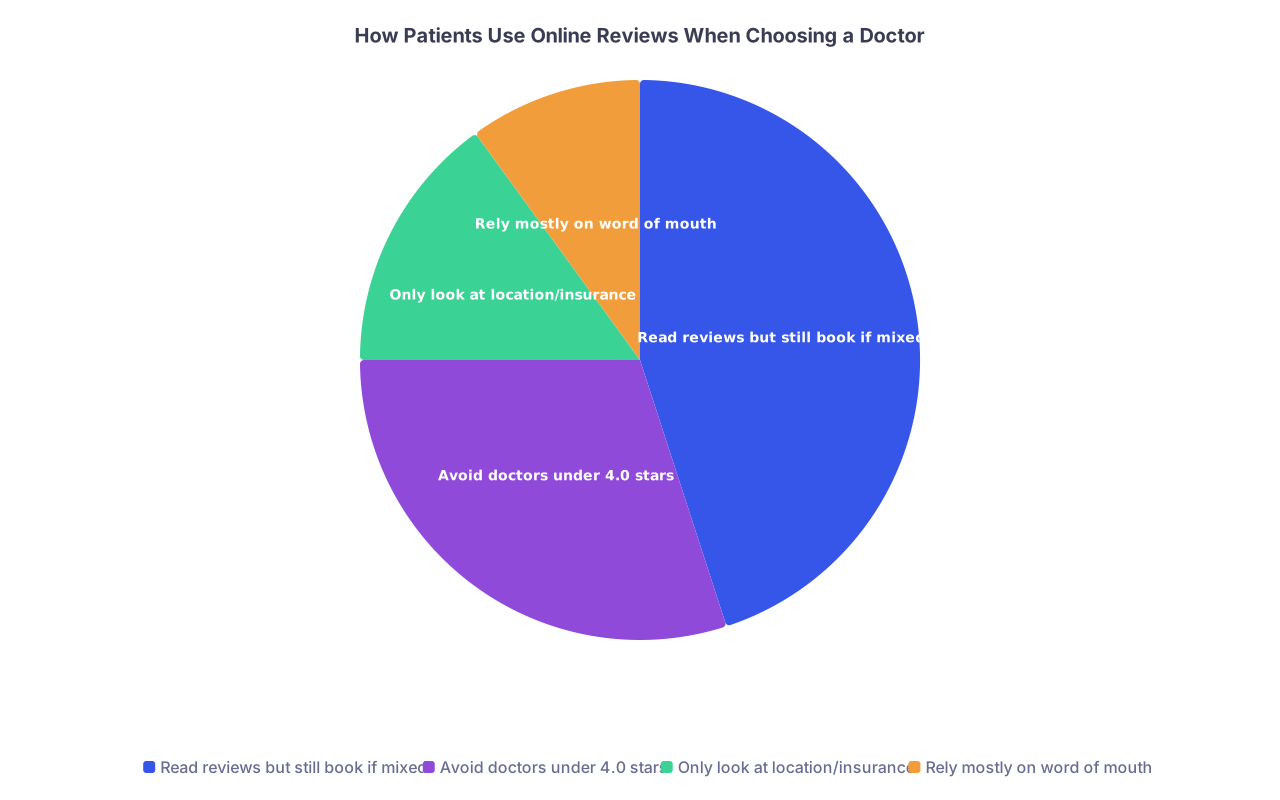
| Category | Value |
|---|---|
| Read reviews but still book if mixed | 45 |
| Avoid doctors under 4.0 stars | 30 |
| Only look at location/insurance | 15 |
| Rely mostly on word of mouth | 10 |
So yeah, reviews matter. But read that chart carefully: most patients don’t need perfection. They need reassurance:
- “Are you a real doctor who other humans actually see?”
- “Are you competent and not a complete monster?”
- “Is the office chaos level tolerable?”
If you’re at 4.3–4.7 stars with mostly good feedback and a few upset people? That’s normal. That’s human. That’s survivable.
If you launch and end up with 3 reviews total, all 1–2 stars, and nothing else for six months? That absolutely can choke off new patient flow.
So the fear isn’t imaginary. It’s just mis-aimed: the danger isn’t one bad review, it’s no strategy plus silence plus a pattern.
Worst-Case Scenarios (And How Likely They Actually Are)
Your brain’s probably already doing this, so let’s say the scary stuff out loud.
Worst-case fear #1: “One angry patient will tank my whole rating”
Mathematically, this is only a threat in the beginning when you have almost no reviews.
You start your clinic. One of your first 3 patients gets mad about a billing error and leaves a 1-star review. Now:
- 1 review, 1 star = terrifying
- 1 bad out of 10 = not great, but fine
- 1 bad out of 50 = a blip
The actual damage isn’t the content of that single review. It’s that there’s nothing else to balance it.
So the fix is boring and very doable: you need volume of normal, happy patients leaving reviews. Not 100 overnight, but steady accumulation.
This is why doing nothing and “hoping nobody reviews me” is actually the riskiest path. You’re then defenseless when the inevitable angry person shows up.
Worst-case fear #2: “A vindictive patient will write something so bad it ruins my reputation”
I’ve seen some brutal reviews. Stuff like:
“This doctor almost killed my mother. Stay away if you value your life.”
Does that feel horrific? Yes. Can it hurt? Yes. But:
- Most patients reading know reviews are emotional and one‑sided. They mentally discount the most extreme ones.
- If your overall pattern is: “Great bedside manner,” “Listens,” “Thorough,” one crazy review just looks like… one crazy review.
- You can respond publicly in a professional, calm way that reassures future patients (without violating HIPAA).
The real reputational danger isn’t a wild, obviously emotional rant. It’s 15 different people over 12 months all saying:
- “Waited 1.5 hours”
- “Staff is rude”
- “Doctor doesn’t listen, in and out in 5 minutes”
That starts to feel like a theme, not an outlier.
Worst-case fear #3: “Bad reviews = lawsuits / board complaints / loss of license”
No. A bad online review is not automatically a legal or licensing issue.
Could a patient who already hates you and wrote a bad review also file a complaint? Sure. But they were going to do that anyway; the review isn’t the cause.
Online reviews themselves are more of a business risk than a legal risk. They can:
- Scare off new patients
- Hurt your search ranking
- Damage referral relationships if other docs read them and believe them
But your license isn’t hanging by a Google star.
What Actually Hurts: Numbers, Patterns, And Timing
Let’s be concrete, because vague “reviews matter” advice just fuels anxiety.
Star ratings and real impact
Here’s a rough idea of how different average ratings actually play out for a new outpatient clinic:
| Average Rating | Real-World Impact on New Clinic |
|---|---|
| 4.8–5.0 | Looks almost too perfect; great but not required |
| 4.3–4.7 | Strong, trustworthy, most patients totally fine booking |
| 3.8–4.2 | Some patients hesitate, especially with few reviews |
| 3.0–3.7 | Noticeable drag on new bookings without strong referrals |
| <3.0 | Major red flag for many new patients |
For a brand-new clinic, I’d start to seriously worry at under 4.0 with more than, say, 10–15 reviews. That starts to look like a persistent problem, not just a couple tough cases.
Early months are fragile
The first 6–12 months are when reviews are disproportionately powerful, because:
- You don’t have word-of-mouth yet
- You don’t have a big referral base
- You don’t have many reviews to dilute bad ones
So a cluster of bad reviews in month 2–4 can sting. You might see:
- Online booking slowing down
- Fewer self-referrals from Google
- Patients canceling after “looking you up”
Is that clinic-ending? Usually no. But if you do nothing to correct course, it can stall your growth enough that the numbers stop working.
Where I’d actually panic (and take aggressive action)
If this were my clinic, here’s when I’d drop everything and treat this as an emergency:
- First year, you have >15 reviews, and your rating is under 4.0, and
- The comments repeat the same 1–2 problems (rude front desk, insane wait times, billing chaos), and
- Your new patient visits from “Google / online” are declining month to month
That’s not “you had a bad day.” That’s “the market is telling you something is broken.”
Everything else? Annoying. Stress-inducing. But fixable.
How Much Control Do You Actually Have Over Reviews?
This is where some of the anxiety is justified and some isn’t.
You can’t control:
- The truly unreasonable patients
- People reviewing you for stuff outside your control (insurance, parking, specialist wait lists)
- When a random bad review decides to drop (always after a 12‑hour day somehow)
You can influence:
- The ratio of good to bad reviews
- The specifics of what happy patients mention
- How future patients interpret the bad reviews when they read them
Think of it like this: you’re not trying to prevent all negative reviews. You’re trying to drown them in context.
Concrete Moves To Reduce The Damage (Without Selling Your Soul)
Let’s get practical. You’re not a marketing agency. You’re an overworked doc trying to not sink your brand-new clinic.
Here’s what actually matters.
1. Build a buffer of good reviews ASAP
Don’t wait until you get slammed to start.
Your goal in the first 3–6 months: get a baseline of 20–40 honest reviews from normal, happy-ish patients.
Not fake reviews. Not your cousin in another state. Real patients who had decent experiences.
Ways that don’t feel gross:
- At checkout: your MA or front desk says, “If you had a good experience today, it really helps us as a new clinic if you leave a quick Google review.” Then hands them a card or QR code.
- In follow-up emails/texts: “As a new practice, your feedback helps other patients find us. If you’d like to leave a review, here’s the link.”
- After specific wins: that patient who literally said, “You’re the first doctor who listened to me”… that’s your review invite moment.
You’re not bribing. You’re not scripting. You’re just making it easy for happy people to speak up, because angry people will find a way regardless.
2. Decide ahead of time how you’ll respond to bad reviews
You do not want to draft your first review response when you’re tired and angry.
Have a template ready that:
- Acknowledges their frustration
- Stays HIPAA-safe (no specifics, no validating that they’re your patient)
- Offers an offline path to resolve things
Something like:
“We’re sorry to hear about your experience. We strive to provide respectful, timely care to all patients and take feedback seriously. Because of privacy laws, we can’t discuss any individual situation here, but we’d like to learn more and see if we can address your concerns. Please contact our office at [number] and ask to speak with [office manager].”
Is this going to make the reviewer update their rating? Probably not. But it signals to everyone else reading: “We’re not ignoring problems. We are adult humans.”

3. Fix whatever keeps coming up in comments
The gold in reviews isn’t the stars. It’s the patterns.
If five different people complain about:
- 60–90 minute waits
- Confusing or surprise bills
- Dismissive staff
That’s your to-do list. Not your shame list.
It might mean:
- You need fewer double-booked slots
- Your staff needs actual scripts for handling angry patients
- You need clearer pre-visit communication on what’s covered and what isn’t
I’ve seen clinics turn their ratings around just by fixing one chronic pain point (like that one front desk person who should not be in a patient-facing role, ever).
4. Redirect energy into places reviews matter less
Online reviews are loud, but they’re not the only source of patients. Especially in medicine.
You can cushion the review anxiety by deliberately building channels where a single 1‑star rant doesn’t matter so much:
- Strong referral network (PCPs, specialists, urgent cares)
- Employer / occupational contracts
- Being on key insurance panels where access is more important than stars
- Local community presence (talks, health fairs, school partnerships)
Patients who come from a trusted referral are less spooked by one angry stranger on Google.
The Emotional Side: This Feels Personal Because It Is
Here’s the part no marketing blog will tell you: bad reviews hurt like hell because they’re public criticism of your identity.
You’re not getting a quiet note in a suggestion box. You’re getting:
“Dr. X doesn’t care and rushed my appointment. Avoid this place.”
On the internet. Forever.
That’s going to hit every perfectionist/people-pleasing nerve you developed over a decade of training. You’re not crazy for feeling it in your body.
A few things I tell people (and have had to remind myself):
Every competent, caring doctor I know has at least a few brutal reviews.
The only ones with zero are the ones who see 3 patients a week or just opened yesterday.Patients are rating an entire experience, not your entire worth as a clinician or human.
They’re rating: parking, wait time, front desk, billing, mood that day, their own anxiety. You’re just the face attached.You will remember the 1 nasty review and forget the 30 glowing ones.
That’s not rational. That’s your brain’s negativity bias doing its thing.
You don’t have to be zen about it. But you also don’t have to let every angry stranger on the internet decide whether you keep your dream of private practice alive.
A Simple, Sanity-Preserving System
If you’re like me, you probably need something structured so you’re not obsessively checking reviews every night at 11 p.m.
Try this:

| Step | Description |
|---|---|
| Step 1 | Set review check day |
| Step 2 | Check reviews once a week |
| Step 3 | Log star rating and themes |
| Step 4 | Send 2-3 review requests to happy patients |
| Step 5 | Draft HIPAA-safe response |
| Step 6 | Identify recurring issues |
| Step 7 | Adjust workflow or staff coaching |
| Step 8 | Any new negative reviews? |
Key rules:
- Only check reviews on one scheduled day per week (or every 2 weeks).
- Every time there’s a negative review, you trigger 2–3 invitations to happy patients that week.
- Once a quarter, actually read through the patterns and make one concrete change.
You’re not pretending reviews don’t exist. You’re putting them in a box where they can’t eat your entire life.

Quick Reality Check Before You Spiral Again
Let me cut through the noise.
- Yes, reviews matter, especially early. Ignoring them completely is naive.
- No, one bad review will not destroy your new clinic. A pattern of bad reviews you refuse to address might.
- You have more control than it feels like. You can build a cushion of good reviews, fix recurring issues, and respond like a grown-up.
You’re allowed to be scared of bad reviews. You’re also allowed to keep building your clinic anyway.
FAQ (Exactly 5 Questions)
1. How many bad reviews is “too many” for a new clinic?
I’d start to worry if you have more than 15–20 total reviews and more than about a quarter of them are 1–2 stars, and they’re all saying similar negative things (wait time, rudeness, billing). That suggests a real operations problem, not just a few unreasonable people. Under that? Treat them as data points, not a death sentence.
2. Should I ask patients directly to leave positive reviews? Is that unethical?
It’s fine to ask happy patients to leave a review as long as you’re not bribing them or telling them what to say. Something like, “If you had a good experience, it really helps us as a new clinic if you leave a review” is completely standard. Just don’t selectively pressure only “perfect” patients while blocking everyone else.
3. Can I get unfair or fake reviews removed?
Sometimes. You can flag clearly fake, defamatory, or non-patient reviews on platforms like Google, but success is hit or miss. If a review complains about clinical care, wait time, or attitude, even if you feel it’s totally wrong, platforms usually keep it. That’s why your best defense is more real, positive reviews and a calm, professional response visible under the bad one.
4. What if my staff is the problem mentioned in bad reviews? Do I fire them?
Not automatically. First, look for patterns: is it one person constantly named or described? Then try coaching, clear expectations, and maybe reassigning them away from frontline patient interaction. If you repeatedly see the same behavior and it doesn’t change—even after feedback—that’s when a staffing change is justified. Keeping a toxic front desk person to “avoid conflict” is more expensive long-term than recruiting a better fit.
5. Is it ever smart to ignore a bad review and not respond at all?
If it’s obviously unhinged, offensive, or clearly not about your actual clinic, you can sometimes leave it alone after flagging it. But for most bad reviews that sound even somewhat legitimate, a short, professional, HIPAA-safe reply helps more than silence. You’re not trying to convince the angry reviewer; you’re talking to the 100 future patients who will read that review and your response and decide whether you look like someone they’d trust.