
The big hospital systems aren’t your competition; they’re your reality. Your competition is your own fear that there’s no room left for you.
The Fear No One Admits Out Loud
Let me just say the ugly thought you’ve probably had at 1:37 a.m.:
“I’m going to pour my life savings into a small clinic and then get crushed by a giant health system with a Starbucks in the lobby and a marketing team the size of my whole future staff.”
You look around and see:
- Massive hospital networks buying up every independent practice
- Urgent care chains on every corner
- “Provider-based” clinic fees that you can’t compete with
- Patients who say, “I just go wherever my insurance app tells me”
And you’re sitting there wondering if starting a small clinic now is like opening a Blockbuster in the era of Netflix.
Let me be very blunt: a small clinic can absolutely survive—and even do really well—but not if it tries to pretend it’s a mini version of a big system. That game? You lose. Every time.
The question isn’t “Is there room?”
The question is “Is there room for a very specific kind of small clinic that plays a totally different game?”
Because that answer is yes. But it comes with strings.
What You’re Really Up Against (It’s Not Just “Competition”)
You’re not just fighting for patients. You’re fighting against:
- Hospital-employed colleagues who don’t have to think about overhead
- Referral patterns locked inside big systems
- Insurance contracts that lowball independents
- Patients trained to think “bigger is safer”
- Your own paralyzing impostor syndrome: “Who am I to start a clinic?”
And underneath all of that is this quiet dread:
“What if I start… and nobody comes?”
Let’s be honest. That can happen. I’ve seen it happen. Places where:
- They signed a lease in a random building because “the rent was cheaper”
- They took any insurance contract offered without doing the math
- They thought “If I build it, they will come” was a business strategy
- They tried to be everything: primary care, urgent care, weight loss, procedures, aesthetics… on day one
Those practices struggle. Some close. And that terrifies you, because you can imagine it being you.
But here’s the flip side I’ve also seen:
Tiny clinics in the shadow of giant systems with packed schedules and waitlists.
Not luck. Strategy.
Where Small Clinics Actually Have the Advantage
You’re not going to beat a massive system on shiny buildings, MRI machines, or marketing budgets. So don’t try.
You win where they’re objectively bad—and they’re bad at a few really important things.
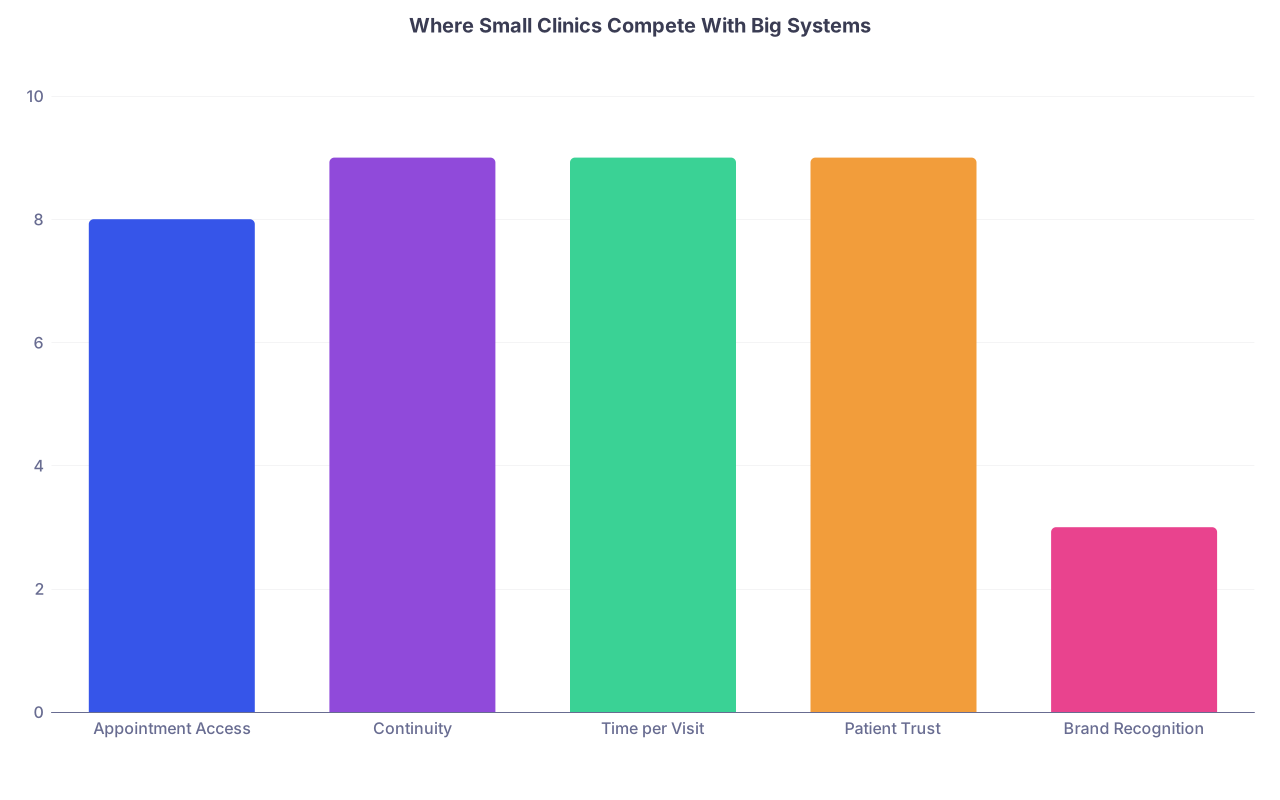
| Category | Value |
|---|---|
| Appointment Access | 8 |
| Continuity | 9 |
| Time per Visit | 9 |
| Patient Trust | 9 |
| Brand Recognition | 3 |
Let’s translate that:
- Appointment access: Big systems have long waits for everything that isn’t urgent. A small clinic can often see patients this week.
- Continuity: Patients hate telling their story to a new face every visit. You can be “their” doctor, not “a” doctor.
- Time per visit: You can choose to run a model where you see fewer patients and actually talk to them. They literally can’t, structurally.
- Patient trust: In a giant system, people feel like a chart number. In a small clinic, you can make them feel like a person again.
- Brand recognition: Yeah, you lose here. No one’s heard of “Dr. You Internal Medicine, PLLC.” Yet.
Your edge is relationship, responsiveness, and focus.
Their weakness is bureaucracy.
If you try to be “small hospital clinic,” you’re dead.
If you choose to be “the one place where people feel actually cared for and not processed,” you’ve got a shot.
The Harsh Reality Check You Secretly Want
You don’t need pep talk. You need: “Is this insane for me, personally?”
So here’s the uncomfortable filter I’d use if we were sitting in a call and you asked me if you should open.
| Factor | Green Light | Red Flag |
|---|---|---|
| Local Competition | Big systems but gaps in niche/service | 6 urgent cares + 4 same-specialty independents within 2 miles |
| Risk Tolerance | Can handle 12–18 months of slow growth | Need full income by month 2 |
| Financial Cushion | 6–12 months expenses saved or financing | Living paycheck to paycheck |
| Patient Base | Some existing or realistic referral paths | Starting completely from zero, no plan |
| Motivation | Want autonomy, can handle business stress | Just hate current job and want escape |
If you’re mostly in the “Red Flag” column, starting a clinic right now might be a bad idea. Not forever. But right now.
If you’re majority “Green Light,” then yes—there’s room for your clinic. But only if you do it on purpose, not out of desperation.
Where Small Clinics Actually Fit in a Big-System World
Think about your local ecosystem. There are a few classic ways a small clinic survives next to the giant:
The “Refuge From The System” primary care
The pitch is basically: “You’re tired of 7-minute visits and MyChart black holes. You want a doctor who actually knows your life.”This can be insurance-based with longer visits (low volume, high-touch) or direct primary care (DPC) membership. Either way, you’re selling access and relationship, not fancy tech.
The hyper-specific niche
Example: a headache clinic, long-COVID clinic, complex chronic pain, ADHD in adults, women’s heart health. Stuff big systems technically offer—but patients get bounced around and feel dismissed.You become “the” person for that problem. People will drive 45 minutes for that.
The procedures/skills they don’t do well
Think small dermatology, vasectomy clinic, office-based gyne procedures, MSK/ultrasound-guided injections, obesity medicine. Focused, efficient, patient-centered.The “human urgent care”
Not the chain with 9 locations. The one where the doc actually follows up, knows families, and doesn’t feel like a fast-food menu of tests.
You don’t need the whole city. You need your 600–1500 people who decide you’re their clinic.

| Step | Description |
|---|---|
| Step 1 | Big System Dominates |
| Step 2 | Relationship Focus |
| Step 3 | Specific Condition |
| Step 4 | Targeted Services |
| Step 5 | Access and Followup |
| Step 6 | Clear Identity |
| Step 7 | Choose Strategy |
The danger is trying to be all of these at once. That’s how you confuse patients and burn yourself out.
The Money Anxiety: Will This Actually Pay My Loans?
The worst fear: “I hang a shingle, and 3 months in I’m praying someone walks through the door so I can make rent.”
Let’s talk in real numbers so this isn’t just vibes.
Very rough, conservative example for a lean, single-physician clinic after ramp-up (not month 1):
- 12–15 patients/day, 4 days/week
- Mix of new and established visits
- Average collected revenue per visit (after write-offs): let’s say $90–$130 depending on payer mix and coding
- That’s maybe $4,300–$7,800 per week in collections
Monthly: $17k–$31k coming in.
Expenses (again rough, lean setup):
- Rent: $2k–$4k
- Staff (1–2 people): $5k–$8k
- Malpractice: $600–$1,200
- EMR, clearinghouse, phone, internet, misc: $1,000–$2,000
- Supplies, billing services, taxes, random hell: $1,500–$3,000
You’re looking at maybe $10k–$18k/month fixed-ish costs.
So your margin could be anywhere from “this is tight and stressful” to “this is good, especially once volume grows.”
What matters: your ramp-up period. Months 1–12 are usually brutal mentally, even if financially survivable.
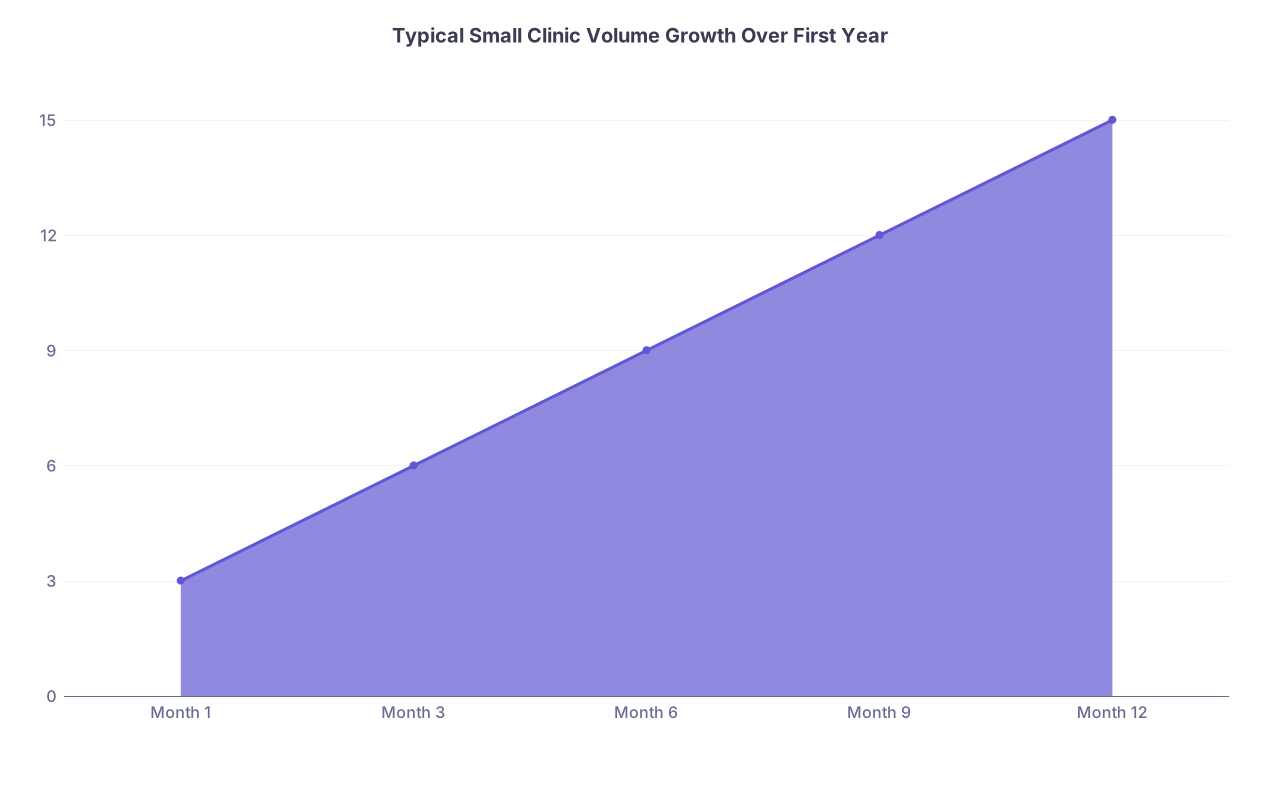
| Category | Value |
|---|---|
| Month 1 | 3 |
| Month 3 | 6 |
| Month 6 | 9 |
| Month 9 | 12 |
| Month 12 | 15 |
And here’s where people panic: they expect Month 3 to look like Month 12. It doesn’t.
So you need:
- A runway (cash or financing)
- A realistic growth plan (not “hope”)
- A personal budget that assumes your take-home is low for a while
If reading this makes your chest tighten because you need a full attending salary right away to survive… then no, a small clinic is probably not financially safe for you this second. That’s not failure. That’s math.
The Psychological Hell Nobody Prepares You For
Let’s be clear: starting a clinic alone after residency or early in your career can mess with your head.
You go from:
- People scheduling patients for you
- Colleagues down the hall
- Built-in reputation from the institution’s name
To:
- Refreshing your schedule and seeing 4 names for the day
- Wondering if the front desk is judging your emptiness
- Hearing your med school peers flex on group chat about their RVUs, bonuses, or “just signed with [Big Name] for $X”
There will be days where you think:
“I made a horrible mistake. I should have just taken a job and shut up.”
And then a weird thing happens. One of your early patients says, “I’ve never had a doctor listen to me like that.” Or brings their spouse. Or refers a coworker. And you get this tiny, stubborn voice saying, “Maybe this could actually work.”

That emotional whiplash between “I’m doomed” and “Maybe I can do this” is the normal state of a new small practice owner. You’re not weird. You’re just out of the herd.
How to Carve Out Space Next to Big Systems (Without Losing Your Mind)
If you’re still reading, you probably haven’t fully talked yourself out of this. So here’s how you tilt the odds.
Focus on four things:
Hyper-clear identity
If someone asked, “What’s different about your clinic?” and your answer is “I care about my patients” — that’s not enough. Everyone says that.You need something like:
“I’m the small internal medicine clinic that gives 30–45 minute visits and answers portal messages same day, focused on complex chronic disease in working-age adults.”
Or: “I’m the headache and migraine clinic with short waits and lots of non-opioid options.”Make it ridiculously easy to find and book you
Website that doesn’t look like it’s from 2008. Online booking. Clear phone number. Clear address. Accepted insurances front and center. Google Business profile with accurate hours.I’ve seen great doctors invisible online. It’s like they don’t exist. Meanwhile urgent care chains are buying Google ads to show up first.
Obsession with the first 50–100 patients
Those early adopters are your marketing department. You over-deliver. You call with results. You remember details. You apologize when you’re late. You fix stuff fast.That’s how you earn “You have to see my doctor” status at dinner tables.
Relentless pruning of everything that burns you out
You’re not a big system. You don’t have to say yes to everything:- You can decide not to take the worst-paying, highest-hassle insurance
- You can set boundaries on portal use
- You can limit procedures that don’t make sense in your model
- You can cap your panel and close to new patients for periods
None of this is magic. It’s just ruthless alignment: small clinic doing what only a small clinic can do.
What If You’re Just Too Scared Right Now?
Then don’t open. Seriously.
You’re allowed to say, “I’m not ready for this level of risk yet.” That’s not weakness. It’s self-preservation.
But if the idea keeps coming back, if you keep daydreaming about your own space, your own schedule, your own way of practicing — ignoring it won’t make it go away. It just turns into this chronic ache of “what if I had tried?”
So maybe you don’t start with a full brick-and-mortar clinic. Maybe you:
- Moonlight somewhere with some autonomy and save aggressively
- Join a small independent group first and watch how they run things
- Start telemedicine in a niche area on the side
- Spend 6–12 months just researching locations, payers, models

| Step | Description |
|---|---|
| Step 1 | Finished Residency |
| Step 2 | Work Employed Job |
| Step 3 | Learn Business Basics |
| Step 4 | Join Small Group |
| Step 5 | Open Own Clinic Later |
| Step 6 | Part Time Employed |
| Step 7 | Start Side Niche Clinic |
| Step 8 | Plan Lean Clinic Now |
| Step 9 | Comfort With Risk |
There are multiple on-ramps. “All or nothing this July” is not the only option.
Bottom Line: Is There Room for Your Small Clinic?
Yes, but not in the fantasy way.
There isn’t room for another generic, everything-to-everyone, low-margin, high-burnout clinic that looks just like the outpatient arm of a hospital system.
There is room for:
- A clearly defined, human, high-trust space
- Run by a doctor who knows what they stand for
- Who’s willing to accept slower growth and more uncertainty upfront
- In exchange for actual ownership of how they practice
The big systems aren’t going away. They will keep buying, expanding, “integrating.” But the more they do that, the more patients quietly crave the opposite: someone real, somewhere small, where they’re not a ticket number.
You can be that place. Not by outmuscling the system. By opting out of its rules where it makes sense and being extremely, deliberately small—and proud of it.