
You are three months into your first attending job, or standing up your own small clinic after residency. Your schedule is packed. Every other visit “runs over” because PHQ‑9s are high, anxiety is through the roof, and half your 20‑minute slots turn into crisis‑management plus med refills. You know you need behavioral health embedded in the clinic. You do not know how to operationalize it without blowing up your schedule, your finances, or your staff.
Let me walk you through how to actually integrate behavioral health into a medical clinic in a way that works day‑to‑day, not just on a glossy consulting slide deck.
1. Decide the Behavioral Health Model First (Before You Hire Anyone)
This is where most clinics go wrong. They hire “a therapist” and then try to figure out how to use them. That fails. You choose the model first, then the staffing.
For outpatient medical clinics, there are three main operating models:
Traditional co-location
A therapist (or psychiatrist) works in your building, uses your rooms, but runs essentially an independent practice. Separate scheduling, separate documentation, weak integration.Pros:
- Easy to start administratively
- Minimal changes to your workflow
- Low complexity
Cons:
- Poor communication and coordination
- No real impact on primary care workload
- Payer sees this as “two separate practices in one office,” not integrated care
This is acceptable as a stopgap. It is not real integration.
Collaborative Care Model (CoCM) – psychiatric consultation model
Evidence‑based, CPT‑code driven model: PCP remains prescriber; behavioral care manager coordinates; consulting psychiatrist reviews caseload regularly and advises.Core pieces:
- PCP = clinical lead and prescriber
- Behavioral Care Manager (BCM) = usually LCSW, LPC, or similarly trained; brief interventions, registry management, patient follow‑up
- Consulting psychiatrist = reviews caseload weekly, makes treatment recommendations, rarely sees patients directly
- Measurement‑based care (PHQ‑9, GAD‑7, etc.)
- Billing with specific CoCM codes (e.g., 99492, 99493, 99494 in the U.S.)
Pros:
- Strong evidence base, especially in primary care
- Scalable across many PCPs
- Financially viable if you align your billing correctly
Cons:
- More complex to set up
- Requires registry, workflows, and clear leadership
- Not ideal if you want long‑term psychotherapy on site
Integrated brief therapy model
You embed one or more behavioral clinicians who deliver brief, focused interventions in 20–30 minute blocks, often same‑day or within a week. Not necessarily full CoCM, but still team‑based.Pros:
- Great for clinics with high same‑day demand
- Flexible; can combine with CoCM codes or traditional therapy codes
- Visible impact on PCP burnout and patient satisfaction
Cons:
- Can become “full‑service therapy” by drift unless you set rules
- Harder to scale across many providers without structure
If you are running a small to medium primary care clinic and want practical, evidence‑backed integration, Collaborative Care with a brief therapy overlay is the sweet spot. If you are not ready for full CoCM, start with an integrated brief therapy model but operate it as if you will move to CoCM within 12–18 months.
2. Define Scope: Who You Will and Will Not Treat In‑House
You cannot be “all behavioral health for all people” inside a general medical clinic. That is how you burn out your one embedded clinician and destroy your schedule.
You need triage rules. In writing. Discussed with staff. Used daily.
Think in tiers:
Tier 1: Mild to moderate depression, anxiety, adjustment disorders
Primary targets for integrated care. PHQ‑9 typically <20, low acute risk, relatively stable social situation.Tier 2: Chronic medical conditions with behavioral overlay
Diabetes nonadherence, chronic pain, insomnia, obesity, tobacco use, cardiac rehab patients with depression. These are high ROI for a medical clinic.Tier 3: Serious mental illness, high acuity, complex trauma
Bipolar I, schizophrenia, active substance use disorder with recurrent intoxication/withdrawal, high‑risk PTSD, active eating disorders. These often require specialized programs.
For a practical start, here is a simple rule set I have seen work well in community clinics:
| Tier | Condition Examples | Usual Disposition |
|---|---|---|
| 1 | Mild-moderate MDD, GAD, adjustment | Managed in-clinic by PCP + BCM |
| 2 | Chronic pain, insomnia, diabetes distress, tobacco use | Managed in-clinic, may use protocols/groups |
| 3 | Bipolar I, psychosis, active suicidality, complex SUD | Referred to external specialty services |
You also need red‑line exclusion criteria for your embedded clinician. Clear ones. Examples:
- No active suicidal intent with plan → immediate safety protocol, not routine BH scheduling
- No new‑onset psychosis or mania → urgent psychiatry referral, ED if unstable
- No IV drug use with frequent overdoses managed solely in primary care BH → refer to SUD specialty
- No active severe eating disorder (BMI < 17 or rapidly falling) → specialty program
Write these out, put them in your policy manual, and train front desk + nursing.
3. Build the Operational Workflow: From PHQ‑9 to Follow‑Up
Integration lives or dies in the workflow. If your medical assistants, front desk, and PCPs do not know exactly “what happens when PHQ‑9 is 18,” you will get chaos.
Think of it as a visible flow, not a vague intention.

| Step | Description |
|---|---|
| Step 1 | Patient checks in |
| Step 2 | Screening questionnaires |
| Step 3 | Usual medical visit |
| Step 4 | Flag in EMR |
| Step 5 | PCP reviews score |
| Step 6 | Warm handoff to BH or schedule |
| Step 7 | BH intake visit |
| Step 8 | Ongoing BH follow up |
| Step 9 | Psychiatrist case review if CoCM |
| Step 10 | Screen positive? |
| Step 11 | Meets BH criteria? |
Break this down practically.
3.1 Screening
You decide which tools are used, by whom, and how often.
Typical setup in primary care:
- New patients: PHQ‑2, GAD‑2, AUDIT‑C, maybe a brief PTSD screen
- Annual wellness: repeat PHQ‑2/9, GAD‑7
- Chronic disease visits (DM, CAD, COPD): PHQ‑9 at least annually, or more often if indicated
You train MAs to:
- Hand out or administer via tablet in the waiting room
- Enter scores into discrete EMR fields
- Know range flags: e.g., PHQ‑9 ≥10 automatically triggers “BH review needed” flag
You do not leave this to “if the clinician remembers.” Build it into rooming process.
3.2 Triage in real time
Once the score is in, you need a rule for same‑day vs scheduled BH.
Example operational rule:
- PHQ‑9 5–9 → PCP addresses, no automatic BH referral
- PHQ‑9 10–14 → PCP offers BH; if patient agrees, schedule BH within 1–2 weeks
- PHQ‑9 ≥15 or any suicidal ideation item >0 → warm handoff today if BH available; if not, schedule within 72 hours and PCP addresses safety
Do not let BH referrals rely entirely on PCP “gut feeling.” Use scores, plus clinical judgment.
4. Staffing: Who You Actually Need and What They Do All Day
This is where everyone underestimates. One therapist part‑time will not “fix mental health” for a 6‑physician clinic. You need the right mix.
Think in roles, not individuals.
4.1 Behavioral Care Manager (BCM)
Core role in Collaborative Care, but also extremely useful in non‑CoCM integration.
Who they are:
- LCSW, LICSW, LPC, LMFT, or in some systems a psychologist
- Strong in brief interventions: CBT, problem‑solving therapy, motivational interviewing
- Comfortable managing a caseload via registry, not just “who is on my schedule today”
What they actually do:
- Receive referrals from PCPs and nurse practitioners
- Conduct 30–60 minute intake assessments
- Deliver brief therapy (6–10 sessions usually, 20–30 minutes)
- Monitor PHQ‑9/GAD‑7 and document progress
- Coordinate with psychiatrist (if CoCM) and communicate recommendations to PCP
- Call patients between visits for check‑ins, problem‑solving, adherence
If you are just starting, 1.0 FTE BCM can realistically support 3–4 busy PCPs in a structured model. That is it. If you have more clinicians, either limit eligibility or add more BH FTE.
4.2 Consulting Psychiatrist
In Collaborative Care, this psychiatrist is not running a full separate clinic. They are doing caseload consultation.
Typical structure:
- 0.1–0.3 FTE psychiatrist for 4–8 PCPs, depending on complexity
- Weekly case review calls with BCM (e.g., 60–90 minutes)
- Indirect: For each patient, they review PHQ‑9 scores, current meds, course, and recommend adjustments
- May see a tiny subset directly (e.g., unclear diagnosis, treatment‑resistant cases)
Operational reality:
You need a clean template. Protect the psychiatrist’s case review time. Do not let admin fill it with random “urgent consults.”
4.3 Psychologist / Therapist (if separate from BCM)
If you want more formal psychological testing or longer‑term therapy for certain targeted groups (e.g., pain management, pre‑bariatric evals), you can add a psychologist.
They should:
- Run structured clinical programs (e.g., CBT‑I group, pain coping skills group)
- Provide focused testing/assessments relevant to medical care (e.g., ADHD, neurocognitive screens, transplant clearance)
- Support training of medical staff in basic behavioral skills
But they should not become the catch‑all for every complex mental health case under the sun. Maintain scope.
4.4 Support staff
You want at least:
- Front desk staff trained on how to schedule BH (especially warm‑handoff same‑day slots)
- MAs or nurses comfortable screening and flagging BH issues
- IT or EMR support able to build BH templates, screening flows, and a simple registry
5. Scheduling and Visit Design: Avoiding Bottleneck Chaos
If you embed BH but schedule them exactly like any other “consultant,” you will kill same‑day access and lose most of the integrated benefit.
You need an intentionally different template for BH.
5.1 Template basics
For a full‑time BCM or therapist:
- 45–50 minute blocks for initial assessments
- 20–30 minute blocks for follow‑ups, with 5–10 minutes buffer for documentation and calls
- Protected “warm handoff” slots each half‑day (e.g., two 20‑minute blocks reserved but releasable after 2 hours if unused)
- One or two weekly blocks for registry review (if CoCM) and case conferences
You also decide in advance: how many sessions per patient, by default? Typical integrated model is 6–10, rarely more than 12. Anything longer becomes de facto external therapy.
5.2 Same‑day warm handoffs
This is the backbone of real integration. It looks like this in reality:
- PCP finishes rapid assessment, realizes PHQ‑9 is 18, patient is overwhelmed
- PCP says: “We have a behavioral specialist here today. Would you be willing to talk with them for 10–20 minutes before you leave?”
- PCP sends an internal message to BH; front desk/MA physically walks patient over if possible
- BH clinician does a focused interaction: triage, safety, basic intervention, next steps
Operational key:
You must preserve 1–2 short, same‑day slots for this. Standard practice is to lock them until 1–2 hours before, then open them for routine follow‑ups if unused.
6. Documentation, EMR, and Communication
If BH documentation lives in a separate system, with separate logins, integration collapses. It has to be in the same EMR, even if under more restricted privacy controls.
You want:
- Shared problem list. Depression, anxiety, insomnia appear on the same list the PCP sees.
- Shared medication list. Psych meds prescribed or recommended are transparent to both BH and PCP.
- Smart phrases/macros for BH notes that pull PHQ‑9 scores into the documentation.
- Easy messaging between BCM, psychiatrist, and PCP.
For Collaborative Care billing, you also need:
- A way to track “minutes of care management per month per patient.” That can be a simple flowsheet or discrete field in the EMR.
- A registry or report that pulls: patient ID, diagnosis, PHQ‑9 trends, days since last contact, minutes per month, and current med regimen.
This can be a purpose‑built registry module, or a hacked‑together Excel‑like report from your EMR. I have seen both work.
7. Billing and Financial Reality (U.S. Focused)
If you ignore billing structure, your BH integration will become charity care instantly. That is fine if you are wealthy or running a grant‑funded clinic. Most are not.
7.1 Collaborative Care CPT codes (U.S.)
Key psychiatric Collaborative Care codes (as of recent years; verify current values/coverage):
| CPT Code | Description | Typical Time Requirement |
|---|---|---|
| 99492 | Initial CoCM (first 70 minutes) | 70 min first month |
| 99493 | Subsequent CoCM (first 60 minutes) | 60 min per month |
| 99494 | Each additional 30 minutes in month | 30 min per unit |
High‑yield details:
- Billed under the PCP/NPP, not the psychiatrist.
- Time includes:
- BCM’s patient care management activity (calls, visits, registry work)
- Psychiatrist’s caseload review and recommendations
- Brief PCP communication about the case
- Patient must have consent documented for CoCM services (often verbal, but documented).
Many commercial payers and Medicare cover these. Some Medicaid programs do; some do not. You must check your top payers.
7.2 Traditional therapy and psych codes
Your embedded clinician can also bill standard codes if your model includes direct psychotherapy:
- 90791 – Diagnostic evaluation
- 90832/90834/90837 – Individual psychotherapy, 30/45/60 minutes
- 90853 – Group therapy
And if your psychiatrist is doing direct care:
- 99213/99214 + 90833 – E/M + psychotherapy add‑on
- 90792 – Psychiatric diagnostic evaluation
Operational reality:
For most primary care clinics, a hybrid makes financial sense: CoCM codes for the measurement‑based, panel‑focused work; therapy codes for a subset with longer direct visits, and group codes for structured programs (e.g., CBT‑I).
7.3 Payer contracting and credentialing
You must:
- Confirm that your practice contracts include mental/behavioral health services for your NPI.
- Credential your BCM/therapists with payers if they will bill under their own NPIs.
- Ensure your practice taxonomy and specialty types line up with what payers expect for CoCM.
Do not wait until after you hire. Get your payer reps on the phone early.
8. Risk, Safety, and Legal Guardrails
If you bring behavioral health into the clinic, your exposure to high‑risk situations goes up. That does not mean you avoid it. It means you get serious about protocols.
8.1 Suicidal risk processes
You need:
- A standard risk assessment form or template for any positive PHQ‑9 item 9 or verbal suicidal ideation.
- A clear pathway:
- Low risk: out‑patient BH follow‑up, safety plan, PCP informed
- Moderate risk: urgent BH appointment, collateral contacts if appropriate, safety planning, more frequent check‑ins
- High risk or uncertainty: ED evaluation, involuntary hold processes if allowed in your jurisdiction
Train every clinician, including PCPs, on when to pull BH in, when to send out, and who can complete involuntary paperwork.
8.2 Documentation standards
Key mandatory elements when risk is present:
- Explicit description of suicidal/homicidal ideation, plan, means, intent, and protective factors
- Who was notified (family, PCP, emergency services)
- Rationale for your chosen disposition (e.g., “no plan, high protective factors, strong family support, patient agreed to plan X”)
- Follow‑up time frame, not vague “follow up as needed”
If your BH notes are locked or have higher privacy settings (as they often should), ensure at least critical risk and plan details are visible to PCPs in some form.
9. Culture Change and Training: Making It Actually Work Day‑to‑Day
You are not just adding a person. You are changing the culture of your clinic.
Without explicit training, your PCPs will underutilize BH. Or misuse it as a dumping ground. Or fear that “my visit will be judged by the psychiatrist.”
You want:
- Initial cross‑training sessions:
- PCPs learn basic brief interventions they can do in 5 minutes
- BH staff learn the constraints of a 15‑minute blood pressure / diabetes / depression visit
- A clear “referral script” for PCPs to use with patients, so it does not sound like “I think you are crazy; go see the therapist.”
- Regular mini‑huddles: 10–15 minutes per week where BH joins the PCP team and they discuss stuck patients.
One line I hear that tells me integration has taken root: a PCP saying, “Let’s put this patient on our BH registry,” not “Let me send them away to mental health.”
10. Measuring Outcomes and Adjusting Operations
If you do not measure anything, BH becomes “nice to have” rather than “core.” You need a few hard numbers.
At minimum, track:
- Clinical outcomes:
- Proportion of BH patients with 50 percent reduction in PHQ‑9 by 12–16 weeks
- Mean change in GAD‑7 scores
- Operational outcomes:
- Time from positive screen to first BH contact
- Show rate / no‑show rate for BH visits
- Financial:
- Number of CoCM codes billed monthly
- Net revenue from BH services vs. FTE cost
A simple chart of PHQ‑9 improvement over months can be powerful when you present to partners or hospital leadership.
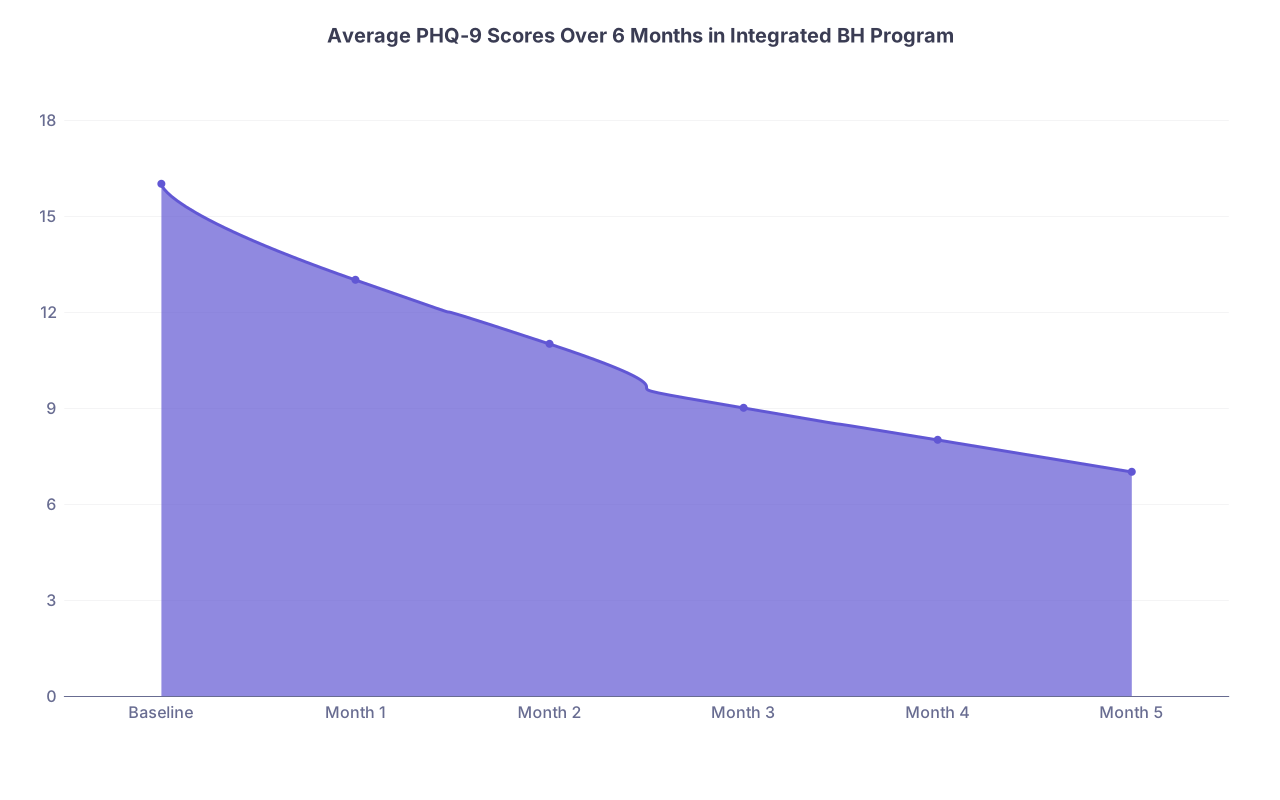
| Category | Value |
|---|---|
| Baseline | 16 |
| Month 1 | 13 |
| Month 2 | 11 |
| Month 3 | 9 |
| Month 4 | 8 |
| Month 5 | 7 |
When something is off, adjust operations, not just staff:
- Too many no‑shows → tweak scheduling windows, reminder systems, offer telehealth BH
- Long lag from screen to BH → increase warm‑handoff slots, re‑train MAs
- Poor outcomes → review fidelity to protocols, examine psychiatrist caseload review quality
11. Special Cases: Telehealth, Rural Clinics, and Small Practices
If you are in a small or rural practice, or just starting solo, you can still integrate BH. The mechanics change slightly.
11.1 Tele‑behavioral health
You can embed BH virtually:
- BCM works remotely, joins visits by video from a private office
- Warm handoff becomes: PCP finishes, then hands tablet or sets up video in exam room for BH consult
- Psychiatric case review is via teleconference
This works surprisingly well if your staff is trained to handle the logistics. You absolutely must have:
- Reliable video platform integrated (or at least stable) with your EMR
- Clear protocols for what cannot be safely handled by tele‑BH (e.g., certain high‑risk crises)
11.2 Micro‑practices (1–2 clinicians)
You probably cannot support a full‑time BCM. Options:
- Part‑time contracted BCM who does 1–2 days per week plus some remote outreach
- Shared psychiatrist across several small clinics running a combined CoCM panel
- Narrow scope: only manage mild‑moderate depression/anxiety in‑house and refer everything else
The principle is the same: you formalize what you will do, how you will do it, and how you will pay for it.
12. A Simple Phased Timeline for Implementation
Do not try to flip the switch in one week. Here is a realistic phased build:
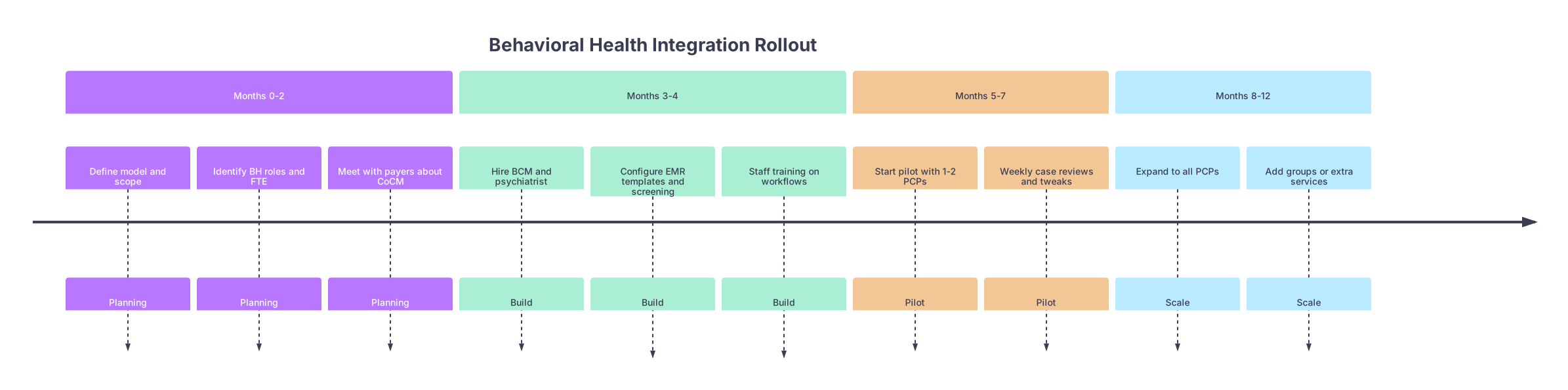
| Period | Event |
|---|---|
| Months 0-2 - Define model and scope | Planning |
| Months 0-2 - Identify BH roles and FTE | Planning |
| Months 0-2 - Meet with payers about CoCM | Planning |
| Months 3-4 - Hire BCM and psychiatrist | Build |
| Months 3-4 - Configure EMR templates and screening | Build |
| Months 3-4 - Staff training on workflows | Build |
| Months 5-7 - Start pilot with 1-2 PCPs | Pilot |
| Months 5-7 - Weekly case reviews and tweaks | Pilot |
| Months 8-12 - Expand to all PCPs | Scale |
| Months 8-12 - Add groups or extra services | Scale |

FAQs (Exactly 6)
1. Do I actually need a psychiatrist on staff, or can my PCPs just manage with a therapist?
If you are treating only mild depression and anxiety and not using Collaborative Care codes, a PCP + therapist model can function for a while. But you cap your complexity and your billing potential. Once your panel includes treatment‑resistant depression, bipolar spectrum questions, or complex comorbidity, a psychiatrist—at least part‑time—is not optional. The consulting psychiatrist dramatically improves prescribing quality and gives PCPs cover in difficult cases. For any serious integration effort, I recommend at least 0.1–0.2 FTE psychiatrist shared across the clinic.
2. How many patients can one behavioral care manager realistically handle?
In a well‑run Collaborative Care program, a full‑time BCM can actively manage about 60–80 patients on their active registry at any given time, spread across multiple PCPs. That is not the same as “who is on their schedule this week.” It includes patients they are calling, checking in on, and tracking progress for. If you push beyond that, quality drops and follow‑ups slip. For a 4–6 provider clinic, 1.0 FTE BCM is usually the minimum viable starting point.
3. What if my clinicians are worried about the extra documentation time for CoCM codes?
That is a fair concern, but it is more perception than reality if you set it up right. Most of the time tracked for CoCM is the BCM’s work and the psychiatrist’s case review, not the PCP’s. The PCP’s extra work is usually a few minutes per month to review and implement recommendations—often done inside normal visits or brief inbox reviews. EMR templates can auto‑calculate time and pull relevant data. If your PCPs are writing long free‑text essays about every BH case, your workflow is wrong; fix the templates, not the concept.
4. How do I handle patients who want long‑term therapy but we are built for brief interventions?
You have to be explicit with patients from the beginning. Your embedded BH is part of a brief, focused program tied to their medical care—usually 6–10 sessions. At intake, your BCM or therapist should explain the model and set expectations. For patients who need or demand long‑term therapy, you maintain a referral network: vetted external therapists, community mental health, tele‑therapy options. The clinic’s role is to stabilize, address core issues, and hand off when appropriate, not to be everything forever.
5. Can I integrate substance use treatment into this model, or is that a separate build?
You can integrate some level of SUD treatment into the same framework, especially for alcohol and opioid use disorder in primary care. That often looks like: PCPs waivered and comfortable prescribing buprenorphine or naltrexone, BCMs doing motivational interviewing and relapse‑prevention work, and a psychiatrist consulting on complex cases. However, high‑acuity polysubstance use with frequent intoxication or withdrawal usually belongs in a higher level of care. Start with limited, protocol‑based SUD integration and build outward only if your team has the skill and the bandwidth.
6. What is the most common operational mistake clinics make when starting behavioral integration?
They hire a good person and throw them into a bad system. No clear scope, no protected warm‑handoff slots, no registry, no psychiatrist back‑up, no payer strategy. The BH clinician becomes a traditional therapist in a medical building with a chaotic, overfilled schedule and no measurable impact on panel outcomes. If you avoid that mistake—with explicit model, workflow, and billing plan—you are already ahead of most clinics attempting this.
Key takeaways:
First, choose a specific integration model and scope before you hire anyone; vague “we’ll see all mental health” plans implode. Second, build concrete workflows—screening, triage, warm handoffs, documentation, and billing—so your staff knows exactly what to do when scores are high. Finally, treat this like a core clinical program, not an add‑on: measure outcomes, protect BH time and roles, and adjust operations when the data shows drift.