
It is 10:30 p.m. You just finished a full clinic day, signed your notes, and finally opened Google to see how your new practice looks to the world.
Four stars overall.
A glowing review from last week about how you “listened more in 15 minutes than my old doctor did in 5 years.” Right under it? A one-star rant about waiting 45 minutes, a rude front desk interaction, and “the doctor seemed rushed and didn’t care.”
Same clinic. Same physician. Completely opposite stories.
This is where most new private practice physicians live: mixed reviews, a vague sense of “we’re fine overall,” and a constant low-grade worry that the wrong review at the wrong time will scare off the right patient or employer.
Let me be blunt: hoping reviews will “sort themselves out over time” is how you end up stuck at 3.7 stars for five years. You cannot afford that, especially in the first 2–3 years post-residency.
You need a system. Not vibes. Not “we’re working on customer service.” A specific, boring, repeatable system that:
- Fixes what is legitimately broken in your patient experience
- Responds to and neutralizes the damage from bad reviews
- Intentionally generates a steady stream of strong, authentic positive reviews
Here is exactly how to do it.
Step 1: Get a Ruthlessly Honest Picture of Your Reputation
You cannot fix what you only half-see.
1.1 Audit every public review channel
Do this once, thoroughly, then set up monitoring.
Search for:
- “Your Clinic Name + city”
- “Your Name, MD + reviews”
- Any prior practice or health system you were affiliated with (some reviews follow you)
Check:
- Google Business Profile
- Healthgrades
- Vitals
- WebMD / Zocdoc (if relevant)
- Yelp
- Facebook page
- Insurance directories that allow ratings (UnitedHealthcare, Aetna, etc.)
Create a simple spreadsheet with:
- Platform
- Total number of reviews
- Average rating
- Date of most recent review
- The last 20 reviews (rating + key complaint/praise in 3–5 words)
You are looking for patterns, not isolated drama.
| Platform | Avg Rating | # Reviews | Last Review (Date) |
|---|---|---|---|
| 3.9 | 47 | 2 weeks ago | |
| Healthgrades | 4.2 | 19 | 1 month ago |
| Yelp | 3.5 | 11 | 4 months ago |
| 4.6 | 8 | 2 months ago |
1.2 Categorize the complaints and praise
Now you read. All of them. Yes, the ranting ones too.
On your spreadsheet, create columns for:
- Wait time
- Staff friendliness / respect
- Doctor communication / bedside manner
- Billing / surprise charges
- Scheduling / phones / access
- Office environment (cleanliness, parking, etc.)
As you read each review, tag the relevant columns with “+” for positive, “–” for negative.
You will usually see something like:
- People like you as a clinician but hate the phones.
- Or they love the MA but feel blindsided by a bill.
- Or they like your care but consistently mention long waits.
This tells you where your reputation risk really sits. Most practices overestimate the impact of one nasty outlier and underestimate the damage of 20 mid-level annoyances all saying the same thing.
1.3 Compare perception vs reality
Now compare reviews with your internal data:
- Average wait time (from scheduled to roomed)
- Phone call abandonment rate
- Claim denial rate / frequency of patient billing complaints
- No-show rate
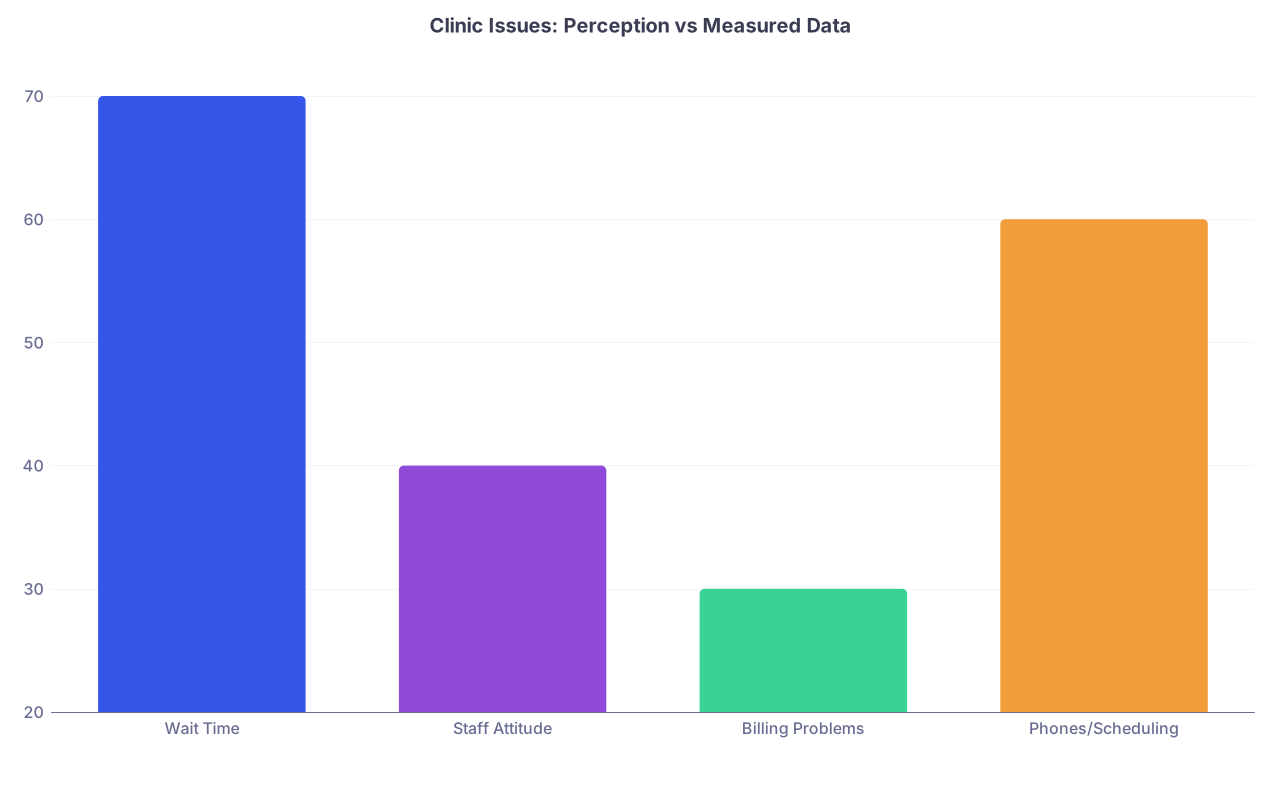
| Category | Value |
|---|---|
| Wait Time | 70 |
| Staff Attitude | 40 |
| Billing Problems | 30 |
| Phones/Scheduling | 60 |
Think of the numbers as “percent of recent reviews mentioning a problem” in each category. If 70% of your recent negative reviews mention wait times and your data shows chronically overbooked templates, you know where to start.
Your first goal is not to collect more 5-star reviews.
Your first goal is to stop generating new 1- and 2-star reviews for the same avoidable reasons.
Step 2: Fix the Operational Problems That Create Bad Reviews
Online reputation is a lagging indicator. By the time it looks ugly, you have been annoying people for months.
Take your top 1–2 problem areas and attack them directly.
2.1 If wait times are the main complaint
Stop defending. Fix it.
Concrete steps:
Measure the full visit time
For at least 2 weeks:- Time from scheduled appointment to check-in
- Check-in to roomed
- Roomed to physician entering
- End of visit
Adjust templates realistically
- If you are always behind by 30 minutes by 11 a.m., your template is a fantasy.
- Lengthen new patient visits. Cut a slot or two in peak hours.
- Build one “buffer slot” in the morning and one in the afternoon that you leave open.
Add proactive communication
Patients hate uncertainty more than delay.- Front desk / MA script: “We are running about 20 minutes behind. If you prefer to reschedule, we can do that now.”
- Put a sign at the front desk: “We respect your time. If we are more than 20 minutes behind, please ask about options.”
Start on time
New practices love to blame the EHR, the lab, the phase of the moon. The truth: if your first two appointments run late every day, the rest of the day is dead.
2.2 If staff behavior / front desk is the main complaint
I have seen excellent clinicians destroyed online because their front desk is chronically short with people.
Steps:
Listen to actual calls
Randomly sample 10–20 recorded calls (if your phone system allows it).
You will hear:- Sighs, rushed tone
- “We don’t do that” with zero explanation
- Confusion about insurance and policies
Train with scripts, not vague “be nicer”
A few examples:Instead of: “We don’t have anything till next month.”
Use: “Our soonest available is ___, but we can put you on a short-notice list and call if something opens.”Instead of: “That’s what your insurance requires. You’ll have to call them.”
Use: “Your insurance company set this requirement. I can give you their phone number and the language you can use when you call.”
Enforce a zero-tolerance policy for disrespect
You can protect staff from abuse and still insist on professionalism.- Feedback must be specific: “Three reviews mentioned you by name as rude. We are going to coach this and recheck in 2 weeks.”
- If someone is consistently generating complaints, they are not the right fit for a patient-facing role, no matter how long they have been there.
Create a short “service standards” one-pager
For example:- Phones answered with a smile in the voice
- Never say “that’s not my job” to a patient
- Always offer a next step, not a dead end
Post it in the staff area. Review it in every team meeting.
2.3 If billing / financial surprise is the main complaint
Nothing poisons reputation faster than “They blindsided me with a $400 bill.”
Steps:
Add financial expectation scripting at check-in for high-risk visits
- New patients
- Procedures
- Anything with known high copays / deductibles
Example MA script:
“Your insurance shows a deductible. This visit will likely be applied to that. We cannot give an exact number today, but many patients in your plan see bills between $___ and $___ for this type of visit.”Staff training on “why the bill looks like that”
Stop letting your front desk throw the doctor or “the system” under the bus.- Teach what CPT and ICD codes are (at a basic level).
- Train them to say: “Your insurance required this billing structure. We do not control the allowed amounts, but I can help explain the statement.”
Simplify your financial policy handout
One clean page:- Copays due at time of service
- Deductible responsibility
- No-show fee, if any
- Contact info for billing questions
Put the same language on your website.
Step 3: Build a Professional, Consistent Review Response Protocol
You cannot control what patients write. You can absolutely control how your clinic looks under each review.
3.1 Decide who owns review responses
This cannot be “whoever has time.”
Assign:
- One primary responder (practice manager or you)
- One backup
- A simple rule: all new reviews get checked at least twice per week
Use email alerts from Google Business and any major platforms. Or a reputation management tool if you want to get fancy, but you do not need that to start.
3.2 How to respond to negative reviews without making it worse
Rules:
- Never reveal PHI or confirm the person is your patient.
- Never argue about facts online.
- Never be defensive in public. That is what offline conversations are for.
Basic template you can adapt:
“We are sorry to read about your experience. This is not the standard we strive for at [Clinic Name]. Because of privacy laws, we cannot discuss details here, but we take your feedback seriously. If you are willing, please contact our office at [phone/email] so we can discuss this directly.”
If the review mentions a clear operational issue (wait times, phones not answered):
“We are sorry you experienced a long wait. We are actively adjusting our schedule templates and communication with patients when we are behind. Your feedback helps us improve.”
You are speaking as much to future readers as to the original reviewer.
3.3 When to flag or report a review
You can (and should) report:
- Reviews clearly about the wrong clinic or wrong provider
- Profanity-laced, harassing comments
- Obvious spam / competitor attacks
Do not waste time reporting every negative review just because you dislike it. Platforms rarely remove them unless they clearly violate policy.
Step 4: Systematically Generate More High-Quality Positive Reviews
Waiting for happy patients to spontaneously leave reviews is like waiting for prior auths to approve themselves.
You need a repeatable pipeline.
4.1 Who should you ask?
Not everyone. Target:
- Patients who explicitly compliment you or the staff in person
- Long-term patients who are stable and satisfied
- Patients you just helped solve a significant problem (pain control, diagnostic clarity, etc.)
If you see a patient say, “You have changed my life,” and then let them walk out without an invitation to leave a review, that is a missed layup.
4.2 How to ask without sounding desperate or unethical
You are allowed to ask. You are not allowed to bribe.
In-person script (physician):
“I am glad we have been able to help. As a small independent clinic, online reviews matter a lot. If you ever feel comfortable sharing your experience on Google, it would help other patients find us.”
Front desk script at checkout:
“If you were happy with your visit today, we would be grateful if you shared your experience in a Google review. I can text you the link.”
The key: make it easy. No one will go home and search your practice name, find the exact listing, and click “Write a review” without friction.
4.3 Make leaving a review stupidly simple
Concrete tools:
- Unique short link to your Google review page (via your Google Business Profile)
- QR code at checkout desk that opens the review form
- Automated text/email follow-up with direct link
Example process:
Patient checks out.
Front desk asks if they are okay receiving a text about feedback.
If “yes,” their name gets added to a “review follow-up” list in your EHR or CRM.
At 5 p.m., your staff sends a batch text:
“Thank you for visiting [Clinic Name] today. If you would like to share your experience, you can leave a review here: [short link].”
No incentives. No discounts “in exchange for.” Just a clear path.

| Step | Description |
|---|---|
| Step 1 | Patient Visit |
| Step 2 | Clinician identifies satisfied patient |
| Step 3 | Front desk asks permission to send link |
| Step 4 | No follow up |
| Step 5 | Add to review list |
| Step 6 | End of day text with review link |
| Step 7 | Patient leaves review |
| Step 8 | Patient agrees? |
4.4 Track your review volume and average rating over time
If you are serious, you track.
Once per month:
- Average rating now vs last month
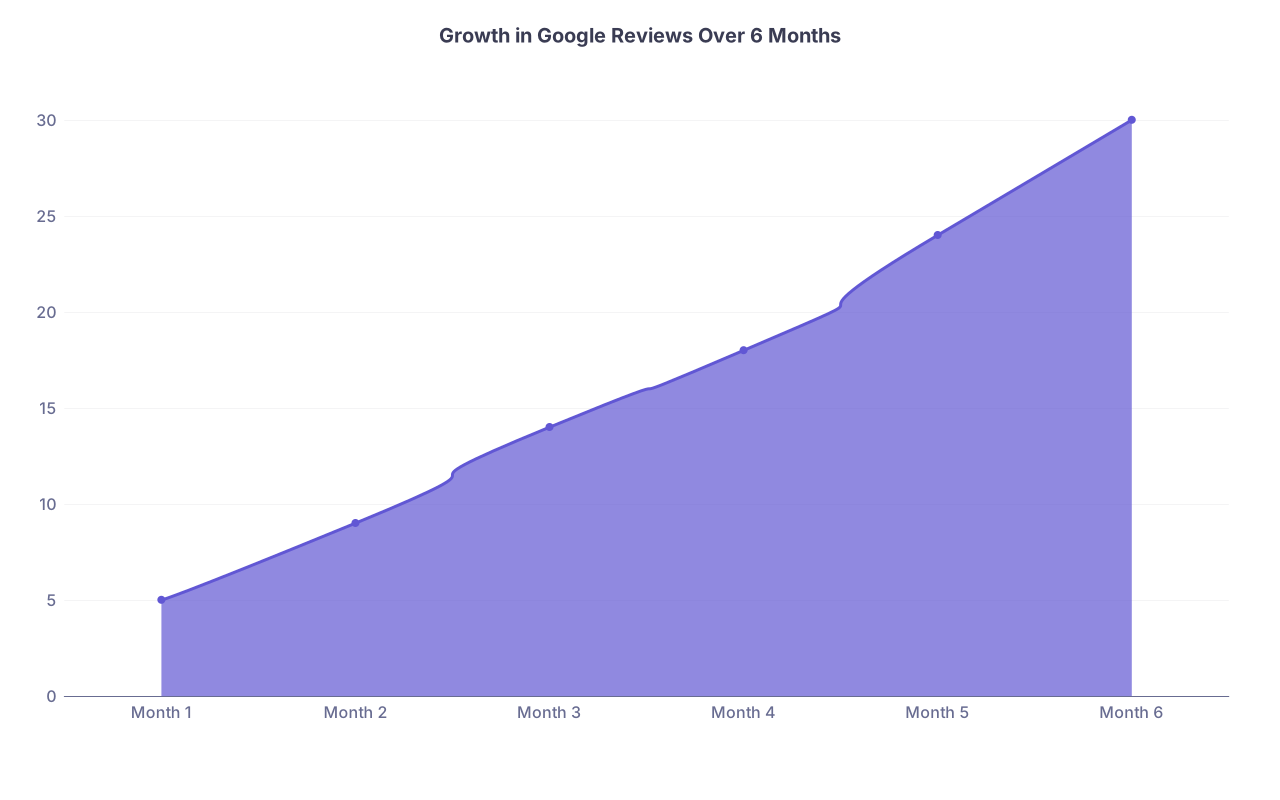
| Category | Value |
|---|---|
| Month 1 | 5 |
| Month 2 | 9 |
| Month 3 | 14 |
| Month 4 | 18 |
| Month 5 | 24 |
| Month 6 | 30 |
You should see:
- More total reviews
- Fewer new negative reviews (because you fixed upstream issues)
- A slowly climbing average star rating
Reputation repair is a 6–18 month project, not a one-weekend “fix.”
Step 5: Align Your Online Story with Your Real Differentiators
Most clinic websites and review profiles look identical:
“Compassionate, comprehensive, patient-centered care.”
Meaningless. Patients read that and scroll straight to reviews.
You can tie your improving reputation to a clearer public story.
5.1 Clarify what your clinic is actually good at
You cannot be “the best at everything.” Pick 2–3 things you want to be known for:
Example differentiators:
- “We run on time” (and actually do)
- “We respond to portal messages within one business day”
- “We specialize in X complex condition”
Then make sure:
- Staff knows these differentiators
- Your website explicitly states them
- Your in-room materials (small signs, patient handouts) echo them
5.2 Make sure your reviews reflect this story
Once you know your strengths, you can nudge patients to talk about them.
For example, if your differentiator is access and responsiveness:
Front desk script:
“If you leave a review, some patients like to share what they found most helpful—like our message response time or how easy it was to get an appointment.”
You are not putting words in anyone’s mouth. You are reminding them what might be relevant to others.
Over time, your reviews start to cluster around your actual strengths. That is how you differentiate from the giant health system down the road with generic 4-star averages and no clear identity.
Step 6: Build Internal Culture Around Feedback, Not Fear
If every bad review becomes a witch hunt or an eye-rolling joke in the break room, you will never move the needle.
6.1 Review rounds: 15 minutes, once a month
Agenda:
- Look at the last 5–10 reviews together (good and bad).
- Pick one system problem to work on (not a person to blame).
- Highlight one positive review that mentions a staff member by name. Recognize them publicly.
This makes reviews part of how you run the practice, not random punishment.
6.2 Translate feedback into small, concrete changes
Example:
Complaint: “Phones never get answered.”
- Change: Add a callback option after 2 minutes on hold; adjust staffing during peak call hours.
Complaint: “Doctor seemed rushed.”
- Change: For complex visits, add a verbal expectation: “We have 20 minutes today. Let us focus on your top 1–2 concerns and schedule follow-up for anything else.”
You are not promising infinite time. You are managing expectations like an adult.
Step 7: Protect Against Reputation Shocks
Sooner or later, you will get a brutal, unfair, possibly unhinged 1-star review.
You cannot stop that. You can blunt its impact.
7.1 Raise your review count as insurance
A clinic with 12 total reviews and two 1-stars looks sketchy.
A clinic with 120 reviews, 4.4 stars overall, and a couple of clearly outlier rants? Patients discount the outliers automatically.
This is why volume matters. Not because you want vanity metrics, but because more data gives a truer picture.
7.2 Have a crisis playbook ready
If you get:
- A viral social media post attacking your clinic
- Multiple coordinated negative reviews in a short time
- A news article related to your practice
Your steps:
- Pause and gather facts internally.
- Draft a short, factual public statement if needed.
- Respond consistently on all platforms with a calm, similar message.
- Do not escalate arguments online. Move detailed conversations offline.
You are a physician, not a brand manager, but this is your business now. Pretending online storms do not matter is naive.
Step 8: Integrate Reputation into Your Growth Strategy
Reputation is not a side project. It is part of your referral and growth engine.
8.1 Make it easy for referring providers to see your reviews
- Include a QR code or short URL to your Google reviews on referral packets.
- When meeting with PCPs or other referrers, be explicit: “We take patient experience seriously and track our reviews monthly.”
8.2 Use improved reviews in hiring and staff retention
Good staff want to work where patients are not constantly furious.
- Share positive reviews in job postings (“Our average rating is 4.6 stars across 200+ reviews.”)
- Recognize staff named in reviews with small rewards or shout-outs.
It reinforces that patient experience is not just the doctor’s problem.
Your Next Move: One Focused Hour
Do not make this theoretical.
Today, block one hour and do the following:
- Google your clinic and your name on at least 3 platforms.
- Create a quick table: average rating, # of reviews, last review date.
- Read the last 20 reviews and tag each as: wait time, staff, doctor, billing, scheduling, environment.
- Pick one category that shows up the most in negative reviews.
- Write down two concrete operational changes you can pilot in the next 30 days to attack that category.
That is it. One hour.
Then schedule a 30-minute meeting with your key staff next week to review what you found and the two changes you plan to make.
Open your browser and start the search now. Your reputation already exists. The question is whether you are actively shaping it or letting it quietly drag your clinic down.