
Urban practices do not always win. In fact, for post‑residency physicians starting or joining private practice, some of the best ROI, best lifestyle, and best long‑term equity are happening in well‑chosen suburban markets—not the big shiny city centers everyone flexes on LinkedIn.
Let me be blunt: a lot of residents are stampeding into dense urban markets because of prestige, not math. And the math is ruthless.
You asked for myth‑busting. So let’s pull the curtain back on why certain suburban clinics quietly outperform “prime” urban practices on revenue, margins, and long‑term leverage.
The Prestige Trap: Why Everyone Thinks Urban Automatically Wins
Most post‑residency job searches follow the same script:
- “I want to be near the big academic center.”
- “I need to be downtown for referrals.”
- “Patients only trust the big city brands.”
This is half true at best, and flat‑out wrong in key ways.
Here’s what actually drives physician behavior right out of training:
- Recency bias: You trained at a big hospital downtown, so your brain assumes “this is where care happens.”
- Brand bias: You’ve internalized that the big academic logo equals quality and legitimacy.
- Peer pressure: Co‑residents talk about NYC, SF, Boston, Chicago like they’re trophies, not cost centers.
The problem: none of that automatically translates to profitable, sustainable private practice. Those things help employment in systems. They don’t guarantee success when you eat what you kill.
To see why, you need to look at the economics, not the skyline.
Follow the Money: Urban vs Suburban Practice Economics
Let’s compare some typical dynamics. Not fantasy. The stuff that shows up on your P&L.
| Factor | Urban Core Practice | Suburban Clinic (Well-Chosen) |
|---|---|---|
| Rent per sq ft | Very high | Moderate to low |
| Parking | Limited / paid | Free / ample |
| Payer mix | More Medicaid/self-pay | More commercial/insured |
| Competition density | Very high | Moderate |
| Referral dependency | Heavy on large systems | Mix of self-referral + PCPs |
| Staff wages | Higher | Slightly lower |
| Patient travel time | Long, transit-dependent | Car-based, shorter |
You do not have to take my word for it. Look at any MGMA or AMA benchmarking data. When you normalize for:
- Overhead percentage
- Net collections per RVU
- Payer mix quality
You see a recurring pattern: practices in decent‑income suburbs with stable employer bases often produce higher take‑home per physician than flashy urban zip codes with the same specialty.
Not because they’re “better doctors.” Because the unit economics are less stupid.
Here’s what usually kills urban practices:
- $50–$90 per square foot rent with escalation clauses.
- No free parking, which secretly throttles no‑show‑sensitive specialties.
- Saturated competition: five dermatology offices in a three‑block radius.
- Heavy Medicaid/uninsured population + aggressive academic systems cherry‑picking the commercial patients.
- Higher staff burnout and turnover because everyone’s commuting 60–90 minutes.
You can “feel important” at your highrise office and still be bleeding 65–70% overhead.
Now compare that to a strategically placed suburban clinic:
- Reasonable rent, sometimes with the chance to own the building.
- Patients who can park 30 feet from your front door.
- Higher commercial insurance penetration in certain suburbs.
- Fewer direct competitors within a 10–20 minute drive.
- Better staff retention because their commute is sane and parking is free.
None of this is theoretical. I’ve seen solo and small‑group suburban clinics in IM, pediatrics, ortho, ENT, GI, and derm outperform urban groups in pure take‑home per FTE, even if the gross revenue is lower.
The Access Myth: “But Urban Has All the Patients”
Another lazy assumption: urban practices win because there are “more patients.”
Yes, the raw population density is higher. That doesn’t mean they’re your patients.
Here’s what the data actually shows in many metro areas:
- Urban cores skew toward:
- Younger adults
- More transient populations
- Higher uninsured/Medicaid rates
- Inner and outer suburbs skew toward:
- Families
- More stable multi‑year residents
- Employer‑sponsored insurance
If you’re running a private practice that bills insurers, you care about the right kind of demand, not just raw headcount.
Look at this simplified breakdown:
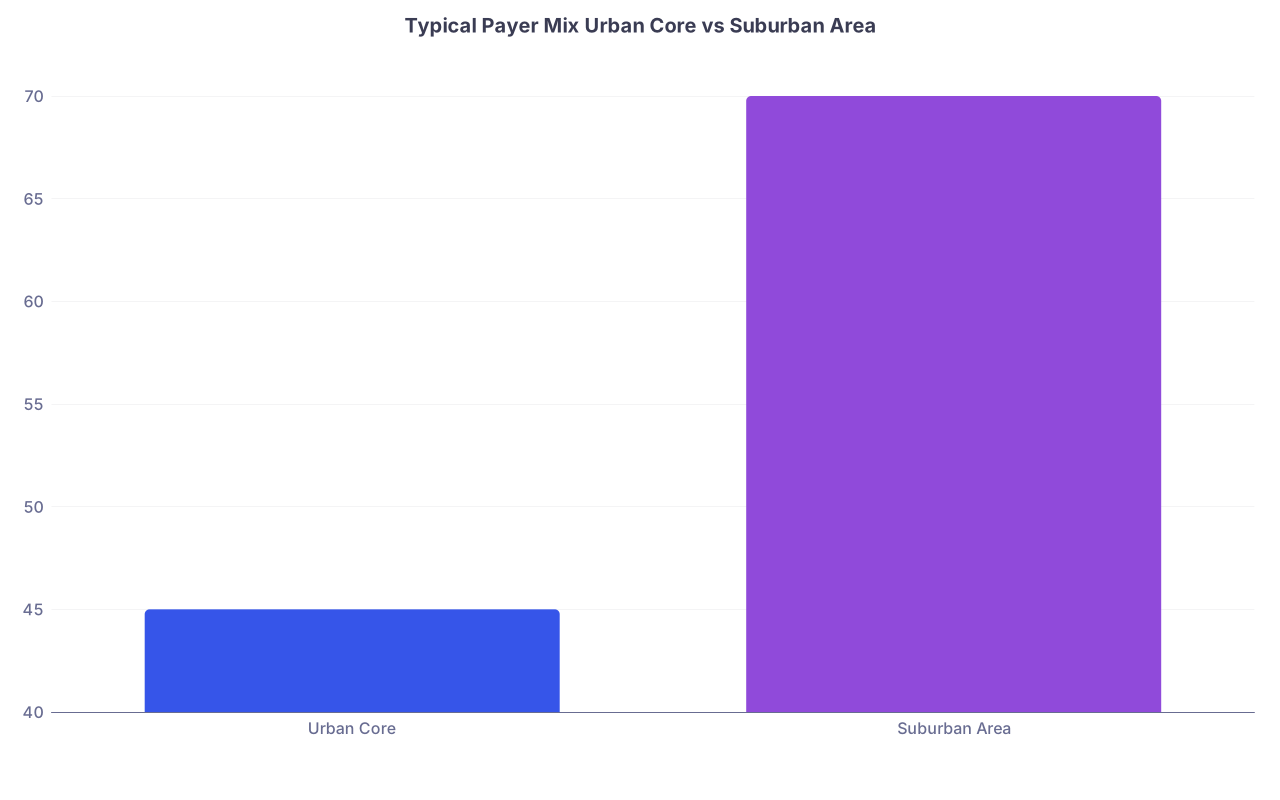
| Category | Value |
|---|---|
| Urban Core | 45 |
| Suburban Area | 70 |
Think of that chart as: percent of visits covered by commercial insurance in a given metro vs its suburbs (ballpark values, but directionally accurate in many regions). The rest is Medicare, Medicaid, and self‑pay.
You don’t need to be a finance major to realize:
- 70% commercial with decent employer plans is a very different business than
- 45% commercial with heavy Medicaid and episodic self‑pay.
Urban density also works against access:
- Travel time is unpredictable.
- Parking is a pain or expensive.
- Transit disruptions, safety concerns, and plain fatigue make no‑shows worse.
Meanwhile, the 38‑year‑old software engineer with two kids in a suburb 25 minutes outside the city? She’s thrilled to drive 10 minutes, park free, and be back at work within an hour. That’s the patient many private practices want, but everyone insists on chasing the downtown address instead.
Why Some Suburban Clinics Quietly Crush It
Not every suburban clinic is a gem. Some are dying. The winners share a few boring but powerful patterns.
1. They pick the right suburb, not just “not urban”
Winning suburbs usually have:
- Stable or growing population (not shrinking bedroom communities).
- Major employers within 10–20 miles (healthcare, tech, manufacturing, universities).
- Above‑average household income for the region.
- A mismatch between demand and supply: too few specialists or even too few decent primary care offices.
That last part is key. You are not trying to “escape the city.” You are trying to go where they need you and can pay you.
I’ve watched two cardiologists open a clinic 25 minutes outside a metro where every cardiology group was clustered within 5 miles of the downtown hospital. Within 18 months, their schedule was booked out 6 weeks. Why? Because every PCP in that suburb hated sending patients downtown for 15‑minute visits and 90‑minute parking drama.
2. They design around patient convenience
Suburban practices that outperform are obsessive about friction:
- Easy parking.
- Proximity to main commuter routes.
- Early morning and late afternoon slots for working adults.
- Online scheduling that actually works, not a fax line from 1997.
- Short wait times and sane visit lengths.
That’s how you win loyalty in a market where you may not have the big academic brand behind you. Patients don’t care if your office overlooks a river or a strip mall. They care if you solve their problem without hijacking their whole day.

3. They run leaner, smarter operations
Suburban clinics often have more control over:
- Space: ability to configure exam rooms, procedure rooms, and flow without hospital bureaucracy.
- Staff structure: cross‑training MAs, front desk, and scribes according to their volume and specialty.
- Tech stack: using simple, cloud‑based EHRs and billing systems instead of monolithic hospital IT.
All that usually translates into lower overhead as a percentage of collections. A suburban internal medicine clinic with 50–55% overhead can easily out‑earn an urban practice running at 65–75% overhead, even with the same RVUs.
The Referral Lie: “If I’m Not Downtown, I Won’t Get Patients”
This one is heavily pushed by academic centers and urban multispecialty groups: if you’re not physically near the hospital, you’ll be invisible.
Reality is more nuanced.
Referrals flow along lines of:
- Trust
- Convenience
- Availability
Not just geography.
Here’s a scenario I’ve watched play out:
- Urban specialty group: “We’re booked out 3–4 months.”
- Suburban independent clinic: “We can see your patient within 2 weeks, and we’ll call you after the visit.”
Guess which one the overworked suburban PCP starts using more?
Many PCPs in surrounding suburbs are exhausted with funneling everything into the giant downtown beast that treats their patients like chart numbers. If you’re a responsive, collegial, competent specialist or PCP in the suburbs, you can absolutely build a solid referral network.
You will not be as plug‑and‑play as being employed by the big hospital. But you’ll also keep a bigger share of the revenue and have more control.
When Urban Actually Makes Sense
Let’s be fair: some specialties and situations do belong in urban cores.
Urban may make more sense if:
- You’re in a highly procedural or hospital‑dependent specialty that lives off the OR or interventional suite (neurosurgery, complex oncologic surgery, advanced interventional cardiology).
- Your bread and butter is the academic referral pattern: rare diseases, transplant, tertiary/quaternary care.
- You’re building a high‑volume walk‑in or urgent care with huge foot traffic and employer contracts downtown.
Even then, many high‑end surgeons live in the city financially because of hospital employment contracts, not private practice margin. Different question entirely.
So I am not saying “never go urban.” I am saying: stop assuming it’s the default best choice for starting or acquiring a private practice.
How to Actually Evaluate a Suburban Opportunity (Post‑Residency Reality)
Let’s get concrete. You’re finishing residency or fellowship. You’re staring at job offers and dreaming of your own thing in 3–5 years.
Here’s the smarter way to look at suburban vs urban, stripped of the romance.
| Metric | Urban Offer / Plan | Suburban Offer / Plan |
|---|---|---|
| Rent per sq ft | ||
| Average payer mix (commercial %) | ||
| Overhead projection (%) | ||
| Competition radius (10–15 miles) | ||
| New patient wait time in area | ||
| Ability to own real estate |
You want to actually fill that table in with real data:
- Call a few local PCPs and ask how long it takes to get patients in to see your specialty, downtown vs suburb.
- Look up commercial lease rates on LoopNet or similar sites.
- Talk to independent practice owners 10–20 miles outside the city, not just your big‑name attendings.
- Ask billing companies what payer mix looks like for zip codes you’re considering.
Patterns will emerge quickly. And some of those “boring” suburbs will start looking a lot less boring once you see what net collections and overhead actually look like.
The Real Endgame: Equity, Not Just Income
One more myth to kill: that your salary is the only number that matters.
Urban jobs often throw bigger starting salaries at you. Fine. But most of those are W‑2 employment with zero equity in:
- The practice
- The building
- The brand
In a suburban setting, especially if you’re deliberate:
- You’re more likely to be able to acquire or build your own space.
- Commercial real estate can become a parallel asset over 10–20 years.
- You can build a local brand that’s less dependent on hospital politics.
I’ve seen physicians who bought a modest building for their suburban clinic in their late 30s and had that building nearly paid off by their late 40s. That asset then becomes retirement leverage, not just an expense line. Try that in the middle of a downtown financial district.
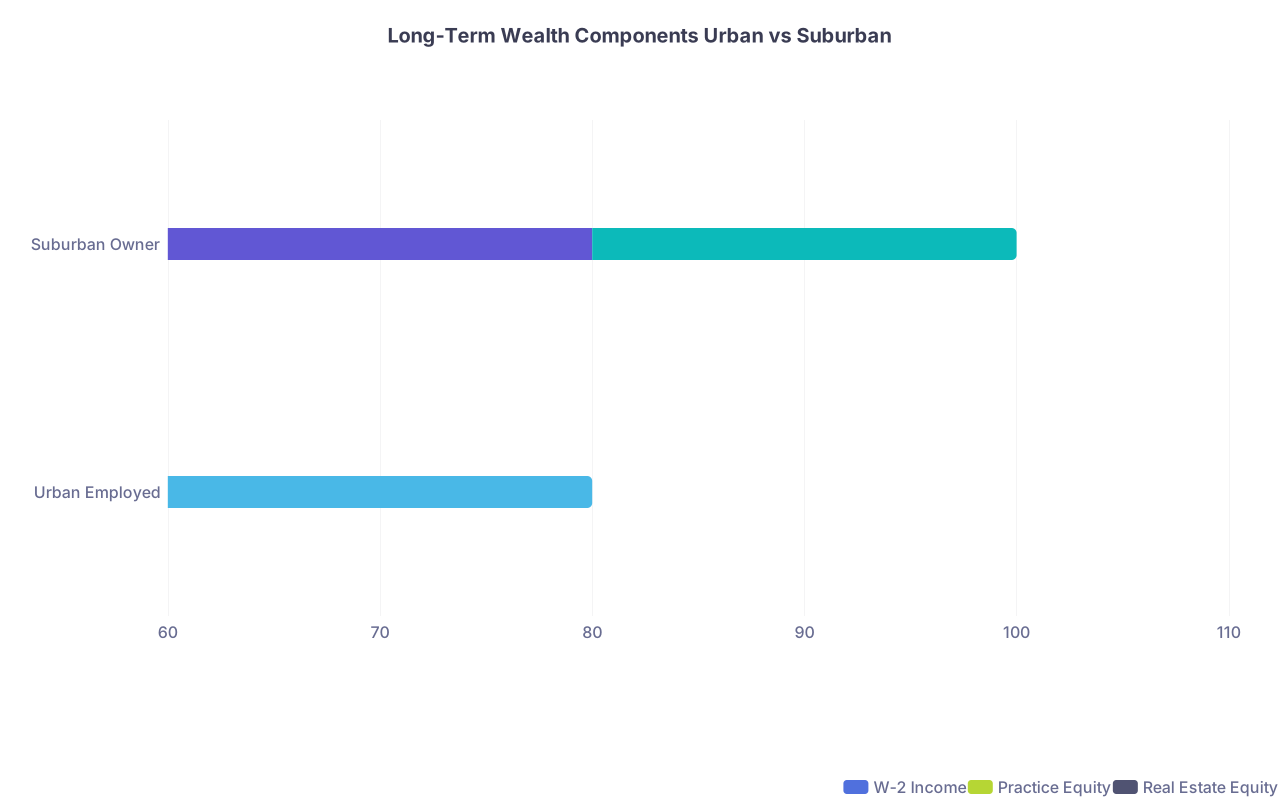
| Category | W-2 Income | [Practice Equity](https://residencyadvisor.com/resources/starting-private-practice/how-experienced-owners-quietly-structure-buyin-and-buyout-agreements) | Real Estate Equity |
|---|---|---|---|
| Urban Employed | 80 | 0 | 0 |
| Suburban Owner | 60 | 20 | 20 |
Those numbers are conceptual, but the structure is real. Urban employment often means high cash flow now, zero ownership later. Suburban private practice can mean slightly less guaranteed income now, much more control and equity later.
FAQs: Urban vs Suburban Practice Reality
1. I want academic involvement. Does that kill the suburban option?
No. Many suburban physicians hold volunteer or adjunct faculty appointments, supervise residents on community rotations, or participate in teaching through affiliated hospitals. You may not be doing pure lab research, but you can absolutely teach and precept while running a strong suburban practice.
2. Are suburban patients “less complex” or less interesting clinically?
Often the opposite. You see a broader mix of bread‑and‑butter and neglected chronic disease, especially in fast‑growing areas underserved by specialists. The notion that only downtown hospitals see “real medicine” is an ego story, not supported by what walks into community clinics every day.
3. Won’t I fall behind on cutting‑edge medicine if I’m not tied to an academic center?
Staying current is about how you learn, not your ZIP code. CME, professional societies, virtual conferences, and journal clubs don’t care where your office is. Many community and suburban physicians are more guideline‑driven than some academic folks who are juggling research, admin, and politics.
4. Is it harder to recruit staff in the suburbs?
Frequently it’s easier. Many MAs, nurses, and front‑office staff live in suburbs and hate commuting into the city. Offering them shorter drives, free parking, and a less chaotic work environment is a recruiting advantage, not a liability.
5. If I know I want my own practice, should I still start with a hospital-employed urban job?
It depends on your debt, risk tolerance, and family situation. But if your endgame is ownership, I’d strongly consider early experience in a well‑run community or suburban practice instead of sinking five years into an urban employed role that teaches you nothing about running a business and locks you into a mindset that the hospital will always handle everything.
Key takeaways:
- Urban is not automatically better; suburban clinics often win on payer mix, overhead, and real‑world access.
- The smartest post‑residency path considers equity and long‑term leverage, not just prestige and starting salary.
- If you’re serious about private practice, stop chasing skylines and start chasing sound economics.