
It’s March of your preclinical year. Your class group chat is on fire:
“Bro, I’m gonna knock out Step 1 in January so I can chill on rotations.”
“Faculty said we should push it later to integrate more path.”
Someone else just posted their Anki stats and a 260 Step 2 score like it’s no big deal.
You’re stuck on one question:
Now that Step 1 is pass/fail… should you take it earlier or later?
Here’s the answer you’re actually looking for: there’s no one-size-fits-all date, but there is a right way to decide. And for a lot of students, the “default” advice they’re getting from classmates is wrong.
Let’s break it down.
The Core Truth: Step 1 Is Still High-Stakes, Just Differently
Pass/fail didn’t make Step 1 optional. It just shifted how the pain shows up.
What changed:
- Programs don’t see your Step 1 number anymore (US MD/DO).
- A pass now is just a checkbox.
- A fail is a neon red flag that follows you all the way into ERAS.
What didn’t change:
- You still need to know the material to survive:
- Shelf exams
- Step 2 CK
- Day-to-day on the wards (where attendings don’t care what’s P/F)
So the real question isn’t “earlier or later?”
It’s: When will you most reliably pass Step 1 while best setting up Step 2 and clerkships?
That’s the frame. Everything else is noise.
Step 1 Timing: What “Earlier” vs “Later” Actually Means
First let’s define the two main camps people talk about:
| Timing Label | Rough Timing | Context |
|---|---|---|
| Early | 0–4 weeks after preclinicals end | Shorter dedicated, heavy reliance on class prep |
| Standard | 4–8 weeks after preclinicals end | Most common at many schools |
| Late | 8–12+ weeks after preclinicals | Longer dedicated, sometimes overlapping with clerkships |
You’ll hear variations:
- “Take it mid-M2” (very early)
- “Take it right before clerkships”
- “Take it after starting rotations” (usually a bad idea unless forced)
Key principle: Your internal Step 1 date matters more than the calendar date.
That “internal date” is: the point at which your baseline knowledge + dedicated time = a 95%+ chance of passing on an NBME.
When You Should Take Step 1 Earlier
“Earlier” here means on the short side of what your school allows. Not absurdly early mid-year just to be edgy.
You’re a good candidate for earlier Step 1 if most of these are true:
Your school’s preclinical curriculum is strong and board-oriented
You’ve had:- Systems-based teaching
- Lots of NBME-style questions
- Dedicated “board weeks” already built in
Places like Mayo, WashU, Baylor, etc often fit this mold.
Your internal data already looks solid
I’m not talking about vibes. I’m talking about numbers:- UWorld percent correct ≥ 55–60% (first pass, mixed, timed)
- NBME forms in or near your school’s “safe zone” for passing
- You’re not getting crushed by basic path/pharm questions
You’ve actually been studying for boards during preclinicals
If you:- Did Anki or another spaced-repetition system consistently
- Used UWorld or AMBOSS alongside classes
- Watched boards-style videos (Boards & Beyond, Pathoma, etc) as you went
Then your “dedicated” is consolidation, not building from scratch.
You want to front-load pain and free your brain for clerkships + Step 2
Here’s the reality post-P/F:- Step 2 CK is often the number programs care about now.
- Shelf exams are harder than people think and build your Step 2 base. If you can clear Step 1 earlier without risk, you can:
- Focus harder on rotations
- Ramp up Step 2 earlier
- Avoid dragging basic-science anxiety into your clinical year
In that situation, taking Step 1 “earlier” (shorter dedicated, closer to end of M2) is smart. You’re using your preclinical prep as your main training, not trying to relearn everything in a 10-week Hail Mary.
When You Should Take Step 1 Later
“Later” here means using the longer end of the dedicated window your school permits, not delaying into clerkships unless you truly have to.
You should lean later if these describe you:
You’re barely passing (or not passing) school exams
If you’re scraping by on block exams, you’re not secretly “Step ready.” That’s fantasy. You need:- Time to actually learn path, pharm, and micro
- Extra weeks to convert “I’ve seen this before” into “I own this”
You did minimal board-style prep during preclinicals
Let’s be honest:- You haven’t really touched UWorld
- Anki was a three-week phase during cardio that died fast
- You crammed for blocks using slides, not concepts
In that case, shorter dedicated is not “efficient.” It’s reckless.
Your NBME and UWorld numbers are below safe pass range
Concrete signals you’re NOT ready:- UWorld < 50–55% correct, first pass
- NBMEs consistently near or below the passing cutoff
- You’re missing basic, first-order questions (not just random zebras)
You’ve got testing anxiety or a prior standardized exam history that’s shaky
If:- MCAT took you multiple attempts
- You chronically underperform on big tests vs practice
Then you can’t treat Step 1 like a casual checkbox.
You want extra buffer. More reps. More NBMEs. More time to stabilize.
In this scenario, later is safer. You’re not gaming the system. You’re preventing the one outcome that does still tank applications: a Step 1 fail.
The Big Risk: Failing Step 1 Now Hurts MORE Than Before
Let me be blunt:
Back in the numeric era, a low-but-passing Step 1 score could sometimes be explained away. Painful, but survivable.
Now?
- Programs only see Pass or Fail.
- A fail looks like:
- You couldn’t clear the minimum threshold when stakes were lower (P/F).
- You might struggle with future licensing exams.
- You might not be safe to invest in.
I’ve seen students with research, great letters, solid Step 2 scores… still screened out or grilled about a Step 1 fail.
So if you’re asking:
“Should I take it early just to get it over with?”
The answer for anyone borderline is: no, absolutely not. You gain nothing from rushing and risking a fail.
How Step 1 Timing Affects Step 2 and Clerkships
Here’s what everyone forgets: Step 1, clerkships, and Step 2 are one continuous arc.
You want to time Step 1 in a way that:
- Doesn’t crush your clerkship performance
- Doesn’t delay Step 2 CK into some nightmare timeline
Let’s compare the trade-offs.
| Factor | Earlier Step 1 | Later Step 1 |
|---|---|---|
| Clerkship start | More mental bandwidth | Starting already exhausted |
| Shelf exams | Stronger Step 1 base | Might still be shaky |
| Step 2 CK timing | Can take it earlier | Risk compressing it |
| Burnout risk | Lower during clerkships | Higher if dedicated drags |
General pattern I see:
If you’re already reasonably prepared, earlier Step 1:
- Frees your cognitive load for the wards
- Lets you space Step 2 more sanely
- Helps you crush shelves (which feed right into Step 2)
If you’re not prepared, artificially forcing “early”:
- Extends dedicated anyway (because you’re too scared to test)
- Bleeds into clerkships mentally or literally
- Wrecks both your confidence and long-term plan
So your Step 1 date should be early only if that’s compatible with a very high chance of passing on practice exams.
A Simple Framework: How To Decide Your Personal Step 1 Timing
Let me give you a straight, no-fluff process.
Step 1: Anchor to your school’s allowed window
You’re probably given something like:
- “Take Step 1 between May 1 and July 15”
That’s your constraint box. You’re not deciding between January and November. You’re mostly choosing between “front of the window” and “back of the window.”
Step 2: Get hard data, not vibes
Within 6–8 weeks of preclinical ending, you should have:
- At least 25–40% of UWorld done in mixed, timed mode
- 1–2 NBME practice exams under standard conditions
Then ask three questions:
- Are my UWorld percentages ≥ 55–60% and trending up?
- Do my NBME scores give me a good margin above the passing cutoff?
- When I review questions, do I mostly miss details or completely miss concepts?
If your answers are:
- Yes
- Yes
- Mostly details
→ You can be safely on the earlier side of your window.
If your answers are:
- No / borderline
- No / barely passing
- I’m missing basic concepts
→ You should be on the later side. Maybe even ask for an extension if that’s an option.
Step 3: Look at your mental and physical fuel tank
You’re not a machine. If:
- You’re already cooked from preclinical grind
- You can’t focus for more than 20–30 minutes
- You’re starting to hate everything related to medicine
Then smashing a super-intense 4-week dedicated just to be “early” is dumb. Take the extra weeks. Spread your studying. Get sleep.
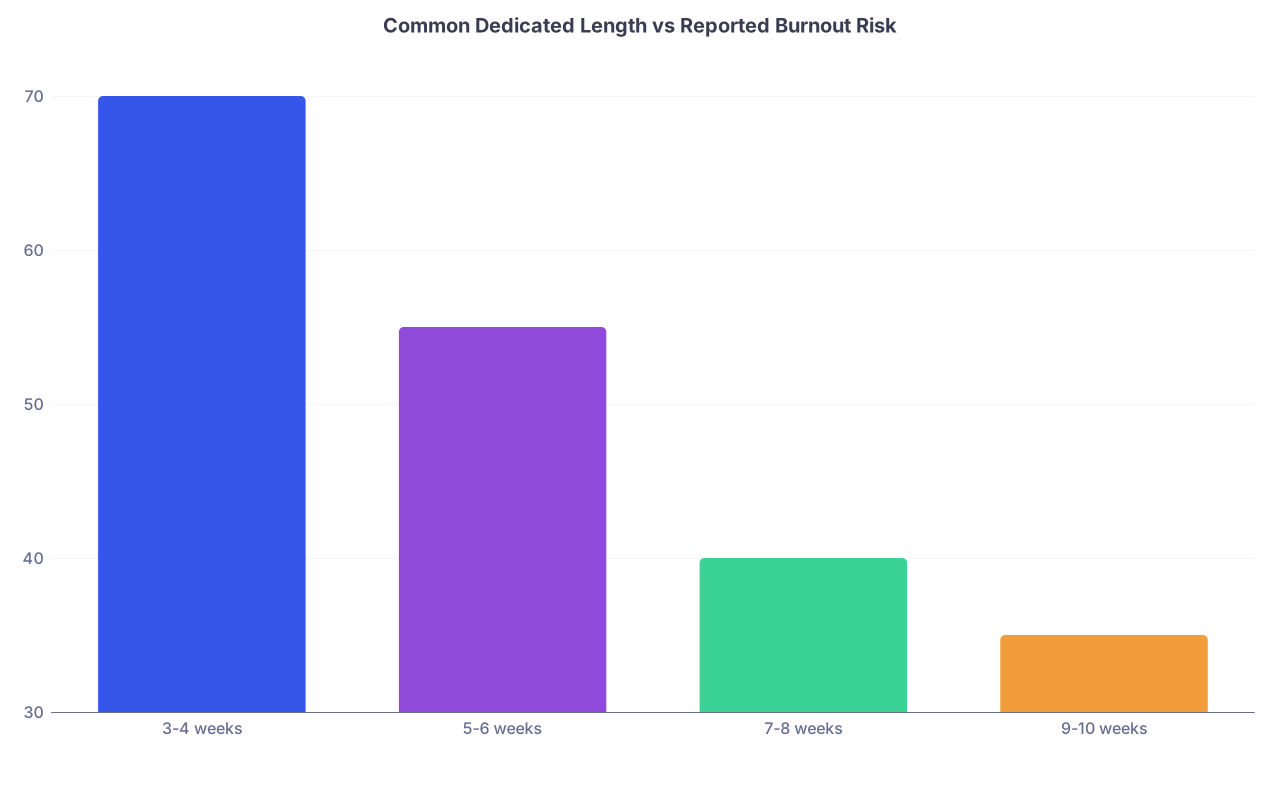
| Category | Value |
|---|---|
| 3-4 weeks | 70 |
| 5-6 weeks | 55 |
| 7-8 weeks | 40 |
| 9-10 weeks | 35 |
(That’s the pattern I’ve seen: really short dedicateds spike burnout unless the student was very well-prepared ahead of time.)
Common Bad Takes About Step 1 Timing (And Why They’re Wrong)
Let’s quickly kill a few myths I hear constantly.
“It’s pass/fail so you don’t need to study that hard”
Wrong. You don’t need a 270. But you definitely need:
- Solid command of core path, pharm, and micro
- Enough repetition that test day feels familiar, not alien
Remember: Step 1 content shows up again:
- On shelf exams
- On Step 2 CK
- On rounds when a resident says “walk me through the pathophys”
You’re not just studying for a checkbox. You’re building the base of your clinical brain.
“Just push it as late as possible so you can study more”
Also wrong for many people.
If you push it late but:
- You procrastinate
- You burn out
- You drag dedicated to 10+ weeks of half-productive misery
You didn’t “get more time.” You just stretched the pain and delayed your life.
Longer isn’t better. Sufficient and focused is better.
“Everyone in my class is taking it early, so I should too”
Your classmates lie. Or at least omit details.
I’ve watched this play out:
- The “I’m testing early” crew quietly moves their dates back 2–3 times.
- The person who posts their “early pass” was scoring 245+ equivalent on NBMEs from day one.
- The struggling students who rush it? They’re the ones in my inbox later with: “I failed Step 1… what now?”
Your decision should be based on your data, not group chat flexing.
Practical Study Implications of Early vs Late
You might be thinking: “Ok, but how does this actually change how I study?”
Here’s the short version.
If you’re aiming for earlier:
- Start serious board-style prep during preclinicals
- Use:
- UWorld or AMBOSS alongside each block
- Anki or another spaced repetition system for long-term retention
- Pathoma/Boards & Beyond or equivalent with each system
- Goal: by the time preclinicals end, you’re in “polish and integrate” mode, not “build from zero.”
If you’re aiming for later:
- Accept that dedicated is a rebuilding phase
- Be disciplined with:
- Daily question blocks (timed, mixed)
- Content review only where questions show you’re actually weak
- Regular NBMEs every 1–2 weeks to track readiness
- Set a firm threshold: you test when 2 recent NBMEs put you comfortably above pass. Not when the calendar says so.

| Step | Description |
|---|---|
| Step 1 | End of Preclinicals |
| Step 2 | Take NBME + Check UWorld |
| Step 3 | Schedule Early in Window |
| Step 4 | Use Later Side of Window |
| Step 5 | Add 2-4 Weeks Focused Study |
| Step 6 | Repeat NBME |
| Step 7 | Confirm Test Date |
| Step 8 | Consider Extension and Support |
| Step 9 | NBME well above pass and UW >= 55%? |
| Step 10 | Now safely above pass? |
Quick Specialty Angle: Does Timing Matter for Competitive Fields?
People aiming for derm, plastics, ortho, etc always ask:
“Should I take Step 1 super early to start research or Step 2?”
Reality:
- Programs in competitive specialties care about:
- Step 2 CK score
- Clerkship grades
- Research
- Letters from big names
- As long as Step 1 is passed on first attempt, the exact date you took it won’t matter.
So if you’re gunning for a competitive field:
- Don’t play cute games risking a fail or a barely-pass just to be “early.”
- Your obsession should be:
- Strong foundation now → better shelves → better Step 2
- Time and brain space for research and strong clinical performance
FAQ: Step 1 Earlier vs Later Now That It’s P/F
1. Is there any advantage to taking Step 1 as early as my school allows?
Only if your practice data supports it. If your NBME scores are solid and UWorld is decent, earlier helps free up bandwidth for clerkships and Step 2. If not, early is just risky with zero upside.
2. How many NBMEs should I take before deciding on an “early” test date?
At least 2–3, spaced 1–2 weeks apart, under real conditions. You want consistent performance above the passing threshold, not a one-off lucky test.
3. Does taking Step 1 later make Step 2 CK harder to schedule?
It can. If you push Step 1 to the extreme end of your window, you can end up:
- Compressing Step 2 between rotations and ERAS
- Taking Step 2 closer to application season with less buffer for a retake
So yes, delay has downstream consequences.
4. What if my school pressures us to take it by a fixed date but I don’t feel ready?
You’re not the first. Options:
- Show them your NBME and UWorld data objectively
- Talk with your dean, academic support, or learning specialist
- In some schools, you can get extensions or modified schedules if there’s a clear risk of failing
Don’t just quietly accept a test date that your practice scores don’t justify.
5. Bottom line: how do I know I picked the “right” time?
You picked well if:
- Your date is within your school’s allowed range
- Your last 2 NBMEs were comfortably above pass
- You’re not relying on a “miracle spike” on test day
- You can explain your choice with data, not vibes or class gossip
If those are true, whether it’s technically “early” or “late” doesn’t matter. You made a rational decision in a P/F world that still punishes failing.
Key takeaways:
- Step 1 is pass/fail, but timing still matters because a fail hurts more than ever.
- Go earlier only if your practice data is strong; go later if you need real time to build a passing foundation.
- Optimize for the whole arc: Step 1 → clerkships → Step 2, not just getting Step 1 “over with.”