
The myth that “you need research for every competitive residency application” is lazy advice.
Here’s the real answer: you don’t always need research, but for certain specialties and certain program tiers, having zero research will cap how competitive you can be, no matter how strong the rest of your application is.
Let’s break this into something you can actually use to make decisions, not panic.
Step 1: Figure Out Which Bucket Your Specialty Is In
First, stop asking, “Do I need research?” in the abstract. The only useful version of that question is:
“Given my specialty and my target programs, how much research do I need to be taken seriously?”
Specialties fall into three rough buckets.
| Bucket | Research Expectation | Example Specialties |
|---|---|---|
| High | Strongly preferred / functionally required | Derm, Plastics, Neurosurgery, Rad Onc, ENT, Ortho |
| Medium | Helps a lot, often expected at top places | Internal Med, Gen Surg, EM, Anesthesia, Neuro |
| Lower | Nice but not core for most programs | FM, Psych, Peds, PM&R, Path (community-focused) |
If you’re aiming for:
Dermatology, plastic surgery, neurosurgery, ENT, ortho, or radiation oncology
→ No research or minimal research is a major handicap, unless you’re applying mostly to lower-tier or community-heavy programs.Internal medicine or general surgery at big-name academic centers
→ They don’t all “require” research on paper, but they absolutely notice if you don’t have it.Family medicine, psych, peds, PM&R, most community-heavy programs
→ A strong clinical record and letters can outweigh research completely, especially if your career goals are clearly non-academic.
So the first move is brutally simple: put your chosen specialty into one of those buckets.
If you’re still early and deciding between specialties, here’s a visual on how “research-y” different choices tend to be:
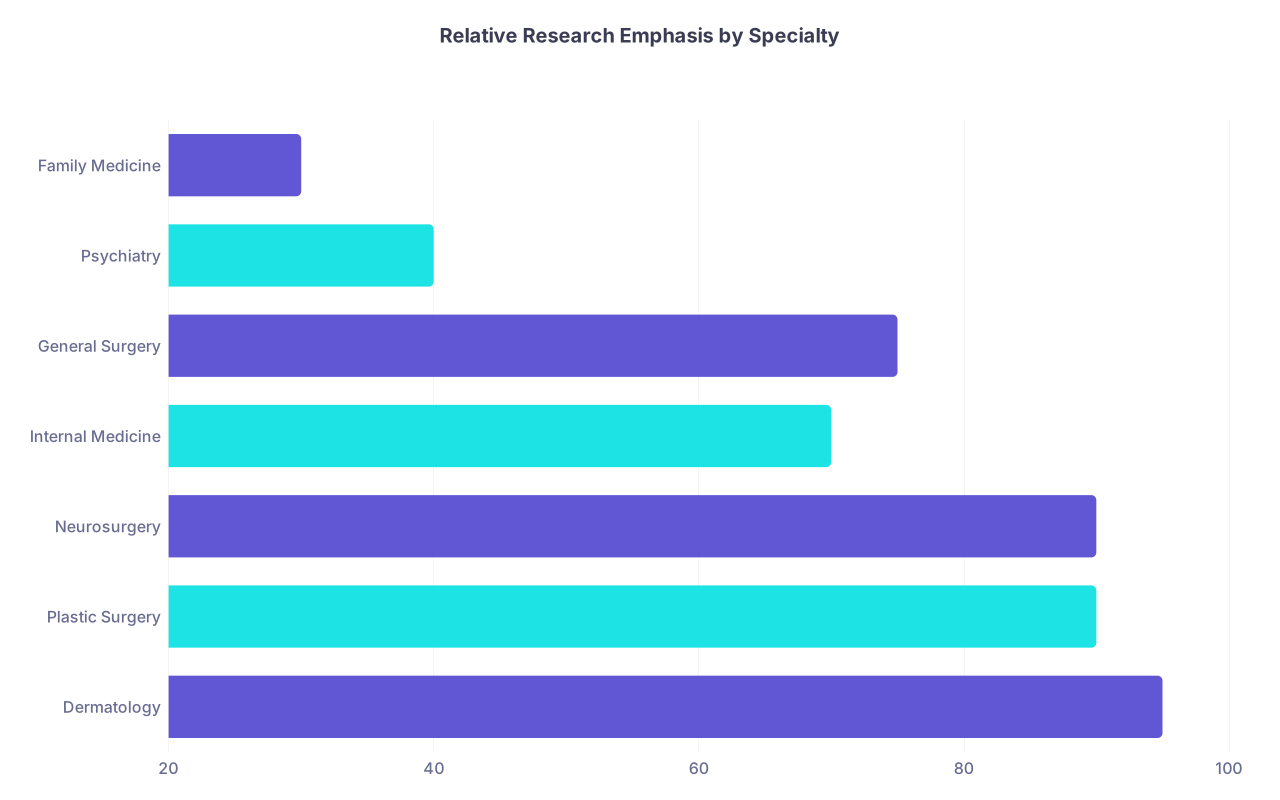
| Category | Value |
|---|---|
| Dermatology | 95 |
| Plastic Surgery | 90 |
| Neurosurgery | 90 |
| Internal Medicine | 70 |
| General Surgery | 75 |
| Psychiatry | 40 |
| Family Medicine | 30 |
Step 2: Decide What KIND of Applicant You Are
Next question: What tier of programs are you targeting?
Think about three levels:
Research-heavy academic powerhouses
Think big university names, major cancer centers, places with a ton of NIH funding.Balanced academic/community programs
University-affiliated, but not top-10 NIH list. Regional academic centers. Some research, some service, some education.Primarily community-focused programs
Less emphasis on publications, more on service, clinical productivity, and fit.
Here’s the blunt truth:
- If you want top-tier academic programs in a high- or medium-research specialty and you have no research, you’re swimming against a riptide.
- If you want solid balanced programs, research can turn a “maybe” into an interview.
- If you want community-heavy programs, research may be borderline irrelevant unless you’re trying to compensate for something (Step scores, school reputation, etc.).
You should now know:
- Your specialty bucket (high / medium / lower research expectation)
- Your program tier (research-heavy academic / balanced / community-heavy)
That combo tells you how much this matters for you, not for some hypothetical applicant.
Step 3: Understand What “Counts” as Research (You’re Probably Overthinking This)
People get stuck thinking research = first-author NEJM paper. That’s fantasy for most students.
Programs are usually happy with:
- Case reports and case series
- Retrospective chart reviews
- Clinical outcomes projects
- QI projects with decent methodology
- Review articles or book chapters
- Poster / oral presentations at regional or national conferences
And yes, actually listed on your ERAS with some evidence you contributed meaningfully.
You do not need 10+ PubMed-indexed original articles to be “competitive” outside of the hyper-elite derm/ plastics / neurosurg crowd. For most specialties and programs, something like:
- 1–3 modest projects with your name on them
- A poster or two at a regional/national meeting
- A sense that you know how research works and can talk about it without sounding lost
…goes a long way.
Step 4: Use a Quick Framework: “Required, Helpful, or Optional?”
Here’s the framework I actually use when advising students:
Ask three questions:
In my specialty, for the programs I’m aiming at, is research:
- Functionally required?
- Very helpful / often expected?
- Mostly optional?
Given my current stats (scores, class rank, school, letters), am I:
- Overachieving and aiming high?
- In the middle of the pack?
- Needing to compensate for a weakness?
Are my career goals:
- Academic / subspecialty / fellowship-heavy?
- Unsure / flexible?
- Mostly clinical / community?
Then classify yourself into one of these:
A. Research is FUNCTIONALLY REQUIRED for You
This is you if:
- You’re applying to: derm, plastics, neurosurg, ENT, ortho, rad onc
AND/OR - You want big-name academic programs in internal medicine, surgery, radiology, etc.
AND - You either want academic medicine or competitive fellowships (cards, GI, heme/onc, etc.)
If that’s you, research isn’t optional. It’s core.
What you should aim for:
- At least a few completed projects, preferably in the specialty or adjacent
- Ideally presentations (posters/orals) and at least some submitted or accepted manuscripts
- A letter writer who can say, “This person actually did real work on our project, not just their name on a poster.”
If you’re late in the game (MS3/MS4) with nothing yet, you need to prioritize fast-cycle projects: case reports, small chart reviews, QI.
B. Research is VERY HELPFUL / OFTEN EXPECTED
This bucket is bigger than most students realize. It’s you if:
- You’re applying to: internal medicine, general surgery, neuro, radiology, anesthesia, EM, OB/GYN
- You’re hoping for: academic or academic-leaning programs, or you’re at a lesser-known school and want to stand out
- You want at least the option of fellowship later
Here, research can function as:
- A tiebreaker between you and the next candidate
- A signal that you’re not just checking boxes—you actually engage with the field
- An excuse for a strong letter and an easy talking point in interviews
What’s “enough” here:
- 1–3 projects where you can clearly explain your role
- Some link (even loose) to your specialty of interest
- A coherent research story: “I got interested in X, worked on Y, learned Z.”
No research at all doesn’t kill you here—but it makes you generic unless everything else (scores, letters, clerkships) is stellar.
C. Research is MOSTLY OPTIONAL
You’re in this group if:
- You’re applying to: family med, psych, peds, PM&R, many path and community-heavy programs
- You want: a solid, clinically focused career; maybe teaching, but not necessarily research-heavy academics
- Your main strengths are: clinical performance, interpersonal skills, leadership, community work
In this world:
- Research can be a nice bonus, especially if it explains your interest in a niche (e.g., child psych, sports med, addiction).
- Lack of research won’t make most PDs blink if your clinical evals and letters are excellent.
- Time spent scraping together weak research just to have something may be worse than doubling down on clinical excellence, teaching, or leadership.
If you have zero research and you’re in this bucket, you’re not “behind” by default. Only chase research if you either want an academic niche or need to patch another part of your app.
Step 5: Weigh Research Against Everything Else You Could Be Doing
This part gets ignored: your time is finite. Research isn’t free.
Every hour you spend fighting IRB submissions or waiting on data is an hour you’re not:
- Honing your clinical skills on the wards
- Building real relationships with attendings who’ll write killer letters
- Studying for Step 2
- Leading something meaningful (clinic, interest group, curriculum project)
Here’s what program directors actually care about, in rough order, across most fields:
, Step/COMLEX Scores, Letters of Recommendation, Research & Scholarly Work, [Personal Statement & Fit](https://residencyadvisor.com/resources/strong-residency-application/what-program-directors-really-prioritize-in-a-strong-application)](https://cdn.residencyadvisor.com/images/articles_svg/chart-average-program-director-priority-weighting-4652.svg "Average Program Director Priority Weighting")
| Category | Value |
|---|---|
| Clinical Performance & [MSPE](https://residencyadvisor.com/resources/strong-residency-application/why-your-deans-letter-matters-more-or-less-than-you-think) | 35 |
| Step/COMLEX Scores | 25 |
| Letters of Recommendation | 20 |
| Research & Scholarly Work | 12 |
| [Personal Statement & Fit](https://residencyadvisor.com/resources/strong-residency-application/what-program-directors-really-prioritize-in-a-strong-application) | 8 |
And that 12% for research? It’s not evenly distributed. For derm and neurosurg, it balloons. For family med, it drops to ~2–3%.
The rational question isn’t “Do I need research?”
It’s: “Given my goals and timeline, is more research the highest-yield use of my limited time compared to other parts of my app?”
If you’re sitting on mediocre Step 2 prep to squeeze in another weak poster, that’s a bad trade in nearly every specialty.
Step 6: How Much Is “Enough” For Different Paths?
To make this less abstract, here’s a rough, realistic target by path:
| Goal | Research Goal (Realistic) |
|---|---|
| Derm/plastics/neurosurg at academic center | 5–10+ outputs (posters, abstracts, papers), specialty-focused |
| Ortho/ENT/rad onc at solid academic | 3–6 outputs, at least some in-field |
| IM or Gen Surg at strong academic | 2–4 outputs, at least one in-field, plus presentations |
| Mid-range academic/balanced programs | 1–3 outputs, any field but coherent story |
| Community-focused FM/Psych/Peds/PM&R | 0–1 helpful but not mandatory |
These are targets, not hard cutoffs. I’ve seen people match derm with less and people not match with more. But this is the ballpark where PDs stop asking, “Do they have any research at all?” and start looking at the quality and fit.
Step 7: If You Decide You DO Need Research, Do It Smart
If your framework says: “Yeah, for my goals, I really should have some research,” then don’t just blindly sign up for anything.
Quick rules:
Choose fast-cycle projects if you’re close to applying
Case reports, retrospective reviews with existing data, QI that doesn’t need lengthy IRB.Work with people who actually finish projects
Ask older students: “Who here gets posters/papers out the door and doesn’t ghost their mentees?”Aim for specialty relevance if possible
Or at least adjacency. Cards research is fine if you’re going into IM; trauma QI works fine for gen surg.Get something presented
A poster at a regional or national meeting is noticeable. It shows follow-through and gives you a line on the CV that’s visible.Protect your Step 2 and clerkship grades
If research starts wrecking those, you’re doing it wrong.
Step 8: If You Decide Research Is NOT Core for You
Then commit to that decision and build the rest of your application like you mean it.
You’ll want to lean hard into:
- Clinical excellence (honors where possible, strong eval narratives)
- Letters from people who’d stake their reputation on you
- A clear, focused personal statement that explains your path and goals
- Longitudinal involvement: continuity clinic, community work, teaching roles
And if you’re worried about looking “light” without research, you can still show you’re engaged intellectually through:
- QI projects that improve something on your service
- Curriculum development (small-group teaching, resident education projects)
- Clinical leadership roles (chief of a student-run clinic, coordinator for a program)
All of that tells a PD: “This person moves things forward,” even without formal research.
Step 9: The Red Flags Around Research You Should Avoid
A few patterns PDs and faculty roll their eyes at:
- Laundry-list CVs with 15 “projects,” none completed or presented
- Obvious “CV-padding” fake involvement: your name buried on a poster you can’t explain
- Over-selling minor contributions as if you ran the entire study
- Letting research tank your clinical performance or Step 2
One strong, honest project that you can explain clearly and thoughtfully beats six fluffy, meaningless “co-authorships” you barely remember.
What You Should Do Today
Here’s your concrete next step:
Write down on a single sheet (or note on your phone):
- Your specialty (or top two if undecided)
- Your target program type (research-heavy academic / balanced / community)
- Your current research output: “0”, “a little”, or “a lot and in-field”
- Your career leaning: “academic-ish / maybe fellowship” vs “mostly clinical”
Then, based on that, decide which bucket you’re in:
- Research functionally required
- Very helpful / often expected
- Mostly optional
Once you’ve labeled yourself, commit to one clear decision:
“Over the next 3–6 months, I will prioritize [research / Step 2 / clinical honors / letters / leadership] as my #1 application improvement task.”
Do that now. Don’t just accumulate projects randomly. Pick the lever that actually moves your application and pull it hard.