
Introduction: Turning Step 2 CK into an Opportunity
USMLE Step 2 Clinical Knowledge (CK)—often referred to by some schools as Level 2 CE (Clinical Exam)—is a pivotal point in your medical education. Unlike Step 1, which is heavily focused on basic science, Step 2 CK shifts the emphasis to clinical skills, real-world patient care, and practical decision-making.
Your performance on Step 2 CK carries significant weight:
- It strongly influences residency applications, especially now that Step 1 is pass/fail.
- It reflects how ready you are to function as an intern on day one.
- It can boost your confidence in clinical reasoning and patient management.
This guide expands on foundational strategies and adds deeper, more practical advice so you can not just pass Step 2 CK, but truly maximize your performance.
Understanding Step 2 CK / Level 2 CE: What You’re Really Being Tested On
To prepare effectively, you need to understand what Step 2 CK actually measures and how.
Exam Focus and Content Domains
Step 2 CK assesses your ability to:
- Apply medical knowledge in clinical contexts
- Formulate differential diagnoses
- Decide on next-best steps in management
- Recognize emergencies and life-threatening conditions
- Understand health maintenance, ethics, and healthcare systems
Core areas include:
- Internal medicine (largest portion)
- Surgery
- Pediatrics
- Obstetrics and gynecology
- Psychiatry
- Emergency medicine
- Preventive medicine and public health
- Professionalism, communication, and systems-based practice
The exam primarily uses multiple-choice questions (MCQs) in clinical vignette format. Many questions are multi-step, requiring you to interpret labs, imaging, or clinical findings, then select the most appropriate diagnostic or management decision.
Why Step 2 CK / Level 2 CE Matters for Your Career
1. Residency Competitiveness
- With Step 1 now pass/fail, many programs lean more heavily on Step 2 CK as a numeric measure of academic performance.
- A strong score can:
- Compensate partially for a weaker Step 1 performance.
- Strengthen your application in competitive specialties.
- Signal that you are ready to handle clinical responsibilities.
2. Indicator of Clinical Proficiency
- Step 2 CK is designed to mirror the day-to-day decisions you’ll make during residency.
- Doing well suggests:
- Solid clinical reasoning
- Understanding of guidelines and standard of care
- Ability to prioritize among multiple valid options
3. Confidence and Professional Identity
- Scoring well is often a turning point where many students feel they truly “think like a doctor.”
- Thorough preparation for Step 2 CK simultaneously enhances:
- Your performance on clinical rotations
- Your comfort during sub-internships and acting internships
- Your readiness for intern year
Building a High-Yield Step 2 CK Study Strategy
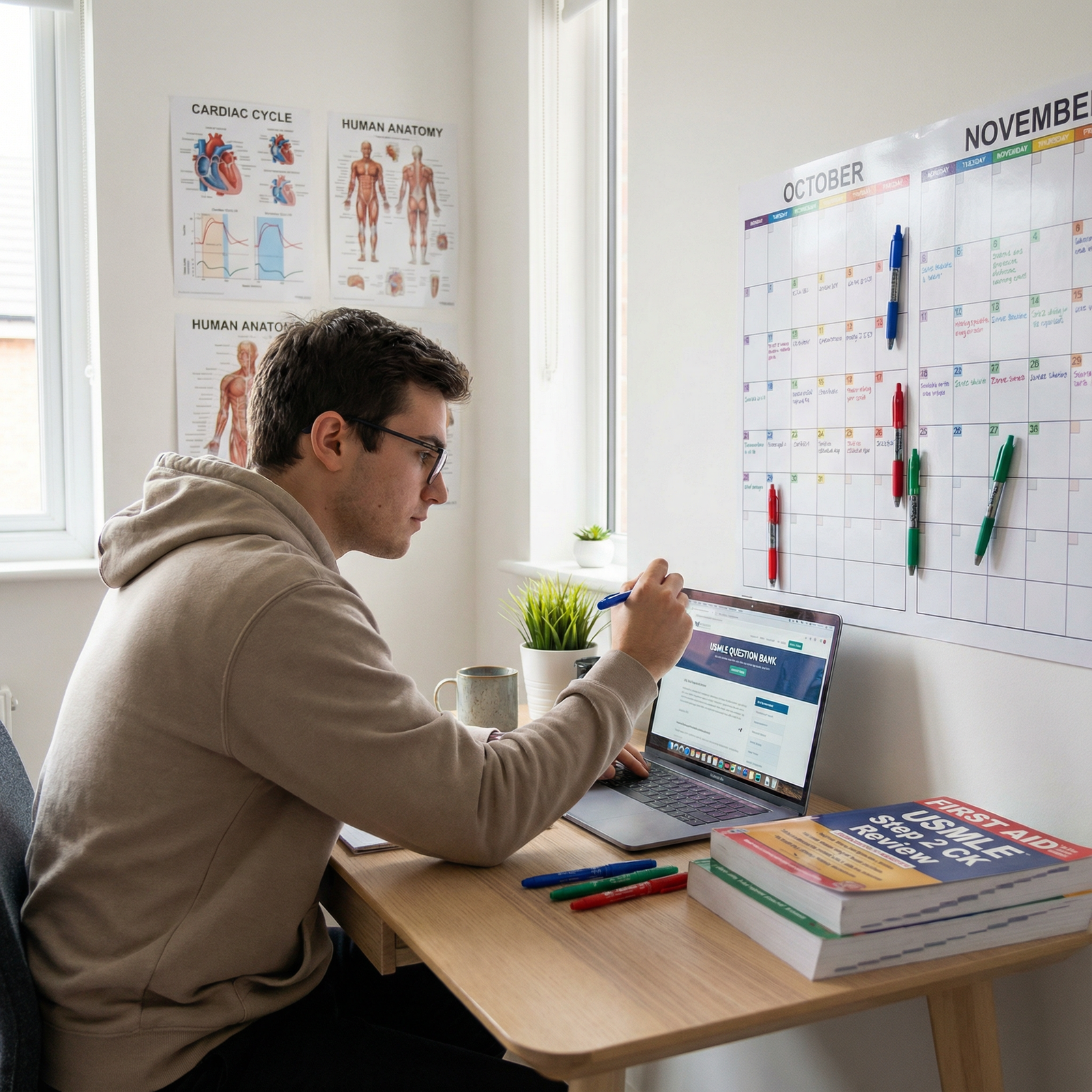
1. Create a Realistic, Structured Study Plan
A comprehensive study plan is the backbone of effective Step 2 CK test preparation.
Assess Your Baseline
Before designing your schedule:
- Review your clerkship grades and shelf exam performance.
- Identify which subjects were weaker (e.g., OB/GYN, pediatrics, psychiatry).
- Consider taking a baseline self-assessment (e.g., NBME practice exam) if you’re close to starting dedicated study.
This helps you allocate your time strategically, not equally.
Set Specific, Measurable Goals
Instead of “study more internal medicine,” define:
- “Complete 40 internal medicine UWorld questions/day with thorough review.”
- “Watch Online MedEd cardiology videos and annotate into my notes by the end of the week.”
- “Finish one NBME self-assessment every 1–2 weeks and review all explanations.”
Use SMART goals: Specific, Measurable, Achievable, Relevant, Time-bound.
Build a Weekly Structure
A commonly effective pattern during dedicated study (4–8 weeks):
- Questions: 40–80 UWorld questions per day (depending on your pace and schedule)
- Review: At least equal time (or more) reviewing explanations
- Content Review: 1–3 hours/day of targeted reading or videos for weak areas
- Spaced Repetition: 30–60 minutes/day of flashcards (Anki or similar)
Sample day:
- Morning: 2 timed UWorld blocks (40 questions)
- Midday: Detailed review of both blocks
- Afternoon: Targeted content review (e.g., OB emergencies + practice)
- Evening: Light review and flashcards
2. Use High-Yield, Quality Study Resources
Not all resources are equal, and trying to use too many is a common mistake. Focus on a core set and use them deeply.
UWorld (Core Question Bank)
- Considered the gold standard for Step 2 CK question practice.
- Use it in timed, random mode once you’re comfortable with the basics, to simulate the real exam.
- Treat UWorld as a learning tool, not just an assessment:
- Read explanations thoroughly (including wrong answer choices).
- Take notes or annotate into a master document or reference (e.g., AMBOSS, First Aid).
- Flag particularly challenging questions to revisit.
AMBOSS
- Strong comprehensive clinical library and high-yield question bank.
- Useful for:
- Clarifying topics that are confusing in UWorld explanations
- Rapid look-up of guidelines, scores (e.g., Wells, CHA₂DS₂-VASc), and algorithms
- Concept integration via its “learning cards” and interactive features
Many students use UWorld as primary QB and AMBOSS as a secondary QB or reference.
Review Books and Notes
- First Aid for the USMLE Step 2 CK or Step-Up to Medicine:
- Good for structured overviews and quick reviews.
- Especially useful during the final 2–3 weeks to consolidate high-yield material.
- NBME Practice Exams:
- Essential for assessing readiness and predicting score range.
- Use them every 1–2 weeks in the latter half of your prep.
- Review not just content, but patterns of error (carelessness vs. knowledge gaps).
Video Resources
- Online MedEd:
- Great for conceptual understanding, particularly early in third year or early in your dedicated period.
- Videos + notes help build a framework that makes question interpretation easier.
- Supplement specific weak areas with other curated videos (e.g., EKG interpretation, OB fetal monitoring strips) as needed.
Mastering Question-Based Learning and Clinical Reasoning
The heart of Step 2 CK is being able to interpret a clinical vignette and make the right next step.
3. Practice Questions with Deliberate Technique
Make Daily Question Practice Non-Negotiable
- Aim for consistent daily exposure rather than sporadic large blocks.
- Treat each question as a micro-learning opportunity, not just a score.
Use Timed and Random Blocks
- Timed blocks train your pacing and endurance.
- Random subject blocks simulate the structure of the real USMLE and force integration across specialties.
- As exam day nears, most or all of your practice should be timed and random.
Learn Actively from Every Question
When reviewing questions:
Ask why each wrong answer is wrong.
Summarize in your own words:
- The diagnosis or key concept
- The most important clues in the stem
- The rationale for the correct answer
- The classic traps the question used
Consider creating:
- Short Anki cards for truly high-yield or frequently missed concepts.
- A “top mistakes” document where you track patterns (e.g., “keep confusing preeclampsia vs. gestational hypertension”).
4. Strengthen Active Learning and Memory Retention
Passive reading is low yield for Step 2 CK. Active learning techniques enhance both understanding and recall.
Teach-Back Method
- After studying sepsis, for example, explain to a peer (or out loud to yourself):
- How it presents
- Initial stabilization steps
- Key lab and imaging orders
- ICU vs. ward criteria
- If you stumble while explaining, you’ve identified a gap to fill.
Concept Maps and Algorithms
- Build quick visual schemes for:
- Chest pain evaluation
- Acute abdominal pain workup
- Anemia algorithms
- Hyponatremia correction strategies
- These maps help you navigate complex questions more quickly and confidently.
Group Study and Case Discussion
- Use small groups selectively:
- Discuss NBME questions you all found challenging.
- Run through rapid-fire “what’s the next best step” scenarios.
- Keep groups focused and time-limited; avoid drifting into inefficient marathon sessions.
Clinical Experience as a Study Tool
Step 2 CK is where your clinical rotations and exam preparation should synergize.
5. Leverage Clinical Rotations Strategically
If you’re preparing during third year or early fourth year:
- Before or after seeing a patient, ask:
- “How would this case appear as a Step 2 CK question?”
- “What would they want to test—diagnosis, management, complications?”
- After your shift:
- Look up 1–3 topics from actual patients and read about them in AMBOSS or a trusted resource.
- Try to identify the “textbook pattern” in real-life presentations:
- The classic STEMI patient
- The postpartum endometritis case
- The febrile neutropenic patient on the oncology floor
6. Hone Clinical Skills That Translate to Test Performance
Even though Step 2 CK is a written exam, clinical skills and reasoning directly impact your performance.
- Practice synthesizing:
- Prioritization: Who in a four-patient list is most unstable and needs your attention first?
- Risk stratification: Who needs admission vs. outpatient follow-up?
- Guideline-based care: Know standard protocols (e.g., unstable vs. stable angina, stroke time windows).
This mindset makes it easier to handle “what’s the best next step” questions that mirror real internal medicine or emergency medicine workflows.
Mental and Physical Preparation: Optimizing Performance
High scores require not just knowledge, but sustainable performance under pressure.
7. Protect Your Sleep, Nutrition, and Exercise
Sleep as a Core Study Strategy
- Aim for 7–9 hours of sleep consistently.
- Poor sleep impairs:
- Memory consolidation
- Attention and processing speed
- Decision-making under uncertainty
- In the last week before your exam, prioritize regular sleep-wake times over extra late-night study.
Eat to Support Cognitive Function
- Favor balanced meals with:
- Complex carbohydrates
- Lean proteins
- Healthy fats (e.g., nuts, fish, avocado)
- Avoid large heavy meals immediately before long study sessions or the exam; they can worsen fatigue and sluggishness.
- Stay well-hydrated throughout prep and on exam day (but don’t overdo fluids immediately before a testing block).
Keep Moving
- Even short, daily activity (20–30 minutes of walking, light jogging, or yoga) helps:
- Reduce stress
- Improve mood and focus
- Combat burnout during intensive study periods
8. Build Exam Stamina and Familiarity
Step 2 CK is a long exam, commonly 9 hours total with multiple blocks.
Simulate Exam Conditions
At least 2–3 times during your dedicated period:
- Take full-length practice days:
- Same number of question blocks as the real exam.
- Same or similar break structure.
- Start at the same time as your scheduled test.
- Use NBME or other self-assessments for some of these simulations.
This helps you:
- Practice mental endurance.
- Fine-tune your break strategy.
- Identify when your focus tends to dip—and plan around it.
Learn the Logistics in Advance
- Confirm:
- Exact exam date, time, and test center location.
- Required identification and allowed items.
- Rules about food, drinks, and breaks.
- Visit or virtually explore the test center if possible, so you know:
- Parking or transit options
- Check-in procedures
- Locker availability
Reducing logistical uncertainty frees up mental bandwidth for the exam itself.
Final Week and Test Day Strategy

9. Smart Strategy for the Final 7–10 Days
Shift from Learning New to Consolidating Known
- Focus on:
- High-yield topics (e.g., acute coronary syndromes, sepsis, pregnancy complications, pediatric emergencies, psych crises).
- Your personal weak areas identified via self-assessments and question review.
- Continue doing questions, but:
- Possibly reduce the volume slightly.
- Maintain quality, thorough review of explanations.
Review Mistake Patterns and High-Yield Summaries
- Revisit:
- UWorld-marked questions.
- Your “top mistakes” document.
- Algorithms and summary sheets (e.g., antibiotics by system, immunization schedules, screening guidelines).
- Use this time to tighten up decision-making frameworks rather than memorize obscure facts.
10. The Day Before and the Day Of the Exam
The Day Before
- Focus on:
- Light review only (e.g., flashcards, algorithms, or topics that calm your anxiety).
- Avoid new complicated topics or long question blocks.
- Prepare:
- Clothes for test day.
- ID, snacks, water bottle (if permitted), earplugs (if allowed).
- Directions and timing for getting to the center.
Plan something relaxing in the evening—walk, movie, time with supportive friends or family—and get to bed at a reasonable hour.
On Test Day
- Eat a familiar, balanced breakfast.
- Arrive early to avoid last-minute stress.
- During the exam:
- Use your breaks strategically (e.g., brief snack, bathroom, light stretching).
- If a question is extremely confusing, mark it, choose your best guess, and move on—you can come back if time allows.
- Keep perspective: one tough block does not define your entire score.
Conclusion: Using Step 2 CK to Become a Better Clinician
Maximizing your performance on Step 2 CK / Level 2 CE is not just about achieving a high score. It’s about:
- Developing strong clinical reasoning.
- Learning to manage time and stress effectively.
- Solidifying the knowledge and skills that will guide your everyday practice as a resident.
By:
- Building a structured, realistic study plan
- Focusing on high-yield test preparation resources like UWorld, AMBOSS, and focused review materials
- Practicing large volumes of questions thoughtfully
- Leveraging clinical experiences
- Protecting your mental and physical well-being
- Simulating the test environment and planning test day intentionally
…you set yourself up not only to excel on the USMLE Step 2 CK, but to step into residency as a confident, prepared, and clinically capable physician.
Frequently Asked Questions about Step 2 CK Preparation
Q1: How long should I dedicate to studying for Step 2 CK?
Most students benefit from 4–8 weeks of dedicated study, depending on:
- How strong their clinical foundation is from clerkships
- How recently they completed core rotations
- How many hours per day they can commit
If your clerkships and shelf exams were recent and strong, 4–6 weeks may suffice. If you had gaps, weaker shelf scores, or a long break from clinical work, consider 6–8+ weeks.
Q2: Which resources should be my primary focus for Step 2 CK?
For most students, an effective core combination is:
- Primary QB: UWorld Step 2 CK (high priority)
- Secondary QB/Reference: AMBOSS (as needed)
- Content Review: First Aid for Step 2 CK, Step-Up to Medicine, or similar
- Conceptual Framework: Online MedEd videos and notes
- Assessment: NBME self-assessments and/or UWorld self-assessments
It’s generally more effective to master a few key resources thoroughly rather than skimming many.
Q3: Can I effectively prepare for Step 2 CK while on clinical rotations?
Yes, but it requires deliberate planning:
- Use downtime on rotations for:
- Short question blocks (10–20 questions).
- Reviewing topics related to patients you’ve seen that day.
- Start question banks early in third year so that by the time you reach dedicated study, you are building on a solid foundation, not starting from scratch.
- Protect dedicated study time in the evenings or on days off, even during busy rotations, to keep momentum.
Q4: What if my practice scores are not where I want them to be?
If your NBME or UWorld self-assessment scores are below your target:
- Analyze your results by content area and error type (knowledge vs. test-taking vs. rushing).
- Prioritize:
- Weak subjects (e.g., OB/GYN, psych).
- Recurring question styles you miss (ethics, next-best-step).
- Tighten your habits:
- Do questions in timed mode to mimic the real exam.
- Review every explanation thoroughly.
- Consider:
- Extending your study period if possible.
- Seeking mentorship from an advisor, senior student, or faculty member familiar with USMLE and test preparation strategies.
Your trajectory over time is more important than any single practice score.
Q5: How important are self-assessments and full-length practice exams?
They are crucial for multiple reasons:
- Gauge your readiness and approximate score range.
- Help you build stamina for full exam day.
- Reveal knowledge and strategy gaps.
- Allow you to practice time allocation across multiple blocks.
Plan at least 2–3 self-assessments in the weeks leading up to your exam, and always thoroughly review the explanations.