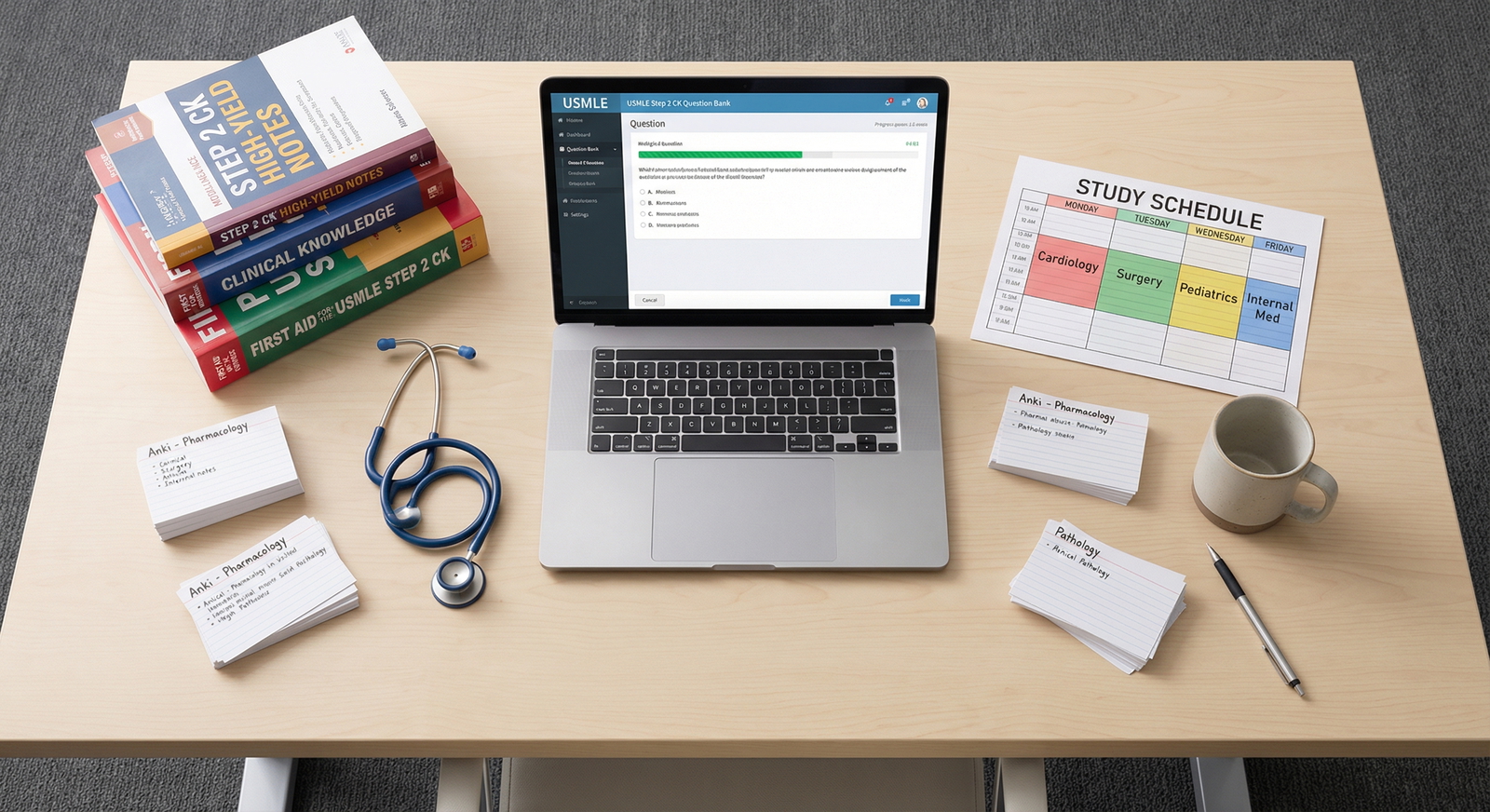
Introduction: Why Step 2 CK Matters More Than Ever
The United States Medical Licensing Examination (USMLE) Step 2 Clinical Knowledge (CK) is a pivotal milestone on the path to residency. With Step 1 now pass/fail, residency programs increasingly turn to the USMLE Step 2 CK score as a key objective metric when screening applicants. For many students, this makes Step 2 CK not only a test of Clinical Knowledge, but a major determinant of specialty and program competitiveness.
Step 2 CK assesses your ability to apply medical knowledge and clinical science principles to patient care. It builds on what you learned during your core clinical rotations and challenges you to think and act like an intern: prioritizing problems, identifying the most likely diagnosis, ordering the right tests, and choosing the best next step in management.
Mastering this exam requires more than just memorizing facts. It demands:
- A structured Medical Exam Preparation plan
- High-yield, case-based Study Strategies
- Consistent practice with question banks
- Deliberate Test Anxiety Management techniques
- Realistic self-assessment and course correction
This roadmap will walk you through understanding the exam, building an efficient study plan, selecting resources, handling common challenges, and approaching test day with confidence.
Understanding USMLE Step 2 CK: Structure, Content, and Stakes
What Is Step 2 CK Really Testing?
USMLE Step 2 CK centers on the application of Clinical Knowledge to realistic patient scenarios. Rather than asking “What is this disease?” it often asks:
- “What is the most likely diagnosis?”
- “What is the best next step in management?”
- “Which test should be ordered first?”
- “What is the most appropriate counseling or preventive strategy?”
Core domains include:
- Internal Medicine (largest portion)
- Surgery (including perioperative management and trauma)
- Pediatrics
- Obstetrics & Gynecology
- Psychiatry and Behavioral Health
- Neurology
- Emergency Medicine and Critical Care
- Preventive Medicine & Public Health / Biostatistics & Ethics
Expect heavy emphasis on:
- Clinical decision-making
- Risk stratification (sick vs. not sick, admit vs. discharge)
- Recognizing emergencies and red flags
- Following evidence-based guidelines
Exam Format and Logistics
Understanding the structure is crucial for both academic and psychological preparation:
- Total Questions: Up to 318 multiple-choice questions
- Blocks: 8 blocks
- Time per Block: 60 minutes
- Total Test Time: 9 hours (including a minimum 45-minute break, which you can manage throughout the day)
- Question Style:
- Primarily single-best-answer MCQs
- Nearly all presented as clinical vignettes
- Increasing use of multimedia (e.g., images, EKGs, radiology, heart/lung sounds)
You’ll take the exam at a Prometric testing center using a computer interface similar to the tutorial and practice tests from the USMLE/NBME. Familiarity with the software in advance can significantly reduce cognitive load on test day.
Why Step 2 CK Is Increasingly Important
A strong Step 2 CK performance can:
- Strengthen your residency application
- Many programs use CK score cutoffs.
- Competitive specialties (dermatology, orthopedic surgery, ophthalmology, radiology, ENT, etc.) often expect higher scores.
- Offset a weaker Step 1 performance
- With Step 1 now pass/fail, Step 2 CK is often the main numeric measure of test-taking ability and Clinical Knowledge.
- Demonstrate readiness for residency
- Programs want residents who can hit the ground running: triage efficiently, manage common inpatient and outpatient conditions, and communicate effectively.
- Satisfy state licensure requirements
- Step 2 CK is required as part of the licensing sequence in the United States.
Building an Effective Step 2 CK Study Plan
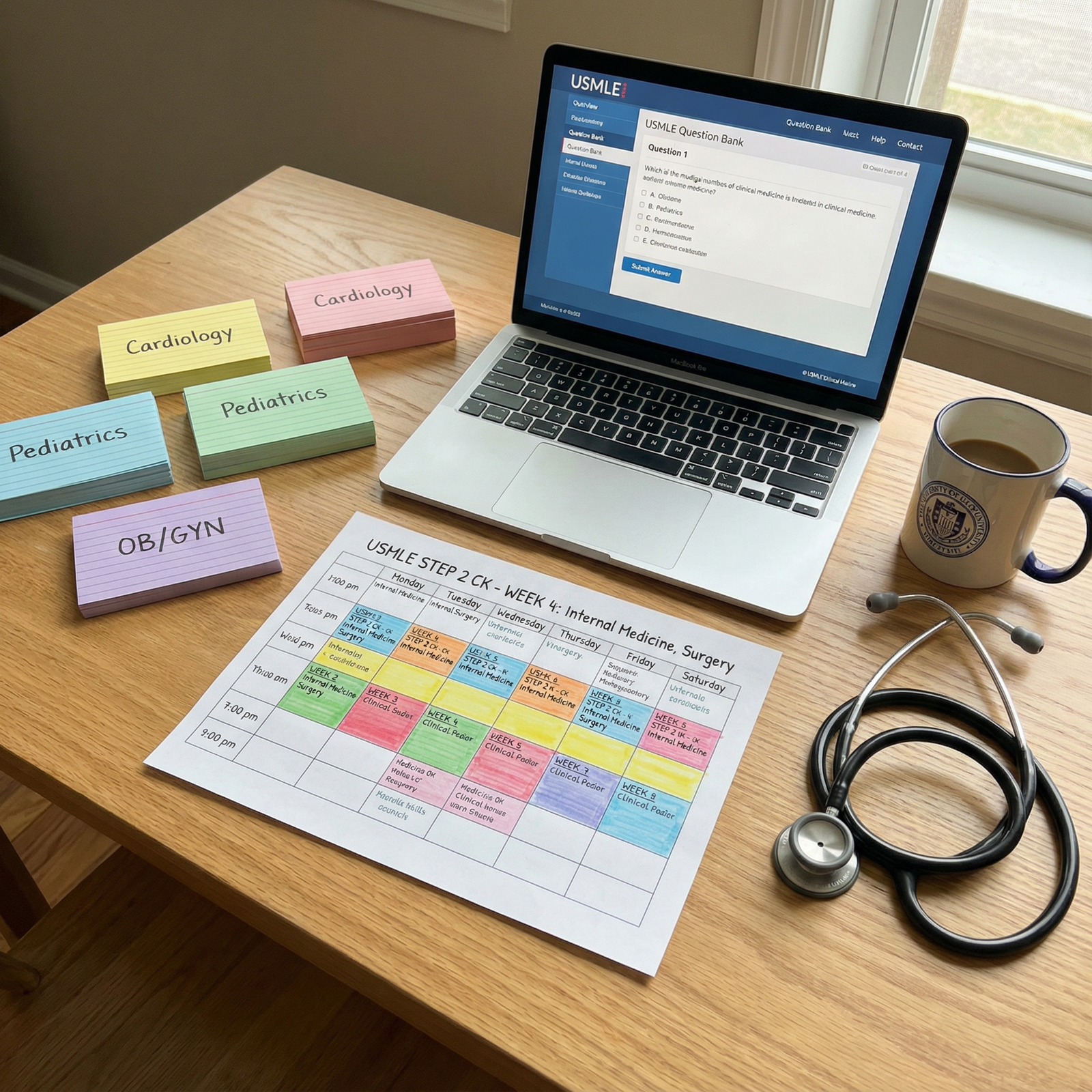
1. Establish a Realistic and Structured Study Timeline
Your Medical Exam Preparation for Step 2 CK should begin well before your dedicated study period.
When to Start
- Core Clinical Year (M3 for many US schools):
- Start light preparation by using Step 2–style question banks during rotations.
- Dedicated Period:
- Most students use 4–8 weeks of full-time study.
- Some extend to 3–6 months of part-time preparation alongside rotations.
Adjust based on:
- How strong your shelf exam performance has been
- Your Step 1 foundation
- Competing obligations (research, sub-internships, personal responsibilities)
Creating a Weekly Study Framework
A balanced weekly plan typically includes:
- Daily Question Blocks:
- 40–80 questions/day (depending on where you are in your timeline and stamina)
- Dedicated Content Review:
- 2–4 hours focusing on weak systems or high-yield topics
- Scheduled Self-Assessments:
- NBME or UWSA exams every 1–2 weeks during dedicated
- Review Days:
- Periodic lighter days focusing on consolidating notes, Anki, or missed questions
Example (during dedicated):
- Morning:
- 2 timed blocks of 40 questions each (80 total)
- Afternoon:
- Thorough review of all questions (2–3 hours)
- Focused reading or videos for weak areas
- Evening:
- 30–60 minutes of flashcards (e.g., Anki)
- Light review of key algorithms (ACLS, sepsis, prenatal care, etc.)
2. Choosing High-Yield Step 2 CK Resources
You cannot use everything. Pick a core set and use it deeply rather than superficially.
Question Banks (Your Primary Study Tool)
UWorld Step 2 CK
- Considered the gold standard
- Aim to complete at least one full pass (often 2, if you start early)
- Do questions timed and random once you are comfortable: this best mimics the real exam
- Take detailed notes on explanations, focusing on why other options are wrong
AMBOSS
- Excellent for integrated learning and rapid reference
- Especially useful earlier in clinical year or as a second bank
- Offers “learning cards” linked to questions and high-yield tables
Strategy tip: If you’re short on time, prioritize depth of review for one bank (usually UWorld) over partial completion of multiple banks.
Review Books and Written Resources
- First Aid for the USMLE Step 2 CK
- Concise, high-yield reference
- Useful for quick refreshers and building checklists
- Step-Up to USMLE Step 2 CK
- More detailed; good for filling in content gaps
- Online written libraries (e.g., AMBOSS library)
- Great for targeted review when a question uncovers a weak topic
Video Lectures and Visual Learning Tools
- OnlineMedEd
- System-based, concept-driven lectures
- Helpful foundation during rotations and early prep
- SketchyMedical
- Particularly strong for micro, pharm, and some path; useful for long-term retention
- YouTube channels / institutional lectures
- Can clarify tough topics like acid-base, rheumatology, or OB triage
Be intentional: use videos to clarify and anchor concepts, not as passive background noise.
3. Integrating Practice Questions and Self-Assessment
Practice questions should drive your entire Study Strategy.
Daily Question Practice
- Start with tutor mode and system-based blocks if you’re early in prep.
- Transition to timed, random blocks as you approach your exam—this builds endurance, pacing, and test-taking instincts.
Key habits during review:
- For every question:
- Identify the clinical pattern or “buzz” features.
- Ask, “What was the key step in reasoning from presentation to answer?”
- Write down the one-sentence teaching point if you missed it.
- Review both correct and incorrect answers: you can learn just as much from lucky guesses.
Formal Self-Assessments
Use official and well-validated practice exams to gauge readiness:
- NBME Self-Assessments for Step 2 CK
- Closest in style and scoring to the real exam
- Take at least 2–3 during your dedicated period
- UWorld Self-Assessment (UWSA) 1 & 2
- Good practice and often predictive, especially closer to test day
Use results to:
- Identify weak systems (e.g., OB, peds, psych)
- Spot patterns (e.g., always missing ethics/biostats, or mismanaging sepsis)
- Adjust your schedule: allocate extra time where you’re consistently underperforming
High-Yield Study Strategies for Clinical Knowledge Mastery
1. Think Like a Clinician, Not a Memorizer
Step 2 CK rewards clinical reasoning. To hone this:
- For each case, walk through:
- What is the primary problem? (respiratory failure, sepsis, acute psychosis, etc.)
- What is the most likely diagnosis or most dangerous alternative?
- What is the immediate priority? (stabilize airway, hemodynamics, stop bleeding, rule out MI, etc.)
- Practice summarizing vignettes in one key sentence:
- “Elderly patient with fever, hypotension, and UTI → septic shock → fluids and vasopressors.”
2. Use Case-Based Learning and Clinical Scenarios
Since Step 2 CK is vignette-heavy, align your preparation:
- During rotations, turn real patients into practice cases:
- Ask yourself: “If this were a test question, what would they ask?”
- “Best next test? Best treatment? Most likely complication?”
- Practice with question banks in block format, mimicking how clinical reasoning flows from one patient to the next.
3. Consolidate High-Yield Algorithms and Guidelines
Many questions test protocols rather than obscure facts:
- Emergency & ICU algorithms:
- ACLS (chest pain, arrhythmias, cardiac arrest)
- Sepsis management (fluids, cultures, broad-spectrum antibiotics, pressors)
- OB algorithms:
- Prenatal screening timeline
- Management of preeclampsia, preterm labor, postpartum hemorrhage
- Preventive care & screening:
- Age-specific screening (mammography, colonoscopy, DEXA, Pap, STI screening)
- Vaccination schedules
Create or use existing summary tables and review them repeatedly in the final weeks.
4. Smart Use of Anki and Spaced Repetition
If you already use Anki:
- Focus decks on high-yield, frequently missed concepts
- Keep cards clinical and conceptual, not trivia-heavy
- Aim for daily, brief, consistent sessions (20–40 minutes) rather than marathon reviews
If you don’t already use Anki heavily, avoid starting massive new decks late in your dedicated period. Instead, make small, personal decks with distilled teaching points from missed questions.
Managing Common Challenges: Time, Rotations, and Test Anxiety

1. Test Anxiety Management and Mental Health
Test anxiety can significantly impair performance even when knowledge is strong. Proactive Test Anxiety Management is as important as any content review.
Practical Strategies
- Simulate test day
- Take full-length practice exams under real conditions: timed, minimal breaks, no phone.
- Helps desensitize you to the length and intensity of the exam.
- Mindfulness and breathing exercises
- 4–7–8 breathing, box breathing, or simple diaphragmatic breathing between blocks.
- Use short guided meditations (5–10 minutes) during prep and the night before.
- Reframe anxiety
- Recognize that some arousal is normal and can actually sharpen focus if channeled correctly.
- Replace catastrophic thoughts (“If I fail, I’ll never match.”) with balanced ones (“I’ve done the work. One test does not define my entire career.”)
If anxiety feels unmanageable, consider:
- Talking to your school’s wellness services or counseling
- Discussing accommodations (e.g., extended time) if you have a documented condition
- Creating a clear test-day routine to reduce uncertainty
2. Time Management During Study Periods
Balancing Clinical Knowledge mastering with fatigue and real-life responsibilities is challenging.
Prioritize High-Yield and Weak Areas
- Use self-assessment data to identify:
- High-yield but weak: must-fix areas (e.g., OB if you consistently miss OB questions)
- Low-yield but weak: do not overinvest here early; address later if time permits.
- Adopt focused techniques:
- Pomodoro: 25–50 minutes focused work, 5–10 minute breaks
- Task batching: Group similar tasks (question review, reading, flashcards) instead of constantly switching
3. Filling Content Gaps Efficiently
No one knows everything. The key is to recognize and systematically patch holes.
- After each NBME or UWSA:
- Make a list of your top 3–5 weak systems or topic clusters.
- Devote 1–2 days per week specifically to these areas.
- Use targeted resources:
- AMBOSS learning cards
- Focused chapters in Step-Up or First Aid
- Short, high-yield videos (e.g., OnlineMedEd for specific topics like CHF, COPD, prenatal care)
Aim for breadth with enough depth to safely manage common conditions, not encyclopedic perfection.
4. Balancing Clinical Rotations and Step 2 CK Preparation
Many students take Step 2 CK while still on rotations, which introduces unique challenges.
Strategies for Studying During Rotations
- Use downtime wisely
- Do small question sets (5–10 questions) between patients or during call if appropriate.
- Review flashcards on your commute (if safe), lunch breaks, or brief gaps.
- Integrate learning from patients
- After seeing a patient with DKA, do 10 questions on DKA management that evening.
- Read a short, focused resource on any condition you encountered that felt shaky.
- Align shelf and Step 2 CK prep
- Use core clerkship shelf study to build a foundation for Step 2 CK.
- Question banks for shelves (often UWorld or AMBOSS) double as Step 2 CK prep.
When to Schedule Your Exam
Consider:
- Completing most core rotations (IM, surgery, peds, OB/GYN, psych, family) before testing
- Avoiding taking Step 2 CK during your heaviest or most time-consuming rotations (e.g., surgery, ICU) if possible
- Allowing at least 3–4 weeks of lighter obligations or dedicated study before your test date
Mindset, Persistence, and Test-Day Execution
1. Maintaining Motivation and Perspective
Step 2 CK prep can feel like a marathon at the end of an already exhausting journey.
To stay grounded:
- Revisit your “why”
- Why do you want to be a physician?
- How will solid Clinical Knowledge help you care for patients better?
- Track progress, not perfection
- Look at your trend over multiple self-assessments, not one bad day.
- Celebrate small wins: improved percentile in OB, better time management, fewer careless errors.
2. Test-Day Strategy and Logistics
The best Study Strategy still needs sound execution on exam day.
- Plan your breaks
- Many students use a break after every 2 blocks (or as needed).
- Use breaks to hydrate, eat light snacks, stretch, and reset mentally.
- Pace yourself
- Aim for ~1 minute/question, leaving a few minutes at the end of each block to review flagged items.
- Don’t get stuck: if a question is unclear, make your best educated guess, flag it, and move on.
- Use the tutorial wisely
- If you’ve already practiced with the software, you can skip or shorten the tutorial to add extra break time.
- Manage the inevitable tough questions
- Everyone sees questions they’ve never encountered. Focus on ruling out clearly wrong options and using core principles (e.g., stabilize airway/breathing first, avoid unnecessary tests).
Conclusion: A Strategic, Balanced Approach to Step 2 CK Success
Navigating the challenges of USMLE Step 2 CK requires more than raw intelligence. Success comes from:
- Understanding the exam’s clinical focus and logistics
- Designing a realistic, structured Medical Exam Preparation plan
- Prioritizing question-based learning and thoughtful self-assessment
- Addressing weak areas methodically and efficiently
- Practicing deliberate Test Anxiety Management and self-care
- Bringing your best clinical reasoning to test day
With disciplined Study Strategies, high-quality resources, and a resilient mindset, you can transform Step 2 CK from a looming threat into an opportunity—to showcase your Clinical Knowledge, strengthen your residency application, and step more confidently into your future role as a physician.

Frequently Asked Questions About USMLE Step 2 CK
1. What is the current passing score for Step 2 CK?
The passing score for Step 2 CK has historically been around 209, but the specific number can change over time as the USMLE periodically updates cutoffs. Always verify the current passing score directly on the official USMLE website before you finalize your preparation plan.
2. How long should I study for Step 2 CK?
Most students spend:
- 3–6 months of light to moderate preparation during rotations (primarily using question banks)
- 4–8 weeks of more intensive, dedicated study before the exam
Your ideal timeline depends on:
- Shelf exam performance
- Step 1 foundation
- Desired specialty competitiveness
- Other commitments (research, family obligations, work hours on rotation)
If your self-assessment scores are far below your target, consider extending your study period rather than rushing.
3. Can I take Step 2 CK before completing all my core rotations?
Yes, you can take Step 2 CK before completing every rotation, but it’s generally recommended that you finish the major core clerkships—Internal Medicine, Surgery, Pediatrics, OB/GYN, Psychiatry, and often Family Medicine—first. These rotations provide crucial clinical context and content that map directly onto the exam.
If you must take Step 2 CK earlier (e.g., for application deadlines), compensate by:
- Using question banks heavily in the uncompleted specialties
- Watching condensed video series (e.g., OnlineMedEd) to cover missing areas
4. What if I fail Step 2 CK or score lower than expected?
A lower-than-expected score is a setback, not the end of your career.
If you fail or underperform:
- Decompress briefly, then review score reports and performance profiles carefully.
- Identify systemic issues:
- Insufficient question practice?
- Weak foundation in a specific system (e.g., OB, psych)?
- Severe test anxiety or pacing problems?
- Create a revised, targeted plan focusing on those weaknesses.
- Use additional self-assessments to ensure readiness before retaking.
Many students successfully retake Step 2 CK and match into residency. Address the underlying causes honestly and seek support from advisors, mentors, or academic support services.
5. Are there official practice exams available for Step 2 CK?
Yes. The most important official resources include:
- USMLE/NBME Practice Exams (Self-Assessments):
- Paid online forms that simulate real Step 2 CK style and provide scaled scores.
- Free USMLE Practice Materials:
- Sample questions and a free practice test on the official USMLE website.
- Prometric Practice Tutorial:
- Familiarizes you with the testing interface and tools (highlighting, strikethrough, etc.).
You should complete at least a couple of full-length practice tests in exam-like conditions to refine pacing and stamina.
For more support on your medical school journey and exam preparation, you may also explore related guides such as:
- Navigating the AMCAS Application
- The Ultimate Guide to Preparing for Your First Clinical Rotation
A strategic, disciplined approach to USMLE Step 2 CK will not only improve your score but also strengthen the clinical reasoning skills you’ll use throughout your career.