
The Common Pitfalls in USMLE Step 3 Preparation: What to Avoid
Preparing for the USMLE Step 3 can feel very different from preparing for Step 1 or Step 2 CK. By the time you sit for this exam, you are often deep into residency applications, already in training, or balancing clinical responsibilities, family life, and board exams all at once. That combination makes it easy to fall into avoidable traps that can undermine your performance.
This guide walks through the most common pitfalls in Step 3 preparation and provides specific, realistic strategies to avoid them—so you can approach the exam with confidence and protect your trajectory toward residency success and independent practice.
Why USMLE Step 3 Matters More Than Many Expect
Step 3 is the final assessment in the USMLE sequence. Unlike earlier exams that heavily test recall and diagnosis, Step 3 focuses on whether you can:
- Manage patients independently
- Prioritize appropriately in emergencies
- Apply evidence-based medicine in real-world clinical scenarios
- Safely and efficiently navigate outpatient and inpatient care
Key Reasons Step 3 Preparation Deserves Serious Attention
Even though some see Step 3 as “just pass/fail,” it still carries real weight:
Residency Applications & Fellowship Competitiveness
- Many programs, especially competitive specialties or fellowships, review Step 3 performance as a marker of clinical readiness and test-taking resilience.
- For international medical graduates (IMGs), a strong Step 3 performance can help offset earlier weaknesses or gaps in the application.
State Licensure and Career Flexibility
- Passing USMLE Step 3 is required for full, unsupervised medical licensure in the United States.
- Some states or hospitals require completion of Step 3 by a certain PGY year; delay or failure can complicate contract renewals or job opportunities.
Program Confidence and Professional Credibility
- Passing Step 3 early in residency can reassure your program that you can progress without the added risk of exam-related remediation.
- It signals that you have mastered core general medicine principles and can safely manage common clinical situations.
Because of this, Step 3 deserves a structured Medical Exam Preparation approach—not an afterthought squeezed haphazardly between night shifts.
Pitfall 1: Not Fully Understanding the Step 3 Exam Format
Many otherwise strong candidates underperform simply because they misunderstand what Step 3 looks and feels like.
What Goes Wrong
- They assume Step 3 is “just more Step 2 CK” and focus purely on multiple-choice questions.
- They don’t realize the exam is two full days with different emphases.
- They fail to appreciate how draining the Clinical Case Simulations (CCS) can be mentally and logistically.
- They underestimate how much pacing and time management affect their performance.
Step 3 Structure: A Brief Overview
Day 1: Foundations of Independent Practice (FIP)
- Focus: Basic science applied to clinical medicine, population health, biostatistics, ethics, and foundational clinical knowledge.
- Format: Multiple blocks of multiple-choice questions, similar to Step 2 CK but with a slightly different emphasis.
Day 2: Advanced Clinical Medicine (ACM)
- Focus: Diagnosis, management, and patient safety in more complex, longitudinal scenarios.
- Format: Multiple-choice question blocks plus several CCS cases (interactive computer-based patient simulations).
How to Avoid This Pitfall
Use the Official USMLE Resources Early
- Review the most recent USMLE Step 3 Content Description and General Information booklet.
- Study the official sample questions and CCS practice cases from the USMLE website to understand the exact interface and expectations.
Do a Full Exam “Dry Run”
- Simulate at least one full-length practice day using a question bank (e.g., 6–7 blocks plus breaks) to practice stamina and timing.
- Practice CCS on a separate day in a quiet environment, using the same break and pacing structure as the real test.
Plan Your Break Strategy in Advance
- Decide how you will divide your break time (e.g., ~10–15 minutes after every 2 blocks).
- Test this plan during practice days and adjust based on concentration and fatigue.
Understanding the format turns Step 3 from a vague threat into a concrete, predictable challenge—which is key for effective Study Strategies and anxiety control.
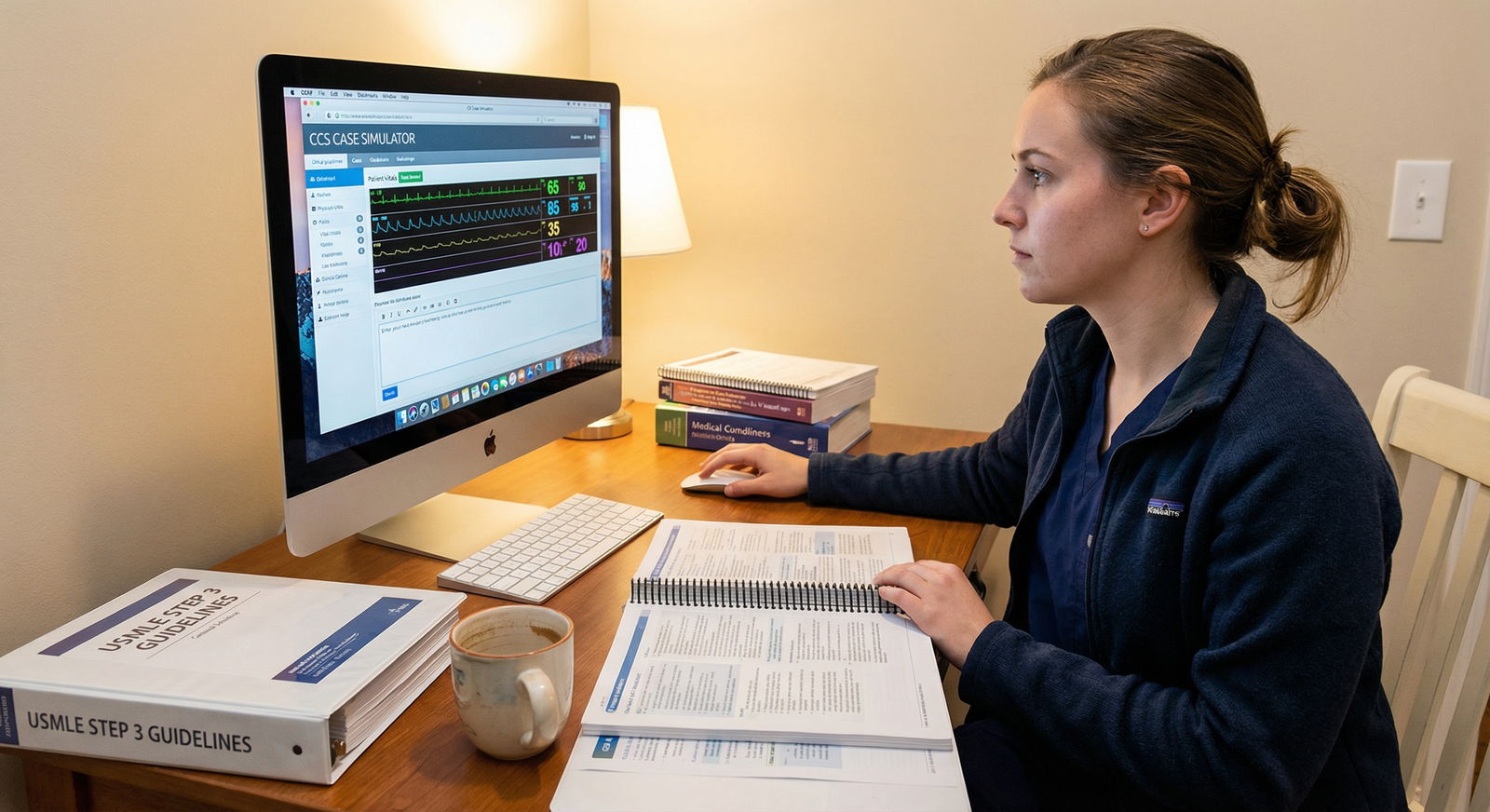
Pitfall 2: Overlooking Clinical Case Simulations (CCS)
The CCS portion is unique to Step 3 and often feels unfamiliar, even to well-trained residents. Neglecting CCS is one of the most damaging and common errors.
What Goes Wrong
- Students disproportionately focus on multiple-choice questions and “save CCS for later,” then never get truly comfortable with it.
- They treat CCS like a trivia exercise instead of a workflow and decision-making exam.
- They don’t practice using the official software interface—so they waste time on exam day figuring out mechanics instead of making sound clinical decisions.
Why CCS Matters
- CCS can meaningfully influence your overall Step 3 performance.
- CCS assesses how you think, prioritize, and manage over time—not just what you know.
- It tests real-world skills: ordering appropriate tests, starting correct treatments, monitoring follow-up, and avoiding unnecessary or harmful interventions.
How to Integrate CCS into Your Study Plan
Start CCS Practice Early (Not in the Last Week)
- Dedicate at least 2–3 sessions per week to CCS starting mid-preparation.
- Gradually increase complexity: begin with shorter, straightforward cases, then progress to longer, multi-step management scenarios.
Use the Official CCS Software Interface
- Download and practice with the official CCS software from the USMLE website.
- Learn where orders, consultations, re-evaluations, and time advancement controls are located. Your goal is to make the interface feel automatic.
Develop a Systematic CCS Approach
For each case, train yourself to:- Stabilize the patient first:
- Airway, breathing, circulation, vitals, IV access, monitoring, analgesia, and immediate life-saving measures.
- Order appropriate initial tests and interventions:
- Labs, imaging, bedside tests, and empiric therapies as indicated.
- Advance time strategically:
- Avoid wasting time; move the clock forward appropriately after initial interventions and check results promptly.
- Adjust management based on new information:
- Narrow antibiotics, respond to lab abnormalities, consult specialists when warranted.
- Complete preventive and counseling measures when appropriate:
- Vaccinations, smoking cessation, contraception counseling, follow-up planning.
- Stabilize the patient first:
Consistently practicing this structured workflow will translate directly into stronger CCS performance and more confident clinical reasoning.
Pitfall 3: Relying on Memorization Instead of Clinical Synthesis
Step 3 is designed to test your ability to synthesize information—not just recall facts. A memorization-heavy strategy that may have worked for Step 1 is insufficient here.
What Goes Wrong
- Learners focus on flashcards and isolated facts at the expense of integrated, patient-centered thinking.
- They get questions wrong, even when they “know the facts,” because they misprioritize, overlook contraindications, or fail to grasp situational nuances.
- They struggle with longer, vignette-based Clinical Case Simulations and complex multiple-choice questions.
Building Strong Clinical Reasoning and Synthesis Skills
Use Question Banks Actively, Not Passively
- Treat every question as a mini-case. After answering, ask:
- Why was this the best next step now?
- What would have been appropriate 1 step earlier or 1 step later?
- What harmful or unnecessary tests/treatments did I avoid?
- Actively summarize the clinical reasoning pathway in a 1–2 sentence “if/then” rule.
- Treat every question as a mini-case. After answering, ask:
Practice “Verbalizing the Plan”
- When reviewing cases, imagine you’re presenting on rounds:
- “This is a 52-year-old with unstable angina; my immediate priorities are…”
- Outline diagnostics, treatments, and follow-up in logical order.
- Teaching this way to a peer or even aloud to yourself solidifies reasoning.
- When reviewing cases, imagine you’re presenting on rounds:
Use Case-Based Study Resources
- Incorporate case-based books and online case series that mirror Step 3 style scenarios.
- Focus especially on ambulatory care, emergency medicine, obstetrics, pediatrics, psychiatry, and chronic disease management.
Connect Pathophysiology to Management
- For important conditions (e.g., sepsis, DKA, ACS, stroke), link:
- Pathophysiology → Clinical presentation → Diagnostic priorities → Immediate and long-term treatment.
- This high-level understanding lets you adapt to novel vignettes rather than memorizing fixed algorithms.
- For important conditions (e.g., sepsis, DKA, ACS, stroke), link:
This shift from memorization to synthesis mirrors what is expected of an early-career physician and directly improves both test performance and real-world clinical care.
Pitfall 4: Avoiding Weak Areas and Letting Gaps Persist
Most examinees know which topics they dislike or avoid—but Step 3 is broad enough that unaddressed weaknesses are likely to appear on test day.
What Goes Wrong
- Students spend most of their time in “comfort zones” (e.g., internal medicine) and neglect weaker domains like psychiatry, ethics, biostatistics, women’s health, or pediatrics.
- Weaknesses become painfully obvious in full-length practice tests but are not systematically addressed.
- Confidence drops when a difficult block or CCS case centers on an avoided topic.
How to Systematically Address Weaknesses
Use Regular Self-Assessment
- Take at least 1–2 NBME or equivalent self-assessment exams during your study period.
- Review question bank performance analytics by discipline and system.
Create a “Weakness-Focused” Study Block Each Week
- Dedicate 1–2 sessions weekly to topics where you’re scoring lowest.
- Examples:
- One week: biostatistics & epidemiology
- Next week: ethics, legal issues, and professionalism
- Following week: pediatrics or OB/GYN
Set Concrete Micro-Goals
- Instead of “get better at OB,” define:
- “Review management algorithms for preeclampsia, postpartum hemorrhage, and ectopic pregnancy.”
- “Do 40 OB/GYN questions and review wrong answers actively.”
- Instead of “get better at OB,” define:
Reinforce Weak Areas in CCS Practice
- Practice CCS cases in domains you find uncomfortable (e.g., postpartum care, pediatric emergencies).
- This helps integrate knowledge with real-time clinical decision-making.
Owning your weak spots early and aggressively turns them into strengths, or at least into areas you can competently manage under exam pressure.
Pitfall 5: Poor Test-Day Strategy and Logistics
Even with strong content knowledge, poor strategy on test day can significantly affect performance.
What Goes Wrong
- Arriving late, stressed, or unfamiliar with the testing center environment.
- Mismanaging break time and going into the last blocks mentally exhausted and hungry.
- Rushing through early questions or spending too long on a few hard ones, leading to time pressure later.
- Approaching CCS cases without a clear time and workflow plan.
Building a Solid Test-Day Plan
Know Your Testing Center Setup
- Drive or commute to the center in advance if possible.
- Confirm ID requirements, parking, locker policies, and food/drink rules.
Simulate Test-Day Conditions Beforehand
- Wear similar layers of clothing.
- Practice using noise-cancelling headphones or earplugs if you plan to use them.
- Use similar snacks and drinks during long practice sessions.
Plan Your Pacing and Breaks
- For MCQ blocks, aim to finish with 5–10 minutes remaining for review.
- Use short breaks between blocks before fatigue becomes overwhelming.
- Save a slightly longer break for mid-day (for food, stretching, bathroom).
Have a CCS-Specific Plan for Day 2
- During CCS, stay calm if the clock “jumps forward” or if the case ends earlier than expected—that can be normal.
- Don’t waste time on unnecessary tests just because they’re available; focus on what is clinically justified.
- Always think: “Is my patient stable? Is there anything else important I should be monitoring or addressing?”
Efficient logistics and thoughtful pacing ensure that your score reflects your knowledge and reasoning—not test-day chaos.
Pitfall 6: Underutilizing High-Quality Review Courses and Resources
Not everyone needs a formal Step 3 review course, but dismissing them outright can be a missed opportunity, especially for those with time constraints, prior failures, or complex life circumstances.
What Goes Wrong
- Overreliance on scattered, outdated PDFs and notes from peers.
- Using one low-quality question bank instead of a reputable one closely aligned with the exam blueprint.
- Ignoring structured resources that could offer accountability and efficient content review.
Choosing and Using Quality Study Resources
Prioritize a High-Quality Question Bank
- Use at least one well-regarded Step 3 question bank known for realistic vignettes and explanations.
- Do questions in timed, random mode to simulate the real exam.
- Read explanations even for questions you got right to refine reasoning.
Consider a Review Course if You:
- Have limited time and want a curated, high-yield path.
- Struggled with Step 1 or Step 2 CK and need extra structure.
- Are an IMG adjusting to US-style testing and clinical practice patterns.
Mix Learning Modalities
- Combine:
- Video lectures for complex or conceptual topics (e.g., biostatistics, ethics)
- Question banks for application
- Short review texts or outlines for last-minute consolidation
- Combine:
Always Check for Updated Materials
- Verify that your resources match the latest USMLE Step 3 blueprint and guidelines.
- Avoid very old print editions or question sets that do not reflect current standards of care.
High-quality, updated resources are non-negotiable for serious Step 3 preparation.
Pitfall 7: Ignoring Well-Being, Sleep, and Burnout Risks
By Step 3, many candidates are juggling clinical rotations, night shifts, residency applications, or family responsibilities. Burnout is common—and it directly impairs focus, memory, and judgment.
What Goes Wrong
- Attempting to study intensively on post-call days or after long night shifts without adequate rest.
- Cutting sleep to gain more study hours, leading to diminishing returns.
- Neglecting exercise, nutrition, and social support.
- Arriving at the exam exhausted and emotionally drained.
Protecting Your Well-Being While Studying
Build a Realistic Study Schedule
- Align your Medical Exam Preparation plan with your rotation schedule.
- On heavy rotations (ICU, nights), scale back unrealistic expectations; use shorter, focused sessions instead of marathon studying.
Prioritize Sleep as a Study Tool
- Aim for consistent, restorative sleep as much as your schedule allows.
- Avoid heavy caffeine late in the day and try to maintain a stable sleep-wake cycle.
Incorporate Stress-Management Techniques
- Short daily practices (5–10 minutes) can include:
- Mindful breathing or brief meditation
- A quick walk outside
- Stretching or light yoga
- These can help reset your nervous system and improve focus.
- Short daily practices (5–10 minutes) can include:
Plan Rest Days
- Allow at least one partial rest day weekly if possible—no intense studying, only light review or nothing at all.
- Use this time for family, hobbies, or simple recovery.
Your brain is one of your most important exam resources; care for it as deliberately as you care for your question bank.

Putting It All Together: A Strategic Step 3 Preparation Blueprint
A smart Step 3 strategy weaves together format familiarity, strong Clinical Case Simulations performance, clinical reasoning, targeted remediation of weak areas, logistical planning, and self-care.
Example 6–8 Week Study Framework (Adjust as Needed)
Weeks 1–2
- Review exam format and logistics.
- Begin question bank in timed, random mode (20–40 questions/day).
- Start CCS practice (1–2 cases/week).
- Identify weak areas using initial performance data.
Weeks 3–5
- Increase question volume (40–60 questions/day, or as feasible with rotation schedule).
- Continue and intensify CCS practice (2–4 cases/week).
- Dedicate focused sessions to weakest content domains.
- Take at least one self-assessment exam.
Weeks 6–8 (Final Phase)
- Fine-tune weak areas based on self-assessment feedback.
- Practice 1–2 full-length test days to simulate stamina and break strategy.
- Continue targeted CCS practice emphasizing workflow and time management.
- Protect sleep, avoid last-minute drastic changes, and refine test-day logistics.
This structure is flexible but provides a concrete starting point you can adapt to your schedule and learning style.
FAQs: USMLE Step 3 Preparation and Common Pitfalls
1. How different is USMLE Step 3 from Step 2 CK?
Step 2 CK focuses more heavily on diagnosis and initial management, often in acute settings. Step 3 emphasizes longer-term management, ambulatory care, patient safety, and how you prioritize decisions over time. It also includes Clinical Case Simulations, which test workflow and decision-making in a way that Step 2 CK does not. Content knowledge overlaps, but the application and format are distinct.
2. How much time should I realistically allocate to Step 3 preparation?
For most residents or recent graduates, 4–8 weeks of focused but part-time study (e.g., 1–3 hours/day on average, adjusted for rotation intensity) is typical. IMGs or those with prior exam struggles may benefit from a longer runway. The key is consistency rather than cramming, and aligning your Study Strategies with your clinical and personal schedule.
3. How should I prioritize multiple-choice questions versus CCS practice?
As a general guide:
- Allocate roughly 70–80% of your study time to high-quality MCQ practice and review.
- Reserve 20–30% for CCS practice, especially in the last 3–4 weeks.
Since CCS has a learning curve, begin early with low-frequency but regular practice, then increase intensity as you approach test day.
4. I’m already in residency and very busy. What’s the most efficient way to study?
- Use question banks in timed, random mode during short daily sessions (even 20–30 questions/day can add up).
- Do CCS practice on days off or post-call when you have more uninterrupted time.
- Focus on high-yield topics that overlap with your current clinical rotation; this reinforces both exam performance and real-world care.
- Consider a structured review course if you need efficiency and curated content.
5. What should I do if I fail Step 3 or feel extremely unprepared after a self-assessment?
- Analyze results in detail to determine whether the main issues were content gaps, poor test strategy, CCS weaknesses, or burnout.
- Extend your preparation timeline; consider formal review courses or tutoring if needed.
- Build a more structured, realistic schedule with protected time for studying and rest.
- Discuss timing and support with your residency program if you are already in training—many programs will help you build a recovery plan.
By understanding and proactively avoiding these common pitfalls, you set yourself up for a more efficient, less stressful, and more successful USMLE Step 3 experience. With clear Study Strategies, thoughtful test-day planning, and attention to your well-being, Step 3 becomes not just a hurdle for Residency Applications, but a meaningful milestone in your growth as an independent, competent physician.