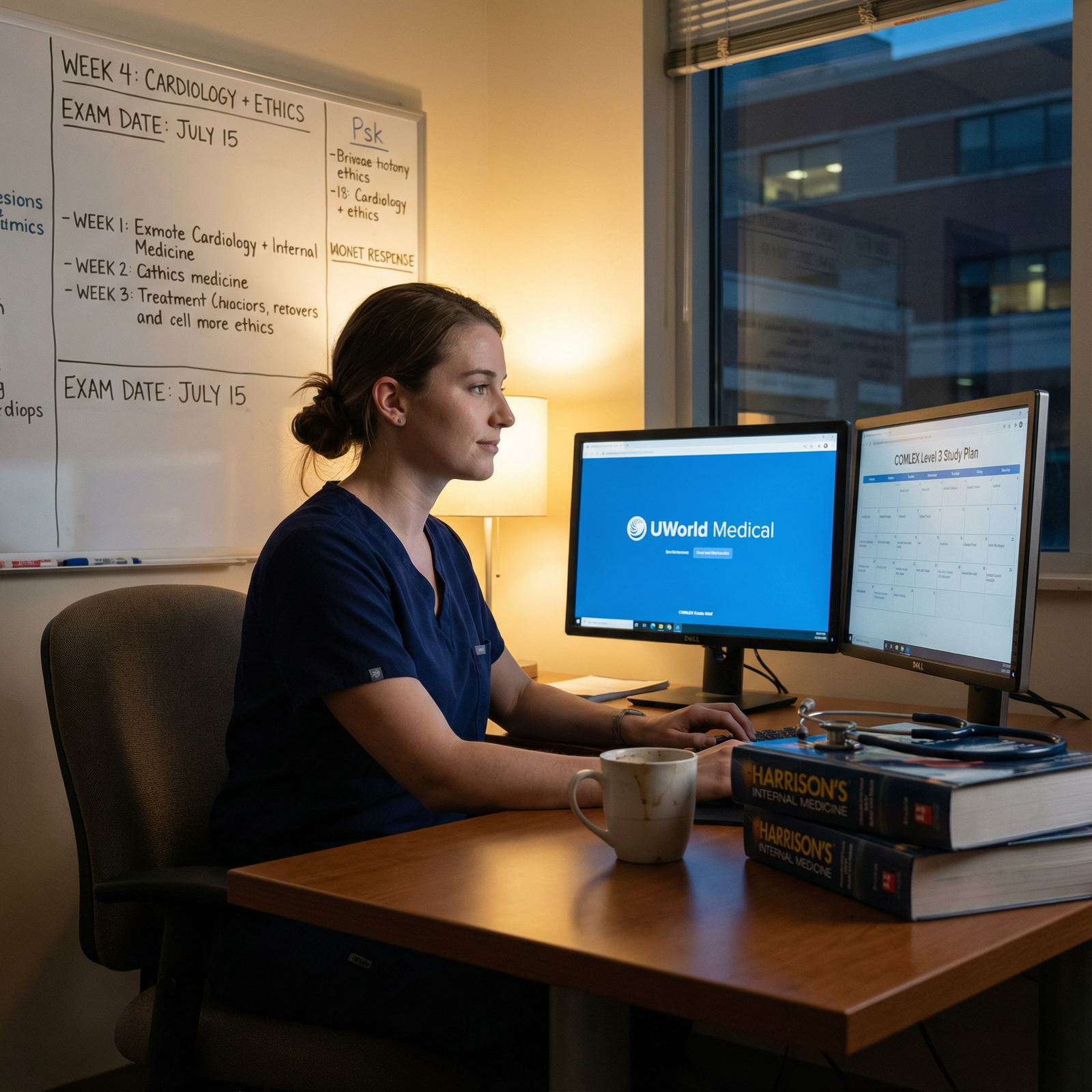
As you reach the final stretch of your medical training, COMLEX Level 3 is your opportunity to demonstrate that you can safely and independently manage patients as a physician. Unlike Levels 1 and 2, this exam is less about memorizing lists and more about applying core principles in realistic, often complex, clinical scenarios.
A realistic, structured Study Schedule is one of the most powerful tools you have for effective Medical Exam Preparation at this stage. You are likely balancing call, clinic, inpatient responsibilities, and a personal life. Without a concrete plan, even highly motivated residents can fall into inefficient, last-minute cramming.
This guide walks you step-by-step through building a practical, flexible COMLEX Level 3 Study Schedule that fits your residency life, emphasizes Time Management, and incorporates high-yield Active Learning Techniques so you can approach exam day with confidence instead of exhaustion.
Why a Structured Study Schedule Matters for COMLEX Level 3
The unique challenge of Level 3 during residency
COMLEX Level 3 is often taken during the first or second year of residency—exactly when your clinical responsibilities and fatigue are peaking. You’re no longer a full-time student; your cognitive “prime time” may be spent on wards, in clinic, or on call.
A clear schedule is not just “nice to have” here—it’s a protective framework that:
- Prevents drift: Without a plan, days slip by with only good intentions and little actual progress.
- Aligns effort with impact: You can focus on high-yield systems and question practice rather than repeatedly reviewing what you already know.
- Reduces decision fatigue: Pre-decided daily tasks mean you don’t waste energy figuring out what to study when you’re already tired.
Key benefits of a well-designed COMLEX Level 3 study schedule
Effective Time Management
- Breaks down a large exam into daily manageable chunks.
- Helps you realistically allocate study time around shifts, nights, and post-call days.
- Allows you to see when you’re overcommitting and adjust early.
Clear Goal Setting and Tracking
- Translates broad goals (“do well on Level 3”) into specific, trackable targets (e.g., “Complete 40 questions/day and review explanations,” “Finish all OB/GYN content by Week 3”).
- Makes it easier to measure progress and adjust before it’s too late.
Stress Reduction and Burnout Prevention
- Predictable, structured preparation reduces last-minute cramming.
- Scheduled rest and buffer days protect your mental health during an already demanding phase of training.
Built-in Flexibility
- A strong schedule is not rigid. It anticipates:
- Call weeks
- Vacation blocks
- Unexpected admissions, cross-cover, or extra clinics
- You have safe “flex” time built in to catch up without derailing your entire plan.
- A strong schedule is not rigid. It anticipates:
Step 1: Understand the COMLEX Level 3 Exam Format and Blueprint
Before you can design an effective Study Schedule, you need a clear mental map of what you’re preparing for.
Core components of COMLEX Level 3
Multiple-Choice Questions (MCQs)
- Spread over two test days.
- Focus on clinical decision-making, next best step, diagnosis, management, and patient safety.
- Heavy emphasis on outpatient, longitudinal care and systems-based practice.
Clinical Decision-Making / Patient-Centered Simulations (PCS)
- Interactive cases simulating real patient encounters.
- Require you to:
- Gather appropriate history and exam data.
- Order and interpret diagnostic tests.
- Initiate and adjust management plans.
- Consider cost-conscious care and patient preferences.
Aligning your study plan with the NBOME blueprint
Review the NBOME COMLEX Level 3 Content Outline and Blueprint (latest version on nbome.org). Identify:
- Clinical disciplines (e.g., Internal Medicine, OB/GYN, Pediatrics, Surgery, Psychiatry, Emergency Medicine, Family Medicine).
- Patient presentations and competencies, such as:
- Health promotion and disease prevention
- Chronic disease management
- Acute care and emergencies
- Osteopathic Principles and Practice (OPP) integration
Build your schedule so that:
- Every major discipline gets coverage.
- Longitudinal and outpatient management (especially relevant to primary care specialties) gets extra focus.
- PCS-style cases are practiced regularly, not just “at the end.”
Step 2: Assess Your Current Knowledge and Clinical Confidence
An honest baseline assessment keeps you from wasting time on areas you’ve already mastered and highlights hidden weak spots.
Use objective practice tools early
Within the first week of your prep:
- Take a baseline self-assessment
- NBOME practice resources (e.g., COMSAE forms tailored to Level 3).
- A mixed, timed block from a high-quality question bank that mimics Level 3.
- Simulate real conditions
- Do at least one timed block without pausing.
- Avoid looking up answers as you go.
Analyze results strategically
Don’t just look at your overall percent correct. Break it down by:
- Discipline: e.g., strong in Pediatrics, weaker in OB/GYN.
- Question type:
- Diagnostic reasoning vs. management vs. screening/prevention.
- Acute care vs. chronic disease management.
- Common error patterns:
- Misreading questions or missing key words.
- Struggling with guideline updates (e.g., hypertension, diabetes, anticoagulation).
- Over- or under-ordering tests.
From this analysis, create:
- A short “critical weaknesses” list (3–5 areas that must improve).
- A secondary list of “refresh but not urgent” topics.
These lists will drive your Study Schedule priorities.
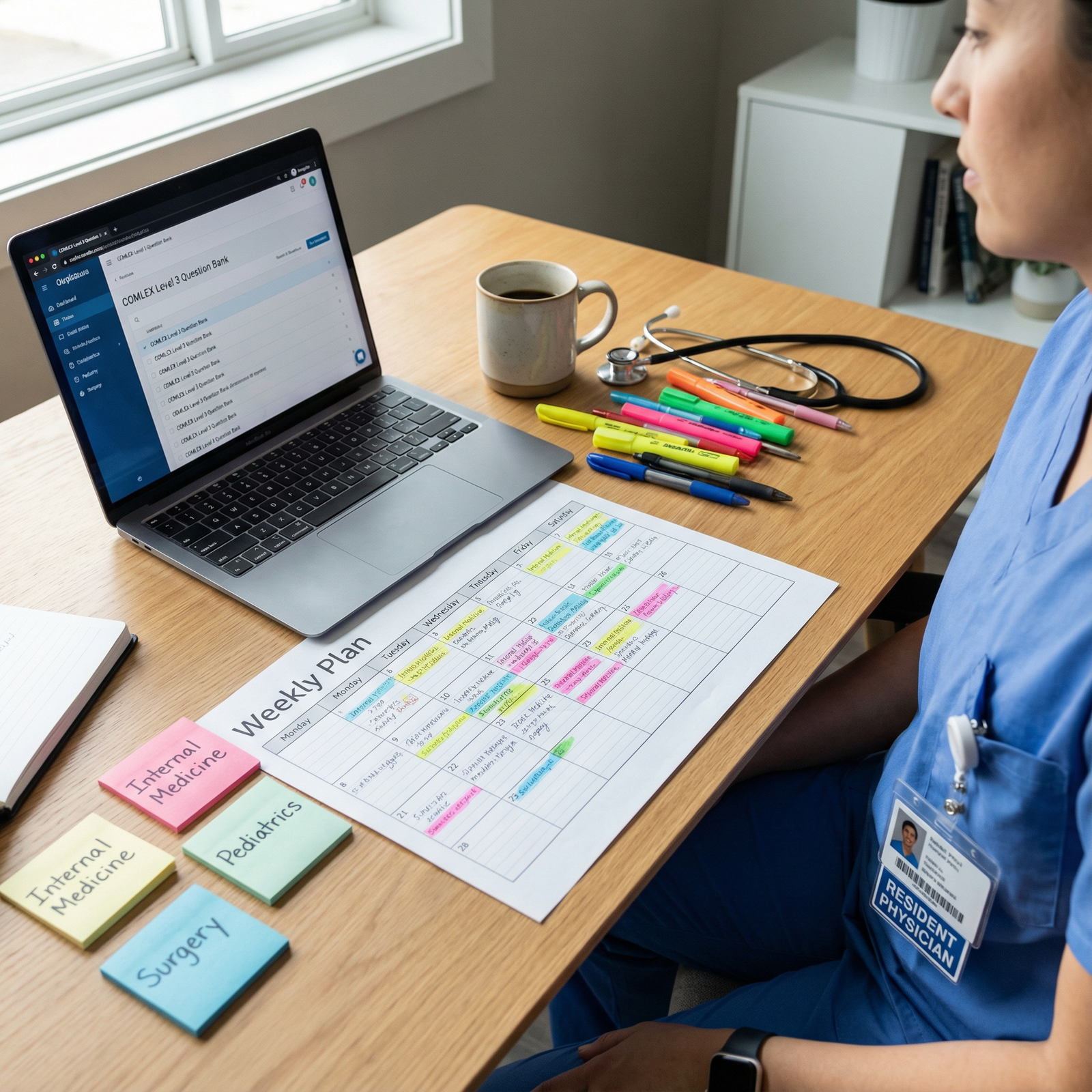
Step 3: Determine a Realistic Study Timeline Around Residency
Your Study Schedule must acknowledge your real life. A perfect plan that ignores call schedules will fail.
Choosing your total prep length
Common timeframes for COMLEX Level 3 prep:
3 months (8–12 weeks)
- Intense but realistic with consistent 10–15 hours/week.
- Good for residents with moderate baseline knowledge and average rotation intensity.
4–6 months
- Better for:
- Very busy programs.
- Residents who struggled with earlier COMLEX exams.
- Those who prefer low-intensity, long-duration studying (e.g., 6–8 hours/week consistently).
- Better for:
Estimating weekly study hours
Consider:
Rotation type
- ICU, trauma surgery, night float → expect limited energy and time; aim for short, focused sessions (e.g., 30–60 min on most days you’re not post-call).
- Outpatient, elective, lighter rotations → schedule longer blocks (2–4 hours on select days).
Typical targets
- Intense but sustainable: 12–18 hours/week.
- Minimum baseline for busy interns: 8–10 hours/week, with increased time on easier weeks or vacation.
Be honest about your capacity. It is better to commit to 10 hours and consistently hit 10 than to plan 20 and repeatedly fall short.
Mapping your timeline
Create a simple “macro” plan:
- Weeks 1–2: Baseline assessment, blueprint review, set up resources, begin light daily qbank.
- Weeks 3–6: Systematic content review + daily questions; start PCS practice.
- Weeks 7–10: Higher volume questions, intensive review of weak areas, 1–2 full practice days.
- Final 1–2 weeks: Consolidation, rapid review, exam strategy, rest optimization.
This macro structure will guide your more detailed weekly plans.
Step 4: Break Down Content by System and Competency
To avoid feeling overwhelmed, convert the blueprint into tangible “study units.”
Core clinical content areas
Aim to cover each of these at least once, with extra time for your weak areas:
- Internal Medicine
- Family Medicine / Primary Care
- Pediatrics
- Obstetrics and Gynecology
- Surgery
- Psychiatry and Behavioral Health
- Emergency Medicine / Urgent Care
- Preventive Medicine & Public Health
- Osteopathic Principles and Practice (OPP)/OMM
Within each area, prioritize:
- Common outpatient diagnoses (e.g., HTN, DM2, depression, asthma).
- Acute presentations you’ll see on call (e.g., chest pain, sepsis, GI bleed, trauma).
- Preventive care and screening recommendations by age, sex, and risk factors.
- Medication safety, side effects, and interactions.
Turn the blueprint into weekly goals
For a 10-week plan, a rough breakdown might be:
- Week 1–2: Internal Medicine (cardio, pulmonary, renal, ID focus)
- Week 3: OB/GYN + Women’s health + preventive care
- Week 4: Pediatrics + adolescent medicine + immunizations
- Week 5: Psychiatry + substance use + behavioral medicine
- Week 6: Surgery + Emergency Medicine + trauma
- Week 7–8: Family Medicine, chronic disease management, geriatrics, OPP
- Week 9–10: Mixed review, high-yield topics, full practice blocks, and PCS
Adjust proportionally based on baseline strengths—if you are a categorical pediatric resident, for example, you may compress your Pediatrics review and allocate more time to adult medicine and OB.
Step 5: Build a Weekly Study Schedule That You Can Actually Follow
Now translate your macro plan into concrete weekly and daily actions.
Example: Balanced weekly Study Schedule (15–18 hours/week)
Assume a relatively moderate rotation without frequent 24-hour calls:
| Day | Study Focus & Duration |
|---|---|
| Monday | 2–3 hrs: 40–50 MCQs (mixed), detailed review of explanations, brief notes or flashcards |
| Tuesday | 2–3 hrs: System-focused review (e.g., cardiology) + 20 MCQs in that system |
| Wednesday | 2 hrs: PCS / case simulations + 20 MCQs, focus on outpatient or longitudinal care |
| Thursday | 2–3 hrs: Secondary system review (e.g., OB/GYN) + 20 MCQs |
| Friday | 2 hrs: OMM/OPP + preventive medicine review + 15–20 MCQs |
| Saturday | 3–4 hrs: Long timed block(s) (60–80 questions) to build stamina; simulate one exam session |
| Sunday | 1–2 hrs: Light review, flashcards, catch-up, reflection on progress, adjust next week’s schedule |
Adapting for call-heavy or night float rotations
During intense rotations:
- Aim for 30–60 minutes on most non-post-call days:
- 15–20 MCQs + rapid review of explanations.
- Use micro-sessions:
- 10–15 minutes during breaks for flashcards (e.g., Anki).
- Plan a heavier block on your golden weekend or lighter day:
- 2–3 hours focused on your weakest system.
Build in “non-negotiables”
To increase follow-through:
- Decide when you will study:
- “6:30–8:00 pm after dinner” or “5:30–7:00 am before sign-out.”
- Decide where you will study:
- Workroom during night shift downtime, home desk, library, or coffee shop.
- Protect at least one rest block per week:
- A half-day or evening where you intentionally do not study.
Step 6: Prioritize Active Learning Techniques Over Passive Reading
For a clinically focused exam like COMLEX Level 3, Active Learning Techniques are far more efficient than passive reading.
1. Daily question practice (your highest-yield strategy)
- Aim for consistency:
- 20–40 questions per day on busy weeks.
- 60–80+ questions per day on lighter or off weeks.
- Always review explanations thoroughly:
- Understand why the correct answer is correct.
- Identify why other options are wrong (misleading but wrong choices are often tested again in another form).
- Tag or flag difficult questions:
- Revisit them closer to exam day.
2. Spaced repetition and flashcards
- Use tools like Anki or other spaced repetition platforms for:
- Guidelines (e.g., USPSTF screenings).
- Drug mechanisms and adverse effects.
- OMM/OPP concepts, Chapman points, and treatment models.
- Create cards strategically:
- Only for concepts you miss or tend to forget.
- Keep cards short and clinically oriented (“60-year-old male with… what’s the next best step?”).
3. Case-based and scenario learning
- Regularly practice:
- Clinical vignettes or PCS-style simulations.
- “Walk through” acute presentations out loud: what history you ask, what to examine, what you order, and how you manage.
- If you’re on a relevant rotation, turn real patients into mental review:
- After sign-out, ask: “If this were a COMLEX case, what would they be testing?”
4. Study groups and teaching peers
- Short, structured group sessions (30–60 minutes) can help:
- Rapidly discuss tricky ethical scenarios, practice counseling statements, or review guidelines.
- Teaching a concept to a co-resident or medical student is one of the strongest ways to consolidate knowledge.
5. Continuous feedback loop
Every 1–2 weeks:
- Review your qbank performance breakdown:
- Which systems are still weak?
- Are you missing more questions due to knowledge gaps or test-taking strategy?
- Adjust your schedule:
- Shift 1–2 extra hours per week toward your weakest areas.
- Add targeted review (e.g., obstetric emergencies, psych pharmacology, renal failure).
Step 7: Build Flexibility and Sustainability Into Your Plan
Your Study Schedule must survive real-world disruptions: overnight codes, sick days, schedule changes.
Plan for adjustments, not perfection
- Include buffer time:
- One light or “catch-up” day each week.
- 1–2 buffer weeks at the end of your timeline for consolidation and unexpected delays.
- Focus on principles, not perfection:
- The goal is steady progress, not hitting every single planned minute.
Regular progress check-ins
Every two weeks, ask yourself:
- Am I doing the number of questions I planned?
- Are my weak areas improving on repeat questions or new blocks?
- Is my stress manageable, or am I approaching burnout?
If you’re consistently unable to meet your targets:
- Reduce your daily volume but increase consistency.
- Consider extending your exam date if you are too overwhelmed and it is feasible.
- Ask seniors or faculty for advice on balancing this with your program demands.

Step 8: Strategic Preparation for Exam Day and Final Weeks
The final 1–3 weeks of your Study Schedule should shift from learning new material to consolidating and optimizing performance.
Final two–three weeks: consolidation phase
- Focus on high-yield review:
- Revisit your flagged questions and toughest topics.
- Emphasize guidelines, red flag symptoms, acute management algorithms.
- Complete 1–2 full-length practice days:
- Simulate exam pacing:
- Timed blocks with minimal breaks.
- Complete both MCQ-style blocks and some PCS practice if available.
- Simulate exam pacing:
Exam strategy essentials
Time management on test day
- Avoid getting stuck on a single question; make a best choice and move on.
- For PCS, prioritize critical actions (airway, breathing, circulation, emergent interventions).
OMM/OPP integration
- Expect OMT questions integrated into management.
- Review indications, contraindications, and typical treatment approaches.
Physical and mental preparation
The week before the exam:
- Sleep:
- Prioritize consistent bedtimes. Do not sacrifice sleep to squeeze in a few more low-yield hours.
- Nutrition and hydration:
- Practice your exam-day meals during long practice blocks.
- Stress management:
- Use brief mindfulness, breathing exercises, or physical activity (even short walks) to reduce anxiety.
- Logistics:
- Confirm test center details, ID, confirmation emails, and travel time.
- Plan your route and backup options in case of traffic or transit issues.
The day before the exam:
- Light review only:
- Skim high-yield notes, but avoid new topics.
- Prepare clothes, snacks, and allowed items.
- Aim for a normal, calm evening routine.
FAQs: COMLEX Level 3 Study Schedule and Exam Preparation
1. How many hours per week should I realistically study for COMLEX Level 3 during residency?
Most residents find 10–18 hours per week to be a sustainable range, depending on rotation intensity and prior performance on COMLEX exams. On heavy inpatient or ICU months, you may only manage 30–60 minutes per day plus a 2–3 hour weekend block. On easier outpatient or elective months, increase to 2–4 hours on several days and a longer weekend session. Consistency over time matters more than any single “perfect” week.
2. What are the best resources to use for COMLEX Level 3 preparation?
While specific resource availability changes, most successful test-takers use a combination of:
- A COMLEX-focused question bank that mirrors Level 3 style and includes PCS-style practice.
- NBOME blueprint and practice materials to understand exam structure and expectations.
- A concise clinical review resource (online or book) that emphasizes outpatient management, guidelines, and osteopathic principles.
- Spaced repetition flashcards (e.g., Anki) for facts, guidelines, and OMM concepts.
The key is to deeply use a few high-yield resources rather than skim many.
3. How should I modify my study plan if I feel behind or fail to meet my weekly goals?
If you fall behind:
- Reassess your schedule honestly:
- Were your expectations unrealistic for your rotation?
- Prioritize:
- Shift focus to weak systems and question practice, rather than trying to “cover everything” superficially.
- Use buffer time:
- Repurpose light or rest days closer to the exam for catch-up if absolutely necessary, but avoid chronic overwork.
- Consider adjusting your exam date:
- If your baseline is low and you’ve made little progress by 4–6 weeks before the test, a postponement may be appropriate if allowed by your program and NBOME.
4. How can I prevent burnout while studying for COMLEX Level 3 during a busy residency year?
To protect your well-being:
- Build in rest: At least one half-day or evening per week with no studying.
- Use efficient, focused blocks: Short, high-quality sessions beat long, distracted ones.
- Maintain basics: Sleep, regular meals, and some physical activity.
- Set boundaries: Communicate your exam timeline with co-residents, family, or friends so they understand your temporary limits.
- Monitor warning signs: If you feel persistently exhausted, hopeless, or unable to function, seek support from your program, mentors, or professional mental health resources.
5. Is it necessary to practice PCS/clinical simulation cases multiple times, or is question practice enough?
While MCQ practice is crucial, PCS-style practice is strongly recommended:
- COMLEX Level 3 specifically assesses how you think through and manage cases over time.
- Repeated PCS practice:
- Trains you to order appropriate tests (not too many, not too few).
- Reinforces stepwise, cost-conscious management.
- Helps you anticipate follow-up and complications.
- Try to integrate PCS practice at least once per week in the middle of your schedule, increasing frequency in the final 3–4 weeks.
A realistic, flexible Study Schedule—anchored in Time Management, Active Learning Techniques, and honest self-assessment—will help you prepare efficiently for COMLEX Level 3 while still functioning as a resident and a human being. With thoughtful planning, consistent question practice, and strategic review, you can approach this final COMLEX milestone with confidence and clarity.