
USMLE Step 3 vs COMLEX Level 3: Which Exam Should You Take?
The final phase of medical licensing exams in the United States—USMLE Step 3 and COMLEX Level 3—often coincides with a demanding period of residency applications, clinical responsibilities, and life transitions. For many osteopathic and allopathic graduates, deciding which physician exam to take (or whether to take both) can significantly affect licensing options, residency competitiveness, and long-term career flexibility.
This guide clarifies the differences between USMLE Step 3 and COMLEX Level 3, outlines strategic considerations for MD and DO graduates, and provides practical, step-by-step advice to help you choose the path that best aligns with your goals.
Understanding USMLE Step 3 and COMLEX Level 3 in the Licensing Pathway
Both USMLE Step 3 and COMLEX Level 3 are “capstone” exams in their respective sequences and focus on readiness for independent practice. They assess whether you can safely manage patients without direct supervision—an essential milestone for full medical licensing.
How These Exams Fit into the Medical Licensing Sequence
USMLE sequence (MD and some DO candidates):
- Step 1 – Basic sciences and pathophysiology
- Step 2 CK – Clinical knowledge and diagnosis/management
- Step 3 – Final exam focused on patient management and systems-based practice
COMLEX sequence (DO candidates):
- Level 1 – Foundational biomedical and osteopathic principles
- Level 2-CE – Clinical evaluation and management
- Level 3 – Final exam focused on independent practice with integration of osteopathic principles and OMT
Both Step 3 and Level 3 are typically taken during the first one or two years of residency, often required for progression in training and for eligibility for full, unrestricted medical licenses in many states.
Overview of USMLE Step 3
USMLE Step 3 assesses whether you can apply medical knowledge and clinical skills essential for the unsupervised practice of medicine, with a strong emphasis on diagnosis, management, and prognosis over two days.
Exam logistics and structure
- Duration: 2 days of testing (usually consecutive)
- Total testing time: Roughly 7–9 hours per day (including breaks)
- Format:
- Day 1 – Foundations of Independent Practice (FIP):
- Multiple-choice question (MCQ) blocks
- Emphasis on foundational clinical science, epidemiology, ethics, and basic medical decision-making
- Day 2 – Advanced Clinical Medicine (ACM):
- MCQ blocks focused on complex management decisions and systems-based practice
- Clinical Case Simulations (CCS): interactive patient scenarios requiring diagnostic and therapeutic decisions over simulated time
- Day 1 – Foundations of Independent Practice (FIP):
Content domains commonly emphasized
- Acute and chronic disease management (inpatient and outpatient)
- Emergency and critical care decision-making
- Preventive medicine and health maintenance
- Women’s health, pediatrics, psychiatry, and surgery
- Biostatistics, interpretation of literature, and quality improvement concepts
- Ethics, professionalism, and legal aspects of practice
USMLE Step 3 is generally required for MDs and increasingly used by DOs who also sit for USMLE exams, especially those pursuing competitive or historically allopathic-specialty residencies.
Overview of COMLEX Level 3
COMLEX Level 3 is the final exam in the COMLEX-USA series and evaluates a DO’s ability to manage patients independently while integrating osteopathic principles and osteopathic manipulative treatment (OMT) into care.
Exam logistics and structure
- Duration: 2 days of testing
- Total testing time: Similar length to Step 3, with multiple timed blocks
- Format:
- Both days: Primarily single-best-answer MCQs and clinical decision-making questions, including multi-step cases
- Embedded cases that unfold in stages, testing diagnostic reasoning, workup, and management
Distinctive features for osteopathic candidates
- Incorporation of osteopathic principles and practice (OPP) and OMT
- Assessment of holistic patient care, including:
- Biopsychosocial model
- Functional and structural evaluation
- Use of manual treatment where appropriate
- Questions often ask you to:
- Identify somatic dysfunction
- Select appropriate OMT techniques
- Decide when OMT is indicated or contraindicated in common clinical problems
COMLEX Level 3 is required for DO licensure through osteopathic licensing pathways and is widely accepted by ACGME residency programs, especially in institutions familiar with osteopathic training.
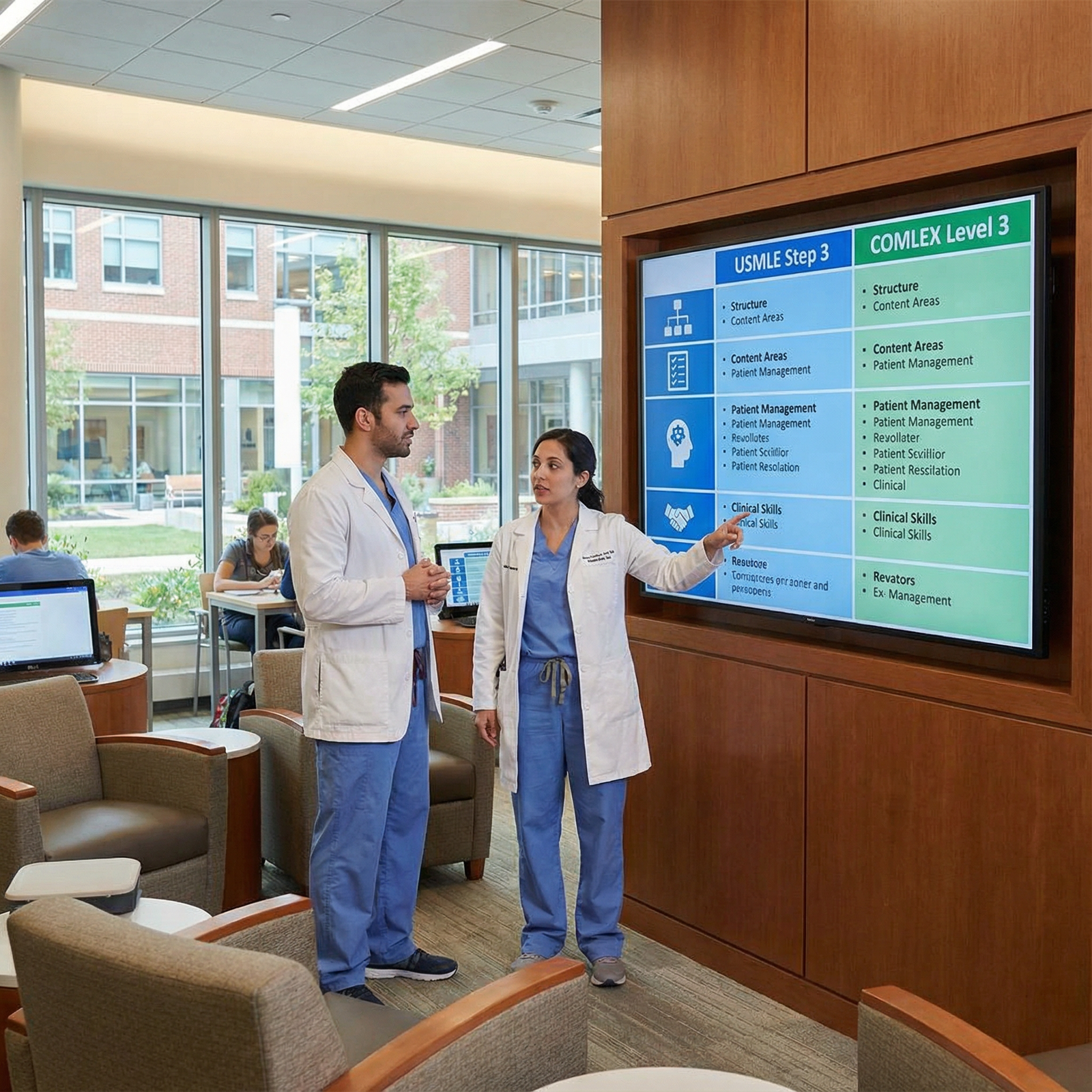
Key Differences Between USMLE Step 3 and COMLEX Level 3
While both exams test readiness for unsupervised practice, they differ in design, emphasis, and how they are perceived by residency programs and licensing boards.
1. Target Audience and Training Background
USMLE Step 3
- Primarily designed for:
- MD graduates of allopathic schools
- DO graduates who choose to take the USMLE sequence
- Emphasizes an allopathic framework of diagnosis and management
COMLEX Level 3
- Specifically designed for:
- DO graduates from osteopathic medical schools
- Integrates:
- Osteopathic structural exam and OMT considerations
- Holistic, systems-based approaches consistent with DO training
If you are an MD graduate, the default path is USMLE Step 3. If you are a DO, COMLEX Level 3 is required, and USMLE Step 3 is optional but often strategically valuable, depending on your goals.
2. Content Focus and Clinical Emphasis
USMLE Step 3 content focus
- Broad, system-based internal medicine and generalist-level knowledge
- Strong emphasis on:
- Management algorithms (e.g., next best step in diagnosis or therapy)
- Risk stratification and triage in acute care
- Public health, epidemiology, and clinical research interpretation
- CCS cases simulate:
- Ordering labs and imaging over virtual time
- Admitting/consulting/discharging patients
- Adjusting therapy as conditions evolve
COMLEX Level 3 content focus
- Similar breadth of clinical medicine (adult, pediatric, OB/GYN, surgery, psych, EM)
- Additional focus on:
- Osteopathic structural and functional issues
- Integration of OMT into care where appropriate
- Whole-person care, including social determinants and function
- Many cases ask: “What is the most appropriate OMT technique?” or “What is the next step incorporating osteopathic principles?”
If you are comfortable with OMT and osteopathic frameworks, COMLEX Level 3 allows you to leverage that background. If your training and practice environment are more allopathic-oriented, USMLE Step 3 content may feel more aligned with your day-to-day experience.
3. Format and Assessment Method
USMLE Step 3 format
- Primarily single-best-answer MCQs
- Notable feature: CCS interactive cases
- You actively “manage” a patient by ordering tests, treatments, and monitoring over simulated time
- Performance evaluates both what you order and when you order it
- Strong emphasis on:
- Prioritization under time pressure
- Sequencing of care (e.g., ABCs, stabilization before definitive management)
COMLEX Level 3 format
- MCQs and clinical decision-making questions, often in case clusters
- Questions may:
- Build on earlier stems in a case sequence
- Ask you to integrate OMT decisions
- The interface is more traditional, without interactive CCS, but still demands multi-step reasoning and planning for patient care episodes.
If you enjoy interactive simulations and dynamic case management, you might appreciate the CCS portion of USMLE Step 3. If you prefer a more traditional question-based interface but with integrated osteopathic content, COMLEX Level 3 may feel more natural.
4. Recognition, Program Preferences, and Career Flexibility
USMLE Step 3 recognition
- Accepted nationwide for medical licensing
- Universally recognized by ACGME-accredited residency and fellowship programs
- Particularly useful if:
- You are a DO applying to highly competitive or historically allopathic-dominated fields (e.g., dermatology, radiology, some surgical subspecialties)
- You plan to move across states with varying familiarity with COMLEX
COMLEX Level 3 recognition
- Required for DOs through osteopathic licensure channels
- Widely accepted in ACGME programs; however:
- Some institutions and program directors are still more familiar with USMLE score interpretation
- A few states and institutions may explicitly reference USMLE in their licensing or credentialing language, even if they accept COMLEX
While acceptance of COMLEX Level 3 is steadily improving, USMLE Step 3 often remains the “universal language” of physician exams. For DOs, this is a key factor when considering whether to sit for both.
Strategic Decision-Making: Which Exam Is Right for You?
Choosing between USMLE Step 3 and COMLEX Level 3 (or deciding to take both) should be a deliberate, strategic decision based on your degree, specialty interests, and where you plan to train and practice.
1. Consider Your Degree and Exam History
If you are an MD (allopathic graduate):
- You will:
- Take USMLE Step 3
- Not be eligible for COMLEX Level 3
- Your main decisions involve timing of Step 3 and integrating preparation with residency obligations.
If you are a DO (osteopathic graduate):
Ask yourself:
Have you already taken USMLE Step 1 and/or Step 2 CK?
- If yes:
- You’ve already invested in the USMLE track
- Taking Step 3 can:
- Provide continuity of score data
- Strengthen applications to programs that track USMLE metrics
- If no:
- Step 3 alone will not replace earlier USMLE steps
- Programs will primarily look at COMLEX Level 1 and Level 2, so Step 3 becomes less critical for residency but may help with later licensure or mobility.
- If yes:
Are you required to take COMLEX Level 3?
- For DOs, COMLEX Level 3 is generally required to complete the COMLEX-USA sequence and obtain licensure as a DO.
- This exam should be considered non-negotiable, whereas USMLE Step 3 is optional but potentially advantageous.
2. Analyze Your Residency and Fellowship Aspirations
Your specialty and target programs can heavily influence your exam strategy.
Questions to research:
Do your target programs:
- State a preference for USMLE scores?
- Accept COMLEX alone without requiring conversion?
- Have DO graduates who matched successfully with COMLEX scores only?
Are you applying to:
- Highly competitive specialties (e.g., derm, ortho, neurosurgery, plastics)?
- Academic programs with rigorous research expectations?
- Programs in regions historically more allopathic-dominant?
In many such scenarios, DO candidates benefit from having both COMLEX and USMLE scores to avoid any ambiguity in evaluation.
3. Understand State Licensing and Long-Term Mobility
Licensing regulations evolve, but some patterns are important:
- Many states are now explicitly COMLEX-friendly for DOs.
- A minority of states or institutions may:
- Primarily reference USMLE in regulations
- Require additional clarification or documentation for COMLEX-only candidates
- Taking Step 3 (if you’re a DO who already took USMLE Steps 1/2) may:
- Simplify future licensure applications
- Increase flexibility if you change states, pursue certain fellowships, or transition into academic/administrative roles later
Before deciding, check:
- Your state medical board (for where you plan to train and where you may eventually practice)
- Requirements for full, unrestricted medical licenses and any nuances for DO vs MD applicants
4. Align with Your Learning Style and Study Bandwidth
These exams are challenging and time-consuming. For DOs considering both:
- USMLE Step 3 and COMLEX Level 3:
- Overlap significantly in core content
- Differ in testing style and osteopathic emphasis
Practical considerations:
- Can you realistically prepare for two major exams while in residency?
- Does your program support dedicated study time?
- Which style of exam (CCS vs OMT-based questions) aligns better with how you think and practice?
Some DO residents choose to:
- Take USMLE Step 3 first, using general internal medicine study resources (e.g., UWorld, general Step 3 review books)
- Then spend additional 2–4 weeks focusing on:
- OMT
- Osteopathic-specific guidelines and COMLEX-style questions
- Before sitting for COMLEX Level 3
Others decide that COMLEX Level 3 alone is sufficient for their goals and avoid the extra time and cost of a second high-stakes exam.
Preparation Strategies and Real-World Insights
Hearing how others approached these exams can help you design a realistic, effective plan.
Study Approaches for USMLE Step 3
Common successful strategies include:
- Question-bank heavy preparation
- UWorld Step 3 Qbank (often the cornerstone)
- Supplement with other banks if time allows
- CCS practice
- Use official NBME/USMLE sample CCS cases
- Practice timing and order entry (e.g., labs, imaging, consults, admission level of care)
- Study timeline
- 4–8 weeks of focused prep, depending on your baseline and clinical demands
- Integrate cases into downtime between shifts
Residents who perform well often emphasize:
- Learning management algorithms (e.g., ACS, stroke, sepsis bundles)
- Practicing prioritization: What must be done immediately vs what can wait
- Using clinical rotations (especially wards and ICU) to reinforce decision-making under supervision
Study Approaches for COMLEX Level 3
For COMLEX Level 3, DO residents commonly use:
- COMBANK / TrueLearn COMLEX Level 3 Qbanks
- COMQUEST or similar osteopathic-focused question resources
- Dedicated OMT review:
- High-yield techniques (HVLA, ME, CS, FPR, etc.)
- Somatic dysfunction diagnosis by region
- Contraindications and safety considerations
- Integrating general internal medicine and EM review resources (which also help with USMLE-style questions)
A common pattern:
- 4–6 weeks of mixed prep
- Increasing OMT focus in the last 1–2 weeks
- Reviewing osteopathic principles in the context of common complaints:
- Back pain, headache, pregnancy, post-op care, respiratory issues
Residents often find that their daily DO training in residency helps reinforce the osteopathic perspective automatically, making exam preparation smoother if it is timed within the first couple years of residency.
Real-World Experiences from Examinees
MD graduate who took USMLE Step 3 early PGY-1:
- Benefited from strong Step 2 CK foundation
- Found CCS cases challenging initially, but manageable with targeted practice
- Emphasized that early completion relieved pressure later in residency and simplified state licensing applications
DO graduate who took both Step 3 and Level 3:
- Used Step 3 prep as the base and layered OMT-specific study for Level 3
- Felt Step 3 was more straightforward in terms of format but appreciated that Level 3 allowed demonstration of osteopathic training
- Believed having both exams helped in a competitive subspecialty fellowship application
DO graduate who took only COMLEX Level 3:
- Matched and excelled in a community-based ACGME program that routinely trains DOs
- Reported no licensing or credentialing hurdles in a COMLEX-friendly state
- Was satisfied avoiding the additional cost, stress, and time of USMLE Step 3
Frequently Asked Questions: USMLE Step 3 vs COMLEX Level 3
1. Can a DO take both USMLE Step 3 and COMLEX Level 3?
Yes. Many DOs choose to take both:
- COMLEX Level 3 is typically required to complete the osteopathic licensing pathway.
- USMLE Step 3 can:
- Enhance competitiveness at certain programs
- Simplify future licensing or credentialing
- Provide continuity if you already have USMLE Steps 1 and/or 2 CK
If considering both, plan your timeline carefully to avoid burnout and ensure your residency schedule allows adequate preparation.
2. Are pass rates or difficulty levels different between USMLE Step 3 and COMLEX Level 3?
Both exams are rigorous and designed to test readiness for independent practice; direct difficulty comparison is complicated because:
- They are taken by different cohorts (MD vs DO, and many DOs take both)
- Content emphasis and exam formats differ
Historically:
- First-time pass rates for USMLE Step 3 have been relatively high, especially for U.S. MD graduates.
- COMLEX Level 3 pass rates are also generally good, but performance is influenced by familiarity with OMT and osteopathic principles.
Regardless of pass rates, both exams require serious, structured preparation—especially when balancing residency duties.
3. If I’m a DO applying to mixed or historically allopathic programs, should I prioritize USMLE Step 3?
If you are already in residency, the impact of Step 3 on initial residency match is no longer relevant. However, for:
- Future fellowship applications
- Licensing flexibility in different states
- Employment in institutions that primarily use USMLE-based metrics
Having USMLE Step 3 can be advantageous. That said:
- For many DO residents in supportive, COMLEX-familiar programs, COMLEX Level 3 alone is sufficient.
- Always research your specific target programs and states when deciding.
4. What are the best resources to prepare for USMLE Step 3 and COMLEX Level 3?
USMLE Step 3:
- UWorld Step 3 Qbank (widely considered the primary resource)
- NBME/USMLE sample CCS cases and CCS practice software
- General Step 3 review texts or online courses (optional supplements)
COMLEX Level 3:
- COMBANK / TrueLearn Level 3 Qbank
- COMQUEST or similar COMLEX-focused question resources
- OMT-focused review resources:
- Savarese OMT Review (or equivalent)
- School-specific OMT notes and manuals
Most DOs find that using a strong internal medicine/Step 3-style resource plus an osteopathic-specific resource covers both exams efficiently.
5. How should I time Step 3 or Level 3 during residency?
Common timing strategies:
USMLE Step 3:
- Many programs encourage taking it during PGY-1 or early PGY-2
- Some require passing by a set time (e.g., by the end of PGY-2) to advance or moonlight
- Consider scheduling during a lighter rotation (e.g., elective, clinic, or research block)
COMLEX Level 3:
- Often taken PGY-1 or PGY-2, after gaining some real-world clinical experience
- Check with your program director for recommended timing and required passing deadlines
Plan backwards from:
- Program requirements
- State licensing timelines
- Major personal and professional events (e.g., wedding, move, new baby) to avoid stacking stressors.
Conclusion: Making a Confident, Informed Choice
Both USMLE Step 3 and COMLEX Level 3 are more than just exams; they are gateways to independent practice, full medical licensing, and long-term career flexibility. The “right” choice depends on:
- Your degree (MD vs DO)
- Your prior exam pathway (USMLE, COMLEX, or both)
- Residency and fellowship goals
- State licensing and mobility needs
- Your study bandwidth and preferred exam style
For MDs, the path is straightforward: prepare well and complete USMLE Step 3 strategically during residency. For DOs, the decision is more nuanced: COMLEX Level 3 is essential, and USMLE Step 3 is optional but can be powerfully beneficial in selected circumstances.
Whichever route you choose, a thoughtful plan, consistent question-based studying, and leveraging your day-to-day clinical experiences will position you for success—not just on your physician exams, but in the independent, responsible practice of medicine.