The biggest mistake IMGs make about visas is timing—not options. Most wait until ERAS season to “figure out” visas. By then, they’ve already limited where they can match.
You’re not doing that. You’re starting in third year. Good. Now let’s make this systematic.
Big Picture: Your Visa Strategy Timeline
Here’s the straight truth: your visa path is decided long before Match Week. Program directors look at you with three questions in mind:
- Will this person pass exams?
- Will this person need sponsorship?
- If yes, is their visa situation going to be a hassle or a risk?
At each stage, you’re either:
- Expanding options (more programs will rank you), or
- Quietly closing doors (without realizing it)
Let’s walk it chronologically, from mid–third year of med school through Match and onboarding, and map what you should be doing when.
Phase 1: Late Third Year – “Define Your Visa Identity”
At this point you should stop thinking “I’ll deal with visas later” and actually choose your likely path.
Months: 18–24 Months Before Match
Roughly:
- If you’re still in med school, this is late third year / early fourth year
- If you’ve graduated, this is about 1.5–2 years before the Match you’re targeting
At this point you should:
Figure out your basic category You’re either:
- Non‑US citizen, living abroad, no US status
- Non‑US citizen, currently in the US (F‑1, H‑4, etc.)
- US citizen / green card holder (then stop reading; you don’t have a visa problem)
Decide your default visa target: J‑1 vs H‑1B
Be very clear: you’re not “keeping all options open.” That’s fantasy. You need a primary path.
- J‑1 (ECFMG-sponsored) – most common for IMGs
- Pros:
- Widely accepted; most IMG‑friendly programs sponsor J‑1
- Predictable process through ECFMG
- Cons:
- Two-year home-country requirement after training (unless waived)
- Limited moonlighting, some state‑specific restrictions
- Pros:
- H‑1B (employer-sponsored) – competitive, fewer programs
- Pros:
- No automatic 2‑year home requirement
- Easier transition to long‑term employment / green card
- Cons:
- Requires all USMLE Steps passed (including Step 3) before H‑1B filing
- Many community programs refuse to deal with H‑1B
- More expensive/complex for programs
- Pros:
At this point you should choose:
- “I’m going to aim for J‑1 and keep H‑1B as a bonus if it’s offered”
or - “I’m going to aggressively target H‑1B programs and structure everything (Step 3 timing, program list) around that.”
Waffling between the two without a plan is how people get stuck.
- J‑1 (ECFMG-sponsored) – most common for IMGs
Map visa strategy to specialty choice
Let me be blunt: some specialties + some visas = disaster.
- If you’re leaning toward primary care (FM, IM, peds) and open to underserved practice:
J‑1 + waiver job after = very realistic. - If you want highly competitive specialties (derm, plastics, neurosurgery):
- As an IMG, H‑1B is already hard. Those specialties rarely take IMGs at all.
- Your focus shouldn’t be visa type yet — it should be: “Can I match there at all?”
- If you’re targeting surgery, anesthesia, EM:
- Many surgery programs are H‑1B‑friendly for strong candidates.
- Emergency medicine H‑1B varies widely; you must check each program’s policy explicitly.
At this stage, your scribbled note should look like:
- “IMG, no US status, aiming Internal Medicine, Plan A: J‑1, open to waiver later”
or - “IMG on F‑1, wants Neurology, Plan A: H‑1B (Step 3 before apps), backup J‑1 programs”
- If you’re leaning toward primary care (FM, IM, peds) and open to underserved practice:
Start collecting your constraints
At this point you should make a simple table for yourself:
| Factor | Your Status |
|---|---|
| Citizenship | |
| Current US Status (if any) | |
| Planned Specialty | |
| Target Match Year | |
| Willing to do 2-year home return? | Yes/No |
| Willing to work 3+ years in underserved US area after residency? | Yes/No |
If you can’t answer those last two honestly, you don’t have a visa strategy yet.
Phase 2: Early Fourth Year / 12–15 Months Before Match – “Align Exams With Visa Goals”
This is where timing starts to matter, especially for H‑1B hopefuls.
Timeline Snapshot
- 12–15 months before Match: You’re planning your USMLE Step 2 CK and possibly Step 3.
- This is the period where people accidentally ruin their H‑1B chances by poor scheduling.
At this point you should:
Lock in your Step 2 CK timing
- Programs want Step 2 CK scores available by ERAS submission (September).
- If you’re aiming for H‑1B, you eventually need Step 3 passed early enough for visa filing (more on that later).
- But do not panic and rush Step 2 CK just to reach Step 3 – a mediocre Step 2 hurts more than a slightly later Step 3.
Decide: Will you take USMLE Step 3 before Match?
- If you’re serious about H‑1B, the answer should usually be: Yes. Before interviews if humanly possible.
- Programs that sponsor H‑1B often strongly prefer Step 3 done before they rank you. Some require it.
Realistic windows:
- Take Step 2 CK → get score back → schedule Step 3
- Many strong applicants aim for Step 3 between:
- November–February the year before Match
or - Latest by May–June of the Match year (risky but sometimes still ok for H‑1B)
- November–February the year before Match
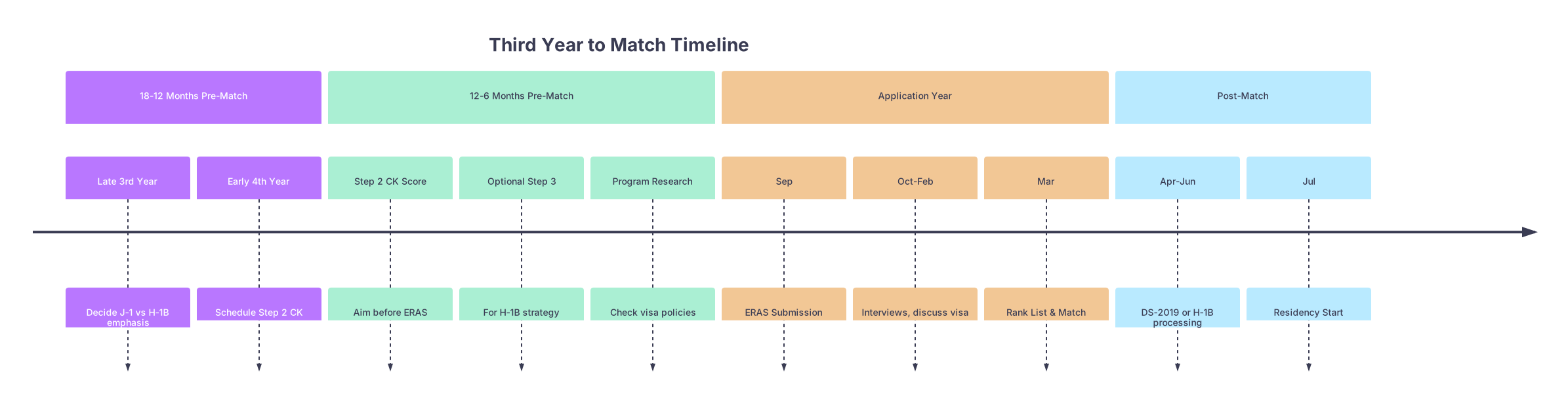
| Period | Event |
|---|---|
| 18-12 Months Pre-Match - Late 3rd Year | Decide J-1 vs H-1B emphasis |
| 18-12 Months Pre-Match - Early 4th Year | Schedule Step 2 CK |
| 12-6 Months Pre-Match - Step 2 CK Score | Aim before ERAS |
| 12-6 Months Pre-Match - Optional Step 3 | For H-1B strategy |
| 12-6 Months Pre-Match - Program Research | Check visa policies |
| Application Year - Sep | ERAS Submission |
| Application Year - Oct-Feb | Interviews, discuss visa |
| Application Year - Mar | Rank List & Match |
| Post-Match - Apr-Jun | DS-2019 or H-1B processing |
| Post-Match - Jul | Residency Start |
If, by this point, you’re not planning to do Step 3 before Match, you’ve basically accepted that J‑1 will be your primary path. That’s fine—but be honest about it.
Phase 3: 10–12 Months Before Match – “Build a Visa-Smart Program List”
This is when your friends are saying, “I’ll just apply broad and see who takes me.” That’s sloppy. You’re going to be better than that.
Step-by-step during this window (usually late 4th year / final year)
At this point you should:
Create a spreadsheet of potential programs
Columns you actually need:
| Program | Specialty | IMG Friendly? | J-1? | H-1B? | Step 3 Required for H-1B? |
|---|---|---|---|---|---|
| Program A | IM | Yes | Yes | No | N/A |
| Program B | IM | Moderate | Yes | Yes | Yes |
| Program C | FM | High | Yes | Rare | Maybe |
Research real visa policies, not assumptions
For each program:
- Check website for:
- “We sponsor J‑1 visas only”
- “We consider H‑1B for exceptional candidates with Step 3”
- “We do not sponsor visas”
- If website is vague, email the coordinator with a short, direct question:
- “Dear [Name], I’m an international medical graduate planning to apply to [specialty] for the 20XX Match. Do you sponsor J‑1 and/or H‑1B visas for residents?”
Save their responses. Programs sometimes change policy by year.
- Check website for:
Sort programs into three buckets
- Bucket 1: J‑1 only
- Your safest pool. Many community IM/FP/peds programs.
- Bucket 2: J‑1 + H‑1B friendly
- Gold mine if you have Step 3 done and strong scores.
- Bucket 3: No visa sponsorship
- Ignore unless you expect to have green card/citizenship by July of PGY‑1 (rare).
- Bucket 1: J‑1 only
Adjust your application strategy by visa path
- J‑1-focused IMG:
- Apply heavily to Bucket 1 + 2
- Do not waste money on Bucket 3
- H‑1B-hopeful IMG (with Step 3 or planning it soon):
- Still apply to J‑1 programs as backup
- Prioritize interviews at places that have clearly sponsored H‑1B recently
- J‑1-focused IMG:
You’re designing a matchable strategy, not a fantasy map of “dream” programs that will never file an H‑1B.
Phase 4: ERAS Season (Application Year) – “Signal Visa Readiness Clearly”
This is where IMGs either calm PD fears or set off alarm bells.
September – ERAS Submission
At this point you should:
State your visa situation plainly in your application
- In the ERAS “Personal Information” / visa sections, don’t be vague.
- If you have a current US status (F‑1, H‑4, etc.), list it.
- If you plan J‑1: programs assume ECFMG will handle the sponsorship. No need to write an essay about it.
- If you’re aiming H‑1B and have Step 3 done:
- Make sure Step 3 result is uploaded and visible.
- Consider a short, factual line in your CV or personal statement like:
- “I have completed all USMLE Steps including Step 3 and am eligible for H‑1B sponsorship.”
Avoid playing the “maybe I’ll get a green card” card
- I’ve seen people write “My family is applying for a green card; I might not need a visa.”
- Programs read that as: “Unclear, unstable situation = risk.”
- Until you actually have permanent residence, behave like you will need sponsorship.
If you’re on F‑1 (US med school or grad school)
- Understand the F‑1 → J‑1 vs F‑1 → H‑1B timing:
- J‑1: simpler; you’ll shift to J‑1 via ECFMG before residency.
- H‑1B: must coordinate OPT end date, H‑1B start, and residency start. This can be messy.
- At this stage, you just need solid documentation of your current status.
- Understand the F‑1 → J‑1 vs F‑1 → H‑1B timing:
Phase 5: Interview Season – “Have the Visa Conversation Without Tanking Yourself”
This part makes people nervous. It shouldn’t. But you do need to be smart.
October – February: Interviews
At this point you should:
Know how each program handles visas before you show up
- Recheck your spreadsheet.
- If the program is J‑1 only, don’t bring up H‑1B like it’s negotiable. It usually isn’t.
- If they’ve historically offered H‑1B, you can carefully signal openness.
Prepare 2–3 sentences about your visa situation
For J‑1-focused:
- “I’m an international medical graduate and will require visa sponsorship. I’m fully eligible for an ECFMG-sponsored J‑1 and understand the two-year home requirement and waiver pathways afterward.”
For H‑1B-credible (Step 3 done, strong scores):
- “I’m an IMG and will require visa sponsorship. I’ve completed all USMLE exams including Step 3, so I’m eligible for H‑1B sponsorship, though I’m also open to a J‑1 if that’s your standard.”
What you’re doing here:
- Showing you understand the process
- Making it clear you won’t be their first rodeo
- Reducing their anxiety about paperwork and deadlines
Don’t ask this question too early: “Will you give me H‑1B?”
Timing matters:
- On interview day, especially early in the conversation, pushing H‑1B can make you look like you care more about visa than training.
- Better approach:
- Ask coordinator or current residents neutrally:
“How does the program usually handle visas for IMGs?”
- Ask coordinator or current residents neutrally:
Use post-interview communication strategically
If you’re ranking a program highly because they’ve historically offered H‑1B:
- In a post-interview thank-you (if allowed), you can write:
- “Given that I’ve completed Step 3, I’d be grateful for consideration for H‑1B sponsorship if it remains available at your program, though I understand final decisions depend on institutional policy.”
They now know:
- You’re eligible
- You’re realistic
- You’re not demanding
- In a post-interview thank-you (if allowed), you can write:
Phase 6: Rank List & Match Week – “Lock In Reality, Not Fantasy”
February – Early March: Rank Order List
At this point you should:
Sort programs by three real-world filters:
- Would I actually train here 3+ years?
- Will they actually sponsor the visa type I can get?
- Does this combination leave me a viable post-residency path?
Quick mental ranking:
- Top: Places that sponsor J‑1 or H‑1B (consistent with your situation), where you’d be happy.
- Middle: J‑1 only but solid training, okay with J‑1 waiver path.
- Bottom: Programs that might cause issues: unclear policies, reluctant conversations about visas.
Be brutally honest with yourself about J‑1 vs H‑1B odds
- If you don’t have Step 3 done by this point:
- Your odds of getting H‑1B are already low.
- Rank J‑1 programs confidently; don’t pretend an H‑1B miracle is coming.
- If Step 3 is done:
- You may get H‑1B at some programs, J‑1 at others.
- Rank based on overall fit; don’t sacrifice a great program just to chase H‑1B at a mediocre one—unless your long‑term immigration plan absolutely demands it.
- If you don’t have Step 3 done by this point:
Phase 7: Post-Match – “Execute the Visa Paperwork Without Panic”
Now the rubber meets the road.
March – July Before Residency Start
At this point you should:
If you matched on a J‑1 path
Your timeline:
- March–April:
- Program confirms they’ll support your J‑1.
- You start ECFMG J‑1 sponsorship application.
- April–May:
- Collect:
- Valid passport
- ECFMG certificate
- Program contract
- Proof of funding (usually your salary letter)
- ECFMG issues DS‑2019 once everything’s in.
- Collect:
- May–June:
- Schedule visa interview at US embassy (if abroad).
- If already in US, you may change status through USCIS instead.
Things that cause delays:
- Expired passport
- Missing ECFMG certificate
- Slow program GME office. Push politely; they’re busy, but July 1 doesn’t move.
- March–April:
If you matched on an H‑1B
Very different game.
Your timeline:
- March:
- Program’s HR/legal confirms they will indeed file H‑1B.
- They ask for:
- USMLE transcripts (including Step 3)
- Medical degree + translations
- ECFMG certificate
- License/permit requirements for that state
- April–May:
- Employer files LCA and H‑1B petition.
- Many programs pay for premium processing to beat July 1.
- May–June:
- Visa approval, then consular stamping if you’re abroad.
If anything in that chain is missing (no Step 3, incomplete documents, late responses), you risk:
- Delayed start
- Forced switch to J‑1 at the last minute (yes, I’ve seen this happen)
- March:
If you’re currently in the US (F‑1, H‑4, etc.)
At this point you should:
- Coordinate carefully:
- End date of your current status
- Start date of J‑1 or H‑1B
- Do not assume “it will just roll over.” It often doesn’t.
- Stay in close contact with:
- Program GME office
- Their immigration attorney (if they use one)
- Coordinate carefully:
Phase 8: Thinking Beyond Residency – “Backwards Plan From Your Endgame”
This is where mature applicants separate themselves. Visa strategy doesn’t end with PGY‑1. You should be thinking 5–10 years out even in third year.
At this point (yes, back in third year) you should already know:
If you choose J‑1:
- You almost certainly will need:
- A J‑1 waiver job in an underserved area (3 years full-time)
OR - To spend 2 years physically in your home country
- A J‑1 waiver job in an underserved area (3 years full-time)
- The J‑1 waiver path is very workable for IM/FM/peds. Tougher for some specialties.
- You almost certainly will need:
If you choose H‑1B:
- You need:
- Employers willing to sponsor H‑1B for residency
- Then usually extend H‑1B for fellowship or attending
- Then transition to permanent residency (green card) with an employer willing to file
- You need:
Your third-year decision about J‑1 vs H‑1B focus is really a decision about:
- Where you’re willing to live after residency
- How quickly you need long‑term security in the US
- How much risk you can tolerate during training (H‑1B denials are rare but more consequential than J‑1 hiccups)
Final Takeaways
- Your visa outcome is shaped 18–24 months before Match, when you choose a J‑1 vs H‑1B–centered strategy and time your exams accordingly.
- By the time you hit ERAS, your job is to signal visa readiness clearly—Step 3 done if you want H‑1B, realistic program list, and concise visa explanations on interviews.
- After Match, execution beats anxiety: respond fast to program requests, get documents in early, and treat July 1 as a hard deadline, not a suggestion.
That’s the timeline. Follow it, and you control the visa side of your match—rather than letting it control you.