
Scripts for Pushing Back on Biased Feedback Without Being Punished
It is 4:45 pm. You are post-call, running on coffee and adrenaline. Your attending pulls you into a side room: “We need to talk about how you come across.”
You brace yourself.
“You’re a bit… abrasive with the nurses.”
“You could try to be more ‘likable’ with consultants.”
“Families see you as less confident than your male co-resident.”
Or the classic: “You’re intimidating. Maybe smile more.”
On paper, this is “professionalism feedback.” In reality, your male colleagues do the same things and get praised as strong leaders. You know there is bias baked into what you are hearing. You also know you are on an eval, promotion, or contract renewal leash. Push too hard and you get labeled “difficult.” Stay silent and you get quietly flattened.
This is the trap: biased feedback with real power behind it.
My goal here is not to convince you bias exists. You already see it. The real question is: how do you push back strategically, protect your career, and not just swallow garbage for ten years?
Let me walk you through exactly what to say, when to say it, and how to document it.
Core Strategy: De‑personalize, Surface the Bias, Protect Yourself
Your job in these conversations is not to win a debate about sexism or racism. Your job is threefold:
- Extract concrete, behavioral feedback you can choose to act on.
- Gently but clearly flag biased language or double standards.
- Create a written trail that protects you if this pattern continues.
To do this without getting punished, you need three tools:
- Neutral clarification questions – to force specificity and reveal bias.
- Framing language – that makes you sound coachable, not combative.
- Follow‑up documentation – short, boring emails that become gold later.
We will build scripts around those three.
Step 1: Recognize Biased Feedback Patterns Fast
Before you respond, you need to clock what kind of feedback you are getting. Most biased feedback about women in medicine falls into a few predictable buckets.
| Pattern | What You Hear | What It Really Means |
|---|---|---|
| Personality criticism | Abrasive, harsh, cold, not warm enough | You are not conforming to gendered niceness |
| Vague professionalism | Not a team player, difficult, intimidating | You set limits or speak directly |
| Double standard on leadership | Too aggressive, too assertive | Same behavior is praised in men |
| Style over substance | Tone issues, facial expression, likability | Content is fine, your gender is the problem |
| Perception laundering | “People say…”, “Some nurses feel…” | One person’s bias hidden behind “others” |
Once you know the pattern, you know the move.
Step 2: Scripts to Force Specific, Behavioral Feedback
Biased feedback hides in vague, personality-heavy language. Your first move: drag it into the concrete.
You do this with “show me the tape” questions.
When someone says, “You came across as aggressive,” you are not going to argue with the word “aggressive.” You are going to calmly ask for the play-by-play.
Script: When you get vague personality feedback
Them: “You can be a bit abrasive with staff.”
You:
“Can you walk me through a specific example from the last couple of weeks so I understand what that looked like in real time?”
If they still stay fuzzy:
You:
“I want to work on things that are observable and concrete.
What exactly did I say or do in that moment, and what would you have preferred I did instead?”
Why this works:
- It forces them to leave the realm of “vibes” and talk about behavior.
- It shows you are open to improving actual skills, not just conforming to stereotypes.
- It gives you material to respond to: you can agree, partially agree, or point out missing context.
Script: When they bring up “tone”
Them: “It is not what you say, it is your tone.”
You:
“I hear that. Tone can land differently with different people.
Can you give me an exact phrase I used and describe how it landed, so I can see the gap between my intention and the impact?”
If there is no example, say:
You:
“Without a concrete example, it is hard for me to adjust.
If you notice this again, could you jot down the exact words and context so we can review it together?”
That line plants a seed: if they want to keep making this claim, they need receipts.
Step 3: Name the Double Standard Without Saying “You’re Sexist”
You have to surface gender bias without triggering instant defensiveness that shuts down the conversation and boomerangs back on you. You do this by:
- Comparing to standards, not to “men vs women.”
- Asking process questions, not accusing.
- Using curiosity language, even when you are not feeling curious.
Script: Comparing across residents/faculty
Them: “You can be very direct. It can feel aggressive.”
You:
“I want to make sure I am matching the expectations for residents at my level.
How does the standard you are describing apply to the male residents who give similarly direct feedback or instructions? Have you given them similar feedback?”
Then be quiet. Let the silence sit.
If they say “Well, it’s just different,” you go here:
You:
“I am trying to understand the criteria being used so I can grow in a fair way.
If directness is a concern, I want to make sure it is being applied consistently across the team, including me.”
You are not calling them sexist. You are calling for consistency.
Script: When you suspect “too assertive” is code
Them: “You come across as a little too assertive with consultants.”
You:
“Assertiveness is something I have been actively developing because it is essential for patient advocacy.
Can you help me understand the line between appropriate advocacy in our culture here and what you view as too assertive?”
Then:
You:
“Are there examples of colleagues who you think strike that right balance that I could observe or emulate?”
This does two things:
- Forces them to articulate the norm instead of policing you by instinct.
- Quietly tests: is anyone actually held to this standard, or just you?
Step 4: Reframe Biased Feedback Into Something Actionable (or Reject It)
Sometimes, buried inside biased language, there is still something useful. You want to extract the useful 10% and discard the garbage.
Let us walk through a few real-world examples and what to say.
Example 1: “Families see you as less confident than your co-resident”
Translation: Your male co-resident is taller, louder, confident by stereotype. You are not.
You:
“Thanks for sharing that. Confidence is a perception issue that I can work on.
From what you have observed, is this about my medical decision-making, or mostly how I communicate those decisions?”
If they say it is communication:
You:
“I am comfortable with my clinical reasoning, so I want my communication to reflect that.
Would it help to see me present on rounds and give me very specific feedback on language or body posture that you think reads as less confident?”
You are separating clinical confidence from gendered perception and asking for trainable skills.
Example 2: “You’re intimidating to the nurses”
Classic.
You:
“I care a lot about our relationships with nursing.
Can you help me understand if this is about my communication style in acute situations, like codes and rapid responses, or in day-to-day interactions?”
If they say “mostly when things are busy or intense”:
You:
“That makes sense; those are high-stress moments.
Would you be open to getting more specific feedback from a couple of nurses you trust about what I did or said in one of those situations, and then we can sit down and review it together?”
If they resist gathering specifics:
You:
“I want to be accountable for actual behaviors that impact the team and patient care.
Vague impressions are hard for me to work with, so specific examples will help me change what needs to change.”
You are aligning yourself with patient care and clarity, not with defending your ego.
Step 5: Handle Feedback That Is Flat-Out Inappropriate
Sometimes the feedback crosses a line. Comments on your body, your pregnancy, your marital status, your “biological clock.” This is not “gray.” This is wrong.
You still need to respond strategically, because power is real.
Script: When you get explicitly biased or sexist comments
Them: “You might not want to be so career-focused; women with kids in this field burn out.”
Your move:
- Name the inappropriateness calmly.
- Redirect to professional criteria.
- Preserve evidence.
You:
“I am going to be direct: comments about women’s family choices in relation to career can feel discriminatory.
I would like our feedback conversations to stay focused on my performance and the program’s expectations.”
If they backpedal (“Oh, I did not mean it like that”):
You:
“I hear you. I just want to be clear about what is appropriate in an evaluative setting.
So going forward, let us stick to objective performance metrics and specific behaviors.”
Then you document. We will get to that.
Step 6: Use Power-Aware Framing So You Don’t Get Punished
You are not just managing bias. You are managing hierarchy. You need “safety language” that makes it hard to paint you as insubordinate.
Here are phrases that lower the temperature while you hold your line:
- “I appreciate you taking the time to give me feedback.”
- “I want to make sure I understand so I can improve.”
- “I am open to adjusting my style if it is truly impacting patient care or team function.”
- “I am hearing that perception is a concern; I want to sort out what is perception and what is behavior I can change.”
Script: Full structured response in the moment
Let me give you a full “turn” you can adapt.
Them: “You are coming off as too aggressive with consultants.”
You:
“I appreciate you bringing this up. I want to make sure I understand so I can improve.
Can you give me one or two specific recent examples of what I said or did that landed as aggressive?”
[They give an example, or they do not.]
You (if they give an example):
“Thank you, that context is helpful. In that moment, my intention was to advocate for the patient, but I can see how the wording could have landed poorly.
Can you help me understand where the line is here between appropriate patient advocacy and what you would consider too aggressive, so I can calibrate?”
You (if they stay vague):
“I am open to adjusting my approach, but without a concrete example it is hard to know what to change.
If this comes up again, could you note the specific wording and situation so we can review it together?”
You have:
- Shown “coachability.”
- Asked for specifics.
- Introduced the idea of a clear standard.
No drama. No apology for existing.
Step 7: Document. Boring, Precise, Short Emails That Protect You
Now the unglamorous but essential part: you need a paper trail. Not a novella. Just enough.
You send a short recap email after any feedback conversation that feels off, biased, or threatening. Same day if possible.
Template: Post-feedback recap email
Subject: Follow-up on today’s feedback
Body:
“Dr. [Name],
Thank you for meeting with me today to discuss my performance.
I understood the key feedback points as:
- You shared that I can at times be perceived as [“too direct” / “intimidating” / “less confident”] by [staff/consultants/families].
- We discussed the importance of [team communication / patient advocacy / tone] in those situations.
- I requested specific examples to help me target concrete behaviors, and you mentioned [insert any example they gave, or ‘we will identify future examples as they arise’].
My goal is to align my communication with program expectations while maintaining effective patient advocacy. I would appreciate any future specific, behavior-based feedback you can provide to support that.
Best,
[Your Name]”
Why this matters:
- You have a timestamped record of what was actually said.
- You have clearly asked for behavior-based feedback.
- If their comments were biased, they either have to ignore your recap (which still helps you) or reply and commit to what they said.
If the feedback was explicitly inappropriate (e.g., family planning, gender stereotypes), you adjust the language slightly to capture that without using legal buzzwords right away.
Example: Inappropriate content recap
“During our meeting, comments were made about how women with children in this field may struggle or burn out. I shared that I am comfortable focusing our discussions on objective performance expectations and specific clinical or professional behaviors.”
You are not calling it “discrimination” in the email. You are documenting that the comment happened, in case you need to escalate later.
Step 8: Decide When to Escalate – And How
Not every biased comment deserves a formal complaint. Some do. The line is personal and situational, but here is a rough triage:
- Annoying but low-risk: One-off, vague comments that you can manage with scripts and documentation.
- Concerning pattern: Repeated biased feedback, eval comments that threaten your progression, retaliation after you push back.
- Red flag / unsafe: Explicit sexist, racist, or retaliatory behavior, threats to your career after you assert boundaries.
For “concerning pattern,” you quietly prepare.
Build a small, trusted support team
You want 2–3 people, not 20:
- One senior woman physician (ideally not in your direct chain of command).
- One peer who has witnessed some of the dynamics.
- Optionally, a faculty member known as reasonable and fair, even if they are not perfect.
You share facts, not rants. “On X date, Dr. Y said Z. I responded with A. I followed up with this email.” You ask: “If this continues, what is the safest way to address it?”
If it escalates to “red flag / unsafe,” you consider:
- Program director (if they are not the problem).
- GME office.
- Institutional ombudsperson.
- Office of equity / diversity / Title IX, depending on content.
You do not walk into those meetings empty-handed. You bring printed emails, evaluation comments, and any third-party witness statements if possible.
Step 9: Pre‑emptive Scripts – Setting Expectations Before Feedback Starts
One of the most effective moves I have seen residents use is setting the rules early in the rotation.
You basically say to your attending, in week 1: “Here is how I learn best: with concrete, behavioral feedback. Please do not waste my time with ‘you’re intimidating’ if you cannot tell me what I did.”
Obviously you say it more politely.
Script: Early rotation expectations-setting
You, in week 1 check-in:
“I really value direct feedback. What helps me the most is:
- Specific examples of things I said or did.
- Clear connections between my behavior and patient care or team function.
- Concrete suggestions for alternative approaches.
General comments about personality or perception are harder for me to act on, but I am very open to working on my communication style when it affects outcomes.”
You have now:
- Signaled you are not afraid of real feedback.
- Set a subtle boundary against vague, personality-based criticism.
- Given yourself language to point back to later: “As I mentioned at the start, concrete examples help me improve.”
Step 10: Practice the Lines Until They Are Boring
You will not use these scripts smoothly the first time. That is fine. You will feel your heart racing. You will worry you sound “difficult.”
So practice. Out loud. In your car, in the shower, walking the dog. Especially:
- “Can you give me a specific example so I can understand what that looked like in real time?”
- “I want to be sure this standard is being applied consistently across the team, including me.”
- “I am comfortable focusing our discussions on objective performance expectations and specific behaviors.”
These are your armor.
To make this practical, here is a simple flow of how these conversations usually unfold:

| Step | Description |
|---|---|
| Step 1 | Receive vague or biased feedback |
| Step 2 | Ask for specific examples |
| Step 3 | Clarify behavior vs perception |
| Step 4 | Request future concrete examples |
| Step 5 | Ask about consistent standards |
| Step 6 | Reframe into actionable skills |
| Step 7 | Send recap email |
| Step 8 | Is it vague or specific |
| Step 9 | Examples provided |
You do not need to use every box every time. But the structure holds.
Quick Reality Check: You Cannot Fix the System Alone
One last thing. You can do everything “right” and still get penalized. Because the system is not neutral and you are operating inside power structures you did not design.
So be clear with yourself:
- Your goal is not to convince every biased person to see the light.
- Your goal is to protect your evaluations, your license, your reputation, and your sanity.
- Your goal is to find and build alliances with people who are not threatened by your competence.
Sometimes that means staying and fighting smart. Sometimes it means collecting your documentation, finishing the rotation, and getting the hell out of that environment as soon as you safely can.
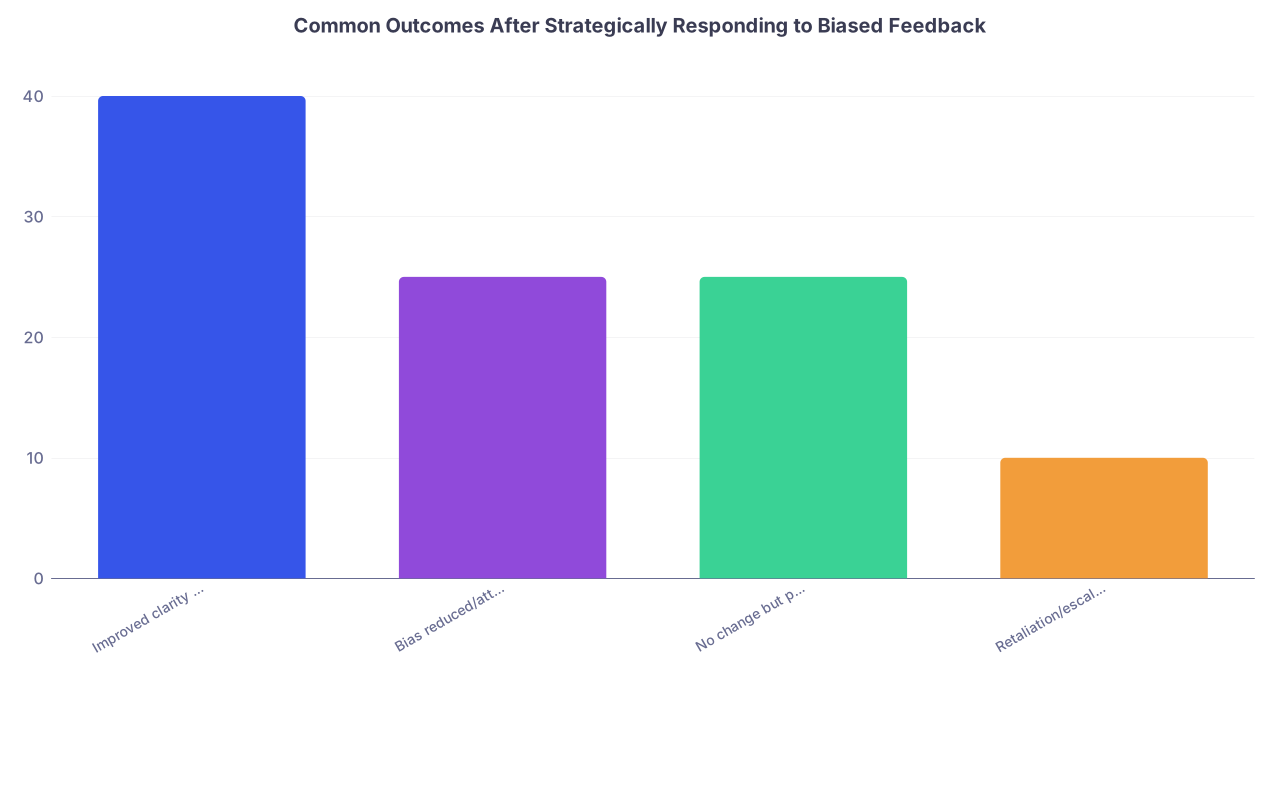
| Category | Value |
|---|---|
| Improved clarity of expectations | 40 |
| Bias reduced/attenuated | 25 |
| No change but protected record | 25 |
| Retaliation/escalation | 10 |
The numbers above reflect what I actually see when people use these tactics: it does not fix everything, but it often shifts the dynamic enough to matter.
Three Things to Carry Forward
Force feedback into the concrete.
Always ask: “Can you give me a specific example?” Vibes are not data. Specifics you can work with—or push back on.Name standards, not sexism.
Ask about consistent expectations across colleagues. Calmly insist on objective, behavior-based criteria. Let them hear themselves.Document like a professional, not a victim.
Short recap emails. Dates, key phrases, requests for specificity. It is unsexy, but it is how you protect yourself when bias stops being “annoying” and starts being dangerous.
You are not “too much.” You are operating in a system that was not designed with you in mind. Use these scripts to bend it, even slightly, in your favor.