
The average residency program’s idea of “work-life balance” is marketing fluff. Your job is to see past the brochure and figure out who actually walks the walk.
Here’s the answer you’re looking for: you choose a program that respects work-life balance by treating balance as a hard criterion, not a bonus. You look for specific structures, behaviors, and red flags. And you believe what current residents show you, not what leadership says in a slide deck.
Let’s break that down in a practical, step-by-step way.
1. Start With a Non-Negotiable Definition of “Balance”
If you cannot define work-life balance, programs will define it for you. And they’ll define it in a way that keeps you working.
For residency and early attending life, real work-life balance has at least these elements:
- Predictable, enforceable limits on hours and call
- Protected time that’s actually protected (didactics, clinic, days off)
- Culture that doesn’t glorify martyrdom or shaming people who go home on time
- Support for being a human being – health care, mental health, sick days, parental leave
- Reasonable control over your schedule outside of truly acute situations
If a program hits only one or two of those, that’s not balance. That’s survival.
You should write your own 3–5 personal non-negotiables before interview season. For example:
- “I will not join a program that routinely violates duty hours.”
- “I need at least 1 full weekend off per month, preferably more.”
- “I want a culture where residents can safely say no or ask for help.”
Everything else (prestige, big name, fellowship placement) sits underneath those.
2. Use Hard Data to Filter Before You Emotionally Attach
Do some cold-blooded screening before you fall in love with a shiny brand-name program.
Look at these structured factors:
| Factor | Good Sign | Red Flag |
|---|---|---|
| Duty hour violations | Rare, acknowledged, addressed | “We don’t track that” or “We just log 80” |
| Vacation | 4+ weeks, scheduled early, respected | 2–3 weeks, routinely changed or cancelled |
| Night float/Call | Clear caps, predictable rotations | Frequent cross-cover, vague expectations |
| Clinic vs inpatient balance | Thoughtful mix, staggered demands | Everyone overloaded at once |
| Wellness resources | Used and protected time, resident-driven | PowerPoints about burnout, no meaningful tools |
Now, add the trend side of it:
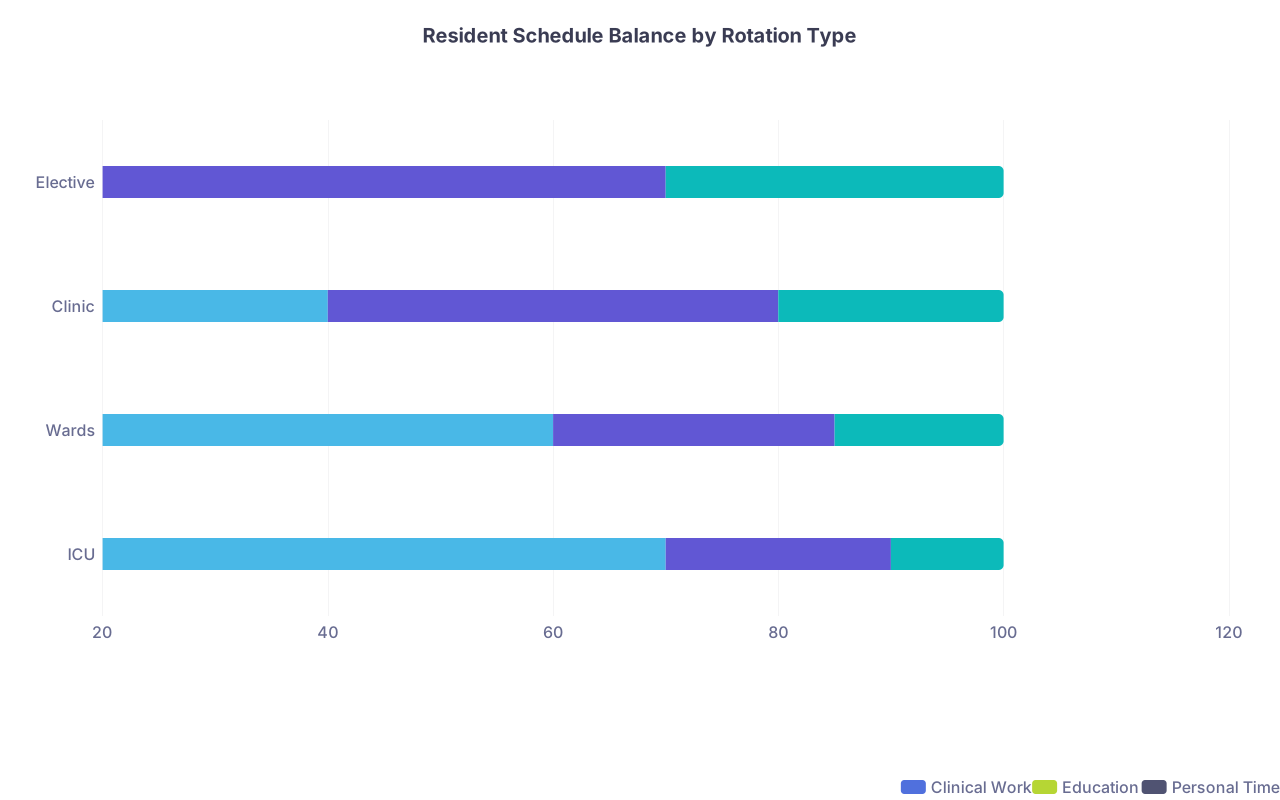
| Category | Clinical Work | Education | Personal Time |
|---|---|---|---|
| ICU | 70 | 20 | 10 |
| Wards | 60 | 25 | 15 |
| Clinic | 40 | 40 | 20 |
| Elective | 20 | 50 | 30 |
This is the kind of ratio you’re trying to uncover for each program: how much of your time is eaten by pure service vs teaching vs actual breathing room.
Where to find this information:
- Program websites (schedules, rotation structure, vacation policy)
- FREIDA / official ACGME summaries
- Program handbooks when available
- Residents on social media (people are more honest than brochures)
If anything is missing (“we don’t publish that”), treat that as data. Programs proud of their schedules usually show them.
3. Dissect the Call + Hours Reality (Not the Story)
Programs will tell you they’re “80-hour compliant” and “protect wellness.” The trick is figuring out what actually happens.
On interviews and second looks, ask concrete, non-fluffy questions like:
- “When you’re on wards or ICU, how many hours are you typically in the hospital in a week?”
- “How often do you stay past your scheduled end time on a normal day?”
- “In the last 6 months, how many times did you personally go over duty hours?”
- “What happens when someone is too sick to come in? Do you have a jeopardy system or is it basically ‘figure it out’?”
Watch how residents answer:
- Good sign: They give numbers, examples, and acknowledge busy blocks without defensiveness.
- Red flag: Laughing, eye contact between residents, “Well, officially…,” or “We’re encouraged to just log 80.”
Also ask about night float vs 24-hour call. Neither is automatically evil, but programs that lean heavily on old-school 24–28 hour calls with thin backup often push residents into the red zone.
4. Decode Culture: What People Actually Believe About Work
This is where most applicants fail. They look at schedule tables and miss the culture that makes the schedule livable—or toxic.
You’re trying to answer: “What is this program’s moral stance on my life outside the hospital?”
Look for these signals:
How people talk about going home:
- Good: “We really push each other to get out on time when possible.”
- Bad: “You can go home when the work is done,” said with a shrug when you know the work is never done.
Attitudes about asking for help:
- Good: “Senior residents want you to call early. You’re never punished for looping them in.”
- Bad: “You’ll learn to handle it,” or “You just figure it out at 2 a.m.”
Stories about leave and emergencies:
- Ask, “Have there been residents who needed medical leave or parental leave? How did that go?”
- Good: Clear process, no bitterness, examples of genuine support.
- Bad: Awkward pause. “We managed… it was hard for everyone.”
How faculty describe “strong residents”:
- Listen for: “balanced,” “asks for help,” “teaches others,” “consistent.”
- Red flag: “Always stays late,” “takes on extra shifts,” “never says no.”
You’ll hear the truth if you let people talk long enough and stop trying to impress them.
5. Ethics Check: Does This Program Treat Residents as People or Labor?
Work-life balance is not just personal preference; it’s an ethical issue. You are not cheap labor; you are a trainee with human limits.
Here’s the ethical checklist I’d use:
- Transparency: Are they honest about the hard parts, or do they spin everything?
- Responsibility: When something goes wrong (burnout, attrition, errors), do leaders talk about systems or blame individuals?
- Psychological safety: Can residents safely say, “I am not safe to work” without retaliation?
- Equity: Are certain groups (parents, international grads, women, residents of color) bearing more of the burden or punished for asking for accommodations?
Programs that get this wrong will grind you down, no matter how pretty the schedule looks on paper.
6. Use a Simple Decision Framework, Not Vibes
By the time rank lists roll around or you choose a job, everything is a blur. So you need a clear framework, not just “I liked the PD.”
Use something like this:

| Step | Description |
|---|---|
| Step 1 | Consider Program |
| Step 2 | Do Not Rank Highly |
| Step 3 | Rank Mid or Backup |
| Step 4 | Rank Near Top |
| Step 5 | Meets Core Wellness Criteria? |
| Step 6 | Residents Seem Genuinely Content? |
| Step 7 | Schedule Structure Works For Me? |
| Step 8 | Mission and Training Fit? |
Your Core Wellness Criteria (you define these before anything else) might include:
- No routine duty hour violations
- 4 weeks vacation, actually taken
- Jeopardy or backup system that’s real, not mythical
- Reasonable call burden with supervision
- Clear access to mental health care
If a program fails those, I do not care how big the name is. It doesn’t go near the top.
7. Red Flags You Should Not Rationalize Away
Let me be blunt: people talk themselves into bad situations all the time because the name is fancy or the city is fun. Then PGY-2 hits and they’re exhausted and stuck.
Red flags that usually predict trouble:
- Multiple residents privately say, “Do not come here” or “We survive, but that’s it.”
- Jokes about “you don’t need your 80 hours” or “we work hard, play hard” from leadership.
- Suspiciously over-polished interview day with no alone time with residents.
- Residents look visibly tired, guarded, or overly scripted in their responses.
- “We’re working on that” for every hard question (duty hours, scheduling, burnout).
- High resident attrition that’s hand-waved as “not a good fit.”
One or two yellow flags you can weigh against other factors. But a cluster of them? Believe them.
8. Practical Question Bank: What to Actually Ask
Here’s what you can literally read off your notes on interview day.
To residents:
- “What does a typical day on your busiest rotation look like—from wake-up to sleep?”
- “How many golden weekends (Sat+Sun off) do you get in a typical month?”
- “When you’re on nights, how do you flip back to days? Is there built-in recovery time?”
- “Have you ever felt unsafe because of fatigue here? What happened?”
- “How often do you see your friends/family during a busy month? Is that acceptable to you?”
- “What’s one thing you’d change about the schedule if you could?”
To faculty/leadership:
- “What are your expectations for residents taking work home—notes, reading, messages?”
- “How do you respond when a resident says they are burned out or overwhelmed?”
- “When was the last time you changed something in the program because residents asked?”
- “Do you track duty hour violations? What have you done when they’re frequent on a rotation?”
Listen for alignment between what residents say and what leadership says. Misalignment is a warning.
9. Personal Reality Check: What Balance Actually Looks Like in Training
You’re not signing up for a spa. You will be tired. You’ll work a lot. That’s baked in.
But there’s a difference between:
- Hard, meaningful work with clear limits, support, and respect
vs - Chronic overwork justified as “the way things are” while people quietly burn out
Reasonable expectations during residency at a good program:
- Some rotations that push you close to 80 hours, but not all year
- Real days off where you’re not constantly charting or responding to messages
- Mentors who explicitly say, “Go home,” and model it themselves sometimes
- Space to maintain at least one or two parts of your identity outside medicine (partner, parent, athlete, musician, whatever)
If what you’re hearing sounds like a lifestyle where everything but residency disappears for 3–7 years, that’s a deliberate culture choice. You do not have to sign up for it.
10. Final Step: Rank the Life You’ll Actually Live, Not the Brand on Your Badge
When you’re making your final choice—residency rank list, job offers, even fellowship—you should ask yourself three blunt questions:
- “If nothing changed about this program for the next 3 years, could I stay healthy here?”
- “Would I be proud to see a friend or my younger sibling train here?”
- “Am I choosing this for my actual life, or for how it will look on my CV or Instagram?”
If you’re honest, the answer is usually obvious. People just do not like what it implies, so they look away.
Do not look away. You only get one body, one brain, one early-career decade. Protect it.
FAQ: Choosing a Program That Respects Work-Life Balance
1. Isn’t all residency hard no matter where you go? Does balance really differ by program?
Yes, residency is hard everywhere. No, programs are not all the same. The difference is not whether you work; it’s whether the system respects your limits, gives you backup, and treats your time and health as real constraints. Some places do this well. Others run on guilt and heroics.
2. Should I ever choose a more prestigious program with worse balance?
Only if the trade-off is intentional and you’re genuinely willing to live that life. If the “prestige” opens doors you truly care about (very competitive fellowship, specific research niche) and the culture is demanding but not abusive, maybe. But choosing misery for a name you’ll stop caring about in 5 years is a bad deal.
3. How can I tell if residents are being honest with me on interview day?
Look at their faces and body language when you ask about hours and support. Watch whether they answer in specifics (“I usually leave by 6:30 on wards”) versus vague slogans (“We work hard but we’re a family”). Ask the same question to multiple residents separately and compare answers. Consistency is your best indicator.
4. Are programs that talk a lot about ‘wellness’ automatically better?
No. Some of the worst offenders have the shiniest wellness slides. What matters is structure: actual protected time, backup systems, transparent duty hour enforcement, access to mental health care that people use. If wellness means yoga once a month and cupcakes, but people are drowning, it’s theater.
5. I care about research/academics. Does that automatically mean worse balance?
Not automatically. Research-heavy academic centers often demand more, but some are very deliberate about schedule design and resident support. Others are exploitative. Treat “academic” as neutral and interrogate the same things: schedules, support, culture. There are community programs with excellent academic outcomes and better balance too.
6. What if my top ‘fit’ program is in a city or region where I don’t really want to live?
You’re choosing a life, not just a job. If the program is truly healthy and the city is just “fine,” I’d usually prioritize the program. But if the location would isolate you from all support systems or make you deeply unhappy, that erodes any balance the program gives you. Be honest about what you need outside the hospital too.
7. How much should I trust online reviews like Reddit or anonymous surveys?
They’re useful but noisy. People who are very happy or very angry post the most. Use them to identify patterns and specific concerns, then verify those by asking targeted questions on interview day and during second looks. Don’t let one bitter post tank a program, but don’t ignore consistent smoke either—there’s often fire.
Key points: define your own non-negotiable version of balance, interrogate programs using specific questions and real structures (not slogans), and trust the lived reality you see in residents over the brand name on the banner.