
You’re on day 11 of a 14‑day stretch on wards. You just finished signing out. You’re halfway to the parking garage when your senior texts:
“Hey, night float just called out. Any chance you can stay and cover? We’re desperate.”
Your stomach drops. You’re exhausted. You promised your partner you’d actually make dinner tonight. But you can hear the subtext: “Team player vs. problem resident.” You’re standing in the stairwell staring at your phone, wondering:
Is it okay to say no? Where’s the actual line between duty and being exploited?
Here’s the answer you’re looking for.
The Core Answer: Yes, You Can Say No. But Not Any Way, Any Time, or For Any Reason.
Let me be blunt:
- Ethically, you are not obligated to destroy your health or violate duty‐hour rules to “help out.”
- Professionally, you absolutely can hurt your reputation by reflexively saying no, or by saying it badly.
- Legally and from a safety standpoint, there are hard lines you should not cross, no matter who’s asking.
You’re always balancing three things:
- Patient safety
- Your own safety (physical, mental, and legal)
- Team and program culture
If taking the extra shift clearly risks the first two, saying no isn’t selfish. It’s responsible.
The trick is knowing which bucket a specific request falls into.
Hard Lines: When You Should Say No
Let’s draw the non‑negotiables first. These are situations where “no” isn’t just allowed — it’s the correct answer.
1. Duty Hours and Legal Limits
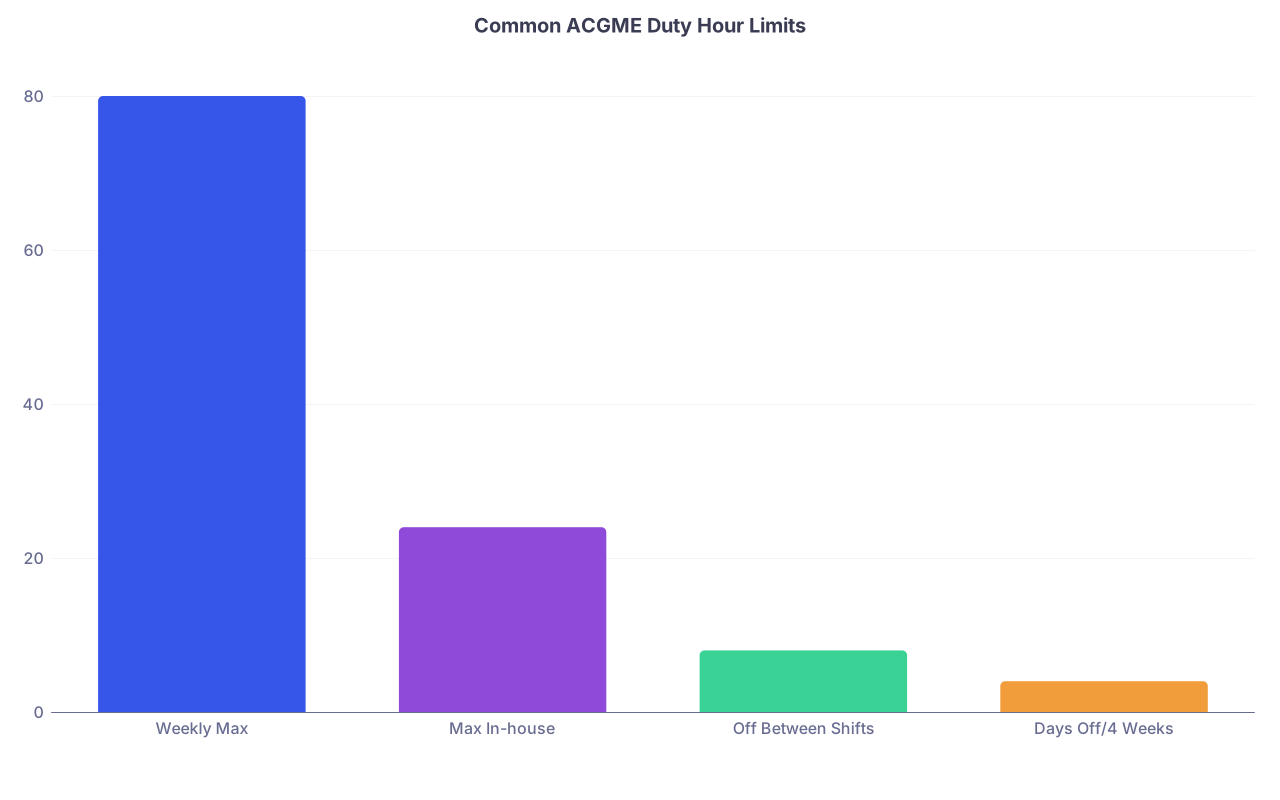
If the shift would put you over ACGME duty hours in a clear, documentable way, that’s a red flag.
Typical lines (check your specialty/program specifics, but they generally include):
- More than 80 hours/week averaged over 4 weeks
- More than 24+4 hours continuous in-house (24 of clinical work + a few for transition)
- Inadequate time off between shifts (e.g., less than 8 hours between major shifts; <14 hours after extended shifts in some specialties)
If you’re on hour 24 and someone wants you to cover another 12? That’s a hard no.
Because:
- Your judgment will be impaired
- Patient risk goes up
- If something bad happens, you’re on the note. And lawyers don’t care that “we were short.”
How to handle it:
“Given my current hours, that would put me over ACGME limits and I’m already at 24 hours in-house. I don’t think it’s safe for patients or compliant for me to stay.”
You’re not whining. You’re stating a regulation and safety concern.
| Category | Value |
|---|---|
| Weekly Max | 80 |
| Max In-house | 24 |
| Off Between Shifts | 8 |
| Days Off/4 Weeks | 4 |
2. When You’re Too Impaired to Be Safe
You already know the feeling:
- You’re nodding off between patients
- You read the same note three times and still can’t summarize it
- You’re making little mistakes and catching them late
Now someone wants you to pick up a last‑minute 12‑hour night shift.
If you wouldn’t trust yourself to drive an unfamiliar highway at 70 mph right now, you should not be managing unstable patients or writing chemo orders.
You owe it to patients — and to yourself — to say:
“I’m already at the point where I’m struggling to stay safe clinically. I’d be unsafe if I stayed or picked up that shift.”
If a senior or attending brushes this off, that’s a program problem, not a you problem.
3. When It Violates Your Contract or Hospital Policy
There are programs that “forget” what’s in your contract or quietly ignore policy, especially around:
- Maximum moonlighting hours
- Types of shifts you’re allowed to cover (e.g., intern alone in ICU)
- Required supervision levels
If the ask clearly violates written rules, you’re allowed to treat that as a boundary.
You can say:
“My understanding is that this coverage situation wouldn’t meet supervision or policy requirements. I’m not comfortable taking responsibility in a way that conflicts with that.”
You’re invoking policy, not just preference.
The Gray Zone: Where You Have a Choice
Most real‑world situations aren’t hard lines. They’re messy:
- You could physically do the shift… but you’d be more tired than ideal
- You could rearrange your life to make it work… but you’d miss something important
- The coverage gap is real… but you’re not the only possible solution
This is where residents either build a sane, sustainable reputation — or become the person everyone whispers about (for good or bad reasons).
A Simple Framework: The 3‑Box Check
Before answering, mentally check 3 boxes:
Safety:
Am I safe to work — for patients and myself? (Sleep, stress, recent errors, mental state)Pattern:
What’s my track record?- Have I generally been willing to help when possible?
- Or have I been saying no to almost everything?
Cost:
What does this specific shift cost me?- Missing a one‑off dinner?
- Missing a major life event?
- Pushing me from “tired” to “unsafe”?
- Enabling a program pattern of permanent understaffing?
If:
- Safety = OK
- Pattern = I usually help
- Cost = Annoying but not huge
Then saying yes is reasonable. You’re making a deposit in your reputation bank.
If:
- Safety = Borderline or bad
- Pattern = I’ve already done multiple favors recently
- Cost = High (health, mental, major personal event)
Then you’re absolutely justified in saying no.

| Step | Description |
|---|---|
| Step 1 | Request for extra shift |
| Step 2 | Say no - unsafe |
| Step 3 | Consider long term reputation |
| Step 4 | Say no - explain cost |
| Step 5 | Say yes if you want |
| Step 6 | Safe to work? |
| Step 7 | Recent pattern of helping? |
| Step 8 | Cost very high? |
How to Say No Without Burning Bridges
Saying “I can’t” isn’t the same as saying, “Not my problem.” The delivery matters.
Here’s a simple template that works 90% of the time:
Start with recognition
“I get that you’re in a bind and this is tough.”State your limit clearly, in one sentence
“I’m not able to safely take on another shift right now.”
Or: “I can’t pick up extra shifts this week because I’m already at my limit.”(Optional) Offer what you can do
- Help brainstorm alternatives
- Swap a different future shift
- Do handoff prep, remote work, or admin help instead
Stop talking
Don’t over‑explain. Don’t apologize 17 times. Don’t start listing your entire personal situation as if you’re on trial.
Example:
“Hey, I know coverage is tight and I’m sorry you’re in that spot. I’m already at 78 hours this week and I’m wiped — I don’t think I can safely cover tonight. If it helps, I can swap and cover one of the lighter weekend shifts later this month.”
That’s adult, reasonable, and defensible.
When It’s Ethically Right to Say Yes (Even If You Don’t Want To)
There are times when, in my opinion, you should seriously consider taking the hit.
Situations like:
- Your co‑resident has a genuine emergency (sick kid, family death, sudden hospitalization)
- A critical area would otherwise be completely uncovered (ICU, ED overnight, L&D when you’re the only resident)
- A mass casualty or disaster situation where everyone is being called in
This is basic solidarity. The kind of thing you’d want them to do for you.
You don’t have to like it. But occasionally stepping up in these moments is part of the professional and ethical social contract.
The key is occasionally. Not “whenever leadership mis‑schedules or under‑staffs.”
| Scenario | Ethically Strong to Say Yes? |
|---|---|
| Co-resident has family emergency | Usually yes |
| Chronic staffing issue, no crisis | Optional / boundaries OK |
| You’re at 80 hr week, still asked | Safer to say no |
| Disaster/mass casualty call-in | Strong reason to say yes |
| Program using you as default backup | Time to push back |
How Programs Cross the Line (and What to Watch For)
Sometimes your discomfort isn’t about one extra shift. It’s about a pattern.
Red flags:
- You’re repeatedly told, “We just don’t log that,” regarding extra hours
- The same 2–3 residents are always leaned on “because they don’t say no”
- You’re subtly shamed for having needs: “Well, some of us are team players…”
- Coverage problems feel chronic, not occasional
At that point, this stops being about your personal resilience and starts being about a systems problem.
You can respond by:
- Keeping an accurate personal log of your duty hours and shifts
- Bringing patterns (not single events) to your chief residents or program director
- Looping in GME or a resident council if safety or duty hours are repeatedly broken
No, this is not “making trouble.” This is called doing the job of a physician who’s responsible for safe systems of care.
| Category | Value |
|---|---|
| Fatigue/Safety | 40 |
| Personal Commitments | 20 |
| Duty Hour Concerns | 15 |
| Burnout Prevention | 25 |
Reputational Reality: How Saying No Affects How You’re Seen
Let me be clear: you can say no and still be seen as a strong resident. Many respected seniors and attendings do exactly that.
What matters is the pattern people see:
You look good when:
- You usually carry your fair share (or more) during normal hours
- You occasionally step up for genuine crises
- You set reasonable boundaries without drama
- You’re consistent — not available when convenient, flaky when it’s hard
You look bad when:
- You constantly talk about being “burned out” but then scroll Instagram at the nurses’ station while others hustle
- You say no reflexively with no explanation or alternative
- You only protect your time, never anyone else’s
It’s not about never saying no. It’s about living in that middle ground:
Respect your limits. Contribute like a professional. Don’t let fear of being “unliked” run your whole life.

Special Case: Moonlighting and Extra Pay Shifts
Different rules here.
If it’s internal moonlighting or extra shifts for pay:
- These are almost always optional by definition
- You are absolutely free to say no — often with zero explanation
- Your first obligations are to your core training duties and your health
If your program treats moonlighting as “strongly encouraged” to keep the hospital staffed, that’s a red flag. That’s not moonlighting; that’s under‑resourced planning.
Use a stricter filter here:
- Are you doing it only for money while your burnout is climbing? Slow down.
- Are your evaluations or learning suffering? That’s your sign to pull back.
- Are attendings or chiefs subtly pressuring you? Document everything and talk to trusted faculty or GME if needed.
A Quick Script Bank: What to Actually Say
You don’t need a novel. You need a few clean sentences.
Too exhausted / unsafe
“I’m already at the point where I’m not safe to keep working clinically. I’m not able to cover that shift safely.”Duty hour problem
“That would push me over our duty hour limits for the week, so I can’t take it on.”High personal cost, but you’d help in other ways
“I have an immovable commitment tonight and can’t take the shift. I can help by swapping later this month or covering an upcoming weekend if that helps.”Chronic pattern you want to push back on
“I’ve picked up several extra shifts recently and I’m at my limit. I can’t take on more right now — we probably need a more sustainable coverage plan.”You’re open but need boundaries
“I can help tonight if absolutely needed, but I’ll need to leave by 7 AM sharp and this can’t become a regular thing.”

How to Build a Healthy Long‑Term Pattern
To not be stuck in this same painful debate every week, do three things:
Decide your personal rules now.
For example:- I don’t exceed 80 hours.
- I don’t work when I’m unsafe.
- I will step up for genuine emergencies and for co‑residents in crisis.
- I won’t carry chronic system problems on my back alone.
Communicate like an adult early.
Tell your co‑residents and seniors, “I’m happy to help within reason and within duty hours, but I’m also trying to guard against burnout.”Track your reality.
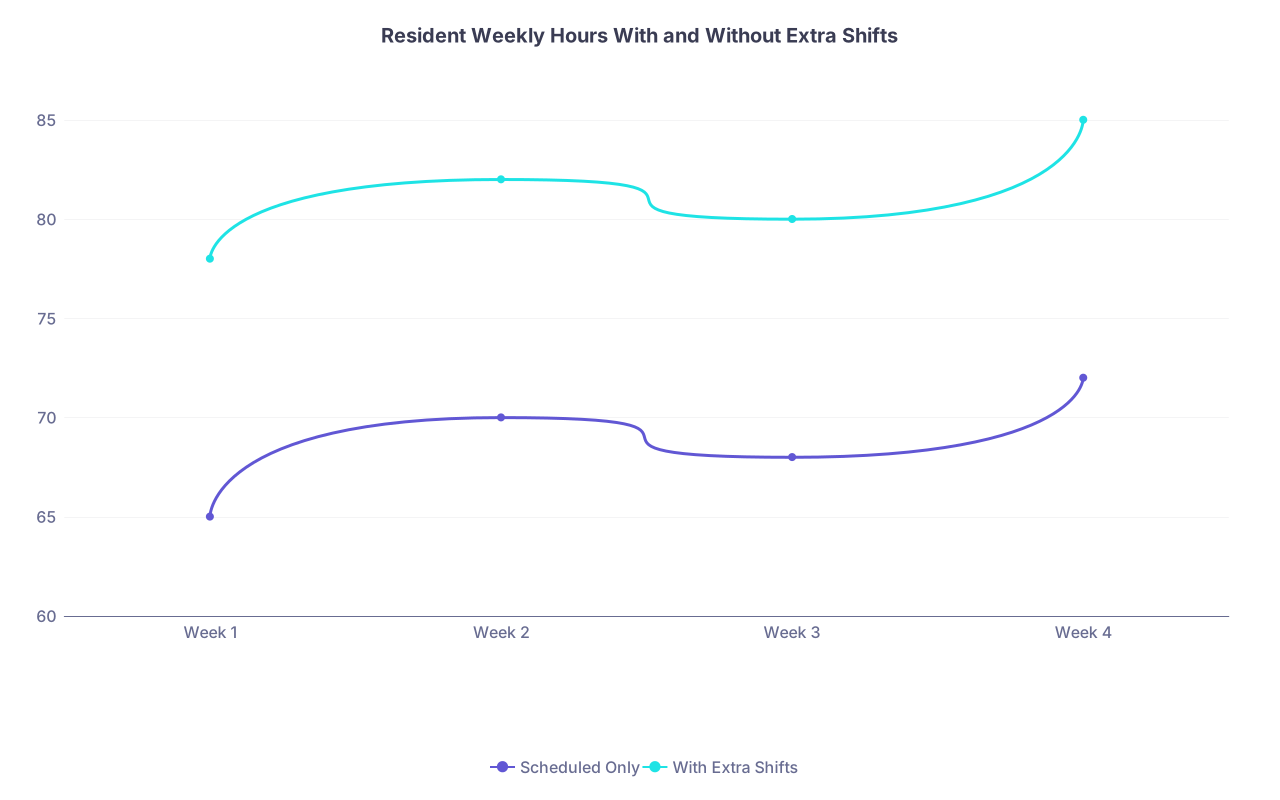
Keep a simple log on your phone of hours and extra shifts. Data is your friend when someone says, “We’re all working this much,” and you aren’t sure if that’s true.
| Category | Scheduled Only | With Extra Shifts |
|---|---|---|
| Week 1 | 65 | 78 |
| Week 2 | 70 | 82 |
| Week 3 | 68 | 80 |
| Week 4 | 72 | 85 |
FAQ (Exactly 5 Questions)
1. Will saying no to extra shifts hurt my chances at fellowship or a job?
Not automatically. Most fellowship directors care far more about your clinical competence, evaluations, letters, and academic output than how many unofficial shifts you picked up. What does hurt you is a reputation for being unreliable, difficult, or unwilling to carry your fair share during normal duties. If you usually show up strong and occasionally say no clearly and respectfully, you’re fine.
2. What if my program culture makes it feel like you can never say no?
That’s a toxic culture, not “normal residency.” Quietly talk to residents a year ahead of you, a chief you trust, or a faculty mentor. If the expectation is constant overwork and unlogged hours, that’s something to raise with the Clinical Competency Committee chair, GME office, or resident council. You’re not obligated to sacrifice your license and mental health because leadership won’t staff appropriately.
3. How do I know if I’m just being “weak” vs. legitimately needing rest?
Check your data, not just your emotions. Look at your hours this week, your sleep over the past 2–3 days, your error rate (almost ordering wrong doses, forgetting orders, missing pages), and your physical signs (headaches, nausea, micro‑sleep). If there are clear safety flags, that’s not weakness, that’s physiology. If you’re just annoyed or mildly tired, that’s different — you might choose to step up occasionally.
4. Is it ethical to prioritize my own mental health over extra patient coverage?
Yes. You’re not a replaceable machine part; you’re part of the safety system. A burned‑out, depleted physician is more likely to make errors, be unkind, and provide lower quality care. Ethically, caring for your own capacity is part of caring for patients. The line for me is: don’t abandon patients you’ve already accepted responsibility for; do set limits on additional work that would compromise your ability to care safely.
5. Can I get in trouble for reporting duty hour violations linked to extra shifts?
Programs are not supposed to retaliate for good‑faith reporting. Does informal retaliation sometimes happen? Sure. But you have more protection than you think, especially if multiple residents document the same problem and bring it through formal channels (duty hour reporting tools, GME, anonymous surveys). If you’re worried, talk to an upper‑level you trust or a faculty mentor about how to raise concerns strategically.
Today, take one concrete step: write down your personal rules for extra shifts — 3–5 simple lines about what you will and won’t do. Put them in your phone. Next time that “we’re desperate, can you stay?” text comes in, you’ll be responding from a plan, not from guilt and panic.