

You’re staring at a job application with that awful, vague question: “Is there anything in your personal history that might affect your ability to perform the essential functions of this job?”
Your cursor is blinking. You’re thinking about that year you were depressed. Or when you hit full-on burnout in residency and had to step away. You’re better now. But the question is sitting there like a trap.
Here’s the answer you’re looking for.
The Short, Direct Answer
Most of the time, you should not voluntarily disclose past depression or burnout on job applications or in early interviews.
Let me be very specific:
- If you’re currently stable, functioning, and cleared to work:
You do not have an ethical or legal obligation to bring up a past episode of depression or burnout. - If your condition is actively impairing your ability to do the job right now:
Your focus shouldn’t be on applying for the job yet. You need treatment and stability first. - If there’s a paper trail that employers will realistically see (e.g., board action, extended leave clearly documented, training gaps):
You don’t lead with it on the app, but you plan a concise, confident explanation if it comes up.
Mental health history is almost always private health information, not required “full transparency material.” People conflate honesty with oversharing. They’re not the same.
What Employers Can and Can’t Ask (Especially in Medicine)
Let’s clear the legal piece, because the ethics live on top of that.
In many countries (including the US), employers generally:
- Can’t ask: “Have you ever had depression, anxiety, or burnout?”
- Can’t require you to disclose past mental health diagnoses that aren’t currently impairing your work.
- Can ask: “Can you perform the essential functions of this job, with or without reasonable accommodation?”
- Can ask about current impairment, not your entire psychiatric history.
For physicians and other licensed professionals, the gray zone is licensing and credentialing forms, not standard job apps.
Licensing vs. Job Applications
Licensing questions can be more intrusive, but there’s been big movement to push them toward current impairment instead of “have you ever.”
Common patterns:
Better / more modern wording:
“Do you have any condition that currently impairs your ability to practice safely?”Worse / older wording:
“Have you ever been treated for a mental health condition, substance use, or emotional disorder?”
If you’re facing the second type, you’re in a different ethical and legal territory. Those are often challenged by advocacy groups, but if it’s on the form, you usually must answer honestly or seek clarification with the board.
Job applications, though? For a private employer or hospital system? They generally don’t need to know your past depression if you’re fine now.
Ethics: Am I Lying If I Don’t Tell Them?
No. Withholding protected health information is not lying. It’s setting a boundary.
Here’s the ethical breakdown:
- You have an ethical duty not to misrepresent your current ability to do the job safely.
- You do not have an ethical duty to share every past health event that didn’t leave lasting impairment.
- Being a “good doctor” or “good professional” doesn’t mean being emotionally naked in front of HR.
If a form asks:
“Can you perform the essential functions of this job, with or without reasonable accommodations?”
and the honest answer is yes, then “yes” is the full answer. You are not obliged to add: “…and by the way, three years ago I was depressed.”
The line you absolutely can’t cross:
If you know you aren’t currently safe to practice or do the job, and you say you are, that’s a problem. Ethically, professionally, and legally.
When Should You Consider Disclosing?
There are cases where bringing it up—strategically and briefly—can make sense. But this is the exception, not the default.
You might consider targeted disclosure when:
There’s a visible gap or documented event
Example: a 6-month leave clearly marked in your training timeline, a non-renewal, or remediation.The employer or program already knows something happened
Maybe your PD mentioned “extended leave,” or you took formal FMLA leave that’s documented.You’re asking for a specific accommodation
Reduced nights, protected therapy time, or specific scheduling constraints. You don’t need a diagnosis label, but you may need to say something functional like:
“I’ve worked with my clinician and have an ongoing medical condition that’s well controlled with regular outpatient care. To maintain that, I’ll need one afternoon every other week reliably blocked for treatment. I fully expect to meet all productivity and clinical expectations.”The culture is explicitly mental-health-forward, and you judge it’s safe
Some academic departments or progressive organizations actually value this as resilience and insight—but do not count on this. That’s context-dependent and requires you to read the room accurately.
When you do disclose, the key is:
- Keep it brief
- Focus on recovery and stability
- Emphasize your track record since that episode and how you now function reliably
Something like:
“During my third year of residency, I had a period of significant burnout that led me to take a brief medical leave. I engaged in treatment, made specific changes in how I manage workload and support, and I’ve been fully functional and practicing safely since then. My evaluations and performance over the last two years reflect that stability.”
Clear. Responsible. And you stop talking there.
When You Should Not Disclose (And Why)
Let’s be blunt: bias exists. People say all the right DEI and wellness words and still screen out candidates they think might be “fragile” or “high risk.”
You should not disclose past depression or burnout when:
- The application doesn’t ask directly for health information.
- There’s no obvious gap or red flag that needs explanation.
- You’re applying to a culture that’s clearly old-school or macho about suffering (“We all survived 120-hour weeks, you’ll be fine.”).
- You’re early in the process (applications, first screen). They need to see your skills and value first, not your vulnerabilities.
HR is not your therapist. And early-stage interviewers are often using highly imperfect heuristics to narrow down a huge pool. Don’t give them an easy reason to toss your file.
Medicine-Specific Considerations: Boards, Credentialing, Malpractice
Here's where it gets more tangled for clinicians.
Licensing Boards
Read every word of the question. Twice.
Typical variations:
“Do you have a condition that currently impairs your ability to practice medicine safely?”
If you’re stable, functioning, and cleared: you can usually answer no.“Have you, in the past 5 years, been hospitalized or involuntarily committed for a mental health or substance use condition?”
If that happened: you probably must say yes and give the brief explanation they ask for.
If you’re not sure whether something “counts,” this is not something you guess on. You talk to:
- A physician health program (PHP) or advocacy group in your state
- A lawyer who knows medical licensure
- Possibly your therapist/psychiatrist for documentation
Hospital Credentialing
Credentialing committees may:
- Look at gaps, references, and performance, not diagnosis labels
- Ask: “Any issues that could affect your ability to safely practice?”
Again, the frame is current safety, not every past struggle.
If you had serious impairment that affected patient care or required substantial leave, you prepare a short, factual explanation that ends in:
“I have been fully stable and practicing without impairment since [year], under regular care.”
Malpractice Concerns
People worry: “If something goes wrong and they find out I had depression, will I be destroyed in court?”
Lawyers love whatever makes a story. But there’s a key point:
- Untreated, active impairment with no action taken is a bigger liability than treated, stable mental illness in the past.
- You’re much safer ethically and legally if:
- You got help
- You complied with treatment
- You removed yourself from unsafe practice when needed
- You returned when cleared and stable
That actually strengthens your position, not weakens it.
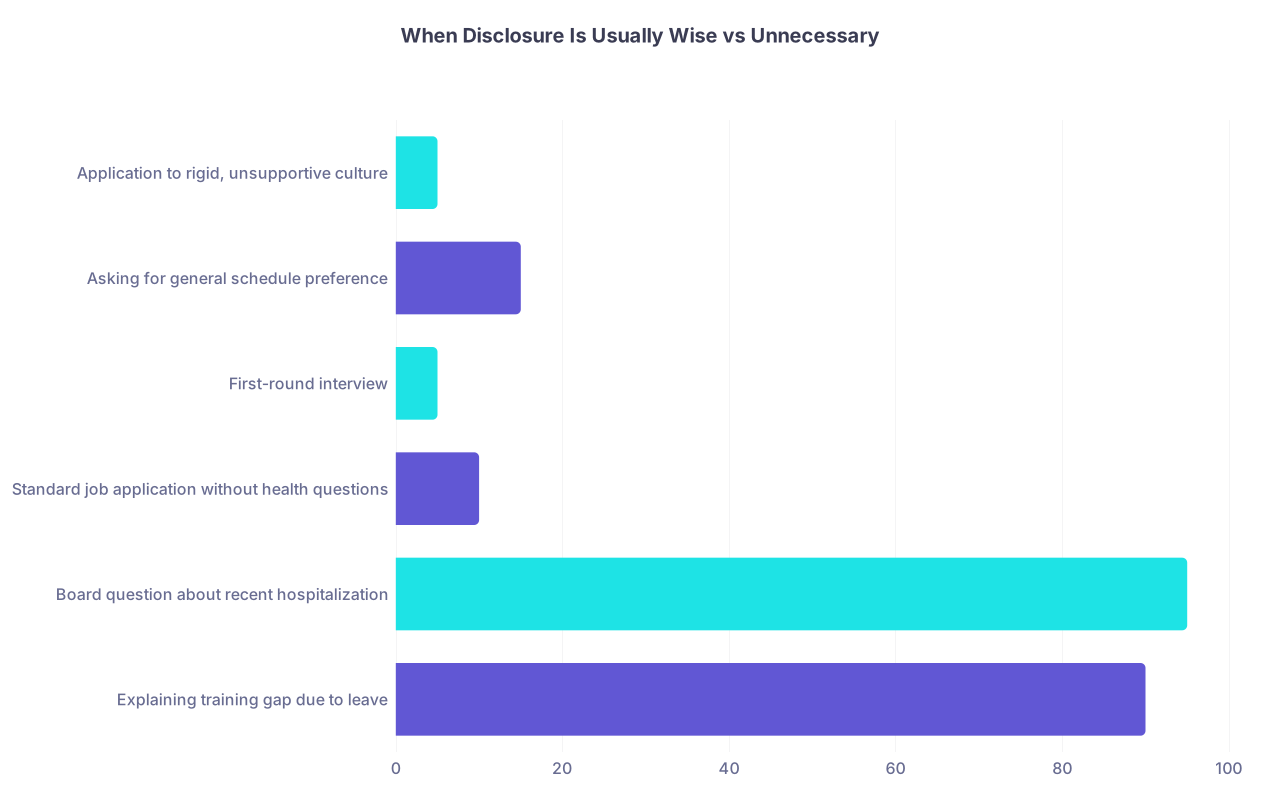
| Category | Value |
|---|---|
| Explaining training gap due to leave | 90 |
| Board question about recent hospitalization | 95 |
| Standard job application without health questions | 10 |
| First-round interview | 5 |
| Asking for general schedule preference | 15 |
| Application to rigid, unsupportive culture | 5 |
(Values are approximate “percent of the time disclosure is helpful/necessary” judgments, not actual statistics.)
How to Talk About It If You Have To
If disclosure is unavoidable or strategically smart, here’s the basic structure:
Name it simply, or even just describe what happened functionally
“I had a period of depression that required treatment and brief leave.”
or
“I had a medical issue that led to short-term leave.”Emphasize action
“I sought help quickly, engaged fully in treatment, and followed all recommendations.”Show resolution and track record
“I’ve been back to full-time, safe practice for [X years/months] with strong evaluations and no further interruptions.”Pivot back to now
“This experience actually sharpened my boundaries and resilience. I manage my workload and self-care very differently now, and that’s reflected in my recent performance.”
What you do not do:
- Launch into your entire mental health history
- Over-apologize or act ashamed
- Invite them to judge whether you’ve “suffered enough” or “are strong enough”
You present it like you’d present any other past medical event that’s now resolved. Calm. Factual. Done.
Practical Decision Framework
Here’s a quick mental flowchart you can run through:

| Step | Description |
|---|---|
| Step 1 | Considering disclosure |
| Step 2 | Answer truthfully, briefly. Consider legal/advocacy help. |
| Step 3 | Clarify question with HR or legal if possible |
| Step 4 | Prepare short, recovery-focused explanation |
| Step 5 | Explain functional need, minimum health detail |
| Step 6 | Do not disclose in early application or interview |
| Step 7 | Is there a direct question about diagnosis or treatment? |
| Step 8 | Is this a licensing or official form? |
| Step 9 | Is there an obvious gap or formal leave? |
| Step 10 | Do you need a formal accommodation now? |
If you walk through that honestly, you usually land at: don’t disclose upfront.
How This Ties Back to Your Own Ethics and Well-Being
This isn’t just about getting the job. It’s about not re-injuring yourself.
Over-disclosing to the wrong audience can:
- Expose you to bias from people who don’t understand mental health
- Create a power imbalance you can’t undo
- Make you carry emotional labor that HR and hiring managers are not qualified to hold
Your mental health story belongs first to you, your clinicians, and trusted peers. Not to a stranger screening 200 applications on a Tuesday afternoon.
You can still live your values—honesty, integrity, transparency—without handing over your full psychiatric file to every employer who asks a vague question.
FAQ: Common Questions About Disclosing Past Depression or Burnout
1. What if I was hospitalized for depression during training—do I have to mention that?
For job applications: usually no, unless they specifically ask about past hospitalizations (most don’t).
For licensing/credentialing: if the form explicitly asks about psychiatric hospitalization within a time window (e.g., 5 years), you generally must answer honestly. That’s where you keep it brief: what happened, that you got treatment, and your stable functioning now.
2. How do I explain a 3–6 month gap on my CV without saying “depression”?
You can use neutral language like:
“Medical leave – fully resolved,” or “Personal medical leave” on the CV itself.
If asked in an interview:
“I had a health issue that required a short-term leave. I followed treatment, recovered fully, and I’ve had no further interruptions since. My evaluations after that period reflect strong performance.”
You don’t need to label it as depression or burnout unless there’s a direct, legitimate reason.
3. Can I get in trouble later if I don’t disclose past depression and they find out?
If you were asked a clear, direct question about past treatment or hospitalization on an official form and you lied, yes, that can be a problem.
If you were asked about current ability/impairment and you truthfully answered yes, you can do the job, then no—you’re not in trouble because you didn’t volunteer extra history. Employers and boards are not entitled to your full medical chart by default.
4. Should I disclose in a “tell us about a challenge” interview question?
Usually no. It’s tempting to turn your depression or burnout story into a polished “overcoming adversity” narrative. And sometimes it works. But you’re taking a real risk with bias, especially early in the process. Use a different challenge—academic setback, failed project, conflict with a supervisor—where the “risk” to them is lower. Save your mental health story for trusted spaces, not generic interview questions.
5. What if I want to disclose because it’s part of my identity and growth?
That’s valid. But you should treat it like any other high-risk disclosure:
- Read the culture first.
- Consider timing—better once they’ve signaled strong interest or after you’re already in the organization.
- Be very intentional about what you share and why.
If your goal is advocacy and destigmatization, that’s great—but it’s safest to do from a position of some established security, not while they’re still deciding if you get a job offer.
6. What’s one sentence I can use if I’m put on the spot and don’t want to go there?
Use something like:
“I did have a personal medical issue earlier in my training, but it’s been fully addressed and I’m functioning well now. I’d prefer to keep the details private, but I’m happy to talk about how I’ve ensured my reliability and performance since then.”
It draws a line, answers the functional concern, and doesn’t open the door to interrogation.
Here’s your next step:
Pull up the last job or credentialing form you filled out (or one you’re about to start). Read every health-related question and rewrite each one in your own words as “Are they really asking about past diagnosis, or current impairment?”
Answer those rewritten questions honestly on a separate page. That becomes your internal guide for what you’ll disclose, what you’ll keep private, and where you might need a polished one- or two-sentence explanation ready.


