
You’re post-call, staring at the next month’s schedule. They’ve given you three straight weekends, a string of nights that nukes your partner’s only days off, and you’re supposed to be in your sibling’s wedding in the middle of it. You’re exhausted, a little angry, and you already hear the voice in your head:
“If I ask for a change, they’ll think I’m not a team player.”
Here’s the blunt truth: there is a right way to ask for a schedule change that massively lowers your odds of backlash. And there are a few very common, very avoidable ways to do it that will absolutely burn goodwill.
Let’s walk through how to do this like a professional adult who cares about patients, colleagues, and their own life—and doesn’t want to get crushed for speaking up.
Step 1: Get Your Story Straight Before You Ask
Don’t fire off a quick text or hallway ask while you’re annoyed. That’s how you sound entitled or sloppy.
First, answer three questions for yourself:
What exactly do you need changed?
Not “this schedule sucks.” Specifics.
“I’m scheduled 7 nights in a row starting 3/10; I need 3/16 off for a family wedding.”
Or: “I’ve been on 4 of the last 5 weekends; I’m asking to have 1 weekend day off next block.”Why is this ethically or practically reasonable?
Frame it in terms that matter in medicine:- Fatigue and patient safety
- Duty hour violations
- Equity across residents or staff
- Pre-approved time off that wasn’t honored
- Serious personal obligation (wedding you’re in, funeral, major exam)
What are your suggested solutions?
The worst thing you can do is show up with a problem and no ideas.
Build at least one concrete option:- Someone who’s already said they’d swap
- Two possible dates you could cover in exchange
- A plan to keep coverage safe (no gaps, no one breaking legal limits)
Do that prep, and you’re already in the top 10% of “people who ask for schedule changes without making everyone hate them.”
Step 2: Choose the Right Channel and Timing
How you ask matters almost as much as what you ask.
Who to talk to
Usually:
- Residents → chief resident or scheduler
- Attendings → division admin or medical director
- APPs / nurses → unit manager / scheduler / charge nurse (for day-of issues)
Don’t go three levels above the person who actually controls the schedule—unless there’s clear bullying or repeated bad faith.
How to communicate
Flat rule: if it’s a non-urgent change more than a few days away, use email or the scheduling system first; then follow up in person if needed.
Urgent (same-day / next-day):
- Use phone or direct message as your first contact
- Then document it in email or the system
Texting a chief at 11 pm about a non-urgent change for two weeks from now? That’s how you train people to resent you.
Step 3: Use a Script That Signals “Adult Professional, Not Drama”
You don’t need to sound robotic, but you do need to hit certain beats: appreciation, clarity, solutions, and respect for patient care.
Here’s an email template you can shamelessly copy and adapt:
Subject: Request for schedule adjustment – [Your Name], [Dates]
Hi [Name],
I noticed I’m scheduled for [brief description – e.g., nights 3/10–3/16, including 3/16]. I have [brief reason – “a family wedding I’m in that day” / “a previously discussed commitment” / “a medical appointment that can’t be moved”] on [date].
I want to make sure we keep coverage safe and fair, so I’ve already:
- Spoken with [Colleague], who’s open to swapping [their shift/dates] with me, or
- Identified a couple options for trade: I can take [X or Y] in exchange.
Would it be possible to adjust my schedule so I’m off on [specific date], using one of the options above or something similar that you think works better for the team?
I appreciate how tight scheduling is and don’t want to create gaps in coverage. Happy to discuss other ways to make this work.
Thanks for considering it,
[Name]
[Role / PGY level, if relevant]
In person, same structure:
“Hey [Name], do you have five minutes to talk about the schedule? I saw I’m on [describe]. I have [reason] on [date]. I’ve talked to [Colleague] who might be willing to swap [X], or I’m happy to cover [Y]. Is there a way to adjust that day while keeping coverage okay?”
This is direct, not apologetic, and very clearly puts patient care and fairness on the table.
Step 4: Do the Ethical Homework: Fairness, Safety, and Transparency
You’re in medicine, not a random office job. There are ethical angles here.
Here’s what you need to keep in mind:
Patient safety beats personal convenience.
If your change would create an unsafe stretch for someone else (e.g., 24+ hours without rest, clear duty hour violations), you’re putting them and their patients at risk. Don’t propose swaps that just move the harm.No dumping shifts on the most vulnerable.
If you always ask the same PGY-1 or always stick nights on the least powerful person, that’s not “being resourceful.” It’s unethical and everyone sees it. Spread trades and favors around.Be honest about why.
You don’t need to share your entire life, but don’t fake a “medical emergency” because you want to go to a concert. Once you’re caught lying about this stuff, trust is gone—and trust is what gets you grace later when you have a real crisis.Track the give-and-take.
Keep a mental log: who’s covered for you, who you’ve helped. You don’t need to keep a spreadsheet, but you should be able to honestly say, “I’ve taken extra weekends to allow others their events too.”
Step 5: Common Traps That Do Create Backlash
These are the landmines. Avoid them and you’re already ahead.
Asking last minute for something that’s been on the calendar for months.
Example: Telling the chief on Thursday that you “just remembered” your best friend’s Saturday wedding that you’ve known about for a year. That’s how you earn the label “unreliable.”Making it someone else’s job to fix your problem.
“I can’t work this day. Please change it.”
No swap suggestion. No flexibility. That’s a hard no in most programs.Playing the martyr card.
“I’ve worked so hard, I deserve this.”
Everyone works hard. That argument just annoys people.Implying discrimination or “unfairness” without data.
If you’re going to say, “I feel like I’m getting more nights / weekends than others,” you need numbers, not vibes. Otherwise you look like you’re just complaining.Going around the chain of command as your first move.
Going straight from “schedule is annoying” to “emailing the program director and GME office” is how you get a reputation for being dramatic. Escalate only after local attempts fail or if there’s a clear pattern of retaliation or abuse.
Step 6: When the Reason Is Health, Burnout, or Safety
This is the part people don’t like to touch, but it’s real.
If you’re asking for a schedule change because:
- You’re so sleep-deprived you’re making dangerous mistakes
- Your mental health is tanking (panic attacks at work, suicidal thoughts, serious depression)
- You have a health condition that’s getting worse with nights or long stretches
You’re not being “weak.” You’re actually doing your ethical job.
Approach it this way:
- Loop in the right ally: program director, trusted attending, or occupational health.
- Use clear, safety-oriented language:
“I’m worried that if I stay on this sequence of nights, I’m not safe to care for patients. I’d like to talk about a temporary schedule adjustment or other support options.” - Expect some skepticism from a few people. That doesn’t mean you were wrong to ask. It means the culture still has catching up to do.
If they blow you off and you’re genuinely unsafe, that’s when you escalate—GME, ombuds, or even outside resources if needed. Ethically, you’re on much stronger ground protecting patients and your health than pretending everything is fine.
Step 7: How to Handle “No” Without Torching Relationships
Sometimes the answer is simply: “We can’t change this one.”
You don’t have to like it, but how you respond matters.
Good response: “Thanks for looking into it. I understand the constraints. If a spot opens or someone is open to a swap later, I’d still be interested. I’ll also try to find safe trade options on my end.”
Bad response:
“This is unfair. Other people get what they want.”
or
“So I just have to miss this and suck it up?” (said with an edge)
What you’re doing when you respond well is obvious: you’re teaching them that you’re reasonable and rational even when you don’t get what you want. That’s exactly the kind of person they’re more likely to help next time.
Quick Reality Check: When You Shouldn’t Ask
A few scenarios where pushing hard is more likely to backfire than help:
- You’re already the person who’s constantly swapping, late, or unreliable. You haven’t rebuilt trust yet.
- You’re trying to dodge an objectively fair “bad” rotation everyone else does.
- You’re asking for a “preference” (don’t like weekends) during a time everyone is needed (July, holidays, known high-volume weeks) and you’ve given no prior heads-up.
In those cases, either accept the shift or pair your ask with a significant give:
“I know this is a rough time. If I can get [X] off, I’ll happily take [Y or Z] that others usually avoid.”
Tiny But Powerful Moves That Lower Backlash
A few tactics that make your request land better:
- Ask early. The earlier you ask, the more likely “yes” and the less annoyed they are.
- Use neutral, professional language. Not whiny. Not aggressive.
- Mention patient care once. It signals you’re thinking beyond yourself.
- Say thanks clearly. Not over-the-top. Just: “Thanks for considering it” or “I appreciate you looking at this.”
- When someone does swap with you, repay that favor. Publicly thank them. Chiefs notice.
| Approach Type | Example Behavior |
|---|---|
| Good | Asks 4+ weeks ahead with swap option ready |
| Good | Frames reason briefly, honestly, and ties to safety/fairness |
| Mixed | Last-minute but for genuine emergency, with apology |
| Bad | No solution offered, demands day off as a right |
| Bad | Repeated vague “mental health” claims with no follow-through on care or discussion |
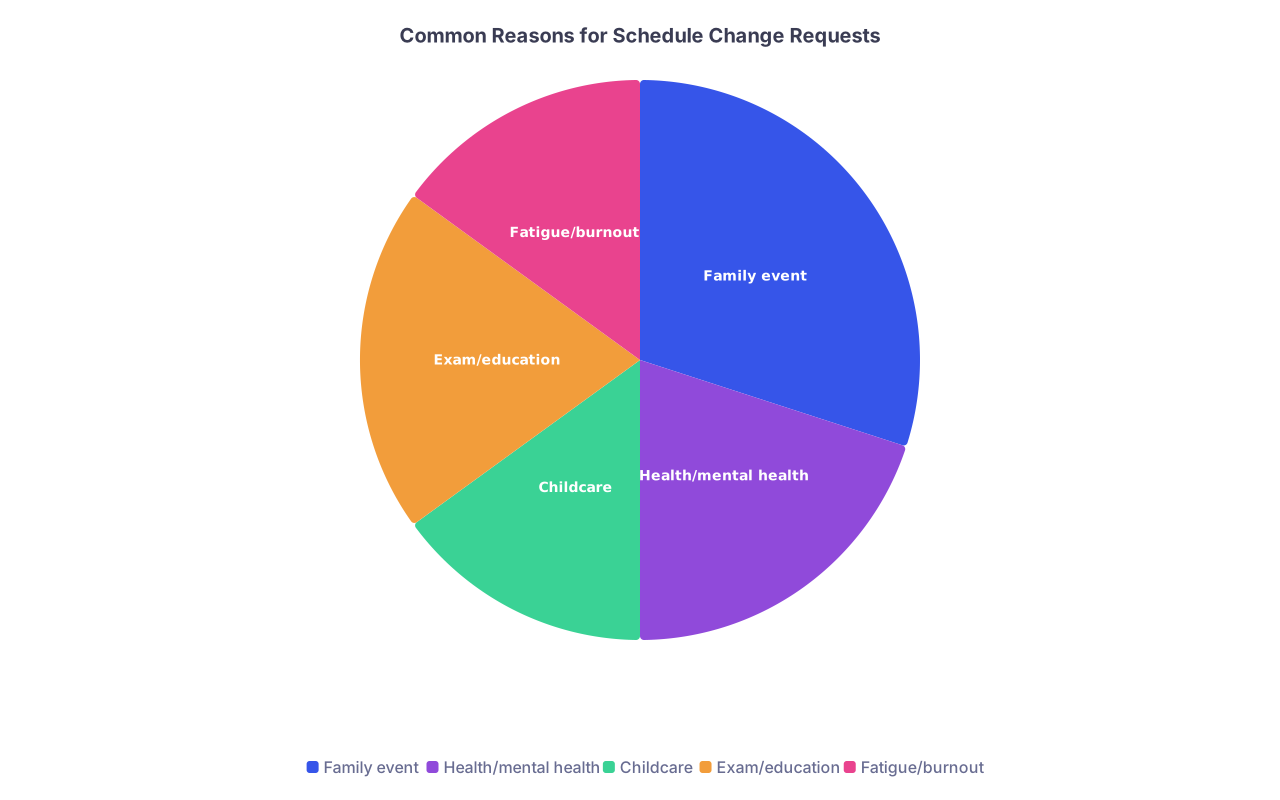
| Category | Value |
|---|---|
| Family event | 30 |
| Health/mental health | 20 |
| Childcare | 15 |
| Exam/education | 20 |
| Fatigue/burnout | 15 |

| Step | Description |
|---|---|
| Step 1 | Need schedule change |
| Step 2 | Call or message scheduler |
| Step 3 | Draft email with solution |
| Step 4 | Identify swap options |
| Step 5 | Send request |
| Step 6 | Confirm coverage and document |
| Step 7 | Confirm and thank |
| Step 8 | Decide to accept or escalate |
| Step 9 | Is it urgent? |
| Step 10 | Response |

FAQ: Asking for a Schedule Change Without Backlash
Is it okay to ask for a schedule change as a resident, or does it always look bad?
It’s absolutely okay. Residents are humans with lives, health needs, and limits. What does look bad is being chaotic about it—asking late, offering no solutions, or making it a pattern. A few well-handled, well-justified requests a year won’t tank your reputation. In fact, if you handle them professionally, people often barely remember them.How much personal detail should I share about why I need the change?
Less than you think. You usually just need the category and seriousness: “family wedding I’m in,” “specialist appointment I’ve been waiting months for,” “urgent childcare issue,” or “mental health concern affecting safety.” If the issue is very sensitive (e.g., psychiatric hospitalization, pregnancy complications), you can say, “health-related and I’m happy to discuss more privately with [PD/occupational health] if needed.” You don’t owe your entire medical chart to your chief.What if my chief or manager always shuts down schedule change requests?
Then you stop treating each one as a one-off problem and start seeing it as a pattern. Document your reasonable attempts (dates, responses), keep your requests rare and well-justified, and if there’s systematic refusal—especially when others get flexibility—you take it to the next appropriate level: program director, HR, GME office, or ombuds. Do it calmly, with specifics, not emotionally with general complaints.Am I obligated to explain that my request is for mental health reasons?
No. You’re not required to disclose a diagnosis. But if the reason is genuinely affecting patient safety or your ability to function, you should say that you’re dealing with a health concern impacting your ability to safely work and you need a temporary adjustment or support. Then route more specific details through a protected channel (occupational health, confidential conversation with PD) instead of informal chats or group emails.How many schedule change requests per year is “too many”?
There’s no magic number, but patterns matter. If you’re asking for changes every month, people will assume your life is disorganized or you don’t respect the schedule work. A rough reasonable pattern: a couple personal-event requests per year, plus truly unpredictable things (illness, family emergencies). If life is throwing constant grenades at your schedule, you may need a bigger structural fix—reduced FTE, different role, better childcare—rather than endless ad hoc changes.
Key Takeaways
- Ask early, be specific, and bring at least one realistic solution (swap, trade, or coverage option).
- Frame your request around fairness, safety, and honesty—not entitlement or vague complaints.
- Even when the answer is no, responding professionally protects your reputation and makes yes more likely the next time.