

You’re walking to your car after another 13‑hour “12‑hour” shift, badge still around your neck, half‑finished note on your mind, inbox full of unsigned labs. Your chest feels tight in that now‑familiar way. You’re asking yourself a question you never imagined back in MS1:
“Is it time to get out of clinical medicine… for my sanity?”
Let me answer that head‑on: sometimes, yes. There is a point where staying is more harmful—to you and to patients—than leaving. The hard part is knowing where that line really is and what to do before and after you cross it.
This is the framework I use when I’m brutally honest with burned‑out clinicians.
Step 1: Sanity Check – Are You Clinically Tired or Clinically Done?
First distinction you need: situational burnout versus structural misfit.
You’re probably not ready to leave clinical medicine if most of this is true:
- You feel better on vacation and stay better for at least 2–3 weeks after.
- You have flashes of real joy in patient care at least weekly.
- When you imagine a different schedule or team, your body actually relaxes a bit.
- The dread is mostly about where and how you practice, not the work itself.
You should seriously consider leaving direct clinical care when:
- Even after a real break, you come back and feel dead inside by day two.
- You fantasize about a minor injury or illness to avoid work.
- The idea of another decade of patient panels/progress notes makes you nauseous.
- The only emotions you feel at work are irritation, numbness, or despair.
That inner shift—from “I’m exhausted” to “I genuinely do not want to do this work anymore”—is a giant red flag. Do not explain it away with “everyone feels this way.” They don’t. Not at this level.
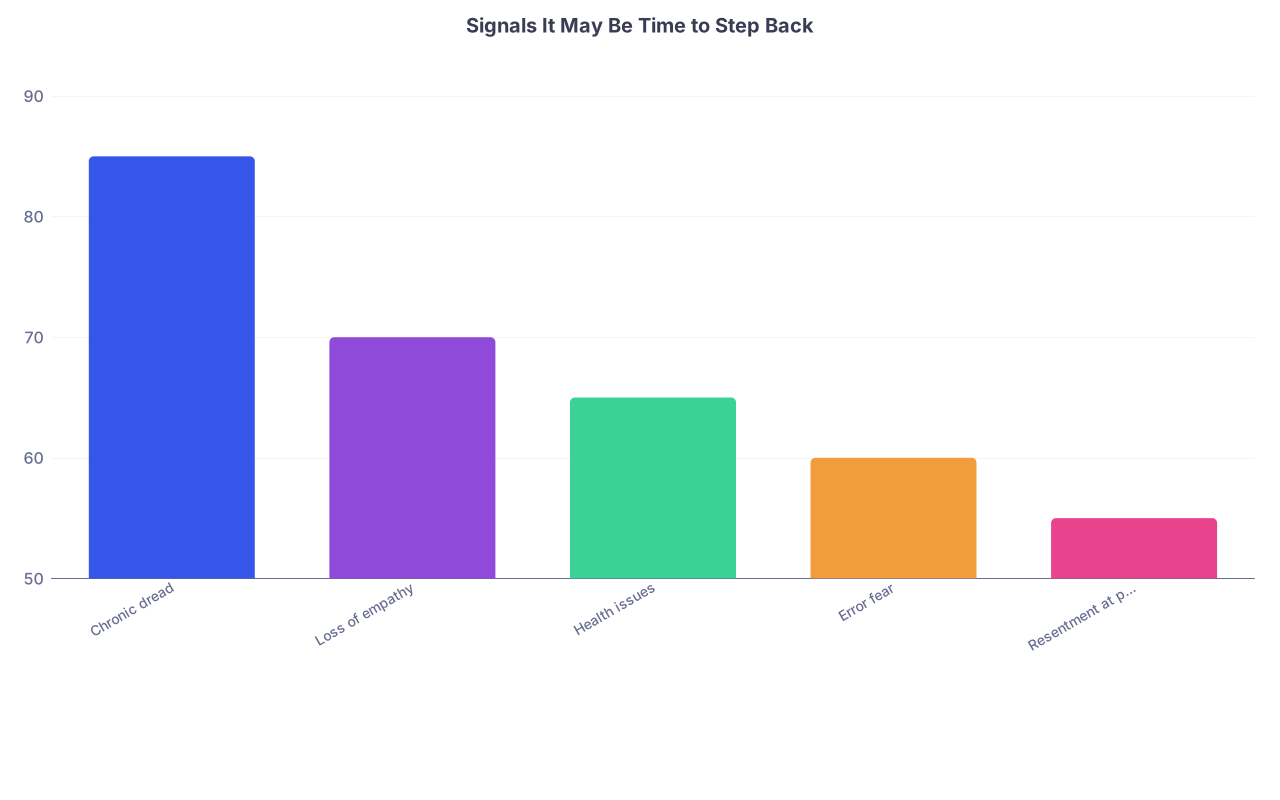
| Category | Value |
|---|---|
| Chronic dread | 85 |
| Loss of empathy | 70 |
| Health issues | 65 |
| Error fear | 60 |
| Resentment at patients | 55 |
The ethics here are simple: if you’re practicing while hollowed out, your judgment, empathy, and patience are impaired. You’re at higher risk of missing things, snapping at people, and cutting corners. That’s not fair to you or anyone you treat.
Step 2: The 5 Red Lines Where Your Sanity (and Ethics) Are in Play
I look for five “red lines” that suggest it’s time to step back or step out. Any 2–3 of these, sustained for >6–12 months despite attempts to fix things, and you’re not overreacting by thinking of leaving.
1. Your Body Is Waving the White Flag
I’m not talking about being tired. I mean:
- New or worsening hypertension, arrhythmia, or GI issues clearly linked to work.
- Panic attacks before shifts, or waking at 3 a.m. ruminating every night.
- You’re using alcohol, sedatives, or stimulants to cope in a way that scares you.
- You get sick constantly, then drag yourself in anyway.
That’s your body saying: “This is not sustainable.” Ignoring this because of “duty” is not noble. It is reckless.
2. You’ve Lost Access to Empathy (and You Know It)
You catch yourself thinking things like:
- “This patient is wasting my time.”
- “I do not care what happens; I just need this note done.”
- “If one more person asks for pain meds, I’m going to lose it.”
Every clinician has dark thoughts in bad moments. That’s not the issue. The issue is:
- Does this feel like your baseline now?
- Do you feel guilty about it and unable to fix it?
If your empathy has flatlined and you can’t get it back, staying in high‑stakes clinical work becomes ethically questionable.
3. You’re Afraid of the Errors You Haven’t Made Yet
Signs this is turning dangerous:
- You’ve made near‑misses or actual errors that clearly link to fatigue or overload.
- You chart in ways that are more about medico‑legal CYA than patient care.
- Your first thought when a lab is abnormal is “I hope this doesn’t come back on me” rather than “How do I help this person?”
If you’re practicing in a constant haze of dread about hurting someone, and the system gives you no realistic way to reduce risk (staffing, workload, support), leaving may be the most honest thing you can do.
4. Your Personal Life Is Nonexistent or Actively Collapsing
Look at the collateral damage:
- Partner says, “You’re never really here, even when you’re here.”
- You miss every major event: kids’ games, anniversaries, funerals.
- You’re too depleted to maintain friendships or hobbies.
- You go off‑service and feel like a stranger in your own house.
You are not obligated to destroy your non‑work life to stay in clinical medicine. That’s a false binary the culture sold you. If maintaining your license means losing your marriage, your health, or your identity, that’s not a balanced trade.
5. You Are Cynical About the Entire System, Not Just Your Job
Everyone complains about admin. That’s normal. But if you notice:
- You assume every new policy is about money, not care.
- You see patients as “throughput” because the system forces that lens on you.
- You’ve stopped believing you can do good work anywhere in the current system.
That level of cynicism is corrosive. To you. To trainees. To patients. Sometimes the problem is your particular institution. Sometimes it’s that you simply don’t want to be inside this machine anymore.
Step 3: Before You Leave Completely, Change What and How You Practice
You don’t jump from 1.0 FTE inpatient to “I’m a medical writer now” overnight. Usually, there’s an in‑between phase where you aggressively redesign your clinical life and see what’s left of your joy.
Here’s the order I’d test things, roughly:
Change hours before you change careers
Drop to 0.8 or 0.6 FTE if at all possible. If leadership says “no,” that’s data: your well‑being is not a priority there. Locums, per‑diem, or part‑time elsewhere might be more aligned.Change setting and scope
Inpatient → outpatient.
High‑acuity → consultative or procedural.
Nights/weekends → daytime.
Adults → peds, or vice versa.
You’d be shocked how many “I hate medicine” people actually hate hospitalist night shift in a toxic group.Change team and leadership
Many doctors don’t hate medicine. They hate their boss. Or their call schedule. Or that one senior partner who dumps work. Switching groups within the same specialty can feel like a different profession.Change your ratio of clinical to non‑clinical work
Teaching, QI, admin, informatics, research, medical education, simulation, policy. Even carving out 20–40% of your FTE for non‑clinical can preserve your sanity.
| Change Type | Example | Time to Implement |
|---|---|---|
| Reduce FTE | 1.0 to 0.7 outpatient | 3–6 months |
| Shift Setting | Inpatient to clinic | 6–12 months |
| New Employer | Different hospital/group | 3–9 months |
| Non-clinical Mix | Add med education/QI | 6–18 months |
| Locums/Per-diem | Short-term flexible shifts | 1–4 months |
If you’ve tried a few of these in good faith, over a reasonable period, and you still feel depleted and misaligned—that’s not failure. That’s clarity.
Step 4: Ethics Check – Are You Obligated to Stay “For the Patients”?
Short answer: no. You’re not a public utility.
Here’s the ethical reality no one states plainly enough:
- Patients deserve care from clinicians who are mentally present, reasonably rested, and not resentful of their existence.
- You are not a disposable resource. You’re a person with moral agency, not an instrument of the healthcare system.
- Staying when you’re dangerously burned out is more ethically questionable than leaving and ensuring someone safer, or a different system, steps in.
The “but there’s a shortage” argument is emotionally manipulative. Yes, there are access problems. Yes, leaving can make that worse locally. But:
- A burned‑out doctor in the room is not equal to “one full doctor of capacity.”
- You do not solve structural workforce issues by sacrificing individuals.
- Many who leave clinical medicine stay in health-adjacent roles that still help patients—just not in the exam room.
If you’re asking whether it’s “selfish” to prioritize your sanity, you’re already in better ethical shape than some people still happily billing 99233s while emotionally checked out.
Step 5: Concrete Exit Options That Are Not Fantasy
You’re not trapped in a binary: “clinic or Starbucks barista.” Here are realistic buckets I see physicians move into.
1. Less‑Intense Clinical Roles
- Urgent care with reasonable staffing and hours
- Telemedicine (primary care, psych, derm, triage)
- Occupational health, student health, concierge IM
- Hospital‑based consults with no admissions or call
- PRN/locums work where you control volume and schedule
These preserve your license and some income while creating space to breathe and explore.
2. Non‑Clinical but Still “Medical”
- Medical education (UME, GME, simulation, curriculum design)
- Clinical informatics / EMR optimization
- Quality and safety, hospital admin, utilization management
- Medical writing, CME content, guideline development
- Pharma/biotech (medical affairs, pharmacovigilance, clinical development)
- Insurance/managed care (utilization review, medical director roles)
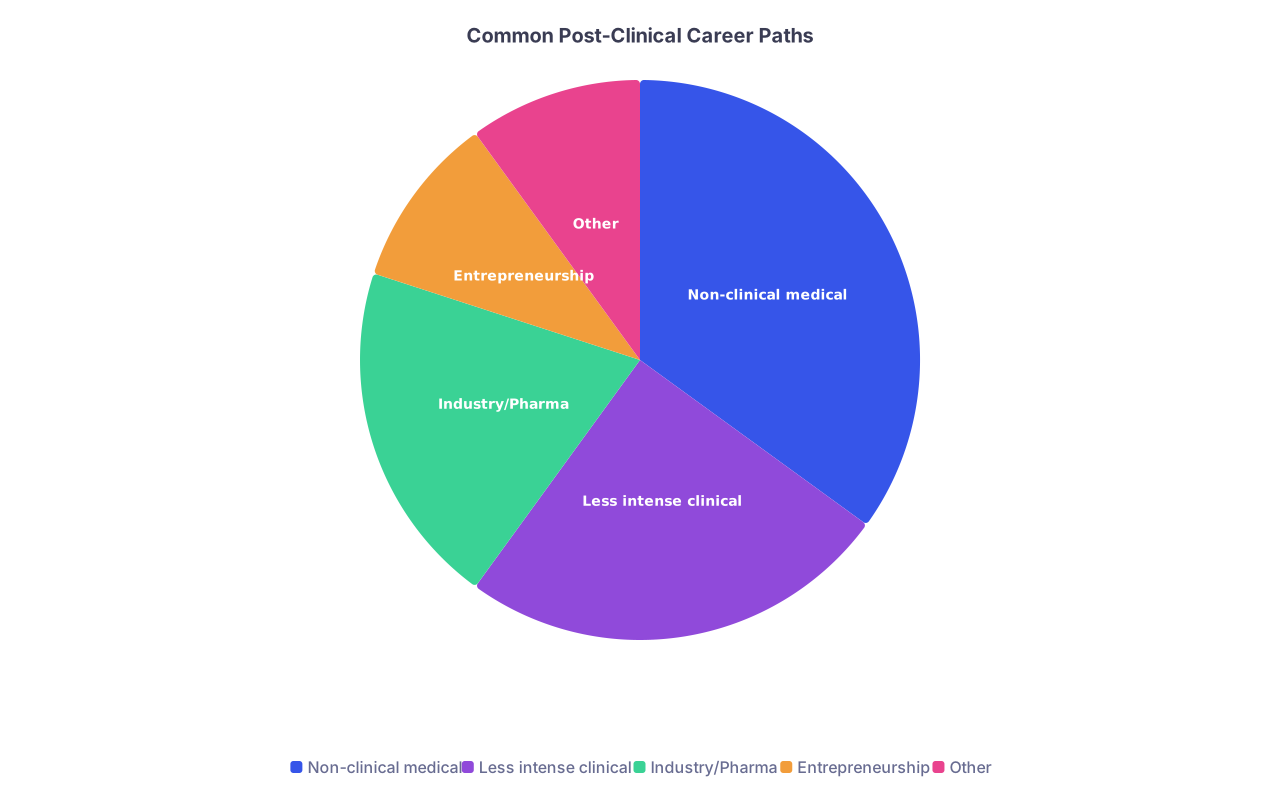
| Category | Value |
|---|---|
| Non-clinical medical | 35 |
| Less intense clinical | 25 |
| Industry/Pharma | 20 |
| Entrepreneurship | 10 |
| Other | 10 |
These jobs are not mythical. They’re competitive, but so is residency—and you did that.
3. Adjacent or Completely New Careers
- Health policy, public health, NGOs
- Startups (digital health, medtech)
- Coaching/consulting for clinicians, systems, or patients
- Writing, speaking, or content creation (health or non‑health)
Yes, some require retraining or accepting a pay cut. That’s the trade. Sanity and alignment in exchange for time, money, or status. For many mid‑career physicians who’ve been “golden handcuffed” for years, it’s still a net gain.
Step 6: A Simple Decision Map (If You’re on the Edge)
Use this as an internal triage, not a formal algorithm.

| Step | Description |
|---|---|
| Step 1 | Chronic distress about clinical work |
| Step 2 | Try role or environment changes |
| Step 3 | Assess red lines |
| Step 4 | Stay with new configuration |
| Step 5 | Plan partial or full exit in 6-12 months |
| Step 6 | Reduce FTE and explore non clinical options |
| Step 7 | Transition to alternative role |
| Step 8 | Symptoms improve with time off |
| Step 9 | Still dread returning? |
| Step 10 | Health or safety at risk |
Key questions to ask yourself and answer in writing:
- If nothing changed at work for 3 years, would I willingly stay?
- Do I like the content of clinical medicine but hate the container?
- What am I afraid will happen if I leave? (Be specific: money, identity, judgment.)
- What evidence do I actually have that those fears are accurate?
If you can honestly say, “If nothing changed, I would still choose to be here”—then it’s not time to leave, just time to adjust. If the answer is “absolutely not,” you’re already out mentally. The rest is logistics.
Step 7: Practical Next Steps if You Think It Might Be Time
Do these before you throw your stethoscope in the trash:
Get a reality‑based mental health assessment
Therapy with someone who actually understands clinician burnout. Maybe psychiatry. Document what’s going on—for you, not just for disability paperwork.Audit your finances like an attending, not a resident
You need a clear number: “Here’s the minimum I need monthly to not panic.”
Many physicians discover they’re more flexible than they assumed once they see the math in black and white.Treat this like a project, not a meltdown
6–12 month timeline.
Concrete steps: updated CV, informational interviews, networking with people already doing what you’re considering.Tell 1–3 trusted people the whole truth
Not the “just tired” line. The real version: “I may leave clinical medicine; I need help thinking it through.” Isolation warps judgment. Get out of your own head.Decide on a trial: partial exit vs full exit
Partial exit: drop FTE, change setting, add non‑clinical work for 12 months.
Full exit: plan to be out of direct care within 6–18 months, with a defined landing zone.

You don’t owe the system a heroic, last‑minute collapse in the hallway. You owe yourself an honest appraisal and a deliberate choice.
FAQ: Leaving Clinical Medicine for Your Sanity
1. How do I know if I’m just burned out versus truly needing to leave medicine?
Look at duration, depth, and response to rest. If normal breaks restore some energy and you still have moments of real connection with patients, you’re likely in burnout territory that might improve with changes. If months of rest don’t touch the dread and you feel a fundamental mismatch with clinical work itself, it’s more than burnout. That’s a values and identity issue, not just an exhaustion issue.
2. Is it unethical to quit clinical practice when my community needs doctors?
No. Ethics are not “stay no matter what.” Clinicians have a duty to provide competent, safe care—if they choose to be in that role. They also have duties to themselves and the people who depend on them outside the hospital. Staying when you’re mentally unwell or deeply disengaged can be more ethically problematic than transitioning out. You’re not abandoning medicine; you’re refusing to practice in a way that harms you and potentially your patients.
3. If I leave clinical medicine, am I wasting my training?
Not unless you decide it is wasted. Your training shapes how you think, solve problems, lead, and handle stress. Those skills are extremely valuable in education, policy, industry, informatics, writing, leadership, and more. Yes, you spent years and a lot of money learning to diagnose and treat. That sunk cost is real. But “I spent so much to get here” is a bad reason to stay somewhere that’s destroying you.
4. How long should I try to “fix” my situation before considering leaving?
If you’ve spent 6–18 months trying substantive changes—reduced FTE, new setting, different group, non‑clinical mix—and you still wake up with dread and go to bed numb, you’ve given it a fair chance. Past that, “just one more year” often becomes three or five, with deeper burnout and fewer options later. Put a clear time limit on “trying to make it work” and honor it.
5. What if my identity is completely tied to being a doctor?
Then step one is not job change; it’s identity work. With a therapist or coach who understands clinicians, you unpack who you are outside your role. You’re not erasing your physician identity; you’re expanding it. Many people who leave clinical work still think of themselves as doctors. They’re just doctors who now do policy, or education, or product design, or writing. The white coat was never the whole story.
6. What are the first 3 concrete actions if I’m 60% sure I need to leave?
First, document your reality: track your mood, symptoms, and specific work incidents for 4–6 weeks. Second, meet with a financial planner (ideally one who works with physicians) to define your numbers. Third, schedule three informational conversations with people who’ve left or partially left clinical medicine in directions you’re considering. Those steps move you from vague dread to specific options.
Key takeaways:
- If your health, empathy, or safety are consistently compromised and do not improve with rest or reasonable changes, it’s not dramatic to consider leaving—it’s responsible.
- You owe no lifelong contract to clinical medicine; you do owe yourself (and your patients) honesty about what you can safely and sanely sustain.
- Leaving clinical practice is not the end of your value as a physician. It’s one possible next chapter—and you’re allowed to choose it.


