
You are on a late Zoom call with a pharma recruiter. Your clinic day ran long, you scarfed down half a protein bar for “dinner,” and now you are trying to sound enthusiastic about a Medical Affairs role you barely understand. The recruiter says, “So tell me about your experience influencing stakeholders across cross‑functional teams?”
You freeze.
You default to, “Well, I see about 20 patients a day and I really care about patient outcomes.”
The recruiter’s smile tightens. You feel it. Conversation dies a little. This is where many physicians lose pharma opportunities they were absolutely qualified for—because they pitch themselves like clinicians, not like future industry colleagues.
Let me be blunt: pharma is full of smart people who respect your MD, but they have also watched dozens of doctors crash and burn in interviews and outreach. The pattern is predictable. And avoidable.
Below are 7 career‑killing mistakes I see physicians make when pitching themselves for pharma roles—and exactly how to avoid them.
Mistake #1: Selling Your Clinical Identity, Not Your Business Value
Most physicians lead with this kind of pitch:
“I’ve been a practicing cardiologist for 12 years, run a busy clinic, and my patients love me.”
Nice. But irrelevant if you do not translate it.
Pharma is not hiring you to see patients. They are paying for:
- Decision making under uncertainty
- Data interpretation
- Risk communication
- Behavior change in peers
- Credibility with stakeholders
You kill your chances when you:
- Recite your CV in chronological order
- Over‑index on volume (“I do 30 cases a week”) without outcomes or impact
- Talk only about “patient care” and not “strategy, execution, results”
Instead, you must convert clinical stories into business language:
- “I led an initiative that reduced 30‑day readmissions for heart failure by 18% over 12 months through protocol redesign and targeted physician education.”
- “I chaired our P&T subcommittee evaluating SGLT2 inhibitors, where I synthesized trial data, modeled budget impact, and aligned cardiology, nephrology, and endocrinology on a formulary decision.”
Those are industry sentences. They show:
- You understand outcomes
- You can influence peers
- You think in terms of impact, not anecdotes
If you cannot describe your work without using “patients” in every third word, you are signaling you have not made the mental shift yet. Pharma will notice.
Mistake #2: Not Understanding the Actual Role (Or Using the Wrong Buzzwords)
Another classic career‑killer: walking into a Medical Affairs or Clinical Development interview and clearly not understanding what they do all day.
Signs you are making this mistake:
- You say, “I really want to help design guidelines,” when interviewing for a Medical Science Liaison (MSL) role
- You talk about “drug discovery” in a late‑phase Clinical Development role
- You keep using “pharma” as one blob, with no nuance between Medical Affairs, PV, HEOR, Regulatory, or Commercial
This reads as laziness. Or entitlement. Neither plays well.
You need a baseline operational understanding of at least the common physician‑entry roles:
| Role Type | Core Focus |
|---|---|
| Medical Science Liaison | External KOL engagement |
| Medical Affairs (in-house) | Strategy, evidence generation, medical review |
| Clinical Development | Trial design and execution |
| Pharmacovigilance (PV) | Safety signal detection and risk management |
| HEOR / RWE | Value, outcomes, and real-world data |
If you cannot answer, in one sentence, “What does this function do for the company?” you are not ready to pitch yourself.
Avoid this mistake by:
- Reading at least 5–10 real job descriptions in that exact function
- Watching 2–3 interviews or talks from people in that role (YouTube, podcasts, company webinars)
- Asking current insiders, “What would be a red flag answer if a physician gave it in your interview?”
Your goal: speak their language well enough that they do not have to educate you on the basics during the interview. That alone separates you from half the field.
Mistake #3: Treating Pharma Like an Escape Hatch, Not a Deliberate Move
I hear this all the time:
“I am burned out. I need to get out of clinical medicine. Anything in pharma would be better.”
You might feel that. Do not say it. Do not even hint at it.
Pharma hears:
- “This person is running away, not running toward.”
- “They will quit again when this gets hard.”
- “They see this as a vacation from real work.”
Your story cannot be “I hate my job.” It has to be “I am pivoting toward bigger‑scale impact using skills I already apply.”
Better framing (and actually true, if you think it through):
- “I reached a point where I wanted to influence care at the population level, not just one patient at a time.”
- “I have always gravitated to guidelines, data, and systems. Industry is where those interests actually drive outcomes at scale.”
- “I am looking for roles where my clinical understanding plus structured thinking can accelerate responsible drug development.”
If you sound desperate, scattered, or bitter about medicine, it is career‑poison in this space. The pharma hiring manager has heard a dozen versions of “get me out of call” and none of those candidates are leading global trials now.
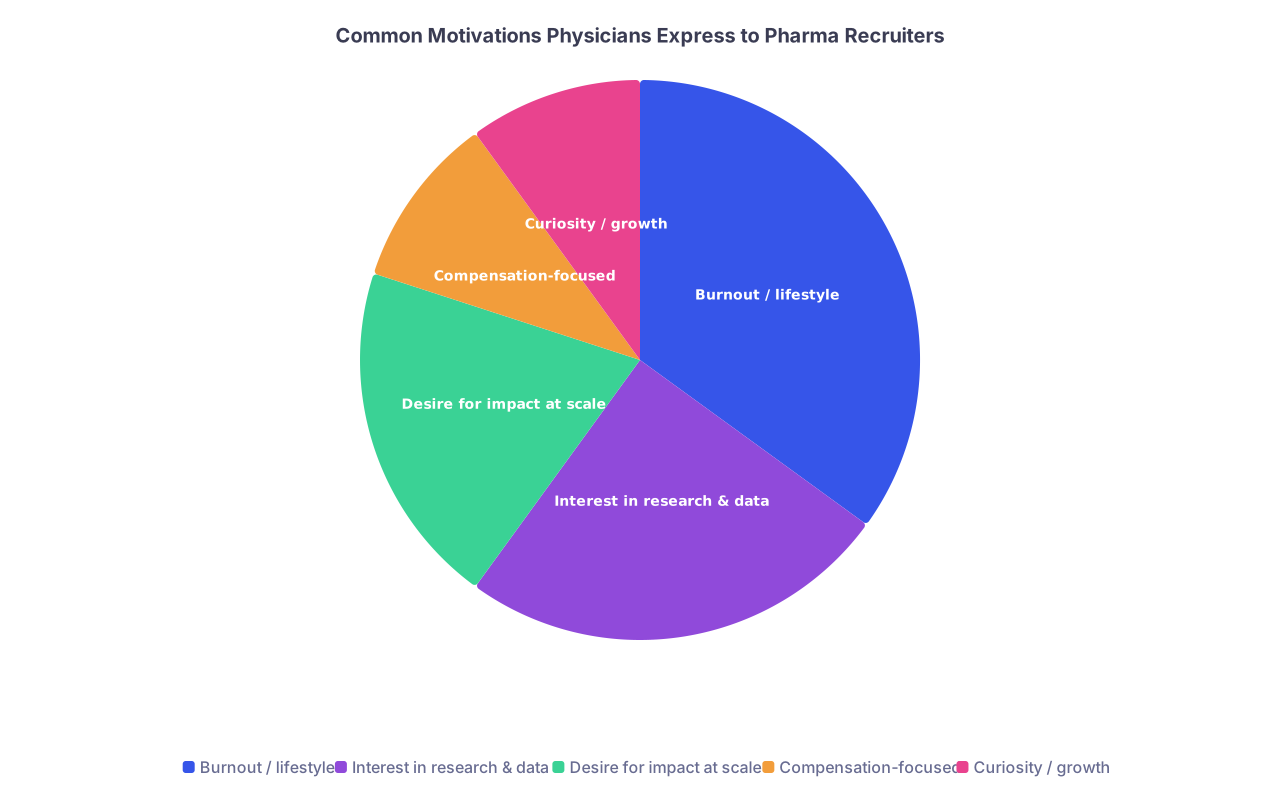
| Category | Value |
|---|---|
| Burnout / lifestyle | 35 |
| Interest in research & data | 25 |
| Desire for impact at scale | 20 |
| Compensation-focused | 10 |
| Curiosity / growth | 10 |
The trap: you think honesty means trauma‑dumping your residency saga. It does not. Share motivation, not misery.
Mistake #4: Using a Physician‑Style CV Instead of a Business Resume
I have seen physician CVs submitted to pharma that are 27 pages long. Twenty. Seven. Every shadowed clinic. Every poster. Every talk to the 4th‑grade science class.
You may as well submit a scanned napkin.
Industry reviewers spend seconds on initial screens. They are looking for:
- Relevant experience
- Transferable skills
- Evidence you understand their world
Not:
- Every CME you ever attended
- Full references for every abstract
- List of all rotations from medical school
You are making a career‑killing mistake if:
- Your CV is >3 pages for an entry or junior role
- The first page has no bullets about cross‑functional work, data, or strategy
- You have “Epic proficiency” and “fluent in EMR” as key skills
For pharma, build a business‑style resume (usually 2–3 pages) with:
- A clear headline: “Board-certified internist with trial experience and guideline authorship seeking Medical Affairs role in oncology”
- Bullets framed in action → impact terms, not “responsible for” fluff
- Separate section for “Industry‑relevant experience” even if unofficial: investigator‑initiated trials, advisory boards, P&T, protocol committees, quality initiatives

If your resume forces the reader to decode what is relevant, you lose. They will not do the work for you. They have 200 other applicants whose value is obvious at a glance.
Mistake #5: Ignoring the Nonclinical Skill Gap (And Pretending You Already ‘Do All That’)
Another way physicians sabotage themselves: insisting their clinical work already covers everything pharma needs.
You say in an interview:
- “Oh, I already do tons of stakeholder management all the time.”
- “I have always been basically doing project management in my clinic.”
- “Communication is communication—patients or executives, it is all the same.”
No. It is not. And industry people know it is not.
Clinical life gives you some raw material. But there are real gaps:
- You have likely never set KPIs or tracked them in dashboards
- You probably have not run structured cross‑functional projects with timelines, budgets, and risk logs
- You may not have written standard operating procedures or regulatory‑facing documents
- You almost certainly have not dealt with promotional review committees, labeling constraints, or compliance language
If you act like there is no learning curve, they will assume you lack self‑awareness. That is a bigger red flag than any skill gap.
Smart way to avoid this mistake:
- Explicitly acknowledge the gap: “I know there is a steep learning curve in regulatory, SOPs, and internal systems. I am prepared for that.”
- Show proof of learning behavior: certifications (GCP, project management basics), courses in clinical research, HEOR webinars, etc.
- Use specific language: “I am comfortable being a beginner again in the mechanics of industry. The underlying analytic and communication skills are there; I am ready to build the scaffolding around them.”
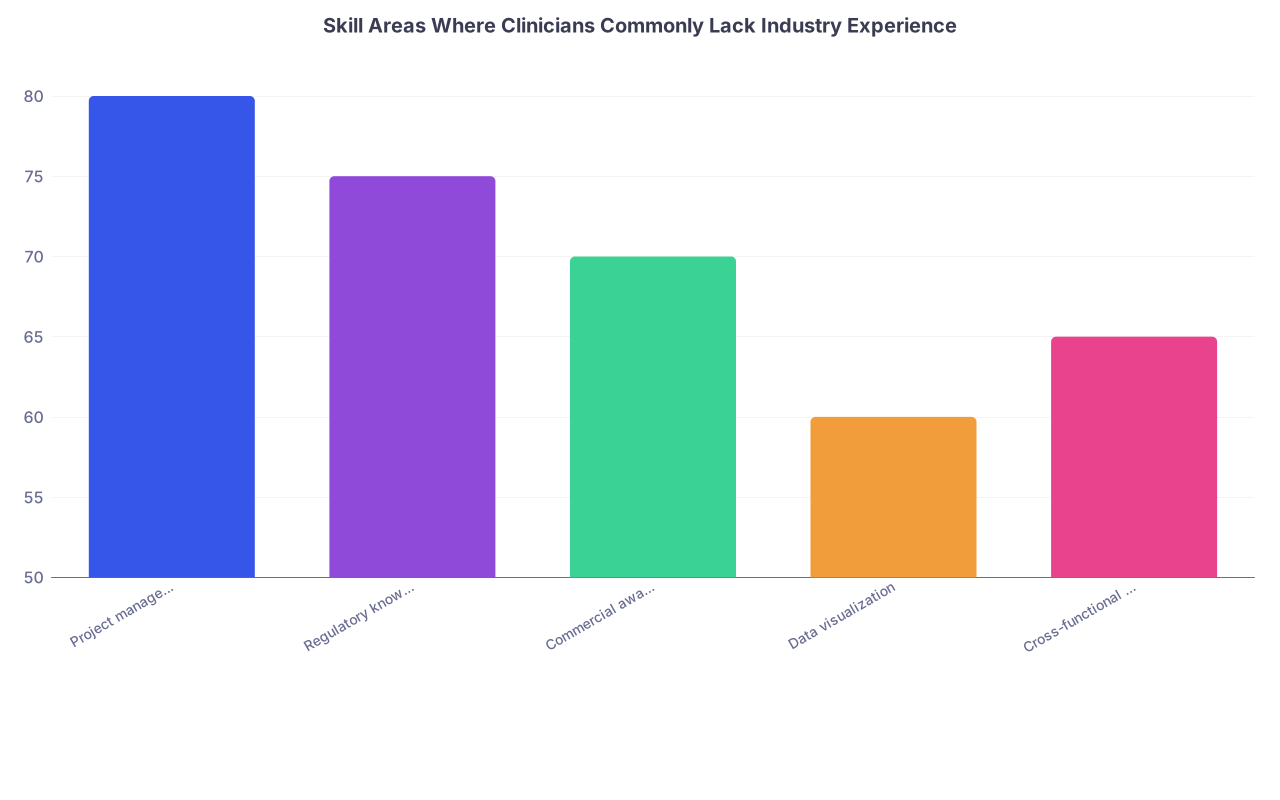
| Category | Value |
|---|---|
| Project management | 80 |
| Regulatory knowledge | 75 |
| Commercial awareness | 70 |
| Data visualization | 60 |
| Cross-functional processes | 65 |
Humility plus preparation beats inflated confidence every time.
Mistake #6: Pitching Like a Lone Hero Instead of a Cross‑Functional Player
Clinicians are used to being the final word. Your orders. Your signature. Your responsibility. In industry, that mindset can tank you.
Pharma runs on:
- Cross‑functional meetings
- Consensus building
- Matrix reporting (you answer to multiple stakeholders)
- Constant alignment with non‑MD colleagues
If your pitch centers on:
- “I make the final call.”
- “I fixed this because everyone else was doing it wrong.”
- “I took charge and pushed it through despite resistance.”
You sound like a liability.
You must demonstrate you can function in a matrix. That you can disagree without grandstanding. That you respect expertise outside medicine.
Replace hero stories with collaboration stories:
- “I co‑led a quality project with nursing leadership and IT, where my role was to translate clinical needs into technical requirements and align physicians around the solution.”
- “Our heart failure path redesign involved pharmacy, case management, and hospital admin; I focused on surfacing concerns early and finding data that addressed their specific objections.”

If you cannot talk comfortably about successful shared ownership projects, you are not ready. Learn to frame your impact without starring yourself as the solo protagonist.
Mistake #7: Playing the “MD Card” and Expecting Doors to Open Themselves
Here is the hardest truth: your MD is an asset, not a golden ticket.
I have watched physicians:
- Show up to networking calls late because “clinic ran over,” like that explains everything
- Send a 3‑line LinkedIn message saying, “I am an oncologist interested in pharma, can you help me get a job?”
- Argue with non‑MD hiring managers about why “a physician should really be in this role”
That arrogance kills opportunities quietly. People nod, hang up, and never refer you again.
Pharma has plenty of MDs. What they do not have is time for someone who thinks degrees outrank experience.
To avoid this:
Respect the gatekeepers.
Treat recruiters, coordinators, and non‑MD managers as peers, not obstacles. They understand the hiring process far better than you.Do the work before asking for favors.
“I have read the last two phase 3 trials in your space, attended your recent webinar on X, and here are two specific questions” beats “Can we hop on a call so I can pick your brain?”Stop name‑dropping institutions as if that replaces relevance.
No one cares that you trained at a big‑name academic center if your examples are still purely clinical with zero industry tie‑in.

| Red-Flag Phrase | Strong Alternative |
|---|---|
| "I am a physician, so I can learn fast." | "Here is how I have already started learning." |
| "Anything outside clinical is fine." | "I am targeting Medical Affairs because..." |
| "I just want better lifestyle." | "I want to impact care at scale by..." |
| "I ran the whole service myself." | "I co-led a multidisciplinary initiative that..." |
If your pitch leans heavily on “MD therefore qualified,” you will keep losing to candidates who quietly did their homework.
How to Rebuild Your Pitch (Without Making These 7 Mistakes)
You can avoid most of these landmines with a short, focused reset.
Step 1: Rewrite Your Story
One paragraph. Max. Answer:
- Why leaving clinical now?
- Why this function (Medical Affairs, MSL, Clinical Dev, etc.)?
- What 2–3 experiences prove you fit?
Make sure:
- It is forward‑looking, not a complaint log
- It shows intentionality, not random escape
- It uses at least some industry language correctly
Step 2: Translate 5 Clinical Experiences into Industry Value
Pick:
- A committee
- A quality project
- A trial or registry
- A teaching or guideline activity
- A tough cross‑disciplinary initiative
For each, write 2–3 bullets:
- What was the objective in business‑like terms?
- Who were the stakeholders?
- What data did you use?
- What changed because of your work?
Those become your talking points for interviews, networking, and your resume.
Step 3: Get a Reality Check from an Insider
Not your co‑attending. Not your program director. Someone actually in industry.
Ask them to:
- Skim your resume for 2 minutes and tell you what stands out (or does not)
- Listen to your 60‑second pitch and point out where you sound naïve, arrogant, or vague
- Flag any phrases that scream “still stuck in clinician mindset”
One brutally honest conversation can save you 6–12 months of rejection.

| Step | Description |
|---|---|
| Step 1 | Clarify Target Function |
| Step 2 | Learn Role Basics |
| Step 3 | Translate Clinical Experience |
| Step 4 | Build Business-style Resume |
| Step 5 | Get Insider Feedback |
| Step 6 | Iterate Pitch |
| Step 7 | Apply and Network Strategically |
FAQs
1. Do I need prior research or trial experience to be competitive for pharma roles?
No, but pretending your morning huddle is “basically clinical research” is absurd. If you lack formal trial experience, lean into:
- Quality improvement projects with measurable outcomes
- Committee work involving protocol design or guideline implementation
- Any exposure to registries, databases, or outcomes reporting
And start fixing the gap now: GCP training, local IRB involvement, or even just careful reading of major pivotal trials in your target area so you can talk about them intelligently.
2. Should I hide my burnout or dissatisfaction with clinical medicine?
You should not fabricate some fake love story with the hospital, but you must filter. Saying “I am exhausted by seeing the same preventable crises because systems never change, and I want to work upstream” is fine. Saying “My hospital is toxic and I hate my patients” is career suicide. Share directional dissatisfaction (“I want scale, systems, data”) rather than emotional venting. That shows maturity and self‑awareness.
3. How early in my career can I realistically move into pharma?
Earlier than most physicians think—but only if your pitch is disciplined. I have seen people transition right after residency or fellowship into junior MSL or Medical Affairs roles. The risk is higher because you have less gravitas, so your story and evidence must be sharper: strong fellowship projects, early trial exposure, guideline work, or standout cross‑functional leadership. If all you bring is “I just finished training and I am tired,” you will be ignored.
Key takeaways:
- Stop selling “I am a busy clinician” and start selling concrete, business‑relevant impact.
- Show you understand the specific pharma function, respect the learning curve, and can work cross‑functionally without leaning on the MD card.
- Build a targeted, forward‑looking story—no desperation, no entitlement—and you will avoid the career‑killing mistakes that sink most physicians before they even get a fair look.