The hardest part isn’t getting an offer. It’s not picking the wrong industry and realizing it 18 months later.
If you’re torn between consulting, pharma, and digital health, you’re not deciding “which sounds coolest.” You’re choosing a workstyle, a pace of life, and a long-term identity outside of traditional clinical practice.
Let’s break this down like a real decision, not a vibe check.
Step 1: Be Honest About What You Actually Want Day to Day
Forget brand names for a second. Don’t start with “McKinsey vs Novartis vs hot startup.” Start with this:
What do you want your average Tuesday to look like?
Here are the three paths in brutally simple terms:
- Consulting: High-intensity, travel-heavy (less than pre‑COVID but still real), PowerPoint, Excel, client meetings, structured career ladder, broad exposure, generalist skill set.
- Pharma/biotech: Longer timelines, cross-functional teamwork, deep therapeutic or functional expertise, more stability, slower pivots, more corporate.
- Digital health / health tech: Fast-moving, ambiguous, constantly changing priorities, product-focused, more risk/reward, real chance to build things that ship.
If you can’t picture yourself enjoying the work format of at least one of these, brand won’t save you.
Step 2: Match Your Personality to Each Path
Here’s where most people go wrong. They evaluate prestige. You should evaluate fit.
Who tends to be happy in consulting?
People who:
- Like structured problem solving and frameworks
- Don’t mind (or even enjoy) being “on” in front of clients
- Are okay with frequent context switching: new project, new topic every 2–3 months
- Can handle travel and longer hours, especially early on
- Care a lot about optionality: PE, strategy roles, start-ups later
Consulting is basically getting paid to learn how to think like an executive and package it so others will buy it. It’s not “deep science” and it’s not direct patient impact. It’s abstract, often high-level, and very slide‑heavy.
Who tends to be happy in pharma?
People who:
- Enjoy depth more than breadth (a disease area, a molecule, a product portfolio)
- Like cross-functional work: clinicians, statisticians, regulatory, commercial all in the same room
- Prefer stable, predictable career paths and benefits
- Are okay with decisions unfolding over quarters and years, not days
Pharma has many “flavors”: medical affairs, clinical development, safety, HEOR, market access, etc. But the common thread: large organizations, process, and regulated environments.
Who tends to be happy in digital health?
People who:
- Like building things: products, processes, teams
- Tolerate (or enjoy) ambiguity and pivots
- Care about iterating fast and seeing impact quickly
- Can operate without much structure or clear career ladders
- Are okay that the company might not exist in 3–5 years
Digital health is perfect if you want to be close to the tech and the end user, and you’re willing to trade stability for learning and impact.
Step 3: Look at the Work, Not the Title
Roles differ massively inside each sector. A “pharma job” could mean 5 totally different lifestyles. Same for consulting and digital health.
Here’s a quick comparison you can actually use:
| Sector | Common Role Type | Key Skill Emphasis |
|---|---|---|
| Consulting | Life sciences consultant | Problem structuring |
| Pharma | Medical affairs / MSL | Communication, evidence |
| Pharma | Clinical development | Trial design, data |
| Digital health | Product / clinical lead | Product thinking |
| Digital health | Clinical operations | Process and execution |
To sanity check fit, ask yourself:
Would I be excited to:
- Spend hours cleaning up a slide deck for a senior client? → Consulting
- Debate secondary endpoints with biostats and clinical teams? → Pharma
- Argue with engineers about why a feature is or isn’t safe/clinically valid? → Digital health
If all three sound awful, you’re not ready to leave clinical work yet.
Step 4: Compare Lifestyle, Money, and Exit Options
Here’s the unromantic comparison people whisper about on coffee chats but don’t put on websites.
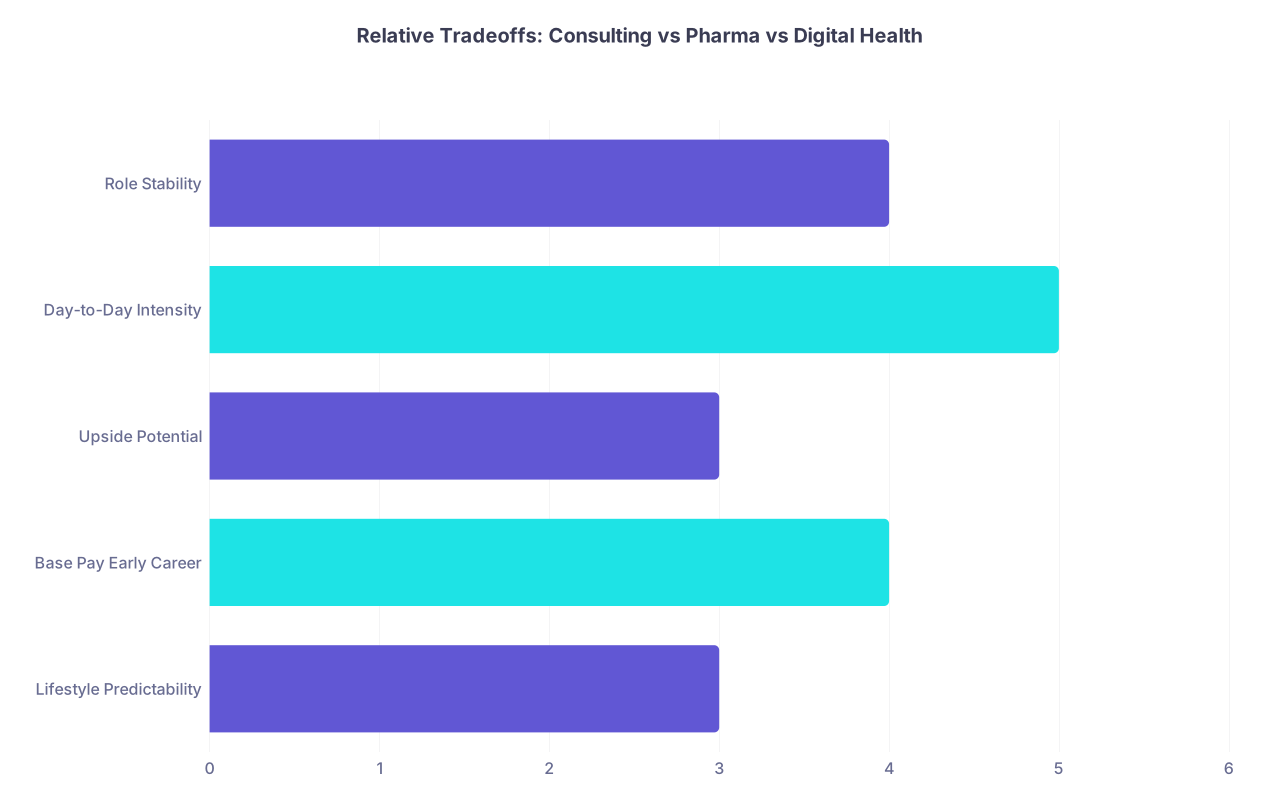
| Category | Value |
|---|---|
| Lifestyle Predictability | 3 |
| Base Pay Early Career | 4 |
| Upside Potential | 3 |
| Day-to-Day Intensity | 5 |
| Role Stability | 4 |
(Scale 1–5, consulting shown as an example at “intensity 5, stability 4” just to visualize; your actual numbers will vary by firm and role.)
Now let’s do this properly in words.
Lifestyle
Consulting:
- Hours: Often 55–70/week, sometimes more on bad projects
- Travel: Less than pre‑COVID, but still some firms/projects require it
- Control: Low early, improves with seniority and firm choice
Pharma:
- Hours: Often 40–55/week, spikes around launches or regulatory events
- Travel: Varies by role; medical affairs/MSL can be travel-heavy, HQ roles less so
- Control: Moderate; big companies have some flexibility but also meetings galore
Digital health:
- Hours: 45–65/week common in growth-stage companies
- Travel: Usually low
- Control: Can be high in what you do, low in what gets thrown at you tomorrow because the roadmap changed
Compensation & upside
Very rough patterns (this is not a salary report; it’s directional):
- Consulting (top firms): Strong base + bonus, very clear progression. Upside increases dramatically if you make partner or jump to PE/strategy leadership roles.
- Pharma: Solid base, good benefits, stable raises. Upside comes from leadership roles or moving into high-impact commercial/strategy positions.
- Digital health: More variance. Startups may pay less in cash but offer equity. If the company hits, equity can be meaningful. If not, it’s just paper.
If you need high, predictable income now (loans, family, etc.) and can’t gamble, pharma or consulting at known firms beats a fragile Series A startup.
Step 5: Map Your Skills and Background to Each Path
Now let’s be practical: where are you most credible right now?
Roughly:
- Consulting loves: strong academics, analytical skills, leadership, communication, comfort with numbers and ambiguity. Prior business experience is nice but not required if you can demonstrate the raw skills.
- Pharma loves: clinical experience (especially in the relevant disease area), publications, trial experience, understanding of guidelines, good communication. Industry exposure helps but isn’t mandatory in all roles.
- Digital health loves: people who can ship things—products, workflows, pilots. Clinical + tech literacy is gold. If you’ve done QI, EMR build projects, or startup work, that’s a plus.
If your CV screams “deep clinical and research experience in oncology,” pharma (especially clinical development or medical affairs in oncology) will likely open up fastest and at higher levels.
If your CV is broad, with leadership roles, some data work, maybe an MBA, and you like solving different business problems, consulting might be the easier first industry jump.
If you’ve been the “tech person” on the team, redesigned clinic workflows, or worked with EMR vendors, digital health may be a natural extension.
Step 6: Think 10 Years Out, Not Just First Job
A mistake I see constantly: people optimize for the first non-clinical role without thinking about the arc.
Let’s talk likely “later moves” from each:
Consulting →
Common exits:
- Biopharma / medtech corporate strategy or BD
- Private equity / venture capital (with some luck and networking)
- Health system strategy / innovation roles
- Digital health leadership, especially in operations or strategy
Pharma →
Common exits:
- Bigger roles within pharma: therapeutic area lead, global roles
- Market access, HEOR, brand strategy, global medical
- Digital health and real-world evidence companies
- Less often: consulting (you’ll usually enter at a higher level if you do)
Digital health →
Common exits:
- Product management or operations leadership in other tech/health tech
- Back into provider organizations in innovation or virtual care roles
- Pharma/medtech digital strategy, real-world data, or patient engagement roles
- Venture/accelerator roles if you’ve built a good network
If your dream outcome is “VC in digital health,” any of the three can get you there, but the most direct may be: consulting (healthcare focus) → digital health operator → VC. Or digital health early → scale success → VC.
Step 7: Use a Simple Decision Framework
Here’s a quick framework that actually works. Score each sector 1–5 on these:
- Day-to-day work enjoyment
- Lifestyle fit (hours, travel, predictability)
- Skill match (how quickly you’d be “good” at the role)
- Long-term options you actually want
- Risk tolerance (company and career)
Then do this:

| Step | Description |
|---|---|
| Step 1 | Start |
| Step 2 | Score each path 1 to 5 |
| Step 3 | Focus networking and applications on that path |
| Step 4 | Shortlist top 2 |
| Step 5 | Do 3+ deep conversations in each |
| Step 6 | Re-score with new info |
| Step 7 | Pick based on where you have best concrete opportunities now |
| Step 8 | Go with higher score |
| Step 9 | Clear winner by 3 or more points? |
| Step 10 | Still tied? |
The part people skip: deep conversations in each area. You can’t think your way through this entirely. You need to hear how people talk about their jobs.
Step 8: What If You’re Still Completely Torn?
If you’re genuinely split, here’s the tie-break logic I give people:
Choose consulting if:
You want maximum optionality, enjoy structured problem-solving, and are okay paying with your time and energy for 2–4 years.Choose pharma if:
You want stability, steady progression, and to stay close to science and clinical decision-making without seeing patients every day.Choose digital health if:
You want to build and iterate fast, tolerate risk, and care less about titles and more about “are we actually changing how care is delivered?”
And if you really don’t know, apply to all three, interview, and pay attention to what your body tells you: which interviews leave you energized vs drained? Where do you find yourself imagining colleagues you’d actually like?
Example Scenarios (So You Can See Yourself in One)
Scenario 1: IM resident, burned out, loves systems more than patients
- Loves: fixing broken processes, reading about policy and payment models
- Hates: repetitive clinic days, constant patient churn
- Likely best fit: Consulting (healthcare focus) or digital health operations / product
- Why: The way they think is systemic, not molecule-level or trial-level. They’ll be bored in a narrow pharma role.
Scenario 2: Heme/Onc fellow with strong clinical research track
- Loves: clinical trials, new therapies, deep disease area knowledge
- Hates: administrative grind, never-ending clinic load
- Likely best fit: Pharma clinical development or medical affairs (oncology)
- Why: Direct fit with skills, lots of companies hiring, impact on how drugs are developed and used.
Scenario 3: FM or EM doc who built a telehealth side gig
- Loves: tech tools, patient experience, building new care models
- Hates: old EMRs, rigid hospital structures
- Likely best fit: Digital health product/clinical lead
- Why: Already acting like a builder; digital health formalizes this and gives them a bigger sandbox.
Quick Visual: Where Each Path Sits on Risk vs Structure
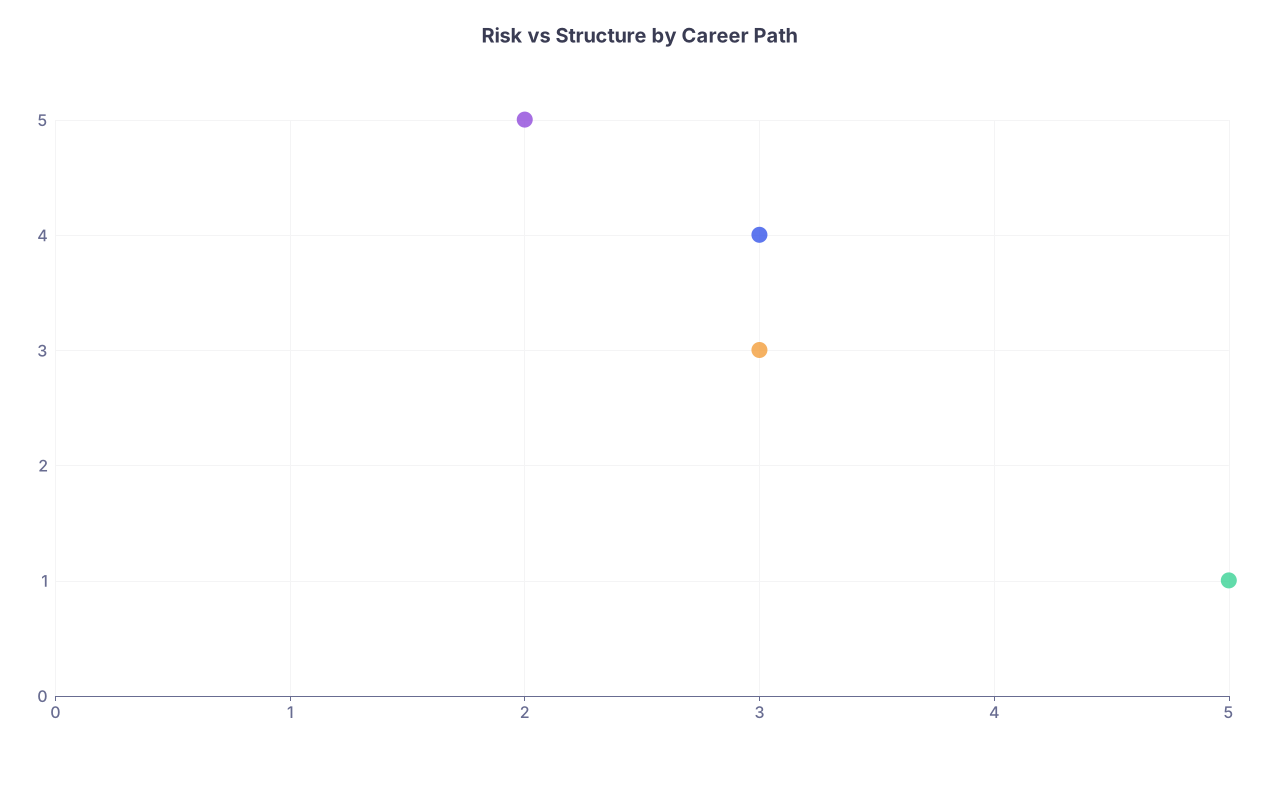
| Category | Value |
|---|---|
| Consulting | 3,4 |
| Pharma | 2,5 |
| Digital Health Startup | 5,1 |
| Mature Health Tech | 3,3 |
(First value = risk level, second = structure level; 1 = low, 5 = high. Rough, but you get the idea.)
How to Test Before You Jump
You don’t need to guess. You can “beta test” each path:
For consulting:
Join a case prep group, do some practice cases, talk to 3–5 consultants about their last project in detail. If you hate the sound of it, that’s data.For pharma:
Talk to medical affairs and clinical development folks. Ask them to walk you through a week and a recent decision they influenced. Also attend an industry-sponsored event and listen with a different ear.For digital health:
Contribute part-time to a small digital health company—advising on clinical content, testing workflows, helping refine protocols. Even 5–10 hours/month for 3–6 months teaches you a lot.

FAQ: Consulting vs Pharma vs Digital Health
1. Which path is “best” for long-term career growth?
None of them wins across the board. Consulting gives you broad, portable skills and strong brand names that open doors later. Pharma gives you a clear vertical ladder and long-term stability. Digital health gives you the fastest learning and potential upside, but the most volatility. “Best” is whatever aligns with the kind of risk, stability, and pace you want over the next decade.
2. Is consulting a good stepping stone into pharma or digital health?
Yes—often a very good one, especially if you join a life sciences or healthcare-focused practice. Many consultants move into pharma strategy, BD, or digital/innovation roles, and plenty jump to digital health as operations or strategy leaders. Just realize: you’ll spend a few years working hard, often on non-glamorous pieces of big problems, before cashing in that optionality.
3. Do I need an MBA to break into any of these?
No. An MBA can help, especially for consulting or senior business-facing pharma roles, but it’s not mandatory. Clinicians get hired into consulting, pharma, and digital health without MBAs all the time if they bring strong clinical credibility, communication skills, and evidence they can think beyond the bedside. If you already have significant education debt, don’t automatically assume “MBA first” is the smart move.
4. Which is better if I might want to go back to clinical practice?
Pharma and digital health usually keep you closer to clinical content and guidelines in a way that translates more directly back to patient care. Consulting can pull you further into the business/strategy world. That said, a lot of clinicians maintain part-time practice alongside pharma or digital health roles; it’s harder to combine with full-time consulting because of hours and travel. If staying clinically active matters, weigh that heavily.
5. How much does prior research experience matter for these roles?
For pharma (especially clinical development and early medical affairs), strong research experience helps a lot. Trial design, publications, statistical literacy—those all play well. For consulting, research helps only insofar as it shows analytical rigor; they care more about problem-solving and communication. For digital health, research is less central; shipping things, improving workflows, or having built something (a registry, a protocol, a QI project) matters more than your h‑index.
6. What’s the single best next step if I’m undecided?
Talk to 3 people in each path. Not generic “informational interviews,” but specific conversations where you ask: “Walk me through your last 2 weeks, meeting by meeting.” Then write down what actually happens in their jobs and rate how much you’d tolerate or enjoy that reality. Finally, apply broadly to roles in the top one or two paths and let real interviews—and your gut responses to them—help you decide.
If you remember nothing else:
- You’re picking a workstyle and risk profile, not just a brand name.
- Score each path on actual criteria that matter to you: day-to-day work, lifestyle, skill fit, and long-term options.
- Don’t try to think it all out in isolation—have real conversations, test things in small ways, then commit and move.