
The myth that “almost all doctors stay in clinical practice” is outdated. The data shows a sizeable, structurally important minority of physicians now work in non-clinical or hybrid roles—and that proportion is steadily rising.
If you are trying to decide whether you are the outlier for wanting a non-clinical path, you are not. Statistically, you are closer to the new normal than you think.
1. So how many physicians are actually non-clinical?
Let us start with hard numbers and then unpack definitions, because the truth lives in the details.
Across U.S. sources (AMA Masterfile, AAMC workforce reports, BLS, plus large survey datasets from Medscape, Doximity, and specialty societies), the picture converges on roughly this:
- Fully non-clinical physicians (0% patient care, primary job non-clinical): about 8–12% of the active physician workforce.
- Hybrid physicians (non-clinical role plus ongoing patient care): another 15–25%.
- Physicians who say they are “seriously considering” leaving clinical medicine in the next 1–3 years: ~25–40%, depending on specialty and survey.
When you combine those, somewhere around one in three actively licensed physicians today is either:
- Already substantially engaged in non-clinical work, or
- On the brink of shifting that way.
That is not fringe. That is a structural shift in the profession.
To make this less abstract, let us quantify a typical snapshot. The U.S. has on the order of 1 million active physicians (counting residents and fellows, depending on the dataset and year). Using mid-range estimates:
- 10% fully non-clinical → ~100,000 physicians
- 20% hybrid clinical + non-clinical → ~200,000 physicians
That yields roughly 300,000 physicians with significant non-clinical involvement.
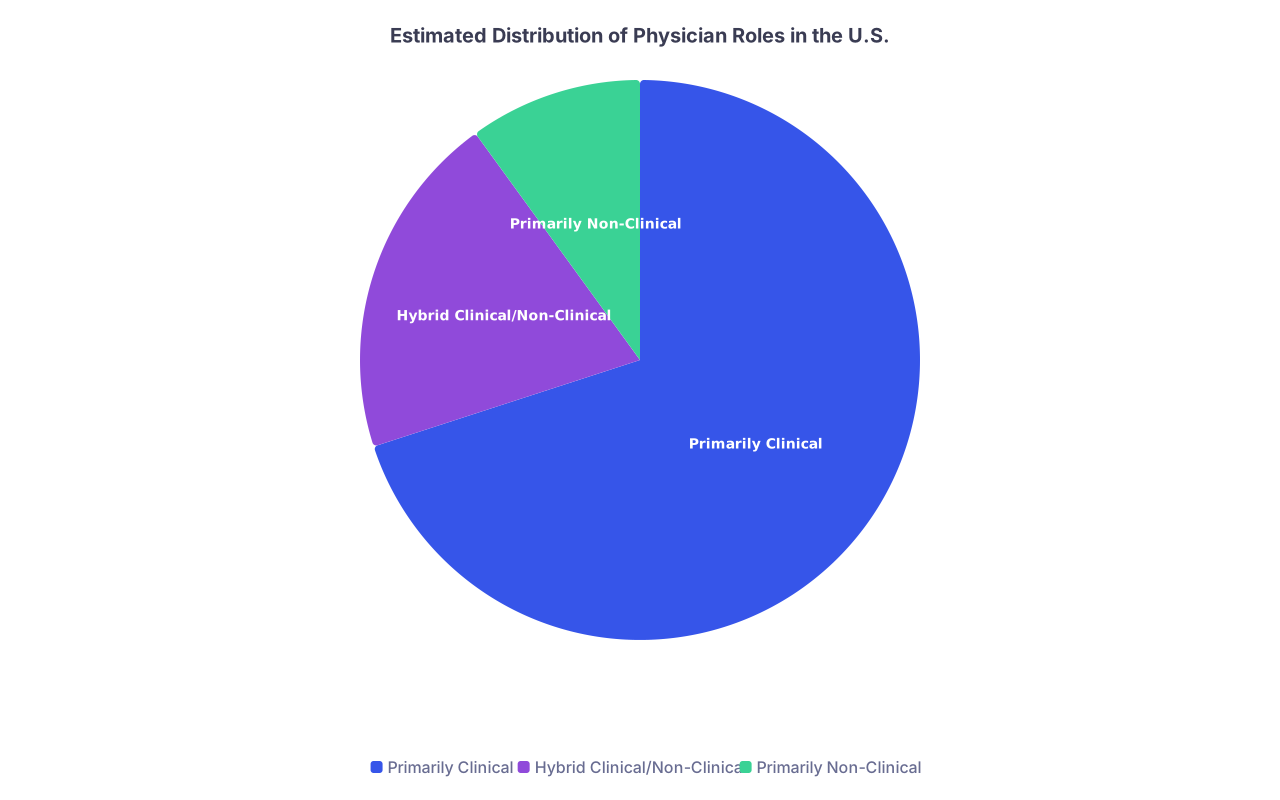
| Category | Value |
|---|---|
| Primarily Clinical | 70 |
| Hybrid Clinical/Non-Clinical | 20 |
| Primarily Non-Clinical | 10 |
You will see lower estimates from older reports (5–7% non-clinical). That is mostly a lag in data and definition. The more recent and granular the survey, the higher the non-clinical proportion looks, particularly among younger cohorts and burned-out specialties.
2. Definition problem: what “counts” as non-clinical?
This is where most confusion starts. People ask, “How many doctors left medicine?” Then they define “medicine” so narrowly that everything except exam-room work disappears.
From a data standpoint, you must distinguish at least four categories:
- Pure clinical – ≥90% of paid time is patient-facing care (outpatient, inpatient, procedures).
- Clinical with side gigs – still primarily clinical, but with small adjunct roles: occasional teaching, a few consulting hours, a medical director hat at a SNF, etc.
- Hybrid – 30–70% clinical, 30–70% non-clinical. Common mix: half clinical, half admin/industry/education.
- Fully non-clinical – ≥90% time in roles where direct patient care is not the primary function.
Survey design matters. Many workforce reports only ask about “patient care vs administration vs research” as a primary category, which hides hybrid careers. Medscape/Doximity-style surveys, which ask about how time is split, show a much higher rate of mixed roles.
Some examples that are technically non-clinical but still “in medicine”:
- Medical director at a health plan, running utilization management.
- Pharma clinical development lead for a Phase III trial program.
- Full-time CMIO (Chief Medical Information Officer) implementing EHR optimization.
- Senior medical writer at a regulatory strategy firm.
- Health policy analyst at a think tank.
Those physicians usually keep licenses, often board certification, sometimes even part-time clinics. But the job that pays the mortgage is not seeing patients.
When I say “10% of physicians are primarily non-clinical,” I am counting people whose main W-2 or 1099 is one of those roles. Side gigs do not qualify.
3. Where do non-clinical physicians actually work?
Let us break the non-clinical universe into a few big buckets and attach realistic percentages. These are approximate but consistent with multiple surveys and employer data.
Among physicians whose primary role is non-clinical, the distribution looks something like this:
| Role Category | Approx. Share of Non-Clinical Physicians |
|---|---|
| Administration / Leadership (C-suite, CMOs, VP roles) | 30–35% |
| Health Systems / Payer / Utilization Management | 20–25% |
| Pharma / Biotech / Medtech (R&D, MSL, safety, strategy) | 25–30% |
| Informatics / Digital Health / Data Science | 10–15% |
| Education / Writing / Medical Communications | 5–10% |
To translate that into the broader workforce (out of 100 physicians total):
- 3–4 are in leadership/admin full-time
- 2–3 are in payer/UM or similar
- 2–3 are in industry (pharma/biotech/medtech)
- 1–2 are in informatics or digital health
- ~1 is in education/writing/communications as primary work
Rough, yes. But this is the correct order of magnitude. The dominant non-clinical employers are not “mysterious startups.” They are health systems, insurers, and large life sciences companies.
4. How non-clinical work varies by career stage
Age and career stage strongly predict whether a physician is pure clinical, hybrid, or fully non-clinical. The odds shift as you age, burn out, and gain leverage.
A simplified breakdown based on multiple workforce patterns:
Early career (0–5 years post-training)
- ~85–90% primarily clinical
- ~8–12% hybrid roles (part-time teaching, admin, quality, etc.)
- ~2–3% fully non-clinical
Mid-career (6–15 years)
- ~65–75% primarily clinical
- ~15–25% hybrid
- ~8–12% fully non-clinical
Late career (16+ years)
- ~55–65% primarily clinical
- ~20–25% hybrid
- ~12–18% fully non-clinical
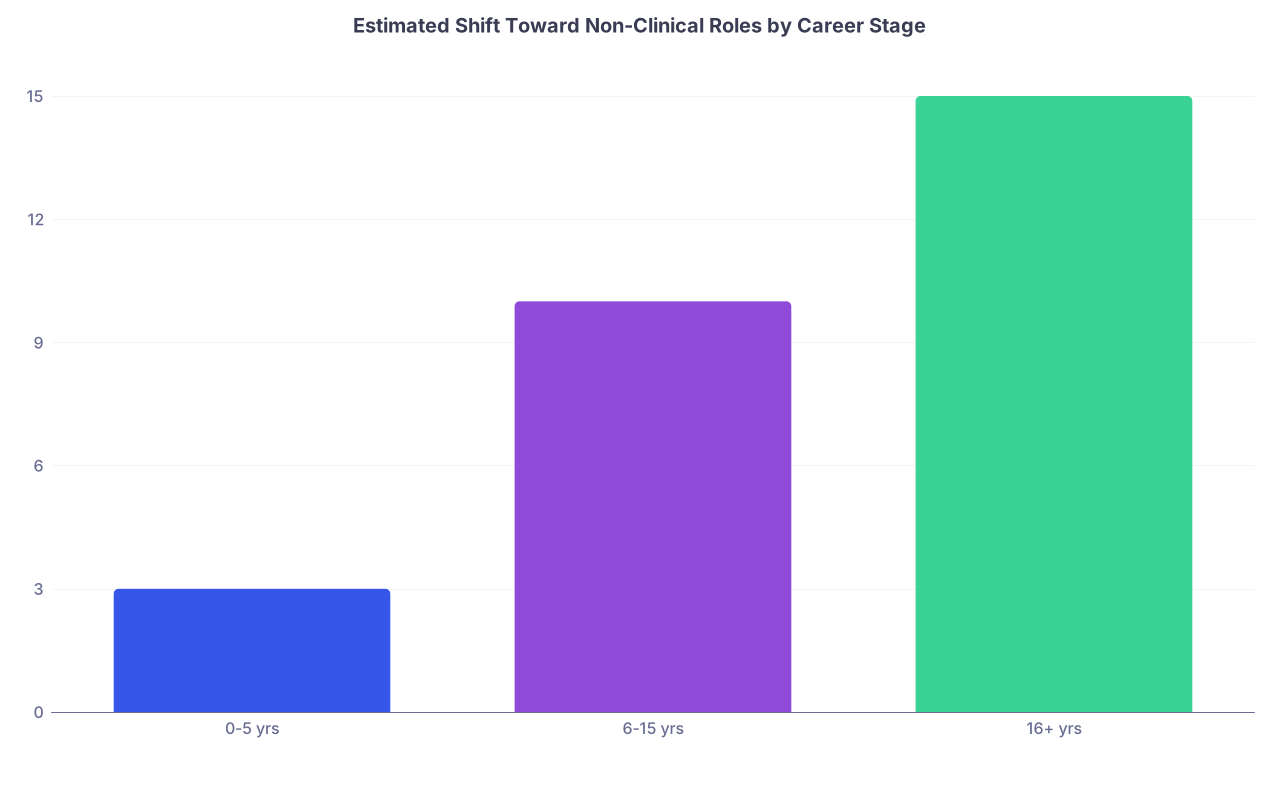
| Category | Value |
|---|---|
| 0-5 yrs | 3 |
| 6-15 yrs | 10 |
| 16+ yrs | 15 |
That bar chart reflects the approximate percentage of physicians who are primarily non-clinical in each career phase. The trend is straightforward: the longer you practice, the more likely you are to move into leadership, industry, or policy.
I have seen the same pattern on the ground. The 32-year-old hospitalist starts with pure hospital shifts. By 40, that same person is a section chief with 30–40% admin time. By 50, they have either become a CMO, gone to industry, or cut back to part-time clinical to make room for something else.
One practical implication: if you are in residency panicking that you “missed the non-clinical train,” relax. The data shows most full transitions happen mid-career, not right out of training. What you need now is skill-building and optionality, not an immediate exit.
5. Specialty differences: who leaves the bedside more?
Not all specialties behave the same. Some are pipelines to non-clinical work; others are almost entirely clinical forever.
Patterns I see consistently:
- Internal Medicine and its subspecialties – disproportionately represented in administration, payer roles, population health, and industry. They are the Swiss army knives of non-clinical transitions.
- Family Medicine – heavily represented in payer/UM, quality, public health, primary-care redesign, and digital health startups.
- Emergency Medicine – high burnout, high exposure to operational issues. Many pivot into admin, informatics, utilization management, and telehealth leadership.
- Pathology and Radiology – strong transitions into industry (diagnostics, AI, device, pharma). Also heavily involved in informatics and lab/hospital operations.
- Psychiatry – growing presence in digital health, mental health startups, and leadership around behavioral health integration.
- Surgery – lower full exits but significant C-suite representation (CMO, CEO, service line leaders), device industry roles, and consulting.
Broadly, cognitive and hospital-based specialties show higher rates of hybrid/non-clinical work. Procedure-heavy fields show more leadership/admin but less total exit from the clinical sphere, largely because their clinical incomes are already high and skills are very specialized.
6. Why the non-clinical trend is accelerating
The older generation of attendings still thinks of non-clinical careers as rare detours. The new data says otherwise. There are three macro-forces that are pushing physicians out of the exam room and into systems-level roles.
6.1 Burnout and disillusionment
Burnout is not a vague vibe; it is a strong predictor of exit.
Across multiple large surveys, 60–65% of physicians report at least one major burnout symptom. Among those, around 30–40% say they are considering a career change, usually meaning a reduction in or exit from clinical practice.
Not everyone who is “considering” will leave. But those numbers explain why non-clinical roles that barely existed 20 years ago (e.g., full-time utilization management, remote chart review, digital health design roles) now have constant physician applicant flow.
6.2 Health system and payer consolidation
As care has corporatized, the number of physician leadership and operations roles has expanded.
Every large health system now employs:
- Chief Medical Officer
- Multiple associate/vice CMOs
- Service line medical directors
- Quality, safety, risk, and population health roles
- Informatics and analytics roles with MD preference
The larger and more metric-driven the system, the stronger the demand for physicians who can speak both clinical and business/data languages. That directly drives the hybrid and non-clinical headcount.
6.3 The rise of data, technology, and regulation
You cannot run modern healthcare without:
- Reliable clinical data
- Algorithm and AI oversight
- Regulatory and compliance expertise
- Privacy and safety frameworks
- Evidence synthesis and real-world data analysis
Physicians are not the only people who can do this work, but there is a premium on those who understand the clinical reality.
The rapid growth of:
- Health tech startups
- Digital therapeutics
- AI/ML tools in imaging and documentation
- Telemedicine platforms
- Real-world evidence units at pharma and payers
…has created hundreds of distinct job titles that did not exist 10–15 years ago. That is where a lot of the 10% fully non-clinical physicians are sitting today.
7. Income and lifestyle: is the trade-off real?
You care about numbers, so let us talk pay and hours.
On average, pure non-clinical physician roles pay:
- Slightly less than high-earning procedure-heavy specialties
- Roughly comparable to or slightly higher than many cognitive specialties
- With better predictability, lower liability, and less weekend/night disruption
Typical base salary bands I see (U.S., full-time):
- Health plan medical director, utilization management: $220k–$320k
- Hospital/health system admin roles (director/VP level): $250k–$400k+ depending on scope
- Pharma/biotech (medical affairs, clinical development, safety): $230k–$400k+ with bonuses and equity potential
- Informatics leadership (CMIO, etc.): $260k–$380k+
- Full-time medical writing/education/communications: $150k–$260k (very wide, depends heavily on niche and productivity)
Compared to clinical:
- Many primary care physicians sit around $220k–$280k with substantial RVU pressure.
- Hospitalists ~ $250k–$330k.
- Procedure-heavy specialists can exceed $500k–$700k+.
So for a hospitalist or PCP, moving to a well-compensated non-clinical role is often income-neutral or mildly positive with fewer hours and less emotional load. For a high-earning surgeon, non-clinical moves can be a pay cut unless you land in senior leadership, industry executive, or entrepreneurial roles.
That is why non-clinical transitions skew toward:
- Burned-out mid-career hospitalists, internists, EM physicians, and family physicians
- Data- and systems-oriented specialists (radiology, pathology, anesthesiology) who can pivot into tech or industry
- Clinicians in smaller markets who are capped by local salary norms and see a better offer from industry or national payers
8. For you: how to interpret this “snapshot”
Let me be blunt. If 30% of physicians are already in hybrid or non-clinical roles, wanting to join them is not weird, selfish, or “wasting your training.” It is statistically normal.
What the data suggests you should do:
Stop treating non-clinical work as binary.
The large middle group is hybrid. They see patients part-time and spend the rest building programs, products, or policies. For many, that is the best risk-adjusted route.Treat skill-building as the constraint, not desire.
The job postings that absorb physicians at scale all ask for some combination of:- Data literacy (EHR, registries, SQL, Excel, basic analytics)
- Management and communication (teams, projects, presentations)
- Understanding of reimbursement, quality metrics, regulatory frameworks
Physicians with those skills have options. Others just have burnout.
Pay attention to your specialty’s pattern.
If you are an internist or hospitalist, there is a wide menu of roles that already exist in volume. If you are in a very niche, procedure-heavy field, you may need a more targeted plan: device industry, business roles, or leadership inside your current system.Use the numbers to push back on guilt narratives.
Administrators and older colleagues often frame non-clinical exits as a “loss to medicine.” The data shows that large, complex systems require a chunk of the physician workforce to operate at the systems and industry level. You are not abandoning care; you are shifting from N=1 encounters to population-, product-, or policy-level impact.
You are choosing which level of the system to influence.