
You’re sitting at your kitchen table at 10:37 PM. Laptop open. Kids finally asleep. Spouse or partner maybe already in bed or on the couch. Your last real clinical shift was years ago—maybe you stopped during pregnancy complications, aging parents, a child with special needs, or just complete burnout that collided with family crisis.
Now the family situation is more stable. Or at least stable enough that the financial pressure and the identity itch are louder than they were. You are Googling “non-clinical jobs for doctors” or “how to get back into medicine after time off” and everything you see is either vague, generic fluff or geared only toward full-time clinical re-entry.
You’re not sure you even want to go back to call, nights, and RVUs. But you also don’t want to throw away the MD/DO and the years you spent earning it.
Here’s the situation: you took time off for family, you’re not clinical-current, and you want back into medicine—but probably not back into the ICU at 3 AM. You need a realistic path, not Instagram inspiration.
This is that path.
Step 1: Get Very Honest About Your “Why” and Your Constraints
Before we talk about pharma, startups, utilization review, or anything else, you need clarity on what you actually need from a job right now. Otherwise you’ll chase the wrong roles and waste 6–12 months.
Grab a notebook, not an app. Write this out. That friction helps you think.
A. What do you actually want from re-entry?
Examples I’ve heard directly from physicians in your spot:
- “I want adult conversation and to use my brain again, but I can’t do nights or weekends.”
- “We need another $60–80k per year or we’re not paying for college.”
- “I’m scared I’ll forget everything and kill someone if I go back to clinical.”
- “I miss being ‘a doctor,’ but I never want to chart for eight hours again.”
You’re allowed to be practical and selfish here. This is not an admissions essay. Write down:
- Income target range (not fantasy—what would meaningfully help your household).
- Schedule constraints:
- Hours per week you can realistically work.
- Must-haves (no overnights, school pickup, remote-only, etc.).
- Emotional boundaries:
- Are you OK with direct patient decisions?
- Do you want zero clinical liability?
- How much stress can you tolerate given your family set-up?
B. Inventory your actual status
You’re probably underselling yourself or catastrophizing. Let’s be precise:
- Are you licensed? Active, inactive, or expired?
- Board certified? Lapsed? Never boarded?
- How long out of direct clinical practice? 1 year is different from 10.
- Any recent CME? Even a few category 1 credits matter more than you think.
- Any part‑time work you’ve done that touches medicine: telehealth, chart reviews, volunteering at a free clinic, school board health committee, helping a practice set up an EMR, etc.
Write the ugly truth. “License lapsed 5 years ago; board certification expired; out of clinical 8 years; no recent CME.” Fine. We work with that. Just do not pretend it’s better than it is.
Once you see your constraints and current state in black and white, non‑clinical directions become much clearer.
Step 2: Understand the Non‑Clinical Landscape Where You’re Actually Competitive
There are a million “alternative careers for doctors” lists. Most are useless because they ignore:
- Your clinical gap.
- Your location.
- Your need for part-time or flexible work.
- The fact you’ve been busy raising humans or caring for parents, not building some consulting empire.
Here are non‑clinical paths that specifically work for physicians re-entering after family time off, including those with rusty skills or lapsed boards.
| Path | Clinical Currency Needed | Typical Schedule | Entry-Level Pay Range (US) |
|---|---|---|---|
| Utilization Review (UM) | Helpful but flexible | Often office hours | $80k–$180k |
| Medical Writing/Editing | Low | Very flexible/remote | $40k–$150k+ (variable) |
| Pharma/Med Affairs (Assoc) | Moderate | Office hours, travel | $120k–$220k |
| Clinical Documentation (CDI) | Low–Moderate | Office hours, some remote | $80k–$150k |
| Health Tech/Startup Roles | Variable | Hybrid/remote | $90k–$200k |
Let me walk you through what these actually look like in real life if you’ve been “out.”
1. Utilization Review / Utilization Management (UM)
You review charts and decide whether hospitalizations, procedures, or tests meet coverage criteria for insurance.
Typical situation for you:
- You’re not touching patients.
- You’re using your clinical reasoning, but not doing procedures.
- You can often work from home after initial training.
- Many companies are fine with “not currently practicing” as long as you have a license (active) and credible training background.
Big names: Optum, Aetna, Cigna, Anthem, Humana, eviCore, various regional insurers and specialty management companies.
Issues:
- No license = harder but not impossible. Some internal review roles will require active license in any state.
- Large backlog of applicants = you need a clean, focused resume, not a standard hospital CV.
2. Medical Writing / Editing / Content
You turn your medical knowledge into words: patient-facing content, CME modules, exam prep questions, clinical guidelines summaries, medical marketing, regulatory writing.
Why this works well for family-return folks:
- It’s extremely freelance‑friendly.
- Remote by default.
- Nobody cares if you haven’t touched an EMR in eight years—if you can write clearly and accurately, you’re in.
You can start small:
- Question banks (UWorld competitor companies, BoardVitals, Rosh Review, etc.).
- Health media sites (Healthline, Verywell Health, WebMD-type platforms).
- CME providers and medical education agencies.
The bottleneck is not your knowledge. It’s your writing samples. We’ll fix that later.
3. Pharma / Medical Affairs / MSL (Medical Science Liaison)
More corporate, more money, more travel (for some roles), and more politics.
Realistic entry points after time off:
- Associate Medical Director or Medical Director at a pharma or med device company if you had previous strong clinical or research pedigree.
- MSL roles if you’re willing to travel and become the physician face of a drug/device in a region.
- Pharmacovigilance / drug safety for those detail‑oriented and okay reading adverse event reports.
If you’ve been out 8–10 years and never did clinical trials or research: harder, not impossible, but you’ll likely start in lower-visibility roles or smaller companies.
4. Clinical Documentation Improvement (CDI) / Coding-Related Roles
You help hospitals and health systems ensure charts accurately reflect the actual severity of illness and proper coding.
This is surprisingly friendly to physicians out of practice:
- You’re reading a lot of charts.
- Many roles are remote or hybrid.
- Coding certifications (like CCDS, CDIP) help but can be obtained while you ramp up.
You do need to be comfortable diving into ICD-10/DRGs/quality metrics, but it’s learnable.
5. Health Tech / Digital Health / Startups
Roles here can include:
- Clinical advisor/consultant.
- Product manager (with clinical emphasis).
- Clinical operations lead.
- Content lead for digital therapeutics, remote monitoring, telehealth platforms.
Pros:
- Often very open to unconventional career paths.
- Frequently remote or hybrid.
- They value your “user insight” as a former clinician and current family caregiver.
Cons:
- Can be chaotic.
- Comp may be partly equity, which does not pay for daycare this month.
Step 3: Translate “I Was Home With My Family” into a Hireable Story
Here’s where most people sabotage themselves. They either:
- Apologize for their family years like a guilty teenager.
- Pretend the gap did not exist and hope no one asks.
- Over-explain the gap with every personal detail of their child’s diagnosis or parent’s dementia.
Do not do any of those.
You want short, direct, and confident.
On your resume/CV:
Add a line for the gap, like:
2018–2023 – Family Leave / Caregiving, Full-Time
Primary caregiver for young children and elderly parent while maintaining ongoing CME and independent clinical reading.
You are not lying. You are framing. If you did any CME, add a “Recent Professional Development” section:
- 2022 – 20 AMA PRA Category 1 Credits – [Topic or provider]
- 2023 – Online coursework in healthcare quality and safety (IHI Open School)
- 2023 – Certificate: Medical Writing Fundamentals (AMWA or similar, if applicable)
In a cover letter:
Two sentences. That’s it.
In 2018, I stepped away from full-time clinical practice to care for my young family and an ill parent. That chapter is now stable, and I am actively returning to medicine in a non-clinical capacity where my training and judgment can contribute to patient care at scale.
No drama. No overshare. No apology.
In interviews:
You need one clean, rehearsed answer:
“I practiced as a [specialty] physician at [institution] until 2018. At that point, I made a deliberate decision to step away to manage family responsibilities—young children and a parent with significant health needs. Over the last [X] years I’ve kept up with [CME, reading, volunteer work if any]. That phase is now stable, and I’m intentionally shifting into a non-clinical role where I can use my medical background more sustainably for my family and my own well-being.”
Then shut up. Let them ask follow‑ups if they want. Do not fill the silence with self-criticism.
Step 4: Rebuild Just Enough Currency Without Signing Up for Residency 2.0
You’re not trying to become chief of cardiology. You’re trying to be credible in a non‑clinical space.
Think in terms of 3–6 months of targeted re‑tooling, not “I must do a full re-entry fellowship.”
A. Low-friction clinical refresh
If your license is still active or can be reactivated without a full reentry program:
- Do 25–50 hours of focused CME in your specialty or in adjacent fields like quality, safety, or health policy.
- Consider short, online certificates that align with non‑clinical roles:
- Quality & Safety (IHI, Coursera, university extension programs).
- Health Informatics basics.
- Medical writing courses (AMWA, Udemy, LinkedIn Learning—yes, the cheap stuff can still be useful).
- Healthcare management/leadership intros.
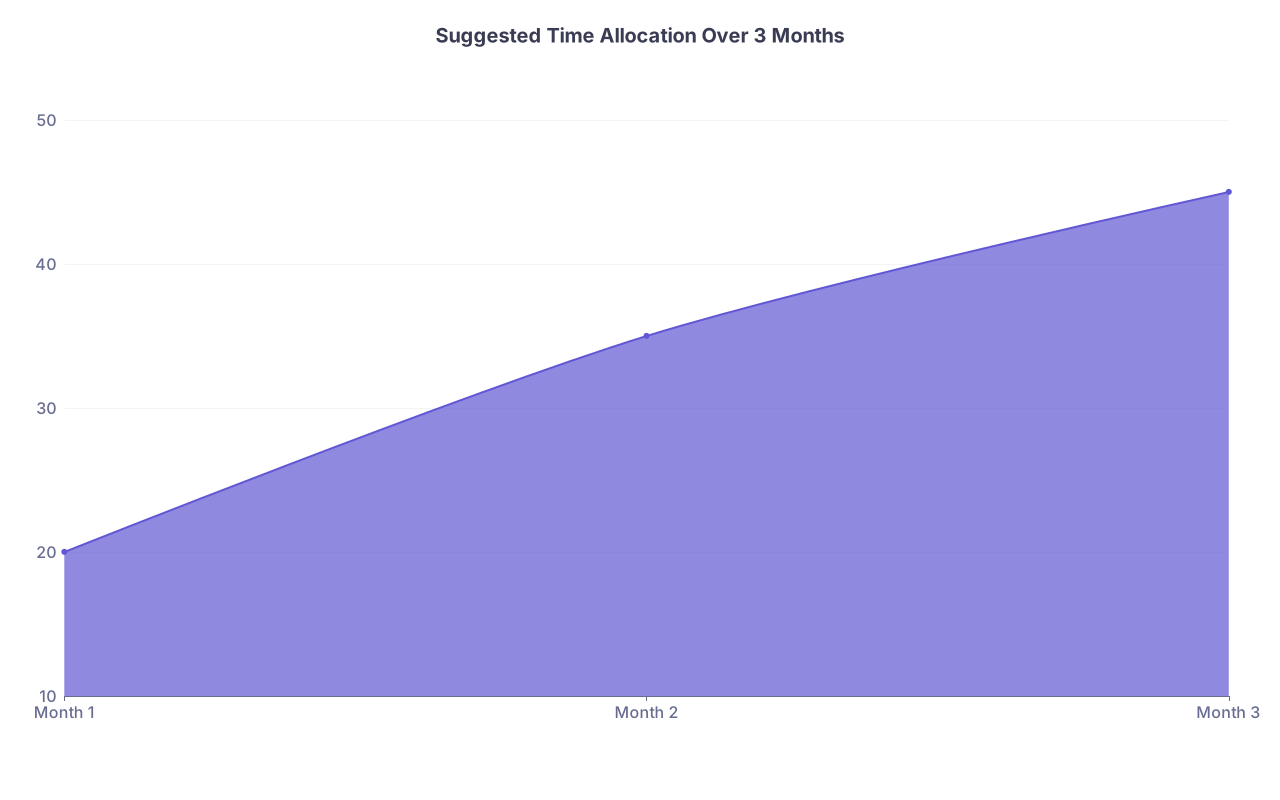
| Category | Value |
|---|---|
| Month 1 | 20 |
| Month 2 | 35 |
| Month 3 | 45 |
This chart is how many hours per month you might realistically dedicate to professional re-tooling around family life—start low and build.
If your license/boards are completely gone and returning clinically would be a multi-year ordeal: stop obsessing about clinical re-entry. You’re not going back to full‑scope practice. Committing to that reality frees you to sell what you do offer instead of apologizing for what you do not.
B. Build 2–3 small, real “bridge” projects
Companies will ask: “What have you been doing lately that’s relevant?
If the answer is “laundry and IEP meetings,” you need a better story. Create 2–3 small projects that function as your portfolio:
Examples:
- Volunteer to help a local clinic or a friend’s practice review and update patient education materials. Turn that into before/after examples.
- Join a hospital committee as an external physician member (quality, patient education, safety) if you still have institutional connections.
- Write 2–3 evidence-based patient handouts or blog posts and publish them on a simple website or LinkedIn articles.
- Take on a small freelance medical writing or editing gig via Upwork or specialty agencies.
You’re not doing this for money (yet). You’re doing it so your resume says something like:
2024 – Freelance Medical Writer (Remote)
Developed patient and clinician-facing content on [topic] for [client or “independent publication”].
Or:
2024 – Volunteer Clinical Content Reviewer, [Clinic or nonprofit]
Reviewed and updated 30+ patient education documents for accuracy, readability, and health literacy.
That reads very differently from “gap until 2024, then suddenly wants a full‑time job.”
Step 5: Rewrite Your Resume Like a Career-Changer, Not a Resident
Your academic CV with every poster from 2012 is dead weight in this context.
You need a lean, targeted, 2–3 page resume. Not 7 pages of every talk you gave.
Focus on:
- Transferable skills: clinical judgment, ability to interpret data, communicate complex topics, manage risk.
- Outcomes: improved processes, teaching, leadership roles—anything that shows you can move systems, not just see patients one-on-one.
A practical structure:
Header – Name, city/state, email, phone, LinkedIn URL (you will make one).
Professional Summary (3–4 lines)
Example:Physician with background in internal medicine and 6+ years of post-residency experience, now transitioning into non-clinical roles in utilization review and medical content. Brings strong clinical reasoning, clear written communication, and experience coordinating care for complex patients and families. Seeking remote or hybrid position where clinical training supports quality, safety, and patient-centered decision-making.
Key Skills – tailor to target path. For UM: evidence appraisal, chart review, payer guidelines, ICD-10 basics, communication with clinicians. For writing: plain-language translation, literature review, referencing.
Relevant Experience – your clinical roles first, then your bridge projects.
Family Leave / Caregiving – one concise entry.
Education, Licensure, Certification – be honest about active/inactive.
Selected CME / Training – last 2–3 years only.
If you’re aiming at multiple paths (say UM and writing), you may need two slightly different versions that rearrange your bullets and skills but tell the same truth.
Step 6: Where and How to Actually Find These Jobs
You’re not 25, and you do not have energy for a 300-application spray-and-pray strategy. So don’t.
A. Targeted platforms
Yes, you’ll still use big boards like Indeed/LinkedIn, but filter aggressively:
- Use search terms like:
- “physician advisor”
- “physician reviewer”
- “medical director – remote”
- “medical writer – physician”
- “clinical documentation physician”
- Filter by:
- Remote/hybrid (if needed).
- Experience level (“associate” or “mid-level,” not just “senior director”).
B. Niche sites & organizations
- Non-clinical physician groups (Physician side gig groups, non-clinical careers forums).
- AMWA (for medical writing).
- LinkedIn groups for UM, CDI, pharma medical affairs.
C. Use LinkedIn like an adult, not like a student
Update:
- Headline: “Physician transitioning to non-clinical roles in [UM/medical writing/medical affairs] | Internal Medicine | Quality & Safety”
- About section: a short, honest version of your story.
- Add projects and publications, even if they’re small.
Then:
Identify 10–15 people with the job title you want (e.g., “Medical Director, Utilization Management” or “Senior Medical Writer”).
Send this kind of message (short, human):
Hi Dr. Smith,
I’m a board-trained [specialty] physician returning to medicine after several years of family caregiving, and I’m transitioning into non-clinical roles in [UM / writing / med affairs]. I’d love to ask you 2–3 specific questions about how you entered your role and what skills you found most critical. Would you be open to a 15-minute chat sometime this month?
Some won’t respond. Some will. You only need a few.
Those conversations get you:
- Real salary info.
- Specific buzzwords to use in your resume.
- Sometimes, a referral.
Step 7: Emotional Armor – Handling Guilt, Identity Loss, and Judgment
No way around this: this transition is not just logistical. It’s existential.
Things I’ve heard from physicians in your situation:
- “Am I still a ‘real doctor’ if I never touch a patient again?”
- “My old colleagues think I ‘couldn’t hack it.’”
- “My family got used to me always being there. Now I feel selfish wanting to work.”
Here’s the blunt version: you already paid your dues. You did the training. You sacrificed your twenties, probably early thirties. Then you sacrificed again for your family. You’re not selfish for wanting a career chapter that actually works for your life now.
A few guardrails:
- Stop asking for career advice from people who have a stay-at-home spouse and full-time nanny. They are playing a different game.
- Stop expecting your old attendings or program directors to “get it.” Many won’t. Their worldview is narrow.
- Choose three people whose opinions actually matter. Your spouse/partner, maybe one trusted colleague, maybe a mentor who has seen non‑linear careers. Everyone else goes in the background-noise bucket.
And remember this: non‑clinical does not mean “less than.” You can impact thousands more patients through smart policy, better documentation, or clear patient education than you ever did per shift.
Step 8: A Concrete 90-Day Action Plan
Let’s pull this into something you can actually do, starting tonight.

| Step | Description |
|---|---|
| Step 1 | Today |
| Step 2 | Clarify constraints and goals |
| Step 3 | Update LinkedIn and resume |
| Step 4 | Complete 10-20 hours targeted CME |
| Step 5 | Create 2-3 small bridge projects |
| Step 6 | Reach out to 15 contacts on LinkedIn |
| Step 7 | Apply to 10-20 targeted roles |
| Step 8 | Interview prep and iteration |
And if you want more granularity:
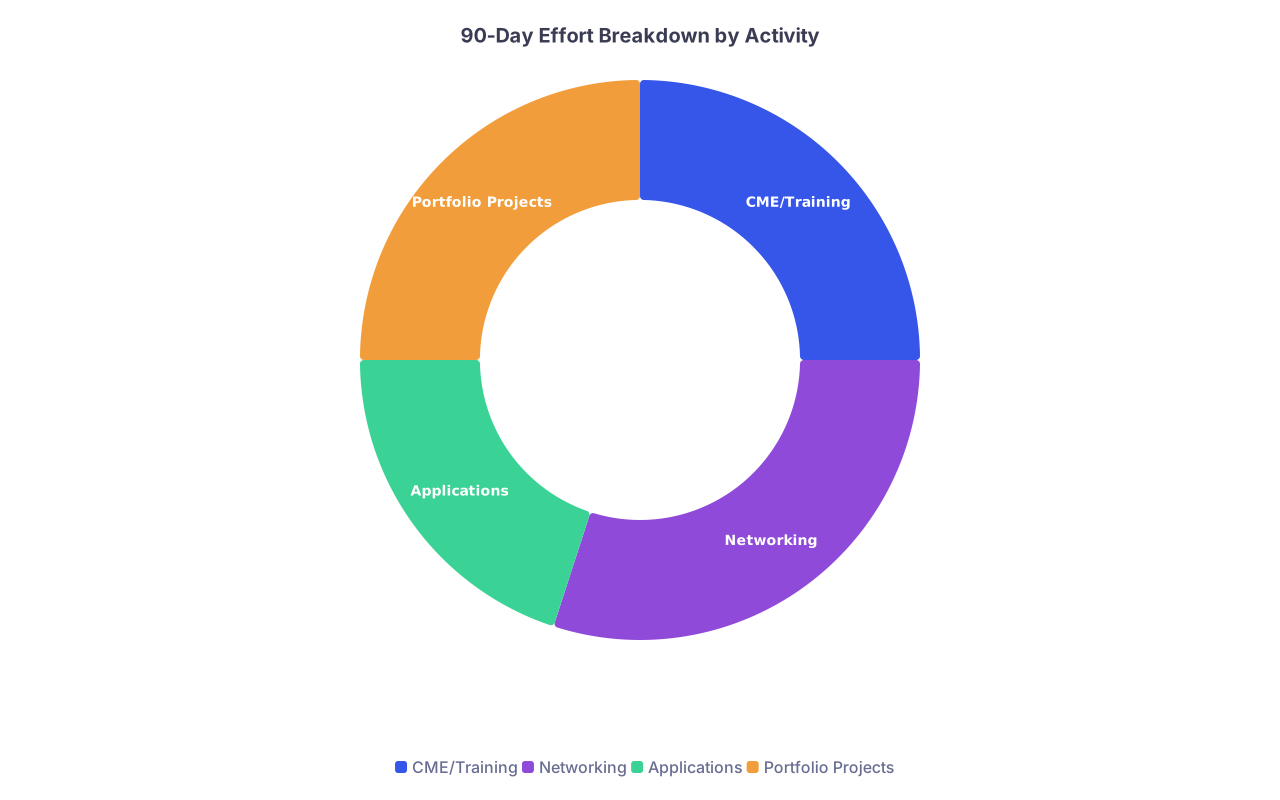
| Category | Value |
|---|---|
| CME/Training | 25 |
| Networking | 30 |
| Applications | 20 |
| Portfolio Projects | 25 |
Ballpark where your time should go. Notice how “applications” are not 80% of the pie. Networking and creating proof of value matter more.
Step 9: Red Flags and Traps to Avoid
Quick list, because I’ve seen people waste years here.
- Massive, expensive “medical career coaching” packages promising guaranteed six‑figure pharma jobs. Be extremely skeptical.
- Jobs that primarily value your MD as a marketing prop but pay poorly and offer no growth (some “concierge wellness” outfits are guilty of this).
- Telehealth positions that sound flexible but need nights/weekends you cannot actually sustain with your family situation.
- Roles that are 1099-only, no benefits, with hourly rates that do not remotely match the responsibility level.
Use this rule: if the compensation, autonomy, or growth opportunity would not be acceptable to someone in your shoes without a career break, do not accept it “because you’re lucky to be here.” You are not a charity case.
Your Next Step Today
Do one concrete thing. Not ten.
Open a blank document and write three bullets:
- “My target non-clinical directions are: [e.g., utilization review, medical writing, health tech clinical advisor].”
- “My non-negotiables (schedule, location, income floor) are: […].”
- “My biggest career insecurity right now is: […].”
Then open your current CV or resume. Rename it: Lastname_NonClinical_Transition_2026.docx.
Delete at least one outdated section that only matters in academia: ancient poster presentations, random minor teaching awards, that kind of thing.
Save it.
That’s the first cut. Tomorrow, you’ll start turning that document into a non-clinical resume and lining it up with those three bullets. Tonight, just make the decision: you’re allowed back into medicine—on different terms this time.