
The worst thing you can do with a stalled academic career is pretend it is not stalled.
If your promotions have quietly stopped moving, your title has not changed in years, your RVUs are fine but your CV is flat, and you’re watching junior people leapfrog you—this is your reality check. And yes, industry can absolutely reboot your career. But only if you approach it strategically, not as a vague escape hatch.
This is about what to do if you are a mid-career academic physician whose promotion has hit a wall and you’re starting to think, “Maybe pharma/biotech/health tech is my next move.” I am going to walk through the actual steps, the traps that will waste 2–3 years of your life, and the specific ways to use industry as a reset button—not just a different cage.
1. First, Diagnose Why You’re Stalled (Brutally)
Before you run to industry, you need a clean diagnosis. Otherwise, you’ll recreate the same problems in a new setting.
Ask yourself, on paper, not in your head:
- Current title: Assistant? Associate? “Clinical” track with no tenure?
- How long at this rank?
- What your institution actually values for promotion (not the policy PDF—the reality)
- Where you’re weak: Grants? First/last-author pubs? Teaching portfolio? Committee visibility? Politics?
You’re probably in one of these buckets:
| Stall Type | Typical Situation |
|---|---|
| Research gap | Few recent first/last author papers, no major grants |
| Track mismatch | On clinical track but want research or vice versa |
| Political block | Department chair or division chief not supportive |
| Burnout productivity drop | Teaching/clinical fine, scholarship collapsed |
| Institutional ceiling | Promotion culture weak or non-existent |
Here’s the uncomfortable truth: if your stall is due to institutional politics, a saturated department, or a track mismatch, industry can be an excellent reset. If the stall is because you have become unreliable, chronically late, or toxic to work with, that’s going with you. Industry is not a personality transplant.
So write this sentence in one direct line:
“My promotion is stalled primarily because ___________.”
If you can’t finish that in under 20 words, you have not thought hard enough yet.
2. How Industry Actually Uses Stalled Academics (When It Works)
Industry does not care about your lack of promotion. They care whether you can:
- Make decisions
- Communicate clearly
- Understand evidence and risk
- Work in teams without drama
- Get things done on a predictable timeline
Your old titles (Assistant vs Associate vs Full) matter far less than you think. What matters is whether your academic history tells a coherent story that maps to a business need.
Typical “stalled” academic profiles that translate well into industry roles:
The mid-career trialist
- You’ve been a co-investigator, site PI, or protocol author on multiple clinical trials
- You understand endpoints, inclusion/exclusion, protocol deviations, IRB chaos
- You stalled because you never landed big PI grants or first/last author in big journals
- Industry loves you for: Clinical development, medical affairs, safety roles
The teaching workhorse
- You run clerkships, residency programs, or didactics
- You have thousands of hours in front of learners and complex content
- Weak on research, strong on explaining nuance and influencing behavior
- Industry loves you for: Medical education, MSL (medical science liaison), field medical, internal training
The clinical guideline nerd
- You sit on hospital committees, quality groups, guideline panels
- You understand real-world practice, not just trial data
- Industry loves you for: Health economics and outcomes research (HEOR), real-world evidence, market access medical, safety
Where industry gets nervous is this profile:
- Very academic, deep in a niche, thin on collaboration
- No evidence you can operate in a non-hierarchical, cross-functional environment
- Reputation for being “brilliant but impossible”
If that is you, still not doomed. But you’ll need to prove you can work in teams and meet deadlines without a small army of learners supporting you.
3. Decide Your Goal: Reboot or Exit?
This is the fork in the road most mid-career physicians ignore.
Are you:
- Using industry as a permanent new path because you are done with academic politics?
- Using industry as a sabbatical and leverage tool—take 3–7 years, build skills, come back stronger?
Both can work. But the strategy is different.
If you want a permanent exit:
- You can be more flexible on location and role type
- You should optimize for compensation, role growth, and skill stacking
- You don’t need to keep a publication pipeline alive after the first 1–2 years
If you want to reboot and possibly return:
- You must protect your academic identity: keep publishing, stay in societies, continue speaking
- You should aim for roles that align with your academic niche (clinical development, med affairs in your subspecialty)
- You want titles and responsibilities that will impress a department chair later (Director, VP, Head of…)
Be explicit with yourself. Write it down: “I am using industry as a [permanent reset / temporary reboot].”
4. Map Your Academic CV to Industry Roles
Here’s where people get lost. They think “I’m a cardiologist” instead of “I’m someone who can lead Phase III heart failure trials” or “I’m someone who can explain complex evidence to skeptical clinicians.”
Translate your background into industry categories.
| Academic Starting Point | Strong Industry Fits |
|---|---|
| Clinical trial heavy | Clinical Development, Safety, Translational Medicine |
| Teaching & education | Medical Affairs, MSL, Internal Training |
| Quality & guidelines | HEOR, Outcomes Research, Safety, Market Access Medical |
| Basic/translational research | Early Development, Discovery, Translational Medicine |
| Public health/epidemiology | Pharmacovigilance, Real-World Evidence, HEOR |
If you have:
- 10+ first/last-author clinical papers → highlight trial design, endpoints, data interpretation
- Thousands of lecture hours → highlight communication, influence, stakeholder management
- Committee leadership → highlight cross-functional collaboration, consensus-building, implementation
You’re not “Associate Professor of X who never made full.” You’re “Experienced clinician-investigator with 15+ years leading multi-stakeholder clinical initiatives and interpreting complex data.”
Different story. Much more useful.
5. Fix Your Story Before You Touch Industry Recruiters
The question you will get—over and over—is:
“Why are you leaving academia now?”
If you answer this wrong, you will sound like damaged goods.
Bad answers (I’ve heard versions of all of these):
- “I’m tired of fighting for promotion.”
- “My chair doesn’t support me.”
- “The politics are horrible.”
- “I’m burnt out.”
- “There’s no funding anymore.”
These might be true. And you should never say them.
You need a forward-looking, business-relevant story that does two things:
- Frames your academic stall as context, not identity
- Shows that industry is a pull, not just an escape
Better framing examples:
“My work has increasingly focused on applying trial data to real-world decision-making. I’ve realized the biggest lever for patient impact is actually at the level of drug development and evidence generation, not just at a single academic center. That’s why I’m looking at clinical development roles.”
“I’ve spent the last decade teaching complex clinical concepts to trainees and colleagues. I want to use that communication skill to help shape how new therapies are understood and used appropriately, which is why medical affairs is very compelling to me.”
“Promotion structures in my current institution don’t align well with the kind of collaborative trial work I do. I’d rather be in an environment where that work is central to the mission, not peripheral.”
Notice: you’re telling the truth without whining.
6. Start Quiet: Information-Gathering Phase (3–6 Months)
You don’t open LinkedIn one day and slam “open to work” if you’ve been in academia for 15+ years. That’s how you get flooded with irrelevant recruiter spam and panic offers.
You start with a quiet, structured information phase:
Inventory your network
- Who from your med school, residency, fellowship is already in pharma, biotech, med tech, consulting?
- Who has moved from your department to industry?
Reach out with very specific language:
- “I’m exploring whether a move into medical affairs or clinical development would make sense in the next 1–2 years. Could I get 20 minutes to understand what your day-to-day looks like and what backgrounds tend to do well in your group?”
Ask concrete questions:
- What does success look like after 12–24 months in your role?
- What do former academics struggle with?
- What backgrounds are on your team now?
- What would my CV signal to hiring managers in your company?
Quietly update your LinkedIn
- Add real descriptions to your roles (“Led X trial,” “Chaired Y committee”)
- Add skills that match industry language (clinical development, medical affairs, pharmacovigilance, evidence synthesis, stakeholder engagement)
You’re not job-hunting yet. You’re learning what game you are trying to enter.
7. Target the Right Entry Points (And Avoid the Career Dead-Ends)
Not all industry roles are equal if your goal is a “reboot” rather than a short-term paycheck.
Here’s a rough layout:
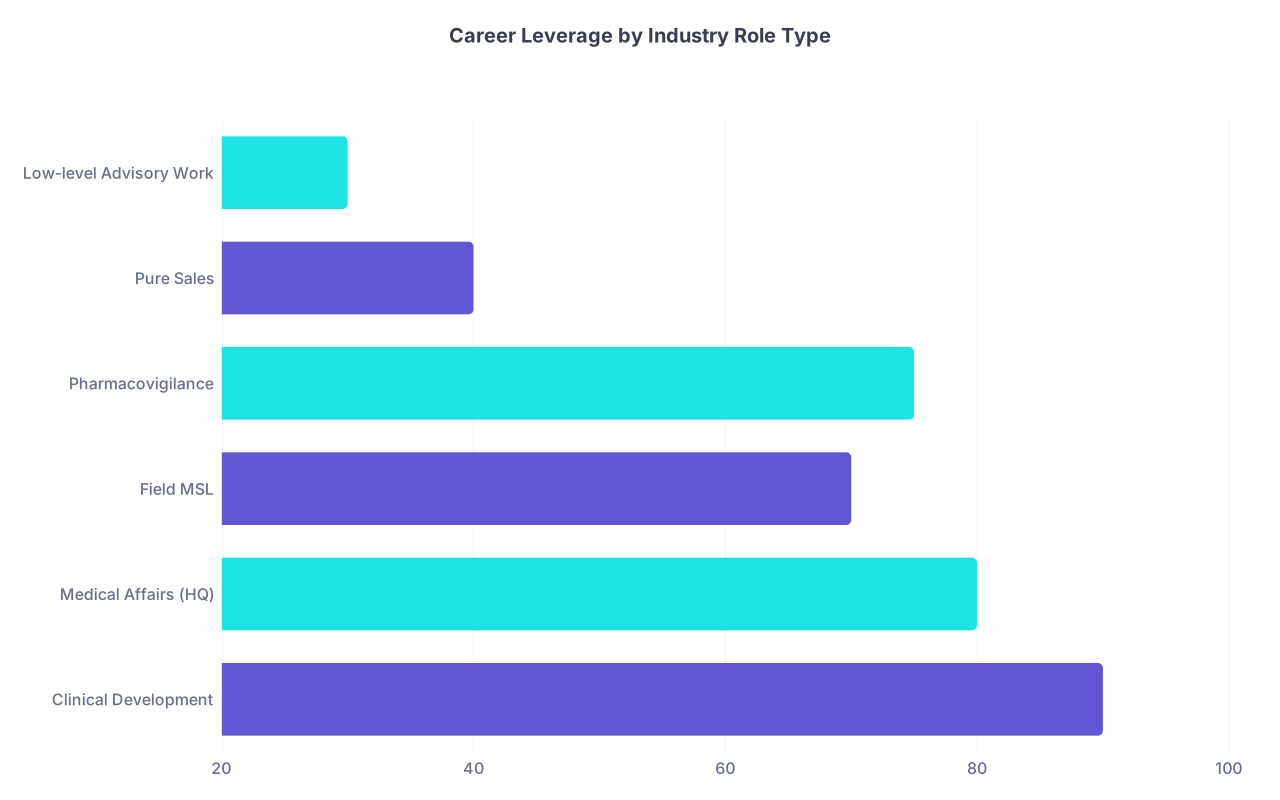
| Category | Value |
|---|---|
| Clinical Development | 90 |
| Medical Affairs (HQ) | 80 |
| Field MSL | 70 |
| Pharmacovigilance | 75 |
| Pure Sales | 40 |
| Low-level Advisory Work | 30 |
(Think of these as “leverage scores” for future options, not salary.)
High-leverage roles for a stalled academic who wants a real reboot:
- Clinical Development (clinical research physician, global clinical lead)
- Medical Affairs (home office roles: scientific director, medical director)
- HEOR / Real-World Evidence (if you’re methods-oriented)
- Pharmacovigilance / Safety Physician (especially if you’re risk- and policy-minded)
Decent bridge roles, especially if you love teaching and networking:
- MSL (medical science liaison), especially senior/principal levels
Works better if you’re extroverted, enjoy travel, and can handle variable schedules.
Dangerous if your goal is future leadership or academic return:
- Pure sales roles with an MD attached
- Very junior, narrow advisory roles where you’re just the “token physician” without decision power
You want roles with:
- Budget responsibility or clear deliverables
- Cross-functional exposure (regulatory, commercial, clinical, safety all around the table)
- A title that clearly says “Physician” or “Medical Director” or “Clinical Research” in it
If the role description sounds like “sitting in a corner reviewing slides,” keep walking.
8. Manage the Money and Lifestyle Shock
You’re probably wondering: “What happens to my income, hours, and control if I jump?”
Typical pattern for U.S.-based physicians:
- Base salary in pharma/biotech: often similar or higher than academic base, but without RVU upside
- Bonus: 10–30% of base, sometimes higher at senior levels
- Equity: can be a rounding error or a life-changer, depending on company and luck
- Hours: usually 45–60/week, but more predictable; fewer nights/weekends, but real deadlines
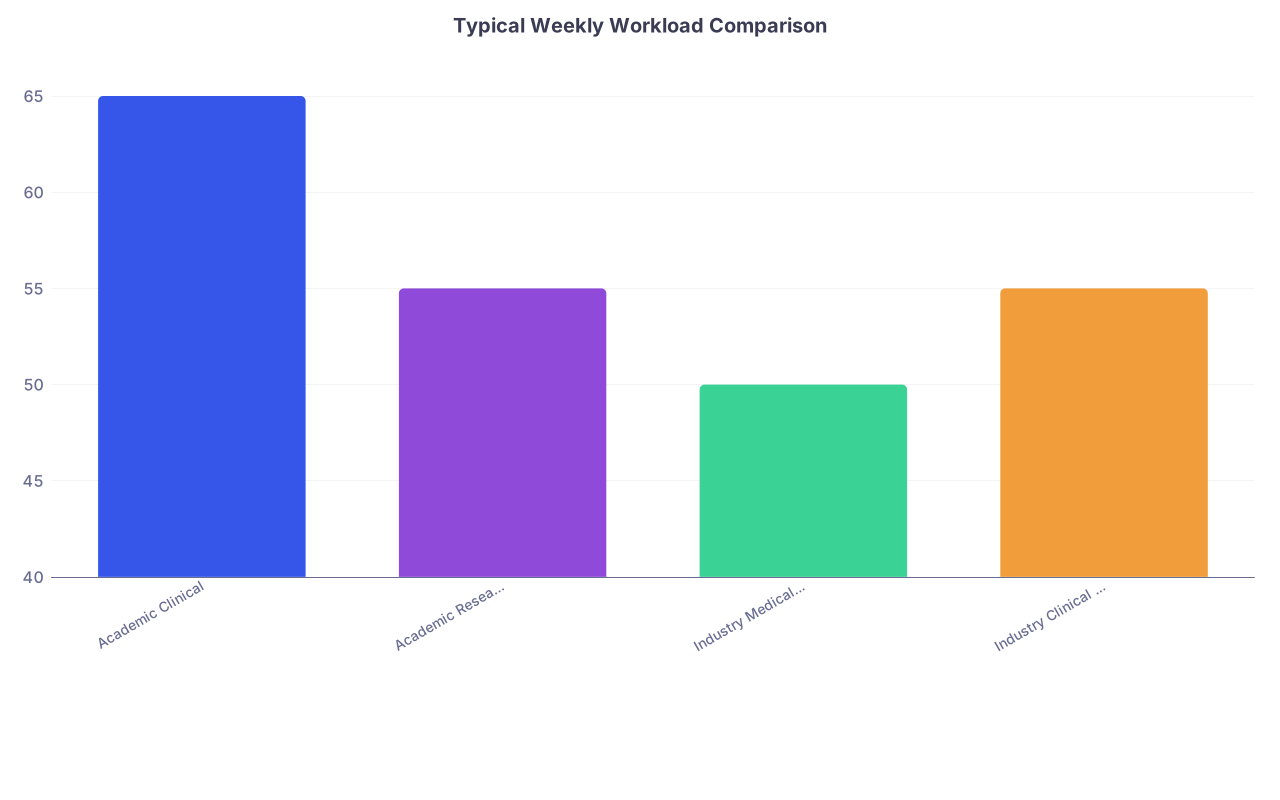
| Category | Value |
|---|---|
| Academic Clinical | 65 |
| Academic Research-heavy | 55 |
| Industry Medical Affairs | 50 |
| Industry Clinical Dev | 55 |
Key realities:
- You’ll lose some control over your day: more meetings, more alignment, more approvals
- You’ll gain predictability: no 2 a.m. admissions, fewer fire drills (not zero)
- Your income composition shifts: salary/bonus/equity instead of salary/RVU/speaking
If you’re using industry as a “reboot,” be honest: Can you handle a culture where your slide deck style matters as much as your p-value interpretation? Because that’s real.
9. If You Might Come Back to Academia, Protect Your Options
Let’s say you’re 45, stalled at Associate Professor, and you’re thinking: “I’ll go to industry for 5 years, make some money, get a Director title, then maybe come back as section chief somewhere.”
That’s not fantasy, but it does not happen automatically. You need to protect your academic brand while you’re out.
Specific things to do:
Keep 1–2 active academic collaborations
- Continue as co-author on projects where your contribution is realistic (data interpretation, trial design, guidelines)
- Don’t ghost your former mentees; stay involved in a sustainable way
Stay visible in societies
- Keep your membership in specialty societies
- Try to maintain at least occasional speaking roles (satellites, CME, panels)
Publish from your industry role when allowed
- Clinical trials, real-world data, reviews, guidelines
- Don’t disappear from PubMed for 7 years and expect a smooth return
Track concrete leadership achievements
- Led X-person team across Y regions
- Ran global Phase III program in Z indication
- Built medical strategy for launch of [drug] in [therapeutic area]
Academic hiring committees now see industry time as an asset when it’s tied to real accomplishments, not as a black hole. But they need proof of ongoing intellectual and professional engagement.
10. The Transition Mechanics: How to Actually Move
When you’re ready to go from “exploring” to “moving,” here’s the basic sequence.

| Step | Description |
|---|---|
| Step 1 | Self Assessment |
| Step 2 | Info Interviews |
| Step 3 | Target Role Types |
| Step 4 | Revise CV and LinkedIn |
| Step 5 | Network Warm Intros |
| Step 6 | Apply to Select Roles |
| Step 7 | Interviews and Case Exercises |
| Step 8 | Offer Evaluation |
| Step 9 | Negotiate and Accept |
Steps, concretely:
Convert your academic CV to an industry CV
- 2–3 pages max
- Results and impact, not just lists of publications
- “Led,” “designed,” “implemented,” “managed” all over the place
Leverage warm introductions
- Alumni, former colleagues, society contacts who’ve moved to industry
- Ask specifically: “Would you be comfortable forwarding my CV to the hiring manager for roles like X in your group?”
Prepare for a different interview style
- Behavioral questions: “Tell me about a time you disagreed with leadership.”
- Cross-functional scenarios: “Commercial wants X, safety wants Y, what do you do?”
- Less “tell me your H-index,” more “show me you can operate in a matrix.”
Don’t panic-accept the first offer
- Get at least a sense of the market: titles, ranges, typical bonus/equity structure
- Ask explicitly about promotion pathways and timelines inside the company
Time your exit
- Try to avoid bailing in the middle of an exam block, graduation season, or a trial milestone where you are central
- You want your department to be publicly sorry to see you go, not quietly relieved
11. What a “Reboot” Actually Looks Like 3–5 Years In
Let’s jump ahead.
You’ve been in industry 3–5 years. What does a successful reboot look like?
Signs it worked:
- Your title rose (e.g., Associate Director → Director or higher)
- You can clearly explain your impact in business terms: launch success, trial completion, safety signal managed, access improved
- Your compensation is more predictable and usually higher than your academic take-home
- You feel marketable outside your current company (recruiters calling with relevant roles)
Optional but powerful: you now have enough leverage to choose.
Return to academia as:
- Division chief who brings industry trial experience
- Program director with deep med affairs relationships
- Professor with credibility in both real-world and trial evidence
Or stay in industry and aim for:
- Global Head roles
- VP/SVP Medical or Development
- Portfolio-level leadership
That’s what “reboot” means: your trajectory is un-stuck, and you have options again.

12. Situations and How to Handle Them
Let me get very concrete about a few common scenarios.
Scenario 1: Associate Professor, denied promotion twice, exhausted
What to do in the next 12 months:
- Stop reapplying for the same promotion with the same CV. That’s self-harm.
- Pick 2–3 industry role categories that align with your real work (e.g., clinical development in your specialty).
- Do 6–10 targeted info calls with people in exactly those roles.
- Start reshaping your activities now (committees, projects, talks) to better match those roles even before you apply.
Scenario 2: On “clinical track,” told you’ll never be promoted beyond current title
Your institution has already decided your ceiling. Believe them.
Plan:
- Accept that academic prestige at that place is not coming.
- Decide whether to:
- Move to another academic center with a track that fits you, or
- Pivot to industry where your clinical-expertise-plus-teaching is valued (med affairs, MSL leadership, training)
If you’re over 40, I lean industry here unless you have an easy lateral academic move.
Scenario 3: Burned out but terrified of “losing your identity” as an academic
You’re not as unique as you think. A lot of people have gone through this.
Try this mental shift:
- You’re not “leaving academia.” You’re upgrading your skill set.
- You’re trading one prestige system (titles and grants) for another (responsibility and impact at scale).
- You can stay intellectually alive through publications, societies, speaking, even in industry.
Most people who make the jump realize after 1–2 years that their attachment was to the idea of academia, not the daily reality.

13. Quick Reality Checks (No Sugarcoating)
A few blunt truths so you’re not surprised:
- Industry will not fix a lack of basic professionalism. Missed deadlines, chaotic email habits, and poor communication get exposed faster, not slower.
- Your publication list impresses exactly one round of people. After that, they care if you can execute.
- You will have non-physician bosses. Some younger than you. Some with MBAs, no MD. If that bothers you deeply, industry will make you miserable.
- Switching at 50+ is absolutely possible. I’ve seen it. It just usually means starting at a slightly lower title than your ego wants. Deal with it or stay stuck.

FAQ (Exactly 5 Questions)
1. Will moving to industry kill my chances of ever becoming a full professor?
No, not automatically. If you vanish from academic life, stop publishing, and do purely internal corporate work, then yes, it becomes very hard. If you maintain collaborations, keep publishing, stay active in societies, and your industry role involves visible scientific work (trials, publications, guidelines), you can come back and be promoted at some institutions. It may not be at your original institution, but full professor from a hybrid academic–industry path is increasingly common.
2. Do I need an MBA or extra degree to move from academia to industry?
Usually not. An MD, DO, or relevant PhD is enough for most medical affairs, clinical development, and safety roles. An MBA can help if you’re aiming at commercial leadership or want to move into general management later, but it’s not a prerequisite for your first industry role. I’ve seen plenty of physicians get VP titles without an MBA because they learned the business on the job.
3. How long should I stay in my first industry job before considering a move?
Typically 2–3 years. Less than 18 months looks jumpy unless there’s a clear reason (site closure, reorg, relocation). Around the 2-year mark, you’ve delivered at least one major project and can credibly claim impact. If your first job is not ideal but not toxic, use it as a paid training program: learn the language, the processes, and then upgrade.
4. Will my salary immediately be higher in industry than in academic medicine?
Not always. If you’re a highly compensated proceduralist with big RVU bonuses, your initial industry base may look lower. But when you factor in bonus, equity, and more predictable hours, the value can be comparable or better. For non-proceduralists with modest academic pay, industry often represents an immediate financial bump. The big financial upside tends to come 3–7 years in, once you hit Director/Senior Director and beyond.
5. What’s the biggest mistake stalled academics make when approaching industry?
They lead with their frustration instead of their value. They talk about toxic chairs, lack of promotion, and burnout in the first five minutes. That signals risk. The right move is to translate your academic work into business-relevant skills—trial leadership, evidence synthesis, teaching, stakeholder management—and present industry as the logical next step, not a rescue mission. Companies hire problem-solvers, not refugees.
Final Takeaways
- A stalled academic career is data, not a life sentence. Treat it as feedback and act.
- Industry can reboot your trajectory if you map your skills to the right roles and control the story you tell.
- Protect your options—whether you stay or return—by staying visible, productive, and professionally disciplined wherever you land.