
The confusion between “Medical Science Liaison” and “Medical Advisor” is not harmless. It is exactly how smart clinicians end up in the wrong job, burned out in pharma instead of in the hospital.
Let me be blunt: MSL and Medical Advisor are not interchangeable labels for “doctor in pharma.” They are different functions, different personalities, different daily rhythms, and in many companies, completely different career ladders.
You want out of traditional clinical practice and into medical affairs? Fine. But if you do not understand the MSL vs Medical Advisor split in detail, you are gambling with the next 5–10 years of your life.
Let me break this down properly.
1. Core Definitions: Field vs Office, External vs Internal
Start from the only distinction that really matters: where the value is created.
Medical Science Liaison (MSL)
A field-based, external-facing medical affairs role. The MSL’s core purpose is to build and maintain scientific relationships with external experts (KOLs, investigators, guideline authors, digital opinion leaders) and act as the company’s scientific face in the field.
They are out there. In hospitals, at conferences, in advisory boards, in investigator meetings. They do not sell, but they support the ecosystem that ultimately drives the product’s adoption and correct usage.
Medical Advisor (MA)
An office-based, internal medical affairs role. The Medical Advisor’s core purpose is to be the medical owner of one or more products/therapy areas inside the affiliate (country) or region. They shape strategy, ensure scientific and compliance integrity, and support cross‑functional teams (marketing, market access, regulatory, pharmacovigilance).
They are in the building. Or on internal calls. They design the strategy that MSLs execute in the field and that commercial teams translate into campaigns (under strict rules).
If you want one sentence:
MSL = external execution and insight generation.
Medical Advisor = internal strategy and decision support.
2. Daily Work: What You Actually Do All Day
People get this wrong because job descriptions are vague on purpose. Let me spell out what the day really looks like.

A day in the life of an MSL
Rough pattern (varies with geography and company):
- 50–70% of time in the field
- 20–30% on calls, planning, internal debriefs
- 10–20% admin and training
Typical week might include:
2–3 days on the road:
- Pre‑planned visits with 3–5 KOLs per day
- Scientific discussions on recent trial data, label changes, safety updates
- Responding to unsolicited questions (off‑label only within strict rules)
- Identifying potential investigators for upcoming studies
- Discussing unmet needs and current treatment patterns
1 day on internal calls:
- Medical affairs team meeting: pipeline updates, new publications
- Sharing field insights: “In region X, oncologists are confused about line of therapy after progression on regimen Y”
- Training sales team: mechanism of action, pivotal trial nuances, how to handle common clinical questions
1 “desk” day:
- Preparing slide decks for KOL meetings
- Following up on medical information requests
- Updating KOL interaction records in CRM
- Planning conference attendance and 1:1 meetings
Travel is not theoretical. I have seen MSLs spending 3 nights a week in hotels during launch years. If you hate airports, trains, and hospital parking lots, this will become painful quickly.
A day in the life of a Medical Advisor
This is a very different beast.
Rough pattern:
- 70–85% internal meetings and project work
- 10–20% external engagement (advisory boards, key KOLs, sometimes speaker training)
- 5–10% compliance / review work
Your week often looks like:
Cross‑functional meetings:
- Brand team meetings with marketing: reviewing campaign concepts, discussing messaging boundaries
- Market access discussions: supporting health economic arguments, reviewing dossiers for HTA bodies
- Regulatory and PV: label updates, risk management plans, periodic safety reports
Medical strategy work:
- Building or updating the Medical Affairs Plan: objectives, evidence generation, educational initiatives
- Planning advisory boards: objectives, attendee list, content, compliance documentation
- Prioritizing ISTs (investigator‑initiated studies) and company‑sponsored trials from the affiliate perspective
Content review and approval:
- Reviewing promotional materials to ensure they are medically accurate and within label
- Approving slide decks for congress booths or symposia
- Reviewing publications and abstracts coming from affiliate‑run studies or local data
Limited but strategic external contact:
- Chairing or co‑chairing advisory boards
- Presenting at internal or external educational meetings (within constraints)
- Maintaining relationships with a small set of key thought leaders at affiliate level
You are not living in PowerPoint and Excel only, but close. If cross‑functional politics and alignment drain you, the Medical Advisor job can be exhausting.
3. Strategic Position: Where They Sit in the Machine
The power dynamics matter. You are not choosing only tasks; you are choosing your angle in the organization.
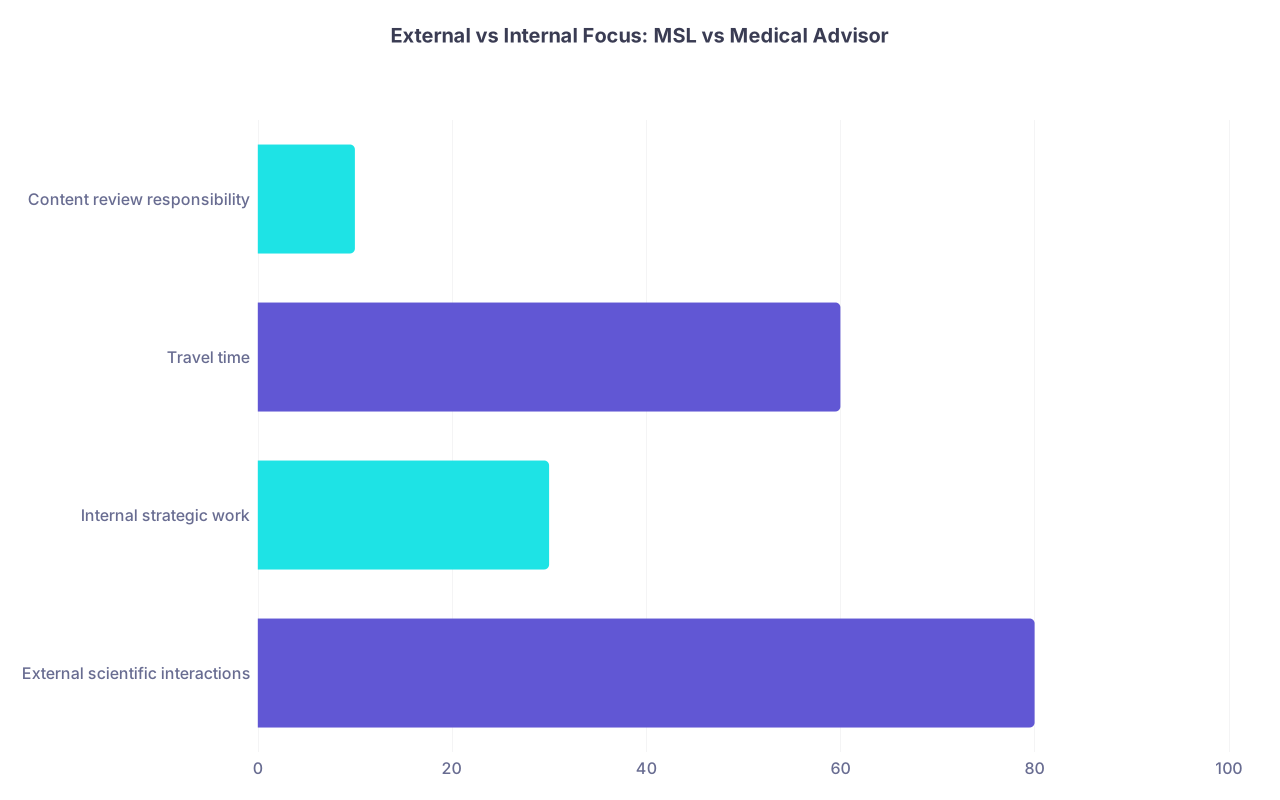
| Category | Value |
|---|---|
| External scientific interactions | 80 |
| Internal strategic work | 30 |
| Travel time | 60 |
| Content review responsibility | 10 |
(The values here approximate MSL emphasis; Medical Advisor is essentially the inverse in practice.)
MSL’s position
MSLs sit in medical affairs, usually under a Medical Affairs Manager, Medical Lead, or Medical Director. They are:
- Non‑promotional. They cannot have sales targets.
- Separate from sales. In decent companies, they do not report to commercial.
- Scientific bridge. They connect what KOLs actually think and do with what head office believes is happening.
The MSL’s power is influence through insight:
- They shape trials by highlighting real‑world feasibility issues.
- They guide label expansion priorities via unmet needs feedback.
- They correct misconceptions from the field before they become entrenched.
But they rarely sign off budgets, own full strategies, or represent the company in high‑stakes affiliate leadership meetings.
Medical Advisor’s position
Medical Advisors are closer to the “center of gravity” for a product in a given country or cluster.
They are:
- Strategic owners of the medical plan for their product(s).
- Decision makers (or at least key influencers) in:
- What local evidence gets generated
- Which KOLs are prioritized at national level
- Where medical budget is allocated (within governance)
They sign off:
- Promotional and non‑promotional materials (with legal / compliance partners).
- Medical education initiatives.
- Investigator‑initiated research support (with global or regional input).
They get invited to affiliate leadership discussions, quarterly business reviews, pipeline prioritization. In other words, if you want to steer the big ship, MA is structurally closer to the helm.
4. Skills Profile: What You Need to Be Good At
You cannot compensate for the wrong personality with enthusiasm. The job will expose you.
| Dimension | MSL Priority | Medical Advisor Priority |
|---|---|---|
| External communication | Very high | Medium |
| Internal stakeholder mgmt | Medium | Very high |
| Travel tolerance | High | Low–Medium |
| Strategic planning | Medium | Very high |
| Presentation skills | High | High |
| Detail orientation (docs) | Medium | Very high |
MSL skill set
You need:
Strong scientific depth:
- Comfort with primary literature, stats basics, trial design.
- Ability to explain complex mechanisms in clear language, without dumbing it down.
Relationship building:
- You must be credible, not a “detailer in disguise.”
- Listening skills: extracting nuanced insights from busy KOLs in 30 minutes.
Autonomy and discipline:
- Planning efficient field routes.
- Managing your calendar with minimal micromanagement.
- Keeping CRM documentation accurate (no one likes it, everyone has to do it).
Composure in clinical discussion:
- Handling aggressive questioning: “Why did your trial exclude group X?” / “Your drug adds no value over what I use now.”
- Saying “I do not know, I will follow up” without collapsing.
More extroverted or at least socially comfortable profiles tend to do better here. If talking to strangers drains you, this will be a grind.
Medical Advisor skill set
You need:
Strategic thinking:
- Translating global guidance into local reality.
- Prioritizing: you never have enough budget or time for all “great ideas.”
Cross‑functional navigation:
- Negotiating with marketing: push back on over‑promotional language without being obstructive.
- Working with market access on value messaging that is medically honest and still competitive.
- Partnering with regulatory and PV without losing your mind over process.
Precision and rigor:
- You are the last medical gatekeeper. Mistakes in labeling, dosing, or safety language will come back to you.
- Handling SOPs, governance, and documentation with painful accuracy.
Political sense:
- Reading the room in senior leadership meetings.
- Choosing battles. Knowing when to say “no” and when to say “we can explore” to keep trust intact.
If you enjoy building conceptual frameworks, writing medical plans, and debating nuance on internal emails, MA will feel like home.
5. Background and Entry Paths
This is where many clinicians switch off and assume “I am a doctor; I can do either.” Technically yes, practically no.
Typical backgrounds
MSL:
- PhD / PharmD heavy in some regions (US and Europe especially).
- MD, DO, or equivalent: often preferred in certain specialties (oncology, rare diseases, neurology).
- Senior nurses, pharmacists, or scientists with strong clinical trial backgrounds can absolutely succeed.
Medical Advisor:
- Physician or PharmD more common.
- For high‑stakes specialties (oncology, immunology, CNS), MD with relevant experience is a strong asset.
- Prior MSL or medical affairs experience is valuable.
In some emerging markets, titles are messy: “Medical Advisor” might include a mix of MSL + MA work. Always read the job description carefully.
Who usually gets what as first role
- Academic PhD with strong communication and some KOL exposure: often more competitive for MSL first.
- Practicing clinician with broad therapeutic experience and some teaching exposure: can enter either, but often MSL is easier without prior industry experience.
- Clinician with prior industry consultancy, guideline work, or policy involvement: more credible jump directly into Medical Advisor.
If you have zero industry exposure, starting as an MSL and then moving to MA after 2–4 years is a very common track. You demonstrate you understand the field and the company’s governance before taking on medical ownership.
6. Metrics and Performance: How You Are Judged
This part is rarely spelled out clearly when you are interviewing. It should be.
MSL performance
You are evaluated on:
Quality and quantity of scientific interactions:
- Number of KOL / HCP engagements (non‑promotional).
- Depth of discussions, not just “touch points.” Some companies track “tier” of interactions.
Insight generation:
- Volume and quality of field insights documented.
- How often your insights trigger concrete actions (e.g., updated training, study feasibility check, label Q&A).
Execution of medical projects:
- Support for studies (recruitment, site engagement).
- Support for advisory boards, educational events, and congress activities.
Soft metrics:
- Internal feedback from marketing, sales, and medical leads.
- External feedback from KOLs when surveyed.
You do not have sales targets. If anyone hints that you do, or tries to tie your bonus directly to sales performance, that is a huge red flag for compliance.
Medical Advisor performance
You are evaluated on:
Delivery of the Medical Affairs Plan:
- Were key medical objectives met (data generation, education, evidence dissemination)?
- Were advisory boards, symposia, and publications executed with quality and on time?
Governance and compliance:
- Quality of material review: low error rates, minimal regulatory escalations.
- Adherence to SOPs and timelines.
Cross‑functional impact:
- Feedback from marketing, market access, regulatory, MSL team.
- Contribution to successful product launch or lifecycle milestones.
Budget and resource management:
- Staying within approved budgets.
- Rational prioritization and justification of spend.
You are closer to classical corporate KPIs. Slides, metrics, dashboards. If that makes your eyes glaze over, think twice.
7. Compensation, Travel, and Lifestyle
Let us talk about the part everyone cares about but pretends they do not.
Compensation
Ranges vary absurdly by country and seniority, but pattern is consistent:
Base salary:
- MSL and Medical Advisor often overlap.
- In many markets, MA base is slightly higher due to strategic responsibility.
Bonus:
- Both get performance bonuses.
- MSLs might have a bigger variable component tied to medical objectives, not sales quotas.
- Medical Advisors’ bonus is often linked to affiliate and product performance, plus medical KPIs.
Long‑term:
- Medical Advisors are closer to medical leadership pipelines (Medical Manager, Medical Lead, Medical Director), where pay jumps are bigger.
- Senior MSLs can move to MSL manager or therapeutic area lead roles, but upward runway is sometimes narrower unless you transition to a more strategic role.
In high‑income countries, senior MSLs and Medical Advisors often out‑earn many attending physicians on an hourly basis once you factor in on‑call and weekend work that you are no longer doing.
Travel and lifestyle
MSL:
- Heavy travel in launch years, lighter in late‑life‑cycle products.
- Irregular hours around conferences and KOL availability.
- More flexibility in day structure overall, but less predictability week to week.
- Can be brutal if you have small children and a partner with an inflexible job.
Medical Advisor:
- Mostly office or home office.
- Occasional travel to regional or global meetings, major congresses, and advisory boards.
- Work hours can still be long, especially pre‑launch and around big submissions.
- Less physical fatigue, more cognitive and political fatigue.
Neither job is “easy” compared with medicine. They are just a different flavor of hard.
8. Career Trajectories: Where Each Role Leads
You are not choosing just your first role. You are choosing your entry lane.
From MSL
Common paths:
- Senior MSL → MSL Manager (Field Medical Manager)
- Senior MSL → Medical Advisor (especially if you show strategic thinking and strong cross‑functional collaboration)
- MSL → Clinical development / trials roles (medical monitor, clinical scientist) if you lean toward R&D
- MSL → Medical education / training lead within a company
MSLs who understand the business side and can talk strategy often end up as very effective Medical Advisors or Medical Managers.
From Medical Advisor
Common paths:
- Senior Medical Advisor → Medical Manager / Medical Lead (therapy area)
- Medical Advisor → Medical Director (affiliate level)
- Medical Advisor → Regional or Global Medical Affairs roles (Global Medical Lead, Global MSL Excellence, Evidence Generation roles)
- Medical Advisor → Market access or HEOR roles (less common, but happens if you enjoy payer discussions)
In practice, a common pattern is:
Resident / specialist → MSL (2–4 years) → Medical Advisor (3–5 years) → Medical Manager / Medical Director.
If you start directly as a Medical Advisor, you need to work harder to stay connected to the reality of clinical practice and the field. The best MAs listen closely to their MSLs and KOLs rather than strategizing from a vacuum.
9. How to Choose Between MSL and Medical Advisor
Here is the part no one gives you directly. Let us be direct.
You probably lean MSL if:
- You get energized by face‑to‑face clinical conversations.
- You like autonomy, being on the road, and not sitting in the same office every day.
- You are comfortable with some logistical chaos: travel, last‑minute schedule changes, conference madness.
- You want to “stay close” to frontline medicine without working nights and weekends.
You probably lean Medical Advisor if:
- You enjoy thinking in systems and strategies more than individual conversations.
- You are fine spending a big part of your week in meetings and in front of a laptop.
- You like crafting arguments, documents, and plans that shape how a drug is positioned.
- You are willing to navigate corporate politics and governance.
If you are honestly in the middle, starting as an MSL often gives a cleaner entry into industry, then you can move inward to a Medical Advisor role once you see how the machine operates.
10. Interview Signals: Red Flags and Green Flags
When you are interviewing, you are evaluating them as much as they are evaluating you. Here is what to listen for.
For an MSL role:
Green flags:
Clear description of non‑promotional, scientific focus.
Structured onboarding with scientific and compliance training.
Separation between sales and MSL reporting lines.
Defined field insight process feeding into medical strategy.
Mention of scientific projects (e.g., support for trials, medical education) beyond “visits.”
Red flags:
- “You will support sales to achieve their targets” as a primary phrase.
- Vague about who you report to, or MSLs reporting into commercial.
- Obsession with number of visits, no discussion of quality of interaction.
- No clear training plan, “we will throw you in and you learn on the go.”
For a Medical Advisor role:
Green flags:
- Clear ownership of Medical Affairs Plan for specific products.
- Involvement in cross‑functional brand team with defined medical responsibilities.
- Structured material review committee or process with proper governance.
- Defined budget and decision latitude for medical projects.
Red flags:
- Blurry boundaries between medical and marketing; you are essentially a “scientific rubber stamp” for whatever marketing wants.
- No mention of accountability for strategy, only “support” for other teams.
- Reporting line into marketing or commercial without strong dotted line to medical leadership.
- Company seems proud of “fast approvals” but cannot explain how they ensure compliance.
If the hiring manager cannot explain how MSL and Medical Advisor roles differ in that organization, walk away. That confusion at the top will become chaos in your day‑to‑day.
11. The Future: How These Roles Are Shifting
You are not entering a static landscape. Medical affairs is evolving, and the MSL vs Medical Advisor split is shifting too.
Trends I keep seeing:
More digital, less pure travel for MSLs
Virtual KOL engagements, remote advisory boards, digital congress platforms. Travel is still there, but hybrid is becoming normal. MSLs now also need to navigate digital opinion leaders on social platforms.More evidence generation responsibilities for Medical Advisors
Local real‑world evidence, outcomes research, and pragmatic trials are expanding. Medical Advisors are expected to understand methodology, not just read abstracts.Stronger compliance and governance
Both roles are being pulled into more process, more documentation. The days of “informal” practices are fading, especially in highly regulated regions.Closer alignment with commercial, but with clear firewalls
Medical is expected to bring deep insights and shape strategy, not sit in an ivory tower. The line between supporting and selling, however, is guarded more aggressively. You need a cool head and spine.
In other words: both roles are getting more complex, not less. Which is good news if you are serious and scientifically strong. It filters out the lazy.
Key Takeaways
“MSL” and “Medical Advisor” are fundamentally different roles: field‑based, external‑facing execution vs office‑based, internal strategic ownership. Treat them as separate career choices, not synonyms.
Your fit depends on personality and preference, not just your degree: if you like autonomy, travel, and live conversations, lean MSL; if you like strategy, cross‑functional work, and governance, lean Medical Advisor.
Long‑term, Medical Advisor roles usually sit closer to leadership decision‑making, but starting as an MSL is often the smarter on‑ramp into industry if you have no prior pharma experience.