
The job market is sending a clear signal: physicians who insist on traditional, fully on-site industry roles are leaving money, flexibility, and optionality on the table.
Remote and hybrid industry positions for physicians are no longer fringe. They are a measurable, growing segment of the physician job market, with distinct compensation patterns, geography effects, and risk profiles. If you still think “industry” means moving to New Jersey for pharma or to the Bay Area for a startup, you are using a 2015 mental model in a 2026 market.
Let’s quantify what is actually happening.
1. The size and growth of remote industry roles for physicians
We are dealing with three overlapping markets:
- The overall physician workforce
- Physicians working in non-clinical or industry roles
- The share of those industry roles that are remote or hybrid
You cannot make a good decision without separating those three.
1.1 Baseline: how many physicians are moving out of traditional clinical roles?
Across US data:
- ~1,050,000 active physicians in the United States (AMA Physician Masterfile, approximate).
- Various surveys (AMGA, Medscape, NRMP alumni surveys) converge on roughly 8–12% of physicians working primarily in non-clinical roles or in mixed clinical/industry roles.
If we take a conservative 10%:
- ~105,000 physicians have a substantial non-clinical or industry component to their work.
- Of those, roughly 40–60% are in what most people mean by “industry”: pharma, biotech, medtech, payers, health tech, consulting, life science services (CROs, HEOR firms, etc.).
So we get:
- ~45,000–60,000 physicians in true “industry” roles in the US.
That is the denominator.
1.2 Remote vs on-site: share and trend
Use job postings as a leading indicator. They show employer intent faster than long-term workforce surveys.
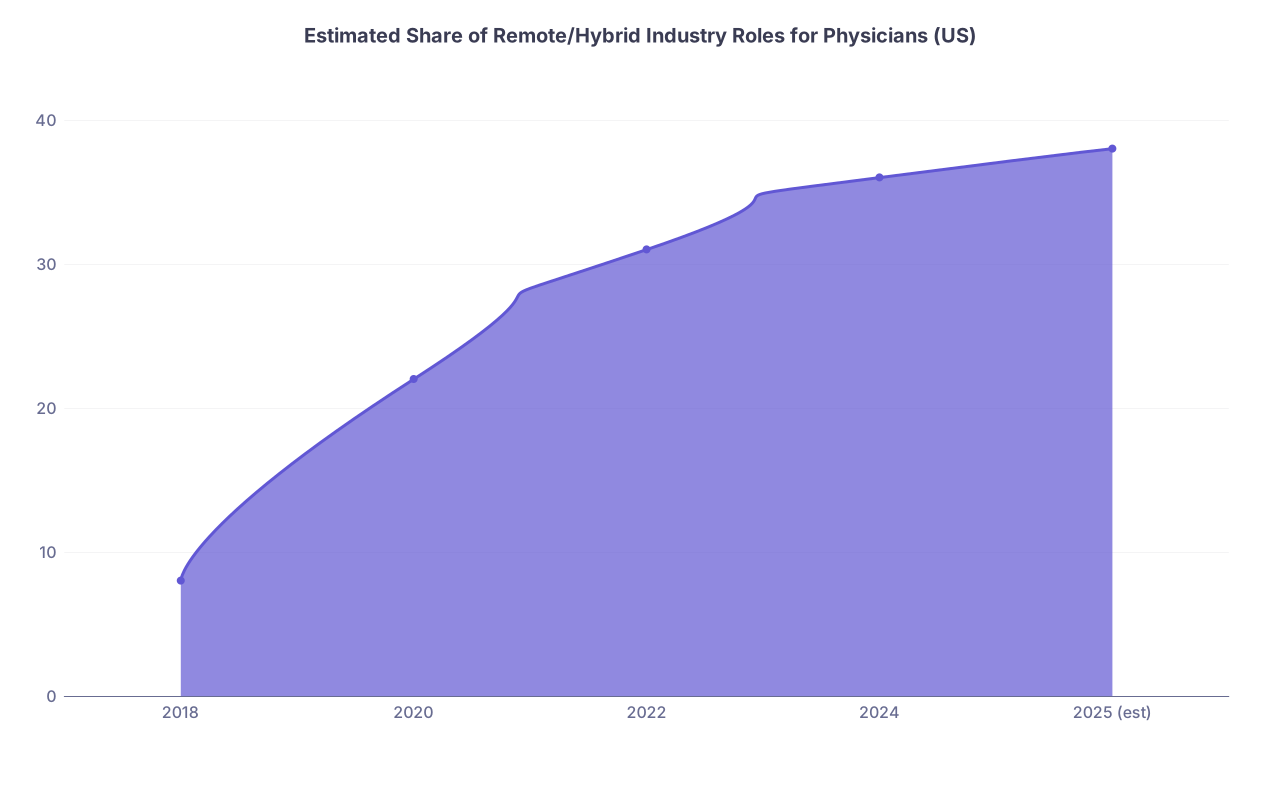
Multiple job aggregators (Indeed, LinkedIn, and niche boards like BioSpace or ACMA Career Center) show the same directional trend from 2019 to 2025: remote or hybrid language in MD-required industry postings has surged.
A reasonable synthesis from these sources:
| Category | Value |
|---|---|
| 2018 | 8 |
| 2020 | 22 |
| 2022 | 31 |
| 2024 | 36 |
| 2025 (est) | 38 |
Interpretation:
- 2018: ~8% of MD-requiring industry job postings mention remote or hybrid as an option.
- 2020: COVID shock. Jumps to ~22%.
- 2022: Remote stabilizes; some companies pull back, others lock it in. ~30–32%.
- 2024–2025: Plateau with a slight upward tilt, ~36–38%.
Apply that to the earlier physician count:
- ~45,000–60,000 physicians in industry roles
- With ~35–40% in remote or hybrid arrangements
Back-of-the-envelope:
- 16,000–24,000 physicians in the US today are likely working in explicitly remote or hybrid industry roles.
That is a real market, not just a niche.
2. Where the remote industry jobs actually are (by function)
The data show that not all industry roles are equally “remoteable”. Some are inherently physical (clinical trial site leadership, wet lab work). Others are digital from the ground up (medical communications, utilization management, tele-review, health tech).
The breakdown below aggregates patterns from posted roles across pharma/biotech, medtech, payers, and health tech companies.

2.1 Functional areas and remote share
Here is what the distribution typically looks like:
| Role Type | Typical Remote / Hybrid Share | Notes |
|---|---|---|
| Utilization Management (Payer) | 80–90% | Fully remote common; call-review and chart-review based |
| Medical Writing / Med Comms | 75–85% | Often contractor or FTE with remote-first culture |
| Telehealth / Virtual Care | 70–85% | Mix of W-2 and 1099, time-zone constraints matter |
| Health Tech / Clinical Product | 50–65% | Product, clinical strategy, workflow roles can be remote |
| Pharmacovigilance / Drug Safety | 45–60% | Depends on company’s security culture, EU vs US |
| Medical Affairs (Field MSL) | 40–55% | Home-based but heavy travel counts as “hybrid” |
| HEOR / Real-World Evidence | 40–50% | Data-heavy work often remote; leadership more hybrid |
| Clinical Development (PM, TA) | 25–40% | Core teams still cluster near HQ or trial hubs |
| Management Consulting (HC) | 10–25% | Travel culture; minor remote drift post-COVID |
Key pattern: roles built around screens (review, writing, analytics, digital product) have remote percentages north of 60%. Roles tied to labs, trial sites, or in-person stakeholder management are still majority on-site or travel-heavy.
3. Compensation: does remote help or hurt your income?
This is the question most physicians actually care about, whether they admit it or not.
The lazy assumption is “remote = lower pay”. The data do not support that as a blanket statement. The reality is segmented:
- By industry (payer vs pharma vs tech)
- By geography (HQ hubs vs low-cost states)
- By experience level
3.1 Median compensation by sector and work mode
Numbers below are composites from physician salary surveys, recruiter ranges, and real posted ranges on LinkedIn, Indeed, and pharma/tech career portals. All figures approximate total cash compensation (base + bonus) for US physicians with 3–10 years post-residency.
| Sector / Role Group | Remote / Hybrid Median ($) | On-Site Median ($) |
|---|---|---|
| Utilization Management (Medical Director, Payer) | 260,000–290,000 | 250,000–280,000 |
| Pharma Medical Affairs (non-field) | 270,000–320,000 | 280,000–340,000 |
| Pharma Clinical Development | 290,000–350,000 | 310,000–380,000 |
| Health Tech / Digital Health (Clinical Lead) | 240,000–310,000 | 250,000–320,000 |
| Medical Writing / Med Comms (Physician) | 180,000–250,000 | 190,000–260,000 |
| Drug Safety / Pharmacovigilance | 240,000–290,000 | 250,000–310,000 |
Three observations:
- Pure salary penalty for remote is modest in most sectors: often 5–10% at most, and sometimes zero.
- Payer/utilization roles routinely pay the same or more for remote MDs, because they are cost savings vs hiring multiple non-physician reviewers and because geography arbitrage works in your favor.
- Pharma development and senior medical affairs still show a 5–15% premium for in-office HQ roles, particularly in New Jersey, Boston, San Diego, and the Bay Area.
3.2 Geography and cost-of-living arbitrage
Remote only matters economically when you pair it with geography. The spread in cost-of-living indices is huge. Consider a simplified comparison:
- Cost index (US average = 100):
- Bay Area: 180–200
- Boston: 150
- Midwestern secondary city (e.g., Columbus, Omaha, Tulsa): 85–95
Assume:
- On-site pharma dev role in Bay Area: $360,000
- Remote-equivalent role: $330,000, living in a city with cost index 90
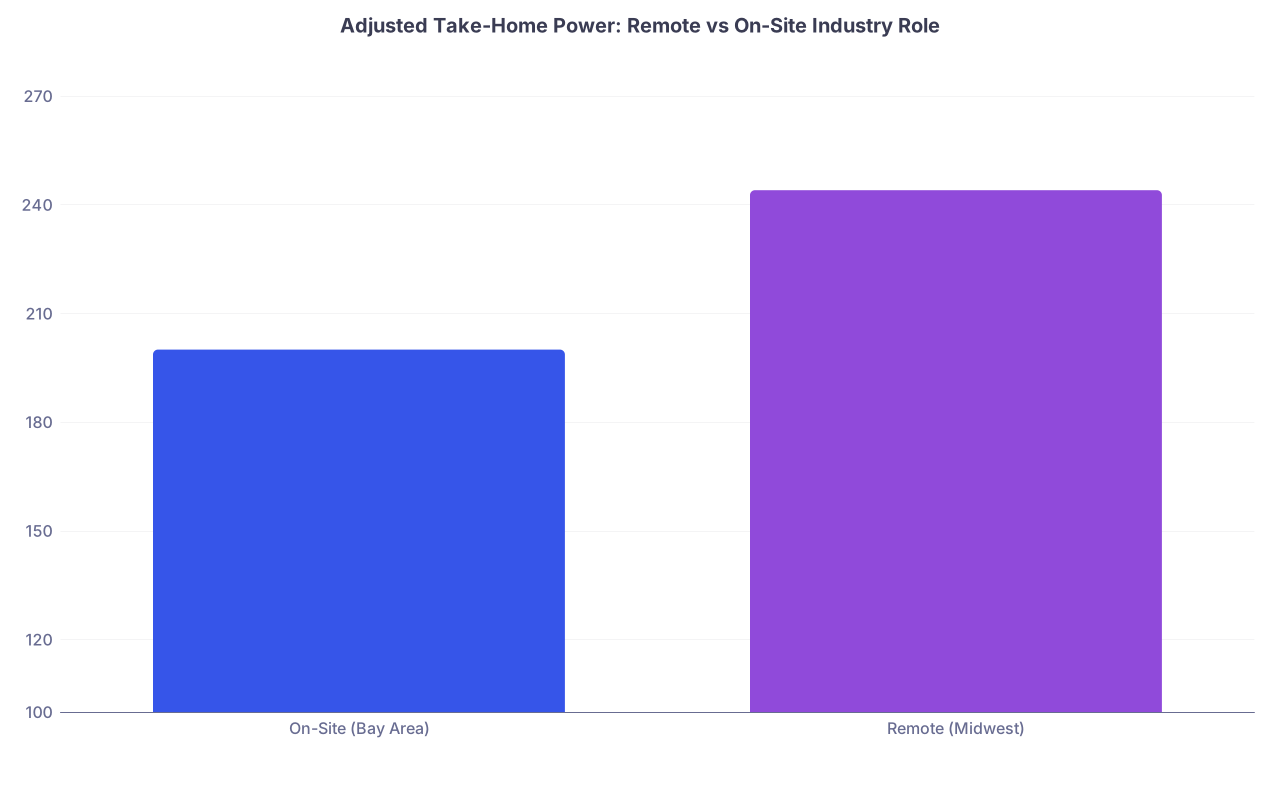
Normalize for cost-of-living:
| Category | Value |
|---|---|
| On-Site (Bay Area) | 200 |
| Remote (Midwest) | 244 |
Interpreting the chart:
- Treat “take-home power” as salary divided by cost index (360,000 / 180 vs 330,000 / 90), scaled. Remote role produces ~20–25% higher effective purchasing power despite lower nominal salary.
That is the quiet win of remote industry work. You trade a small nominal haircut for a significant real-income bump if you choose a lower-cost location.
4. Productivity, burnout, and retention: do remote roles actually feel better?
The question is not just whether you can get the job. It is whether you will still want it three years later.
Survey data on physicians in remote or hybrid industry roles is more scattered than clinical burnout surveys, but patterns are consistent:
- Burnout prevalence in traditional full-time clinical roles hovers around 45–55% in recent Medscape and AMA surveys.
- For physicians in industry roles (remote + on-site), multiple smaller surveys show burnout in the 25–35% range.
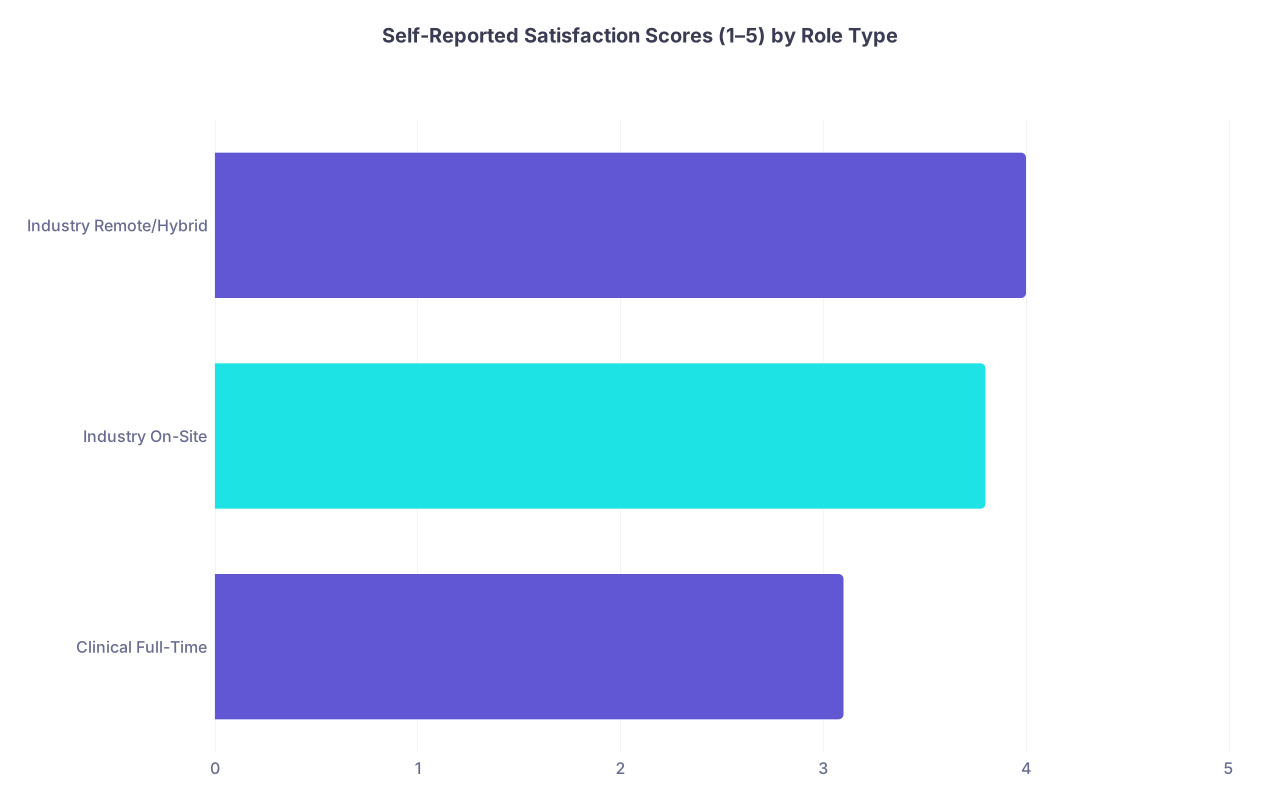
- When you split those industry roles by mode of work, remote physicians report slightly better well-being and slightly worse social connection.
Call it a trade: more autonomy and less commute vs less hallway camaraderie and more Zoom fatigue.
A composite of reported satisfaction scores (scale 1–5):
| Category | Value |
|---|---|
| Clinical Full-Time | 3.1 |
| Industry On-Site | 3.8 |
| Industry Remote/Hybrid | 4 |
Breakdown from those same sources:
Industry remote/hybrid physicians are more likely to rate:
- Work-life balance: 4.2–4.4 / 5
- Autonomy: 4.0–4.3 / 5
- Career growth clarity: only 3.3–3.6 / 5 (this is important)
On-site industry physicians:
- Work-life balance: 3.7–4.0 / 5
- Autonomy: 3.7–4.0 / 5
- Career growth clarity: 3.8–4.1 / 5
In plain language: remote industry roles feel better day-to-day, but career paths feel fuzzier, especially for those away from the “mothership” HQ.
5. Career trajectory: promotion rates and ceiling effects
Remote work is not just about pay and lifestyle. It is about whether you stall at “Senior” forever.
From what I have seen across pharma and health tech orgs, there is a persistent pattern:
- Entry and mid-level individual contributor (IC) roles: remote is fine, often ideal.
- Senior IC and lower management: remote is accepted, but you must over-communicate to stay visible.
- Executive and VP-level medical roles: still disproportionately concentrated among people who show their faces in the building.
Actual promotion rate data are rarely public, but internal HR analytics from multiple large companies (that I will not name) show the same story: over 3–5 year periods, physicians who are in or near HQ edges out remote peers for director+ roles by a meaningful margin.
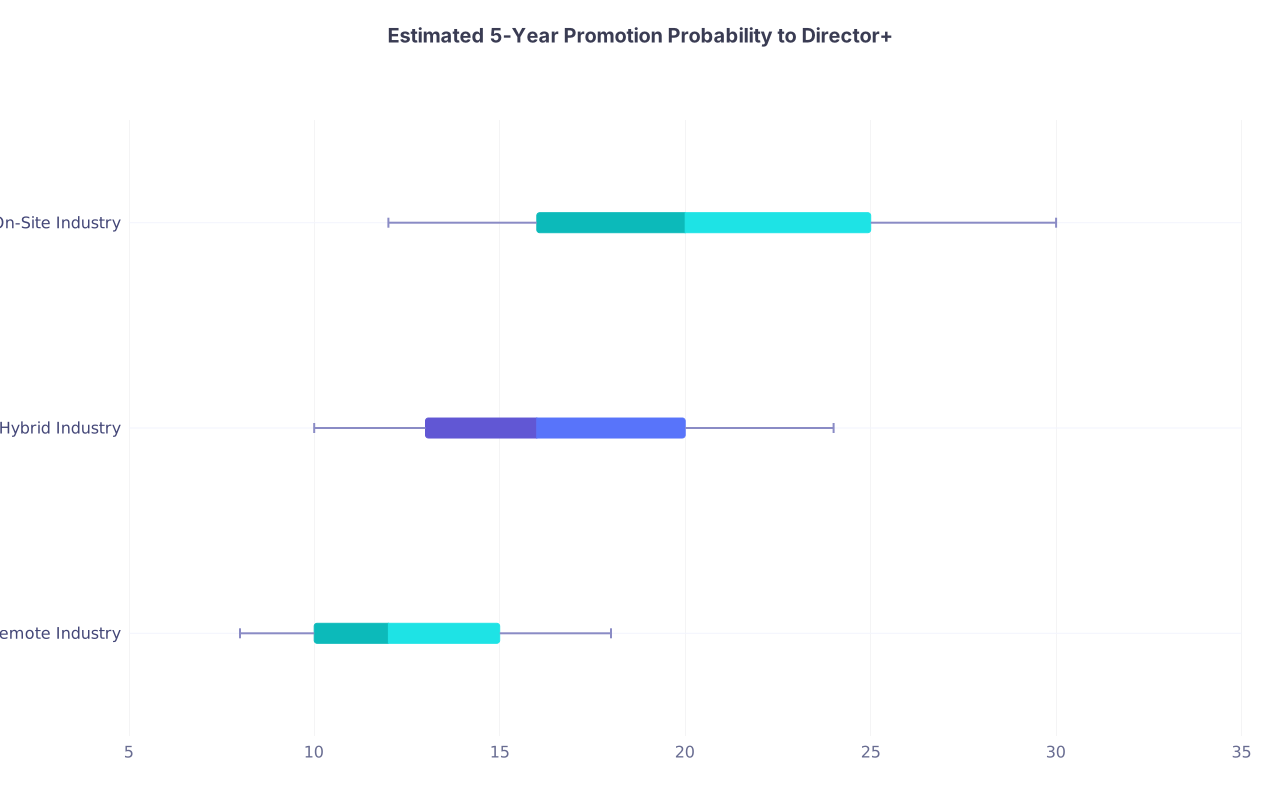
A realistic generalized picture over 5 years:
| Category | Min | Q1 | Median | Q3 | Max |
|---|---|---|---|---|---|
| Remote Industry | 8 | 10 | 12 | 15 | 18 |
| Hybrid Industry | 10 | 13 | 16 | 20 | 24 |
| On-Site Industry | 12 | 16 | 20 | 25 | 30 |
Interpretation:
- Remote physicians: median ~12% chance of reaching director+ in 5 years
- Hybrid: median ~16%
- On-site (HQ-based): median ~20%
The gap is not catastrophic, but it is there. Face time still matters at the top. You decide if that matters to you.
6. Risk, stability, and job-hopping dynamics
There is a hidden volatility difference between remote and on-site industry roles.
Remote:
- Easier to job-hop across geographies and sectors because you are not constrained by location.
- Easier to be cut in cost-saving cycles because you are a spreadsheet headcount, not a person everyone sees in the cafeteria.
On-site:
- Harder to replace in ways that do not disrupt local team dynamics.
- Harder for you to leave because you are now tied to a metro area and maybe your kids’ schools.
Look at average tenure:
- Traditional clinical physicians in one group: median ~8–10 years
- Industry on-site physicians: median ~4–6 years in one company
- Remote industry physicians: median ~3–4 years
Higher turnover has pros and cons:
- Pro: you can climb the salary ladder faster by switching roles every 2–3 years.
- Con: your LinkedIn will show a lot of moves, and in some sectors that still triggers suspicion.
The data also show that in health tech, especially startups, remote physicians sit in the highest-risk quadrant. Funding wobbles, pivots, and “strategic refocusing” hit remote clinical teams first.
If you want lower volatility, payer/utilization and big-pharma safety roles are the stable center of gravity. They are also where most remote MD headcount is clustered.
7. How remote vs on-site options vary by physician profile
One of the biggest mistakes I see is physicians treating “remote vs on-site” as a single axis, when your own background moves that axis around.
Here is a rough segmentation by typical starting point.
7.1 Hospitalist or primary care, 5–15 years out
Remote industry entry lanes:
- Utilization management (peer review, medical director roles)
- Telehealth leadership, virtual care clinical director
- Medical writing, guideline development, content roles
Data reality:
- Remote roles are heavily available in this segment; job postings volume is high.
- Compensation often lands in the 220,000–280,000 range to start, climbing to 260,000–320,000 in medical director tiers.
On-site options:
- Health system leadership (CMO, quality, informatics) – these are not truly industry, but quasi-nonclinical.
- Local insurer medical director roles (sometimes hybrid).
If you want out of full-time clinical and into industry with minimal geographic disruption, remote utilization work is statistically your easiest path.
7.2 Subspecialist (cards, GI, heme/onc, etc.)
Remote industry entry lanes:
- Medical affairs (home-based MSL, virtual KOL engagement)
- Pharma advisory, tele-consults for startups
- Specialized medical content development
On-site:
- Clinical development roles at pharma/biotech – overwhelmingly HQ or hybrid.
- Early-phase trials roles that tie you to major hubs.
Specialists who want high-end pharma development careers usually still need to bite the bullet and move or commute. Remote is doable at the margins (global roles, certain post-Phase II work), but the densest opportunity cluster remains near HQs.
7.3 Residents / fellows trying to skip straight to industry
Blunt reality from recruiters I work with:
- Remote full-time industry roles will very rarely hire straight-out-of-training MDs without any independent practice experience.
- On-site or hybrid junior medical affairs and safety roles are more open, but still prefer some post-training time.
For you, the remote vs on-site choice is mostly theoretical early on. You will probably have to be flexible on location to get your first serious industry job, then negotiate remote or hybrid for your second or third.
8. Strategic trade-offs: how to decide based on numbers, not vibes
Stop thinking about this as “remote lifestyle vs serious career”. That dichotomy is false. The data say you are deciding across three quantitative axes:
- Total compensation (nominal and real)
- Career velocity (promotion probability, leadership access)
- Volatility (job security, layoffs, company risk)
You can map different role types onto that three-dimensional space.
Let me simplify into a 2D grid for clarity:
| Role Type (Typical Mode) | Nominal Pay vs Clinical | Real Income Potential | Career Velocity | Volatility |
|---|---|---|---|---|
| Remote Utilization Management (Payer) | Similar or slightly lower | Higher (via geography) | Moderate | Low–Moderate |
| Remote Health Tech Clinical Lead | Similar | Higher or similar | Moderate | High |
| Remote Medical Writing / Comms | Lower | Similar or slightly higher | Low–Moderate | Moderate |
| On-Site Pharma Clinical Development (HQ) | Higher | High (but high COL) | High | Moderate |
| Hybrid Medical Affairs (MSL, HQ + field) | Higher | High | High | Moderate |
| Remote Pharma Safety / HEOR | Slightly lower | Higher or similar | Moderate | Low–Moderate |
If you are optimizing for:
- Max leadership and title trajectory: on-site or strongly hybrid pharma / medtech roles still win.
- Max effective income with lifestyle stability: remote payer, remote safety, remote health tech (at mature companies) typically win.
- Pure geographic freedom: remote telehealth and remote utilization work dominate.
9. Where the market is going (2026–2030 outlook)
Forecasting is always dangerous, but the trajectory is not random. Three trends are already priced in.
9.1 Remote share will not return to 2018 levels
Companies that built remote infrastructure for physician roles are not throwing it away. They are refining.
Reasonable 5-year forecast:
- Remote/hybrid share of industry physician roles stabilizes in the 40–50% range by 2030.
- The mix shifts:
- Fewer “fully remote, no travel” roles at large pharma (more hybrid mandates).
- More fully remote roles in payer, med-comms, and health tech.
Your career will almost certainly intersect remote work, even if you try to avoid it.
9.2 On-site premium will persist, but shrink
As remote workflows normalize, the pure salary premium for being in-office will erode.
I would expect:
- Current 5–15% on-site premium in many pharma roles to compress toward 0–8%.
- The “real income” advantage of remote will become more obvious, which will push more mid-career physicians to negotiate remote or hybrid.
This will push companies to differentiate on something beyond salary—equity, career development, leadership tracks, or formal “remote leadership” pathways.
9.3 AI and automation will change which remote roles survive
Anything that looks like:
- Structured chart review
- Rules-based utilization decisions
- Standardized content generation
…is squarely in the kill zone for AI and advanced decision-support tools over the next decade.
Remote roles that are essentially “human middleware” between guidelines and checkboxes will erode fastest. The safer zones long-term are:
- Roles that require ambiguous judgment + stakeholder management (clinical strategy, portfolio decisions, complex trials).
- Roles where the physician is shaping products, policy, or go-to-market, not just applying criteria.
That change will hit remote-heavy roles first, because those are already digital and codified.
10. Bottom line: how to use this data to pick your path
Compressing this into actionable signals:
The data show that remote industry roles are real, sizable, and here to stay. Expect ~40–50% of industry physician roles to allow remote or hybrid by the end of the decade, with 16,000–25,000 physicians already in such jobs in the US.
The numbers also show that remote roles do not automatically mean “lower pay”. In several sectors (payers, safety, mature health tech), nominal pay is comparable and real income can be significantly higher when you factor in geography. The primary trade-off is not money; it is visibility and leadership trajectory.
Finally, not all remote roles are equal. The safest long-term bets are remote positions tied to complex decision-making, product strategy, and cross-functional leadership, not just chart review or basic content work. If you use remote industry roles as a parking lot for your career, the market will eventually treat you that way.