

The biggest mistake doctors make about “physician‑shortage areas” is thinking they’re all the same. They’re not—and some will fit you perfectly while others will burn you out in 6 months.
Let me walk you through how to actually decide if a shortage area is right for you—not for some idealized “mission-driven” doctor on a brochure.
1. First: What Exactly Is a Physician‑Shortage Area?
Before you can decide if it fits, you need to know what you’re signing up for.
In the U.S., you’ll mostly see three types of designations:
| Term / Acronym | What It Usually Means |
|---|---|
| HPSA | Health Professional Shortage Area (primary care, mental health, or dental shortage) |
| MUA/MUP | Medically Underserved Area / Population (high need, poor access) |
| Rural / Frontier | Low population density, long distance to hospitals and specialists |
You’ll find them on HRSA’s website, state workforce sites, and in job descriptions: “HPSA score 17,” “Rural, medically underserved,” “eligible for loan repayment,” etc.
Translation in real life:
- Fewer doctors per capita than average
- Patients often travel far for care
- You may be doing broader‑scope work than in a major metro
- Infrastructure, support, and staffing can be very hit‑or‑miss
None of that is automatically good or bad. It’s about fit.
2. The Core Question: What Kind of Doctor Do You Actually Want to Be?
Skip the buzzwords. Answer this brutally honestly.
Ask yourself:
- How much autonomy do I want?
- How broad do I want my clinical scope to be?
- How much chaos am I willing to tolerate in exchange for impact?
Shortage areas tend to give you:
- More autonomy (often less bureaucracy, more trust)
- Broader scope (you may be “the” doctor for everything)
- Higher responsibility earlier (fewer layers above you)
If that excites you—if the idea of being the go‑to person for a community feels energizing—you’re already leaning in the right direction.
If you read those three bullets and felt your blood pressure rise, you should be very careful.
3. The Four Big Fit Domains You Must Evaluate
Here’s the frame I use when advising residents and attendings who are shortage‑area curious. You need to check fit across four domains:
- Clinical fit
- Life and community fit
- Support and infrastructure
- Financial and career upside
If any two of these are a terrible mismatch, it’s usually not worth it.
3.1 Clinical Fit: Will the Day‑to‑Day Medicine Suit You?
You’re not going to magically love a scope of practice you hate just because the zip code has fewer doctors.
Core questions to ask (and literally ask on interviews):
What’s my typical patient mix?
Age, complexity, number of chronic diseases, procedures.What is the realistic scope of practice?
In a rural HPSA, a “family med” doc might:- Do prenatal care, joint injections, skin procedures
- Round in a small hospital
- Handle more urgent/emergent stuff because the ED is 45 minutes away
What backup do I actually have?
- Who covers if I’m unsure: another doc, an APP, a phone‑a‑friend specialist?
- Are there telehealth consult options?
- How far is the nearest hospital with ICU, cath lab, surgery?
What does call really look like?
- Home call vs in‑house
- Frequency (q3 vs q7 vs “whenever someone quits”)
- How often you get called in, not just “you’re on call”
If you like complex, relationship‑based medicine and don’t mind being stretched a bit, shortage areas can be a clinical playground in the best possible way.
If you’re happiest in very narrow, highly sub‑specialized lanes, be careful; many shortage‑area jobs need generalists or sub‑specialists willing to see bread‑and‑butter too.
3.2 Life and Community Fit: Could You Actually Live There?
This is where a lot of people lie to themselves. They say, “It’s just a job; I’ll adapt.” And then they’re miserable and leave in 18 months.
You need to audit your non‑clinical life needs with the same seriousness as your clinical needs.
Ask yourself:
How far from:
- A major airport do I need to be?
- Family or close friends?
- The kind of city life I like (restaurants, concerts, sports, etc.)?
What do I need for:
- My spouse/partner’s career?
- Schools for kids (public vs private, special needs, diversity)?
- Religious or cultural community?
Do I like small‑town visibility? In many shortage areas, you’re “the doctor” 24/7. People recognize you in the grocery store, at Little League, at church. Some physicians love that. Others feel suffocated.
The question isn’t “Do I care about these things?” It’s “What will I resent after a year?”
If you’ve spent your life in major coastal cities and your partner needs a niche tech job, a frontier town with 4,000 people is probably a disaster no matter how much loan repayment they’re dangling.
3.3 Support and Infrastructure: Are You Set Up to Succeed or To Be a Warm Body?
This is where otherwise good ideas go to die.
You must separate “mission‑driven language” from “actual working conditions.”
On every interview, get concrete answers to:
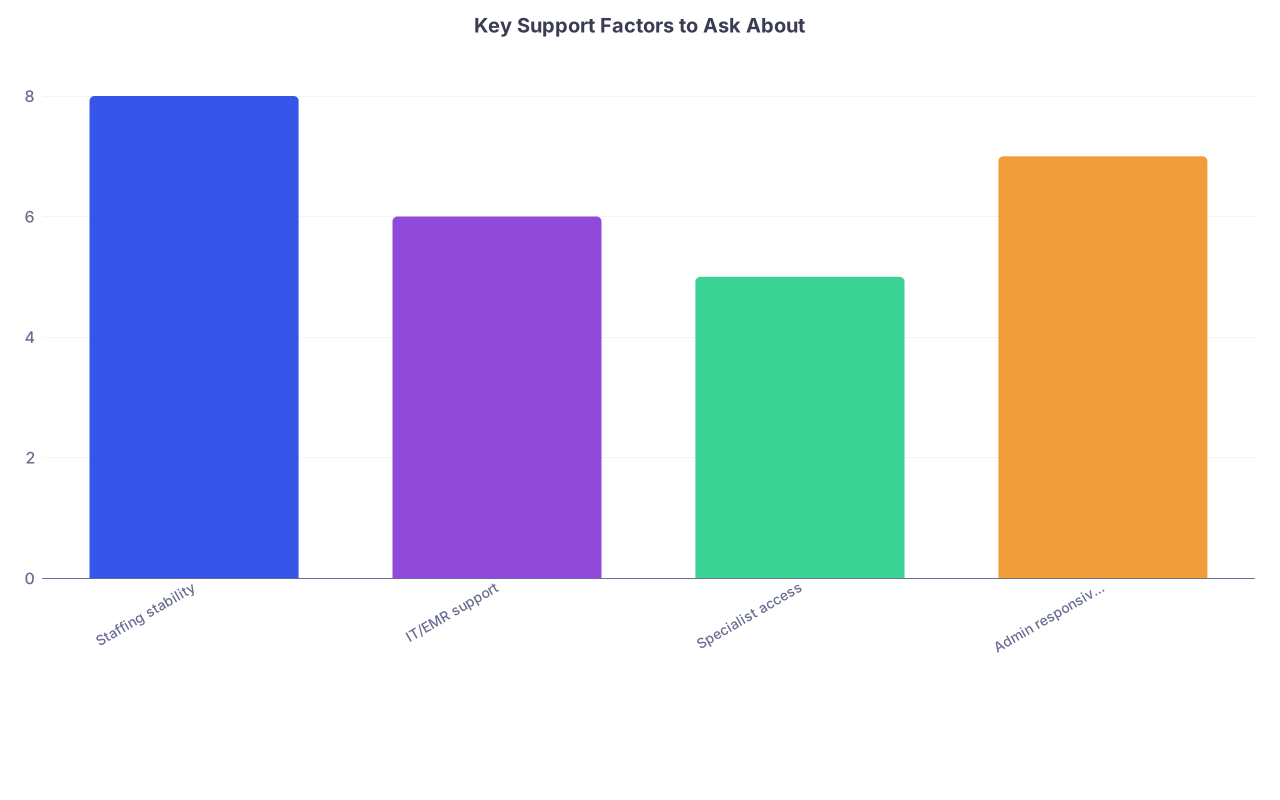
| Category | Value |
|---|---|
| Staffing stability | 8 |
| IT/EMR support | 6 |
| Specialist access | 5 |
| Admin responsiveness | 7 |
(Scale 1–10 is how important these usually are to long‑term happiness.)
Ask:
Staffing:
- What’s turnover like among nurses, MAs, front desk?
- When someone leaves, how long are positions vacant?
- Who rooms patients, handles prior auths, manages refills?
Technology and EMR:
- Is the EMR modern or a fossil?
- Is there on‑site IT help or is it “call a 1‑800 and wait”?
Administration and leadership:
- Do any leaders still see patients, or are they purely corporate?
- When docs raise concerns, what’s an example of a change that happened?
- How many MDs/Nps/PAs have left in the last 2 years, and why?
Referrals and transfers:
- How hard is it to get a patient in to cardiology, psych, GI, etc.?
- Who handles the logistics when a patient needs to be transferred to a tertiary center?
Good shortage‑area jobs exist. They tend to be places where leadership is realistic about the challenges, transparent about turnover, and proud (with specifics) of how they support clinicians.
If answers are vague (“We’re like a family here,” “We all just pitch in”), assume there are problems.
3.4 Financial and Career Upside: Is the Trade‑Off Actually Worth It?
Shortage‑area roles often sell themselves on money and incentives. Some are legit. Some are smoke and mirrors.
Here’s what to look at:
| Incentive Type | What To Check Carefully |
|---|---|
| Base salary | How it compares to MGMA/Medscape regional data |
| Sign‑on bonus | Repayment clauses if you leave early |
| Loan repayment (NHSC, state) | Separate contract vs employer “promise” |
| Relocation allowance | Taxable? Repayment if you leave? |
| RVU/productivity bonus | Realistic volume assumptions? |
Three big rules here:
- Do not overvalue loan repayment if it traps you in a toxic job for years.
- Ask for concrete income numbers for physicians currently at the site.
- Understand exit penalties—clawbacks, non‑competes, tail coverage.
Career‑wise, shortage‑area work can:
Strengthen your CV if you’re interested in:
- Academic primary care
- Health policy and workforce issues
- Leadership roles in community health systems
Give you leverage later:
- “I built X service line in a rural area” is compelling
- Demonstrated broad scope and adaptability is attractive
But if you’re aiming for a hyper‑subspecialized academic niche, doing generalist work in a remote area for 5–7 years may not help you.
4. How to Reality‑Check a Specific Job (Before You Uproot Your Life)
You should treat shortage‑area jobs like complex procedures: preparation matters more than bravado.
Here’s a simple sequence to follow:

| Step | Description |
|---|---|
| Step 1 | See Job or Program |
| Step 2 | Check Personal Priorities |
| Step 3 | Research Location and HPSA Status |
| Step 4 | Talk to Current and Former Clinicians |
| Step 5 | On Site Visit |
| Step 6 | Score Fit Across 4 Domains |
| Step 7 | Walk Away |
| Step 8 | Negotiate and Decide |
| Step 9 | 2 or More Domains Poor Fit |
Key reality checks:
Talk to former clinicians if you can find them
Ask them:- Why they left
- What they wish they’d known
- What is actually great about the job
Visit on a normal weekday
- Watch clinic flow
- Sit in the break room over lunch and just listen
- Pay attention to how people talk about leadership
Walk the town / neighborhood
- Go to a grocery store and a coffee shop
- Drive the route you’d commute
- Look at housing you’d actually live in, not the “best case”
If the site resists you talking to people without them present, or tries to overly control your schedule, that’s a yellow flag.
5. A Simple Self‑Assessment: Are You Built For This?
Here’s a blunt, fast screen. Answer each item honestly “Yes” or “No.”
You are likely a good fit for a physician‑shortage area if:
- You genuinely like broad‑scope medicine
- You’re comfortable making decisions with incomplete information
- You derive satisfaction from being embedded in a community
- You’re okay with imperfection—systems, roads, broadband, all of it
- You can set boundaries and say “no” even when “they really need you”
You’re likely a poor fit if:
- You need clear lines, algorithms, and multiple consultants on every complex case
- You get restless or depressed when far from urban centers
- You strongly value anonymity in your personal life
- Your partner or family is clearly not on board
- You’re doing it only for the loan repayment or signing bonus
None of this is about being a “good” or “bad” doctor. It’s about environment. A fantastic ICU doc can be utterly miserable in a rural outpatient primary care HPSA. And vice versa.
6. How Shortage‑Area Work Fits Into the Future of Medicine
You’re not choosing in a vacuum. Shortage areas are central to where medicine is going:
- Telehealth and e‑consults are expanding specialist reach into remote communities
- Value‑based care and population health models are often piloted in these settings
- Health systems and investors are increasingly courting rural and underserved markets
Shortage‑area experience now can position you as:
- The person who actually understands how these models work on the ground
- A future leader in system design, policy, or community‑focused innovation
But that only matters if you can tolerate—and ideally thrive in—the setting in the meantime.
7. Quick Comparison: Urban vs Shortage‑Area Practice
Not as a “one is better” table, but as a reality check:
| Factor | Urban / Non‑Shortage | Typical Shortage Area |
|---|---|---|
| Scope of practice | Narrower, more referral | Broader, more generalist work |
| Autonomy | Often lower | Often higher |
| Backup | Plentiful specialists | Limited, slower access |
| Lifestyle options | High (food, culture, etc.) | Lower, but strong community feel |
| Visibility | More anonymous | Highly visible in community |
| Incentives | Lower financial extras | Higher loans/bonuses, housing help |
You’re trading one bundle of pros/cons for another. The point is to pick the bundle that matches who you are.
FAQ: Physician‑Shortage Areas
1. How do I actually find out if a location is a designated physician‑shortage area?
Use the HRSA “Find Shortage Areas” tool (just Google that phrase). You can search by address, county, or facility. Job postings usually mention HPSA or MUA status as well. For loan‑repayment‑eligible jobs, also check the National Health Service Corps (NHSC) or your state’s loan repayment program site—those list qualifying clinics and hospitals.
2. Are physician‑shortage area jobs always paid more?
No. Some are very well compensated with strong loan repayment and high base salaries. Others are average or even below average, especially if they’re mission‑driven FQHCs or critical access hospitals with tight margins. Always compare offers against MGMA or Medscape data for your specialty and region, and factor in cost of living. A “big” salary in an area with no housing or outrageous call demands is not a good deal.
3. Is a physician‑shortage area a good first job out of residency?
It can be, but only if the support structure is real. As a new attending, you don’t want to be the only doc within 60 miles with no mentorship. Look for: another experienced physician on site, telehealth backup, a formal onboarding process, and reasonable patient volumes ramping up over time. If they expect you to see 24–28 complex patients a day from month one in a chaotic environment, that’s a red flag.
4. Will working in a shortage area hurt my chances of getting an academic job later?
Usually not, and sometimes it helps. If you keep a strong clinical record, get involved in QI projects, teach students or residents (many academic centers have rural rotations), and maybe publish or present on underserved care, it can actually make you more interesting. What can hurt is letting your procedural or subspecialty skills atrophy if you plan to re‑enter a very narrow field; in that case, you need a deliberate plan to maintain those skills.
5. What are the biggest burnout risks in shortage‑area practice?
Three come up over and over: feeling clinically overextended without backup, chronic understaffing of nurses/MAs/front desk, and isolation (social and professional). You manage those by probing hard about staffing and turnover before you sign, setting strict boundaries around your schedule and call, and building a peer network outside your immediate town—online communities, state specialty societies, and regional colleagues you can call.
6. What’s one concrete thing I should do before I accept a shortage‑area offer?
Call at least one current physician and one former physician who worked there. Not the names HR gives you by default only—ask directly, “Has anyone left in the last 2–3 years who might be willing to talk?” Then ask both of them the same three questions: “What’s actually great about working there? What’s the hardest part? If you were me, what would you want to know before signing?” Their answers will tell you more than any glossy recruitment packet.
Open a blank page right now and make four headings: Clinical, Life/Community, Support, Financial. Under each, write 5 honest must‑haves. Then the next time you see a “physician‑shortage area” job, hold it up to that list and see if it actually fits you, not the fantasy in the job ad.


