
The worst way to prepare for medical mission work is to base yourself in the middle of nowhere with no patients, no team, and no income.
If you want to practice near medical mission fields, you need to think like a strategist, not like a tourist with a stethoscope.
This is about choosing locations where:
- You can have a stable, sustainable clinical career
- You have easy, repeated access to mission fields
- You’re not burning out your family, your finances, or your license
Let’s walk through what that actually looks like in real life.
First, Get Clear On What “Near Mission Fields” Really Means
People throw around “medical missions” like it’s one thing. It isn’t. You need to define your actual use case, because the best strategic location changes based on how you want to serve.
You need to answer three questions honestly:
How often do you realistically want to be in the field?
- Once a year for 1–2 weeks?
- Quarterly?
- Half the year?
- Full-time long-term?
What type of work are you envisioning?
- Short-term surgical brigades (hernia repairs, OB/Gyn, plastics, ENT)
- Primary care and chronic disease management
- Disaster/relief (earthquakes, conflict zones, epidemics)
- Teaching/mentoring local clinicians
- Public health, systems building, or leadership roles
Who else is affected by your location choice?
- Spouse with their own career
- Kids who need consistent schooling
- Elderly parents
- Your own specialty requirements (procedures, OR time, call, etc.)
Once you know your answers, you’re not just asking “Where are poor people who need help?” You’re asking “Where can I base myself so I can reliably and repeatedly access those people while keeping my own life sustainable?”
That’s the adult version of “following your calling.”
The Core Strategy: Live in the Gateway, Serve in the Field
The smartest pattern I’ve seen over and over: live and work in a gateway city/country that’s close (geographically and logistically) to the mission field, not in the most remote village itself.
Think of it like this: home base vs forward operating base.
Your home base needs:
- Decent hospitals/clinics where you can maintain your skills
- Reasonable income potential
- Decent schools if you have kids
- Public safety that doesn’t keep you up every night
- Transportation hubs that connect to multiple mission sites
Your mission fields are where you:
- Run clinics
- Teach
- Operate
- Train staff
- Support long-term local efforts
So you’re picking: “Where’s the best place for my home base to be near my mission fields?”
This is where geography, airlines, and border politics suddenly matter more than your Instagram.
Strategic Regions and Gateway Cities
Let’s break this down by region, with real-world examples of “live here, serve there” setups.
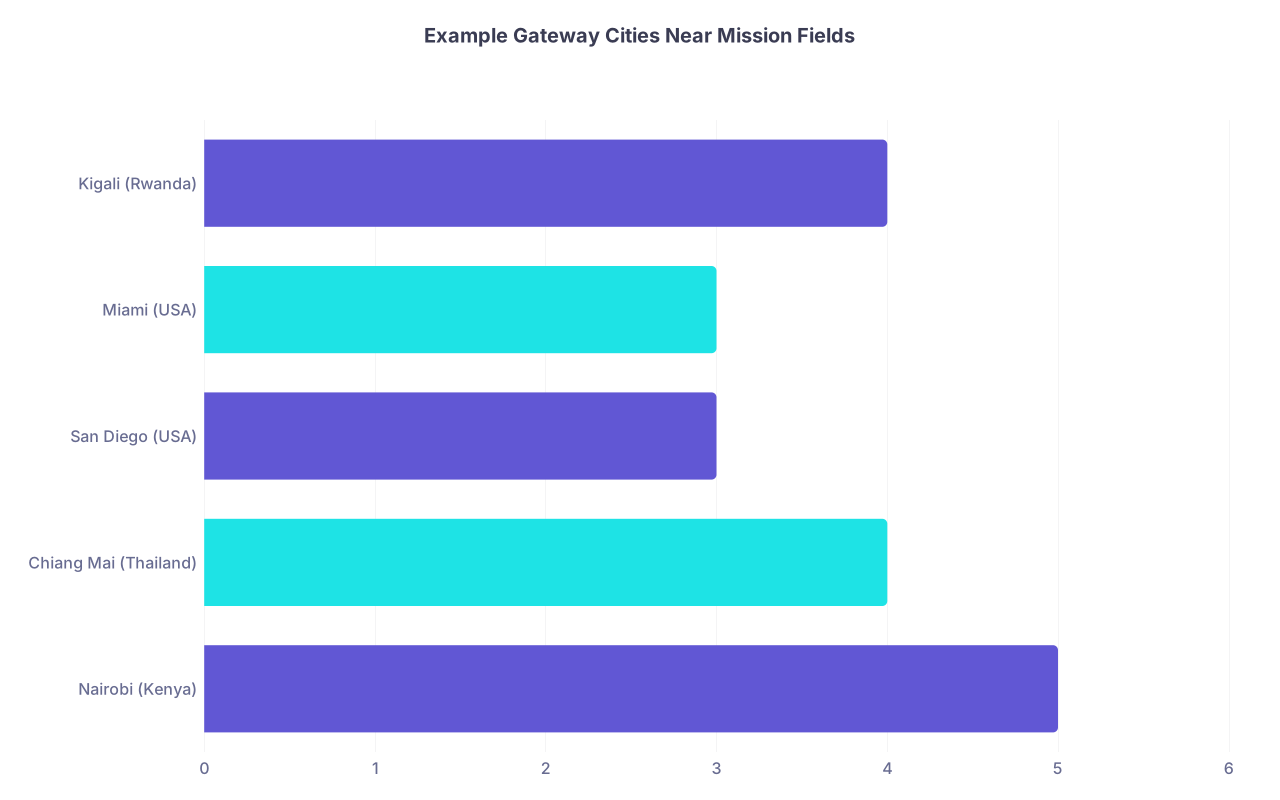
| Category | Value |
|---|---|
| Nairobi (Kenya) | 5 |
| Chiang Mai (Thailand) | 4 |
| San Diego (USA) | 3 |
| Miami (USA) | 3 |
| Kigali (Rwanda) | 4 |
Scale: 1 = limited reach, 5 = excellent hub access to multiple mission fields
East & Central Africa
If you’re serious about mission-adjacent work in Africa, East Africa is one of the best regions to think about.
Kenya – Nairobi as a hub
You live/practice in or near Nairobi. You serve in:
- South Sudan
- Somalia (usually via secure NGO channels)
- Northern Kenya (Turkana, Garissa, Wajir)
- Parts of Eastern DR Congo (via flights/NGOs)
- Refugee-heavy regions (Dadaab, Kakuma)
Why Nairobi works:
- Jomo Kenyatta International Airport is a major African hub
- Strong NGO presence (MSF, Red Cross, WHO, many faith-based groups)
- Decent private hospitals (Aga Khan, Nairobi Hospital, MP Shah) to maintain high-level practice
- Good international schools
- English widely used in medical settings
Tanzania – Dar es Salaam / Arusha / Mwanza
You live/practice in better-connected cities and go out to:
- Lake Zone missions (Mwanza, Shinyanga, rural islands)
- Southern Highlands
- Remote Maasai areas near Arusha
Slightly less hub-like than Nairobi, but if you’re linked to a specific mission hospital (KCMC, Bugando, etc.), this can work very well.
Rwanda – Kigali as a stable base
Kigali isn’t a massive hub like Nairobi, but it’s:
- Incredibly stable and relatively safe
- Quickly developing healthcare infrastructure
- Linked into regional initiatives (East Congo, Burundi, etc.)
This works best if you’re anchored to an academic/teaching hospital and intermittently crossing to more remote areas under institutional umbrellas.
Southeast Asia
Southeast Asia is full of “live here, launch there” opportunities if you don’t romanticize hardship and think strategically.
Thailand – Chiang Mai or Bangkok as base
Live in:
- Chiang Mai (popular mission hub, slower pace)
- Bangkok (massive medical and airline hub)
Serve in:
- Rural Northern Thailand
- Myanmar (when borders/situation allow, often from Mae Sot or via NGOs)
- Laos
- Parts of Cambodia
Why Thailand is strategic:
- Thai healthcare is relatively strong, so you can practice at a high level
- Tons of NGOs and mission organizations already based there
- International schools, air connectivity, and some creature comforts that make long-term work realistic
Malaysia – Kuala Lumpur as a quiet power move
KL is underrated. You can:
- Work in solid private or public hospitals
- Tap into outreach in East Malaysia (Sabah/Sarawak)
- Connect to Indonesia, Myanmar, Bangladesh, and others via short flights
It’s more “global hub with access to underserved places” than traditional mission base, but that’s exactly why it’s smart.
Central America & Caribbean – Living in the US but Looking South
If you’re US-based and want frequent missions without uprooting your life completely, you look at border and coastal cities.
US–Mexico border – San Diego, El Paso, McAllen, Brownsville, Tucson
Live/practice in the US. Cross into Mexico regularly.
You:
- Keep a US license, malpractice, and income
- Join or help run clinics across the border (Tijuana, Nogales, Juárez, Matamoros)
- Often partner with long-standing organizations (Border Compassion, various church-based charities, migrant clinics)
San Diego in particular is:
- Close to Tijuana and other Baja outreach sites
- Near an international airport
- Full of physicians already doing this style of work
South Florida – Miami/Fort Lauderdale as Caribbean launch pad
Live/practice in Miami. Serve in:
- Haiti
- Dominican Republic
- Jamaica
- Smaller Caribbean islands hit by hurricanes or chronically underserved
Flights are short, frequent, and relatively affordable. Many teams do repeated short-term trips with consistent follow-up.
Here, your “mission proximity” is via air routes, not by car.
South Asia
You’re dealing with huge populations, major health burdens, and complicated politics.
India – Metro base with rural reach
If you can work in India (citizenship/visa issues matter a lot here):
Base in:
- Bangalore
- Hyderabad
- Delhi
- Pune
Serve in:
- Rural Uttar Pradesh, Bihar, Rajasthan
- Tribal regions
- Remote mission hospitals (e.g., in Chhattisgarh, Odisha, Northeast)
This works mostly if:
- You’re Indian or have long-term visa pathways
- You’re tied to an Indian NGO, Christian mission hospitals, or academic centers
Nepal – Kathmandu/Pokhara base
Base in Kathmandu or Pokhara. Serve in:
- Mountain clinics
- Earthquake/flood response
- Remote district hospitals
Good for:
- Surgery, anesthesiology, EM, FM, OBGYN, ortho
- Mountain/expedition medicine overlap
Europe as a Launch Pad to the Middle East & North Africa
Europe can be your stable base while your mission fields are across the Mediterranean.
Southern Europe – Athens, Rome, Marseille, Barcelona
Live/practice in:
- Greece, Italy, Spain, or southern France
Serve with:
- Refugee clinics
- North Africa (Morocco, Tunisia) through partnerships
- NGOs in the Middle East (often via Turkey, Lebanon, or Jordan)
This tends to be more public health, refugee medicine, and chronic disease management than “classic” field missions, but it’s very real mission work.
Types of Cities to Target (And Avoid)
Forget countries for a moment. Focus on city archetypes. If you pick the right type of city, you’ll have options.

Look For:
International Hubs With Cheap Regional Flights
Places like Nairobi, Bangkok, Miami, Istanbul, Addis Ababa. You want:- Multiple airlines
- Direct flights to poorer neighboring countries or rural regions
- Competition that keeps ticket prices reasonable
Strong Local Hospitals
You need to:- Maintain procedural and clinical skills
- Have access to colleagues and CME
- Avoid becoming “that mission doc whose skills are 10 years out of date”
Existing NGO/Mission Ecosystem
Lone-ranger missions are a mess. You want:- Established orgs: MSF, Samaritan’s Purse, World Vision, Partners In Health, local faith-based systems
- Local clinicians who’ve been there before you and will be there after you
Stable-enough Governance and Safety
If your base is constantly at risk of coup, cartel, or collapse, your work won’t be sustainable. You can visit unstable places from a stable base; the reverse is much harder.Good Schools and Family Infrastructure
If you’ve got a family, this isn’t optional. Spotlight:- International schools
- Reasonable housing
- Access to decent healthcare for your own kids/spouse
Avoid:
Hyper-remote locations as your primary base
Great for short-term stints or 6–24 month postings. Terrible as a long-term base if you want flexible, multi-country impact.Tourist fantasies
Being based on a gorgeous island with no meaningful routes to major mission fields is self-sabotage dressed as sacrifice.Places with hostile medical licensing environments
If it takes two years and ten bribes to get a license, that’s not a strategic base.
How to Actually Structure Your Life Around This
This is where people get stuck. They love the idea but have no concrete model. So here are real-world patterns I’ve seen work.

| Step | Description |
|---|---|
| Step 1 | Residency Finished |
| Step 2 | Work full time in US city |
| Step 3 | Work in gateway city |
| Step 4 | 2-4 trips per year to mission fields |
| Step 5 | Partner with one or two NGOs |
| Step 6 | Split time hospital and missions |
| Step 7 | Teach local clinicians |
| Step 8 | Rotate into rural or conflict areas |
| Step 9 | US Based or Abroad Based |
Model 1: US/Europe Base + 2–4 Trips a Year
You:
- Work full-time in a US or European city near an international airport
- Block off 2–4 weeks at a time, 2–4 times a year
- Go to the same mission site repeatedly
Best for:
- Surgeons, anesthesiologists, OBGYN, IM/FM who want stable income and family life
- People who can’t or don’t want to move abroad long term
Strategic US locations:
- Miami (Caribbean, Central America)
- Houston or Dallas (Latin America, Africa connections)
- New York/Newark (Africa, Middle East via big hubs)
- Los Angeles (Pacific, parts of Latin America, Asia)
- San Diego / other border towns (direct Mexico work)
Model 2: Live in a Gateway City Abroad, Do Local + Regional Missions
You:
- Move to Nairobi, Chiang Mai, Kigali, or similar
- Work for a local hospital, academic center, or NGO
- Take regular shorter trips (3–10 days) to:
- Rural clinics
- Neighboring countries
- Disaster zones when things flare up
This is the classic long-term mission-adjacent model for people who really want to be immersed in a region but not be off the grid.
Model 3: Long-term Field Work With a Back-Up Base
You:
- Spend 6–11 months a year in a very remote mission setting
- Keep a base (family, church, or tiny practice) in a gateway city or home country
- Return periodically to:
- Reset
- Get CME and recertified
- Reconnect with supporters
High-burnout risk unless you’re extremely intentional about rest and boundaries.
Legal, Financial, and Licensing Reality Check
This is the boring part people skip. It’s also what wrecks them three years in.
| Factor | What You Need to Check |
|---|---|
| Licensing | Can you get licensed locally? How long does it take? |
| Income | Can you earn enough to support yourself/family? |
| Safety | Crime, political stability, health risks |
| Schools | Options for children, language of instruction |
| Flights | Cost and frequency to your mission fields |
Licensing
You need to answer:
- Are you going to be clinically practicing in your base country, or only in the mission field countries?
- Will you keep a US/UK/EU license and just work short-term abroad under NGO umbrellas?
- Does the gateway country require full licensure even for volunteer work?
NGOs sometimes provide coverage under their own operational frameworks, but that doesn’t replace proper licensure where you’re actually practicing medicine. Do not hand-wave this.
Malpractice and Legal Protection
In many mission contexts, formal malpractice suits are rare, but:
- You’re still legally and ethically responsible
- Some US malpractice policies explicitly exclude foreign work
- Some mission organizations offer coverage; read the fine print
If you keep a stateside practice:
- Check that your malpractice carrier is okay with your mission work
- Make sure your time away doesn’t breach any contractual obligations
Financial Sustainability
I’ve watched passionate physicians burn out not because of the medicine, but because money crushed them.
Be blunt with yourself:
- Can you cover:
- Loans
- Kids
- Insurance
- Retirement (yes, even as a “mission” doctor)?
Often, the most sustainable setup is:
- Solid paying job in a gateway city or home country
- Repeated, planned mission work, not last-minute “I’ll just wing it”
How to Choose Your Location Step-by-Step
If you’re serious, do this in writing. Otherwise you’ll just chase vibes.
Define Your Primary Mission Field
Don’t start with “I’ll go anywhere.” Start with:- A region you care about
- A population (refugees, rural poor, specific country or people group)
List Neighboring Countries and Cities With Good Infrastructure
Example: If your heart is in Haiti, your list probably includes:- Port-au-Prince itself
- Dominican border zones
- Miami / Fort Lauderdale as your major US launch point
Map Flight Routes and Travel Times
Literally:- Open Google Flights or similar
- See which cities have direct or frequent flights into your mission area
- Compare costs and travel duration
Overlay Licensing and Job Opportunities
Ask:- Where can I realistically get licensed?
- Where can I find a job/residency/fellowship?
- What language barriers will I face?
Check for Existing Organizations
You do not want to reinvent the wheel.Search:
- “[Country/City] medical mission hospital”
- “NGO clinics [country] health”
- “Faith-based hospital [country]”
- “Global health partnership [university name] [region]”
Reality-Check With Your Family and Season of Life
Single and 28 is different from 45 with 3 kids. That’s not judgment; it’s logistics.If you have a spouse with a career:
- Look for major cities, not tiny towns
- Consider countries with expat communities and job markets for them
Pilot the Model Before Committing Long-Term
Do:- A 2–4 week trip
- Then a 2–3 month stint (if possible)
- Try living in the gateway city and doing a short mission from there
See how your body, marriage, and bank account feel afterward.
Examples of Smart Pairings
To make this concrete, here are pairings that actually work in the real world.
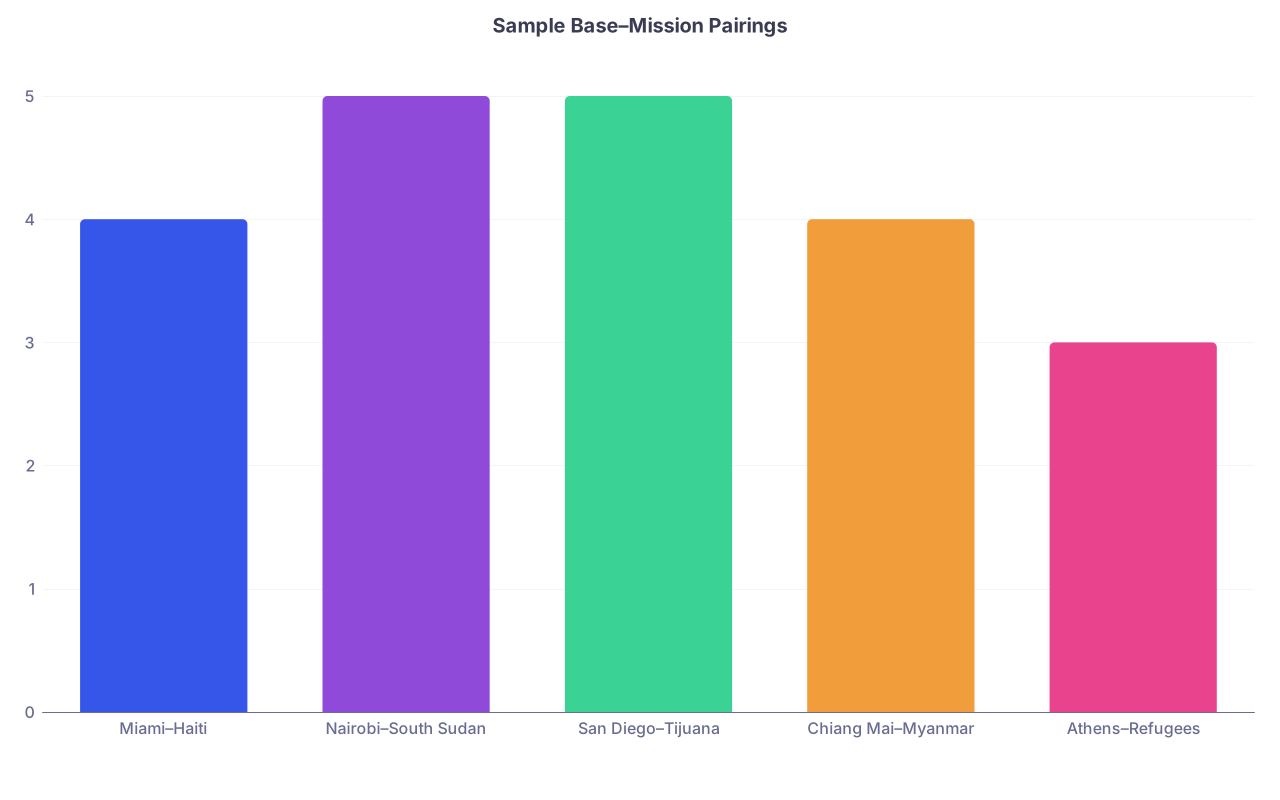
| Category | Value |
|---|---|
| Miami–Haiti | 4 |
| Nairobi–South Sudan | 5 |
| San Diego–Tijuana | 5 |
| Chiang Mai–Myanmar | 4 |
| Athens–Refugees | 3 |
Scale: 1 = weak pairing, 5 = highly strategic and established routes
Miami → Haiti / Caribbean
Frequent flights, large Haitian diaspora, tons of NGOs.San Diego → Tijuana / Baja Mexico
Drive across the border for clinic days, return home same night.Nairobi → South Sudan / Somalia / Northern Kenya
Use Kenyan base for training, supply chains, and referral pathways.Chiang Mai → Northern Thailand / Myanmar border
Live in Chiang Mai, work with cross-border clinics.Athens → Refugee communities from Syria, Afghanistan, Africa
Stable base in EU, ongoing refugee medical needs.
Final Reality Check
If you want to practice near medical mission fields, the “near” is doing a lot of work. It means:
- Near enough you can show up consistently, not just once and disappear.
- Near enough that your travel days don’t eat half your service days.
- Near enough that your family and finances can absorb the lifestyle.
The point is not to collect stamps in your passport. The point is to be strategically positioned so your skills get used well and often without destroying the rest of your life.
Keep three things front and center:
- Pick a gateway, not just a “romantic” field location.
- Anchor yourself to existing organizations and systems, not solo hero missions.
- Choose a setup you can sustain for a decade, not a year.
Do that, and you’re not just “doing missions.” You’re actually building something that lasts.


