

42% of physicians in high‑premium states effectively lose the equivalent of one full month of salary every year to malpractice coverage alone.
That is not a rounding error. That is the data punching a hole in a lot of “just go where they pay more” advice.
This is where most physicians get fooled: they look at raw compensation and completely ignore malpractice premiums, tail risk, and litigation climate. On paper, a $450,000 offer in one state looks better than $380,000 in another. After you factor premiums, effective tax, and risk, the $380,000 job can come out ahead. Sometimes far ahead.
Let me walk through the numbers, not the myths.
The Core Equation: Risk‑Adjusted Take‑Home
The real metric that matters is not salary. It is risk‑adjusted net compensation:
Net income after malpractice premiums, typical tail costs (amortized), and realistic defense/litigation exposure.
You can think of it in three parts:
- Gross comp – what the contract says.
- Risk drag – malpractice premiums + tail + higher probability of suit.
- Effective risk‑adjusted comp – gross minus risk drag.
Let’s put structure on that instead of vibes.
| State | Typical Attending Comp (IM) | Malpractice Premium (IM) | Premium % of Salary |
|---|---|---|---|
| California | $280,000 | $10,000 | 3.6% |
| Texas | $290,000 | $9,000 | 3.1% |
| New York | $265,000 | $35,000 | 13.2% |
| Florida | $270,000 | $40,000 | 14.8% |
| Illinois | $260,000 | $28,000 | 10.8% |
These are realistic ballpark ranges for internal medicine attending coverage (occurrence or claims‑made with mature step‑ups) in higher‑risk metro areas. Subspecialties like OB/GYN, neurosurgery, and cardiothoracic surgery can be 3–6× higher.
So 3–4% of salary in some states. Over 15% in others for higher‑risk specialties. That is a massive spread.
Now I will step through the states that consistently come out as “best” and “worst” when you look at both premiums and compensation.
Data Snapshot: How Big Is State‑to‑State Variation?
We have three key axes:
- Median physician compensation by state.
- Median malpractice premiums by specialty and state.
- Litigation intensity: paid claims per 100,000 residents and mean payout.
You do not need perfect precision to make good decisions. You need orders of magnitude and relative positioning.
On the compensation side, recent state‑level data consistently shows:
- Lowest‑paying states cluster around $260,000–$290,000 for primary care, $380,000–$420,000 for specialists.
- Highest‑paying states often hit $320,000–$360,000+ for primary care, $450,000–$520,000+ for specialists.
On malpractice premiums:
- “Safe” tort‑reform states: IM premiums often $6,000–$12,000, OB/GYN $30,000–$60,000, neurosurgery $35,000–$70,000.
- High‑risk states: IM $25,000–$40,000, OB/GYN $80,000–$150,000+, neurosurgery $90,000–$180,000+.
So you can easily see 2–4× premium differences for the same specialty, same risk profile physician, different state.
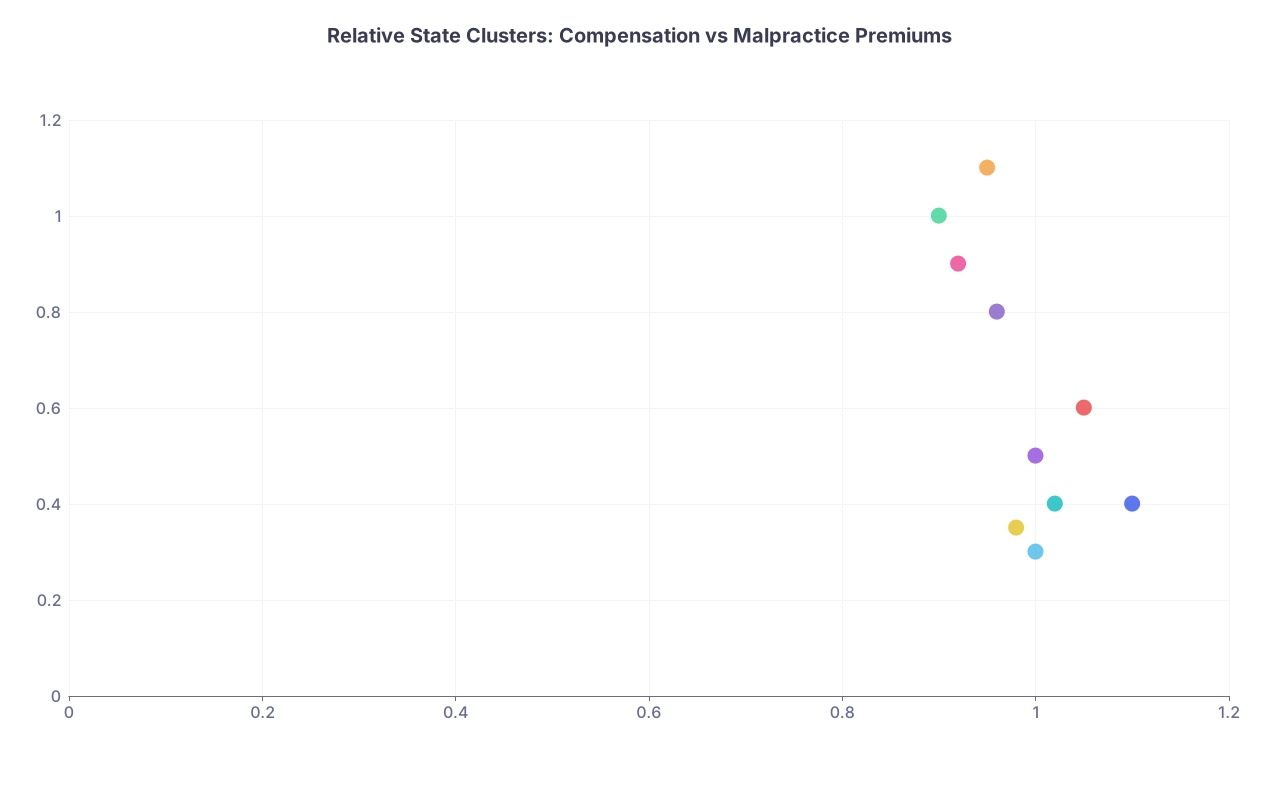
To visualize this tradeoff, think in quadrants:
| Category | Value |
|---|---|
| TX | 1.1,0.4 |
| CA | 1,0.5 |
| NY | 0.9,1 |
| FL | 0.95,1.1 |
| IL | 0.92,0.9 |
| WI | 1,0.3 |
| MN | 0.98,0.35 |
| IN | 1.02,0.4 |
| MA | 0.96,0.8 |
| NV | 1.05,0.6 |
Here the x‑axis is relative compensation (1.0 = national average), y‑axis is relative malpractice premium (1.0 = national average). Lower right is your ideal: higher pay, lower premiums.
You see immediately: a state like Texas (roughly 1.1 pay, 0.4 premium) looks very different from New York (0.9 pay, 1.0 premium) from a risk‑adjusted standpoint.
Best States: High Pay, Contained Risk
Let me be blunt: if you completely ignore location preferences, family ties, and lifestyle, and you only optimize for income per unit legal risk, a consistent pattern emerges.
1. Texas – The Tort Reform Poster Child
Texas is the case study everyone cites for a reason.
Key data points:
- Strong tort reform (non‑economic damages capped at $250,000 per physician in most cases).
- Physician compensation often 5–15% above national median for many specialties.
- Malpractice premiums 40–60% lower than high‑litigation coastal states for the same specialty.
Take an OB/GYN example:
- High‑risk state scenario:
- Comp: $450,000
- Premium: $120,000
- Premium = 26.7% of salary
- Texas‑type scenario:
- Comp: $480,000
- Premium: $55,000
- Premium = 11.5% of salary
You are looking at an extra $95,000 of effective income annually just from lower premiums and slightly higher comp. Over a 10‑year period, that is close to a million dollars before compounding, without working a single extra hour.
I have watched surgeons move from the Northeast to Texas and realize they had effectively been giving away a small house every three years to their carrier.
2. Indiana / Wisconsin / Minnesota – Quietly Efficient
These do not show up in glossy “top 10 cities” lists, but the numbers are boring in the best way.
Common features:
- Reasonable tort reform and more predictable jury behavior.
- Strong large group and health system presence that negotiates decent coverage.
- Compensation often at or slightly above national average, especially for non‑coastal metro and rural settings.
- Premiums that sit solidly below national median.
A typical internal medicine attending in these states:
- Comp: $290,000–$320,000
- Malpractice: $7,000–$12,000
- Premium share: 2–4% of salary.
Compare that with a coastal high‑litigation state hitting 10–15% for the same specialty. You keep roughly an extra $15,000–$25,000 per year, plus lower psychological risk.
For procedure‑heavy specialties, the gap becomes six‑figure territory.
3. Nevada (Post‑Reform), Some Mountain States
Nevada used to be a disaster. Post‑reform, it stabilized. Think:
- OB/GYN coverage that used to be $120,000+ dropping into the $50,000–$70,000 range.
- Statewide recognition of physician flight if premiums stayed insane.
Certain Mountain West states (e.g., Utah, Idaho, Wyoming) combine:
- Above‑average compensation to attract physicians to less dense markets.
- Litigation environments that are less plaintiff‑friendly simply by culture and jury composition.
- Malpractice costs that are low relative to comp, especially in non‑metro regions.
The catch: you give up big‑city amenities. But the math is compelling if you only care about risk‑adjusted dollars.
Worst States: Compensation Taxed by Litigation
Now the other side. There are states where malpractice premiums and litigation climate effectively act as a shadow tax on physician income.
Again, I am not talking about vibes. I am talking about real money that leaves your pocket every year and real exposure if a case goes sideways.
1. New York – High Density, High Risk, Underwhelming Pay
You have probably heard someone say, “But New York pays more.” Data says otherwise. Adjusted for cost of living, many New York physicians are not only underpaid—they are heavily exposed.
For many core specialties:
- Compensation often at or slightly below national median, especially in NYC and surrounding areas where hospital systems hold leverage.
- Malpractice premiums significantly above national averages.
Take general surgery:
- Comp in New York metro: $400,000–$450,000.
- Malpractice premium: $60,000–$90,000 (depending on claims history and carrier).
- Premium burden: 15–20% of gross.
Same surgeon in a reformed state:
- Comp: $420,000–$480,000.
- Malpractice: $20,000–$35,000.
- Premium burden: 5–8%.
That is a 10‑percentage‑point swing in effective take‑home, every year. And that ignores higher personal income taxes and cost of living.
In practice, some New York physicians adapt by:
- Joining large hospital systems that self‑insure (shifting risk profile but limiting independence).
- Accepting lower comp to avoid personally paying huge premiums.
- Leaving for other states after 5–10 years when the numbers no longer make sense.
I have seen entire private groups slowly hollow out for exactly this reason.
2. Florida – Compensation Mirage, Risk Reality
Florida is complicated. You see flashy comp numbers:
- Orthopedics: $600,000+
- Cardiology: $550,000+
- GI: $500,000+
Many of those numbers are real. Then the malpractice premiums hit.
For OB/GYN in Florida’s high‑risk counties:
- Premiums frequently run $100,000–$150,000+ annually.
- Some carriers have simply exited the market; others impose brutal rates or restrictions.
The pattern:
- High comp headlines attract candidates.
- Once you factor massive premiums, high claim rates, and volatile juries, effective compensation drops sharply.
- Contract structures sometimes offload more risk/coverage cost onto the physician than you realize at first pass.
The data on paid claims per physician is consistently higher in Florida than in most tort‑reform states. And the probability of being sued at least once in your career is not hypothetical; for some specialties it approaches inevitability.
3. Illinois, New Jersey, Pennsylvania – The Middle‑Tier Headaches
These are not as extreme as New York or Florida. But they are bad enough that, on a spreadsheet, you start asking, “Why am I here?”
Characteristic profile:
- Compensation: often near or slightly below national median in major metros due to oversupply and system consolidation.
- Malpractice premiums: substantially above national median, especially in Chicago, Philadelphia, and parts of New Jersey.
- Litigation environment: plaintiff‑friendly, unpredictable award sizes, expensive defense.
An internal medicine physician:
- Chicago area: $260,000–$285,000, premiums $20,000–$30,000.
- Similar role in Indiana/Wisconsin: $290,000–$320,000, premiums $7,000–$12,000.
So you earn less and pay more for the same job, across the state line. That is not a rounding error. That is a strategic error if you ignore it.
The Hidden Variable: Who Actually Pays the Premium?
One detail that muddies these conversations: contract structure.
Many job descriptions boldly say, “Malpractice coverage provided.” Physicians see that line and stop analyzing. Mistake.
There are at least four common structures:
Employer‑paid occurrence policy
Best case. Your liability is bounded to non‑economic fallout (reputation, time, stress). Rare outside big systems or academic centers.Employer‑paid claims‑made with tail provided
Still good. But verify tail triggers (e.g., what if you leave voluntarily, are fired, or the group dissolves?).Employer‑paid claims‑made, tail on you
Extremely common in private practice. Tail can cost 150–250% of your mature annual premium. For high‑risk specialties in high‑risk states, that is a six‑figure check when you leave.Stipend / withhold structure
Group “covers” malpractice, but takes it out of your collections or productivity pool implicitly.
So when we talk about “states with high malpractice premiums,” the actual impact on you depends heavily on which bucket you are in.
But state choice still matters, because even if your employer formally pays the premium, that cost is baked into:
- Lower base salary offers.
- Lower partnership distributions.
- Less margin for negotiation.
A $100,000 cheaper annual premium in a tort‑reform state gives the employer much more room to pay you better or invest in staff, tech, etc. Over time, that shows up in your bank account even if you never see the policy bill.
Quantifying State Risk: A Simple Index
Let me put this in a format you can actually use when comparing offers.
Define a crude Malpractice Risk Burden Index (MRBI):
MRBI = (Malpractice Premium / Compensation) × Litigation Intensity Factor
Where:
- Malpractice Premium / Compensation is a fraction (e.g., 0.05 = 5%).
- Litigation Intensity Factor is a scalar, say:
- 0.8 for low‑claim, low‑payout states.
- 1.0 for average states.
- 1.2–1.4 for high‑claim, high‑payout states.
Example – General Surgeon in two states:
- State A (tort‑reform):
- Comp: $450,000
- Premium: $25,000
- Litigation factor: 0.9
- MRBI = (25,000 / 450,000) × 0.9 ≈ 0.05
- State B (high‑risk):
- Comp: $470,000
- Premium: $75,000
- Litigation factor: 1.3
- MRBI = (75,000 / 470,000) × 1.3 ≈ 0.21
State B is roughly 4× more burdensome from a malpractice risk perspective, for only a 4–5% bump in comp. Bad trade.
You can approximate this yourself with whatever data you can get your hands on—quotes from carriers, MGMA or Doximity comp data, and publicly available malpractice environment summaries.
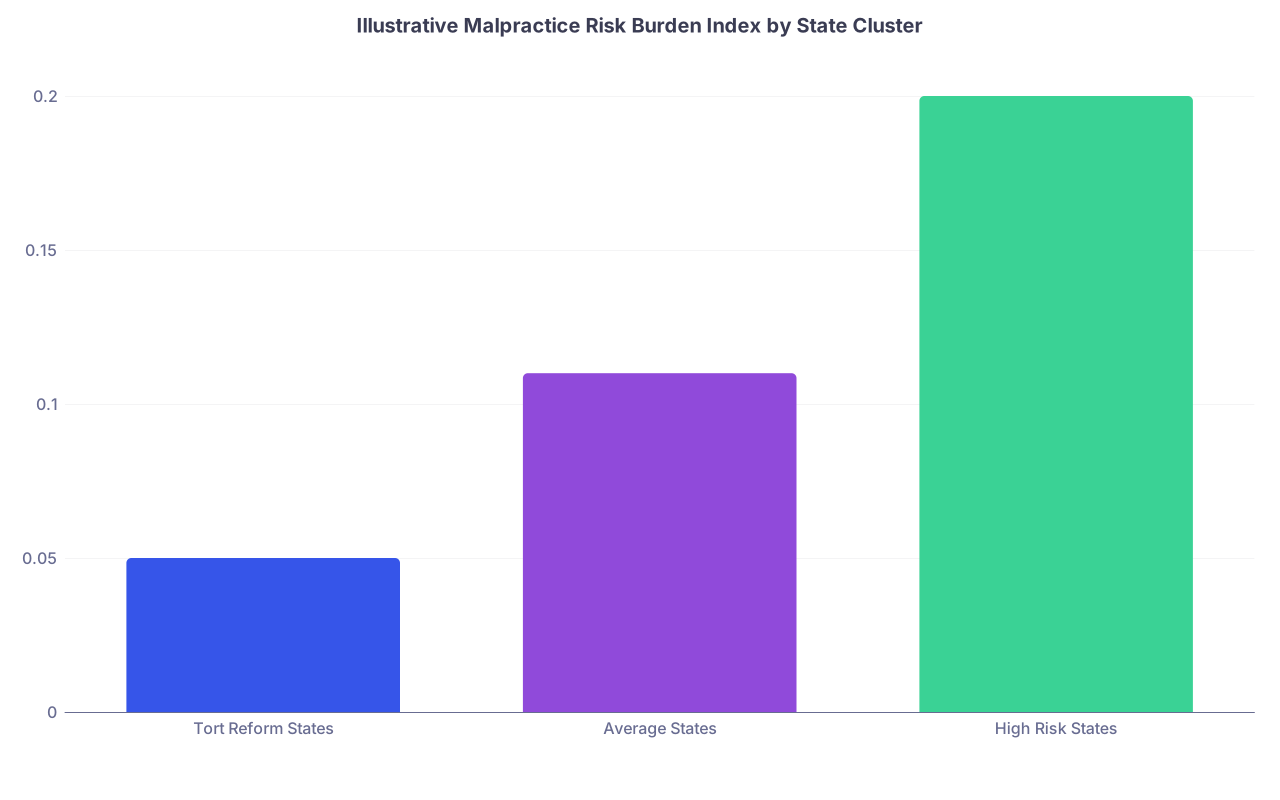
To see how different patterns cluster:
| Category | Value |
|---|---|
| Tort Reform States | 0.05 |
| Average States | 0.11 |
| High Risk States | 0.2 |
The exact values will differ by specialty, but the relative order is consistent.
How To Use This When Choosing Where To Work
I have seen too many physicians treat malpractice like a footnote. The data suggests it belongs on page one of your decision matrix.
A practical approach:
Get actual premium numbers, not hand‑waving. Ask:
- What type of coverage?
- Who pays the premium?
- Who pays the tail?
- What is the current annual premium for someone in my role?
Benchmark compensation against regional and national data for your specialty and setting (academic vs community vs private).
Compute crude ratios:
- Premium as % of salary.
- Estimated MRBI using a rough sense of litigation intensity.
Compare across states, not just across offers. If one job looks “good” in Florida, check what a similar role in Texas or Indiana pays with their premiums.
You will often discover:
- The “high offer” in a high‑risk state is actually mid‑pack or worse once you subtract the malpractice drag.
- Quiet midwestern or southern markets generate the best net financial outcomes.
And you should be explicit with yourself: “Am I willing to give up $30,000–$80,000 a year in effective income and take on higher legal risk just to live in X city?” Sometimes the answer is yes. At least it is an informed yes.
The Future: Will This Gap Shrink?
Short answer: not quickly.
Trends that matter:
- Tort reform is politically sticky. States that passed strong caps (Texas, Indiana, etc.) are not rushing to unwind them. That sustains lower premiums.
- Plaintiff bar is well organized in coastal and legacy high‑litigation states. Big‑ticket verdicts are not going away there.
- Self‑insured health systems may buffer individual doctors a bit, but do not erase state‑level risk. They price it into your comp.
- Telemedicine and cross‑state practice introduce new complexity, but most insurers still underwrite heavily based on where you primarily practice.
I do not expect New York or Florida to suddenly become malpractice havens. Nor do I expect Texas or Indiana to quietly triple premiums. The current distribution will likely persist with gradual shifts, not reversals.
So the state‑level choice you make early in your career will likely have decade‑scale consequences for your risk‑adjusted wealth.
Key Takeaways
Raw compensation by state is misleading. Malpractice premiums and litigation climate can erase 10–20% of your effective income in high‑risk states, especially for procedural specialties.
The best risk‑adjusted states for physicians tend to be tort‑reform, midwestern, or certain southern/mountain states (e.g., Texas, Indiana, Wisconsin, Minnesota), where premiums are low and comp is at or above average.
High‑litigation states like New York, Florida, and parts of Illinois/New Jersey/Pennsylvania function as a shadow tax on physicians: higher premiums, more suits, and often no meaningful pay premium to compensate you for that risk.


