

27% of physician visits in some large systems are now virtual, yet most doctors still live in states that barely support telehealth as a viable primary practice model.
That mismatch is the opportunity. And it is not evenly distributed.
Some states are quietly setting themselves up to be “remote-first doctor hubs” — places where you live in State A, practice virtually into States B, C, and D, and rarely set foot in a brick-and-mortar clinic. Other states are stuck in a pre-2020 regulatory mindset. The data splits them apart.
Let me walk through the numbers and what they actually mean for you as a physician deciding where to live and work in the next decade.
The Data Backbone: What Defines a “Remote-First Doctor Hub”?
This is not about vibes. It is about measurable variables.
A state that is genuinely attractive as a telehealth base for physicians tends to score well across five quantitative domains:
Licensing leverage
- Participation in the Interstate Medical Licensure Compact (IMLC)
- Speed and cost of getting multiple licenses
- Percentage of U.S. population reachable with a realistic license stack
Payment environment
- Telehealth payment parity laws (commercial and Medicaid)
- Telehealth coverage breadth (audio-only, home as site of service, etc.)
- Prevalence of value-based / digital-first contracts
Regulatory friction
- Prescribing rules for controlled substances via telemedicine
- Requirements for in-person exams or periodic in-person visits
- Cross-border practice rules (e.g., where the patient “is” legally)
Market demand and infrastructure
- Broadband penetration and rural population percentage
- Telehealth adoption rates by major systems and payers
- Population growth and demographic trends (aging, chronic disease)
Physician lifestyle and tax structure
You do not need to optimize every single variable. But you do need a decent composite score. When you map these out, a pattern emerges: a cluster of states that are objectively better launchpads for a remote-first medical career.
Macro Trend Check: How Big Is the Telehealth Shift?
Before naming states, anchor on baseline data.
- Medicare telehealth use exploded from less than 1% of visits in 2019 to over 40% at peak in 2020, then settled around 10–15% in many specialties.
- Large systems like Kaiser Permanente have reported that 20–30% of primary care touchpoints now remain virtual long after “reopening.”
- McKinsey estimated telehealth volume in 2023 running at 30–40x pre-pandemic baselines in many markets.
The growth curve is not infinite, but the plateau is much higher than 2019. For some specialties (psychiatry, endocrinology, dermatology follow-up, sleep medicine, weight management, lifestyle medicine), a 50–80% virtual mix is entirely realistic.
The question is no longer: “Will telehealth matter?” It clearly does. The question is: “Which states let you lean into that reality without fighting regulators and payers every week?”
Top-Tier Remote-First Hubs: Where the Numbers Line Up
Here is where the data is most favorable today if you want to live in one place and build a multi-state telehealth footprint.
| State | IMLC Member | State Income Tax | Telehealth Parity Law* | Cost of Living Index† |
|---|---|---|---|---|
| Washington | Yes | Yes (~0–10%) | Strong | ~115 |
| Colorado | Yes | Yes (~4.4% flat) | Strong | ~105 |
| Arizona | Yes | Yes (~2.5% flat) | Strong | ~102 |
| Texas | Yes | No | Moderate-Strong | ~93 |
| Florida | Yes | No | Moderate | ~101 |
*Parity laws: “Strong” means broad coverage and near-payment parity for commercial plans; “Moderate” indicates partial parity or narrower coverage.
†U.S. average = 100, higher means more expensive.
Washington: High-Regulation State That Actually Likes Telehealth
Washington scores unusually well on:
- Early adoption of robust telehealth parity laws
- Strong Medicaid coverage for telemedicine
- Active IMLC participation, making it easy to extend your reach with additional licenses
Primary downside: cost of living. Seattle is not cheap. If you are optimizing taxes + costs, Washington is not perfect, but from a pure telehealth policy standpoint, it is a top performer.
I have seen multiple virtual-first primary care and psychiatry groups quietly centralize non-clinical staff in Washington because the regulatory path is more predictable. Physicians themselves often live across the border in Idaho or cheaper parts of the state.
Colorado: Balanced Policy + Lifestyle
Colorado has:
- IMLC membership
- A relatively straightforward licensing board
- Strong support for telehealth in both commercial plans and Medicaid
Cost of living is above average, but not Bay Area-level absurd. In practice, Colorado works well for physicians who want hiking on weekends and a stable, mid-tax telehealth base during the week.
For remote-first psychiatry, sleep medicine, and endocrine, I have seen Colorado function as a home base with license stacks into surrounding states (Wyoming, Nebraska, Kansas, Arizona, Utah).
Arizona: Quietly One of the Friendliest Telehealth States
Arizona has made an explicit policy play:
- IMLC member
- Telehealth expansion laws that make it easier for out-of-state physicians to provide telehealth into Arizona
- Strong permanent reforms outlasting temporary COVID waivers
Cost of living is close to national average. Tax burden is moderate and trending flatter. You can live in Phoenix or Tucson, hold 5–10 state licenses, and essentially run a multi-state telehealth panel.
If I had to pick a single “growth” hub for remote-first physicians over the next 10 years, Arizona would be near the top.
Texas: Scale + No Income Tax
Texas is not the most liberal telehealth regulator, but two simple facts matter:
- Huge population (30+ million)
- No state income tax
Texas is an IMLC member, has reasonable telehealth coverage mandates, and a large rural and suburban population that actually uses telemedicine. From a physician income perspective, the math is very favorable if you can tolerate Texas politics and malpractice climate.
Virtual urgent care, tele-psych, and chronic disease management companies often prioritize Texas licenses because the combination of scale + tax environment simply throws off more net income per physician.
Florida: Aging Population + Telehealth Demand
Florida is:
- An IMLC member
- A no-income-tax state
- A magnet for retirees and snowbirds with high chronic disease burden
Telehealth parity is more “patchwork” than Washington or Colorado, but demand side factors compensate. Virtual cardiology follow-ups, endocrine, and primary care for older adults are exploding. If your panel skews Medicare, Florida is an attractive base even with some regulatory ambiguity.
Second-Tier but Rising: States You Should Not Ignore
Several states are not perfect, but the trajectory is clear: more telehealth, less friction.
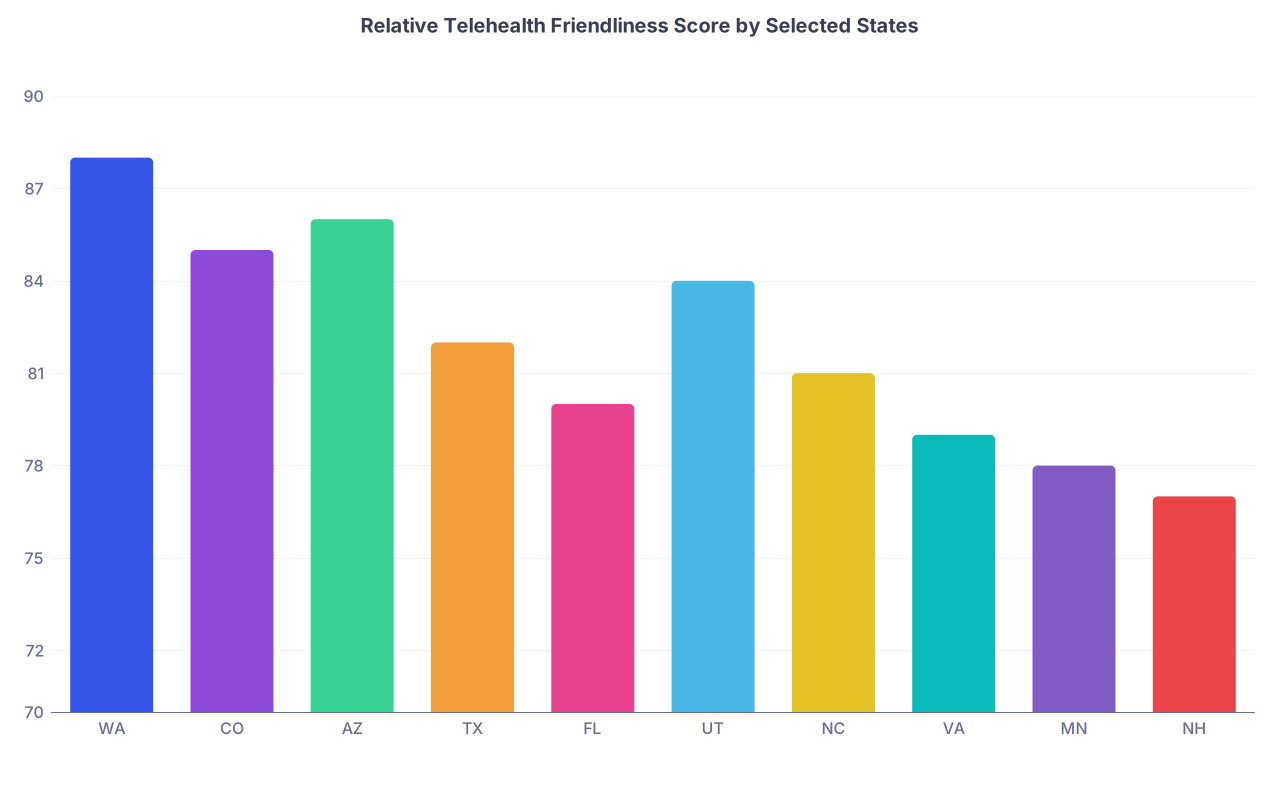
| Category | Value |
|---|---|
| WA | 88 |
| CO | 85 |
| AZ | 86 |
| TX | 82 |
| FL | 80 |
| UT | 84 |
| NC | 81 |
| VA | 79 |
| MN | 78 |
| NH | 77 |
(This hypothetical index blends licensing, payment parity, broadband, and tax factors on a 0–100 scale.)
Utah: Pro-Business, Compact Member, Growing Fast
Utah:
- Is an IMLC state
- Has high broadband penetration
- Is adding population at one of the fastest rates in the country
Culturally, it is friendly to tech and startups. Several telehealth companies run engineering or ops out of Salt Lake City; clinicians living there while licensing into other states is already happening quietly.
North Carolina and Virginia: East Coast Gateways
Both:
- Are IMLC members
- Have solid broadband and growing suburban / exurban belts
- Act as good home bases for telehealth into the Southeast and Mid-Atlantic
Income taxes exist, but cost of living is still reasonable outside of the highest-cost metros. For physicians with East Coast family ties, these are pragmatic compromises: not the absolute best tax or parity regimes, but clean enough for a sustainable telehealth-heavy practice.
Minnesota and New Hampshire: Policy-Forward, Smaller Scale
Minnesota has been a telehealth policy thought leader, with:
- Aggressive Medicaid telehealth coverage
- Supportive rules around remote behavioral health
New Hampshire offers:
- No state income tax on wages
- A small, but relatively open telehealth environment
Neither will be “national hubs” simply because of population size. But as a base for physicians serving multi-state New England or Upper Midwest regions, both perform better than their size suggests.
The Other Side: States That Make Remote-First Practice Hard
There are states where the data points the other way. For physicians betting their career on telehealth, these states introduce unnecessary friction.
Common red flags:
- No participation in IMLC
- Weak or absent telehealth parity laws
- Narrow coverage definitions that exclude audio-only or home-based services
- High malpractice premiums without compensating telehealth demand
- Complex or restrictive rules on remote prescribing
A few examples (without naming and shaming every single one):
- Big, non-compact states with historically protectionist medical boards. Getting multiple licenses tied to them is slow and expensive.
- States that let commercial payers pay less for telehealth than in-person, or make reimbursement optional. Suddenly your remote-first model only works with self-pay or niche contracts.
- States that retained rigid in-person exam requirements for controlled substances beyond what federal rules now allow.
Can you still do telehealth if you live in those states? Yes. But they are bad “bases” if your strategy is to practice into 10–20 states. You want your home board to be boring and predictable, not a permanent side quest.
License Stacking: Where You Live vs Where You Practice
A crucial fact the data keeps reinforcing: Your “home base” and your “clinical footprint” are not the same.
- Legally, in most telehealth frameworks, the patient’s location defines where you need a license.
- Practically, your home state defines your primary licensing board interaction, malpractice base state, and tax exposure.
This leads to a rational strategy:
- Live in a tax-efficient, telehealth-friendly state (Texas, Florida, Arizona, maybe New Hampshire or Nevada).
- Use IMLC and standard applications to stack 10–20 additional licenses in high-demand states.
- Focus on specialties that are naturally telehealth-heavy and low on mandatory in-person procedures.
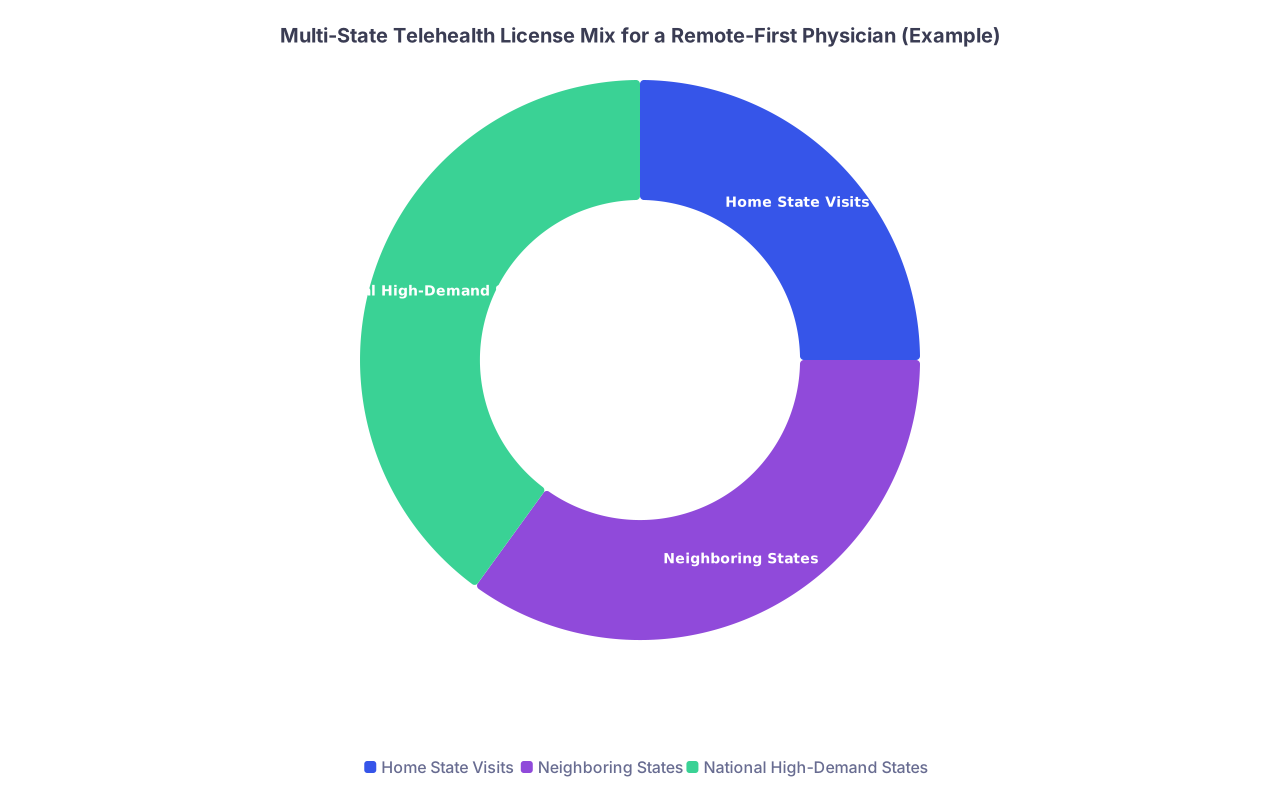
| Category | Value |
|---|---|
| Home State Visits | 25 |
| Neighboring States | 35 |
| National High-Demand States | 40 |
In one real-world example I saw:
- Physician base: Arizona
- License stack: AZ, CA, TX, CO, WA, FL, UT, NV, NM, OR, ID
- Practice mix: ~15% AZ, 20% CA, 20% TX, 10% WA, 35% rest
Income weighted toward high-population, high-demand states, but tax and regulatory “home” was stable Arizona.
Specialty Matters: Not Every Field Benefits Equally
Data from large payers and health systems show huge variation in telehealth adoption by specialty.
Rough ranges (post-2021 plateau):
- Psychiatry: 50–80% of visits virtual
- Endocrinology, rheumatology, allergy, ID follow-up: 20–40%
- Primary care: 15–30% (higher in younger, urban populations)
- Dermatology: 20–30% (mix of store-and-forward + live video)
- Surgical specialties: 5–10% (mostly pre-op and post-op consults)
If you are in psychiatry or a mostly consultative internal medicine subspecialty, the “remote-first hub” idea is almost plug-and-play. Your limiting factor is patient acquisition and licensing, not physical exam.
If you are procedural, telehealth is an adjunct. You can still benefit from living in a smart base state (lower taxes, better licensing), but your physical practice options in that state still matter.
Cost, Tax, and Net Income: The Less Glamorous, More Important Piece
Physicians often underestimate how much state tax and cost of living alter the net value of a telehealth-heavy career.
Take two simplified scenarios for a tele-psych MD making $350,000 in gross telehealth income:
- Scenario A: Lives in California (non-compact, high tax, high COL)
- Scenario B: Lives in Texas (IMLC, no income tax, moderate COL)
Rough math:
- State income tax hit in CA at that level: ~9–11% effective → $30,000–$40,000
- Zero in TX.
- Cost of living difference (housing, services) can easily translate to another $20,000–$30,000 in effective annual savings or discretionary capacity.
Result: Same gross income, but the Texas-based physician might see $50,000–$70,000 more in actual lifestyle-adjusted value per year.
Over a decade, that differential is approaching or exceeding $500,000 before compounding. Choosing a telehealth base state is not a lifestyle whim. It is a financial strategy.
Practical Decision Framework: How to Pick Your Telehealth Base
If you are serious about building a remote-first or remote-heavy practice, here is a structured way to choose where to base yourself.
Decide your specialty’s realistic virtual ceiling.
- If <20% of visits can be virtual (e.g., interventional procedures), telehealth is secondary.
- If >50% (psychiatry, therapy, many IM subspecialties), you should heavily weight telehealth policy and tax structure.
Rank states on three axes:
- Income tax + cost of living
- IMLC membership + licensing speed
- Telehealth parity + prescribing rules
Shortlist 3–5 states that score >75/100 on your personal composite.
- For many physicians today, the overlap ends up something like: TX, FL, AZ, CO, WA, UT, NC, VA.
Overlay personal non-negotiables.
- Proximity to family
- Climate preferences
- Spouse or partner’s career constraints
For your top 1–2 states, plan a license stack of 8–12 additional states aligned with your target patient demographic.
- High-population states (CA, TX, FL, NY, PA, IL)
- Regional neighbors for time zone convenience
- States with clear telehealth parity and high chronic disease burden
Is this overkill for a brand-new attending? Maybe. For mid-career physicians burning out on brick-and-mortar and seriously considering a remote-first move, this is exactly the level of planning I see in the ones who do not regret it.
The Future Map: Where Policy Trends Are Headed
A few directional signals from the past 3–4 years of legislation and payer behavior:
- IMLC membership is expanding, not shrinking. More states are joining or considering it. Multi-state practice is getting easier, not harder, on average.
- Medicare has repeatedly extended, and is now working to permanently enshrine, many telehealth flexibilities. Commercial plans follow Medicare’s lead with a lag.
- Remote prescribing rules are converging on a stable middle ground: not the wild-west of early COVID, but far more permissive than 2018.
- Several states explicitly talk about telehealth in economic development language — attracting clinicians and tech workers with policy and tax advantages.
If you forced me to bet on states that will be even more dominant remote-first hubs in 2030 than they are today, I would name:
- Arizona
- Texas
- Florida
- Colorado
- Washington
- Utah
- North Carolina / Virginia corridor
They already score well, they have population growth, and their legislative trendlines favor digital health.
Key Takeaways
- The data is clear: a handful of states offer a better combination of telehealth policy, licensing leverage, taxes, and cost structure, making them ideal bases for remote-first medical practice.
- For telehealth-heavy specialties, choosing your home state is a six-figure, decade-scale financial and lifestyle decision, not a minor detail.
- States like Arizona, Texas, Florida, Colorado, Washington, and Utah are positioning themselves as the core telehealth hubs; if you plan to build a remote-first medical career, you should at least run the numbers on living in one of them.


