

It’s 10 p.m. You just finished another hospitalist shift in the US/UK/Canada. Your non‑medical spouse is on the couch, laptop open, finishing work for a fully remote job they could technically do from anywhere with Wi‑Fi. You run the same conversation again:
“If we moved somewhere cheaper, we could actually get ahead. But where? And what would it actually look like?”
You are not asking for Instagram fantasy. You want to know: in which countries does a physician income (local or locum or telemedicine) go the furthest while your spouse keeps their remote career alive?
This is exactly the situation: physician + remote-working spouse, looking for countries where:
- Physician pay (local or foreign-sourced) is decent or can be maintained.
- Cost of living is low enough that you can actually save or buy time back.
- Infrastructure (internet, schools, safety, visas) does not make life miserable.
I’m going to walk you through how to think about this as a working doctor, not as a digital nomad YouTuber. Then we’ll hit specific country examples that actually work.
Step 1: Decide Your Core Earning Model
Before you even open a cost‑of‑living spreadsheet, you have to answer one brutal question:
Where is the physician money coming from?
You have three main models:
- Local Physician Job + Remote Spouse Job
- Telemedicine/Locum in High‑Income Country + Both Remote
- Short High‑Pay Contracts + Base in Low‑Cost Country
If you do not pick a primary model, everything else stays fuzzy and you will spin your wheels.
Model 1: Local Physician Job + Remote Spouse Job
You move to a new country, you work clinically in that country, your spouse keeps their remote job (likely paid in USD/EUR/GBP).
Good fit if:
- You want stable clinical work and a team.
- You like the idea of integrating into a system, not just doing telehealth from a laptop.
- You are willing to do the licensing slog in one new country.
Bad fit if:
- You want geographic flexibility every 6–12 months.
- Your specialty is very procedure-heavy and hard to port (e.g., interventional cardiology, neurosurgery) without major recertification.
Model 2: Telemedicine/Locum in High‑Income Country + Both Remote
You live in Country B (cheap, nice), but your physician income comes from:
- Telemedicine for your home country (US/UK/Canada/Australia).
- Periodic locum tenens trips to your home system (1–3 months/year, intense work).
Your spouse keeps a remote job based on a strong currency.
Good fit if:
- You have (or can get) telemedicine gigs that let you work cross‑border.
- You’re comfortable being “professionally based” in one country and physically based in another.
- You’re not desperate for on‑the‑ground clinical team life.
Model 3: Short High‑Pay Contracts + Base in Low‑Cost Country
You use:
- Gulf region contracts (UAE, Saudi, Qatar), or
- Northern Europe/Scandinavia locum-style contracts, or
- Rural/underserved area locums in your home country
Then you base yourself and your spouse in a low‑cost country in the “off” time.
This is more complicated logistically, but the income can be massive relative to spending.
Step 2: Understand Where Physician Money Actually Stretches
You are not looking for “highest pay.” You are looking for (doctor pay + spouse remote pay) – (realistic expenses).
Think in terms of purchasing power:
| Country/Region | Approx Doctor Net Monthly (Local) | Approx Cost for Comfortable Couple | Savings Potential (Local Income Only) |
|---|---|---|---|
| US (urban) | $12,000 | $9,000 | Medium |
| UAE (Dubai) | $13,000 | $6,000 | High |
| Portugal | $3,500 | $3,000 | Low |
| Thailand | $4,000 (intl hospital) | $2,500 | Medium-High |
| Mexico (private) | $4,500 | $2,000 | High |
These are rough, but you see the point: the US may pay more nominally, but cost structure eats it. In some smaller markets, you make less as a doctor but life is dramatically cheaper—and your spouse’s remote USD/EUR income becomes rocket fuel.
Step 3: Countries Where Physician + Remote Spouse Works Really Well
Now let’s get to what you actually came for: concrete places.
1. UAE (Dubai/Abu Dhabi): High Income, No Tax, Strong Remote Setup
You: Specialist or GP working in a private hospital or large health system in Dubai or Abu Dhabi.
Spouse: Remote job paid in USD/EUR/GBP, working from a comfortable apartment with strong internet.
Why it stretches:
- Physician salaries are high, especially in private/tertiary centers.
- No personal income tax. Your take‑home is your gross, minus housing/benefits if employer-provided.
- Remote spouse income hits your account on top of that, tax situation depending on your citizenship.
Reality check:
- Cost of living is not “cheap,” but relative to take‑home pay, you can still save aggressively.
- Healthcare systems are modern, English widely used, schools solid (but international school fees are brutal if you have multiple kids).
Your life looks like:
- You run full‑on specialist clinics in a modern facility.
- Your spouse works US/EU hours; evenings may be late depending on time zone.
- Weekends in Dubai malls/restaurants or short flights to Europe/Asia. You are not “geographically arbitrary” but you’re financially ahead.
This is probably the most powerful combo for a couple who wants both: strong clinical career and high savings rate.
2. Portugal: Lifestyle Play + Remote Currency Arbitrage
You: Possibly not working clinically in Portugal initially (unless you bite off EU licensing), or working limited local medicine if you are EU‑trained.
Spouse: Strong remote job with Western salary.
Why Portugal works:
- Golden‑visa era is changing, but there are still D-type visas (digital nomad / passive income) that make it friendly for remote couples.
- Cost of living is lower than most of Western Europe, especially outside Lisbon/Porto.
- Healthcare is decent; private options are reasonably priced even if you’re not in the national system yet.
Where your physician background matters:
- You might not practice locally at first, but you can:
- Do telemedicine back to your home country (if licensed).
- Take short contracts (locums in UK/Scandinavia/US) and then return to Portugal as your base.
Spouse’s remote salary (e.g., $120k–$200k USD) in Portugal translates to a very comfortable life, especially if you supplement via telehealth or part‑time clinical work abroad.
3. Thailand (Bangkok/Chiang Mai): International Hospitals + Remote Work Haven
You: Possibly working at an international hospital (Bangkok Hospital, Bumrungrad, Samitivej) if you have the right specialty and experience, or doing remote work (telemedicine, consulting, education).
Spouse: Remote, USD/EUR‑paid job.
Why it’s strong:
- International hospitals pay less than US/UK but still decent locally, especially with expat packages.
- Cost of living can be wildly lower than Western cities, even if you live well.
- Excellent internet, ton of co-working spaces, remote work culture is basically normalized among expats.
What I’ve seen work:
- US board‑certified internists, pediatricians, surgeons working in international hospitals with schedules similar to home but better support/staffing.
- Spouse working US hours in a condo with good Wi‑Fi and pool.
- Combined income dramatically exceeds spending, especially without kids in private international schools.
Caveat: licensing and job offers in international hospitals are competitive. You need:
- Strong CV.
- English language plus some openness to basic Thai.
- Willingness to operate within a private, customer‑service‑heavy healthcare culture.
4. Mexico (Mexico City/Guadalajara/Mérida): Private Practice + Remote Dollar/Euro Income
You: Either:
- Working in private clinics/hospitals (if trained/licensed in Mexico), or
- Holding on to telemedicine work back home while based in Mexico.
Spouse: Remote job with Western pay.
Why money stretches:
- Everyday costs—housing, food, local services—are dramatically cheaper than US/Canada/Western Europe.
- If either of you are earning in strong currency, you can live at a high standard for a fraction of what you’re used to.
Patterns that work:
- US‑trained physician doing US telemedicine (urgent care, primary care follow‑ups) from a base in Mexico.
- Spouse in tech/marketing/finance working remote for a foreign company.
- Long‑term rentals in safe, established neighborhoods (Condesa/Roma in CDMX, or quieter cities like Mérida).
You do need to be serious about:
- Security (pick safer areas, be realistic, not naive).
- Legal residency and tax planning (don’t DIY this—hire a cross‑border accountant and an immigration lawyer).
5. Central/Eastern Europe (Poland/Czech Republic/Hungary): Moderate Doc Pay, Strong Remote Spouse Boost
You: Either:
- Local physician in the public or private sector with EU credentials, or
- Continuing to earn via contracts in Western Europe while basing in a cheaper EU state.
Spouse: Remote job, likely in tech or business, paid German/UK/US levels.
Why it can work:
- These countries often have lower cost of living even within the EU.
- You get EU infrastructure: trains, healthcare systems, decent schools, relative safety.
- Remote spouse income + modest physician income = very comfortable middle/upper-middle-class life with solid savings potential.
This is particularly good if:
- One of you has EU citizenship.
- You want a base that doesn’t feel like an “expat island” and you’re okay with colder winters and less English outside big cities.
6. “Base + Locum” Strategy: Example — Living in Portugal/Thailand, Working in UK/US
Let’s outline what I see successful couples doing when the doctor wants to keep high‑pay home-country work but not live there.
Basic shape:
- Base in lower-cost, pleasant country (Portugal, Thailand, Mexico, Eastern Europe).
- Doctor:
- Does 3–4 intense months per year of hospitalist/ED/locum work in US/UK/Scandinavia.
- Or maintains regular telemedicine blocks scheduled over the year.
- Spouse:
- Works fully remote in home country time zone.
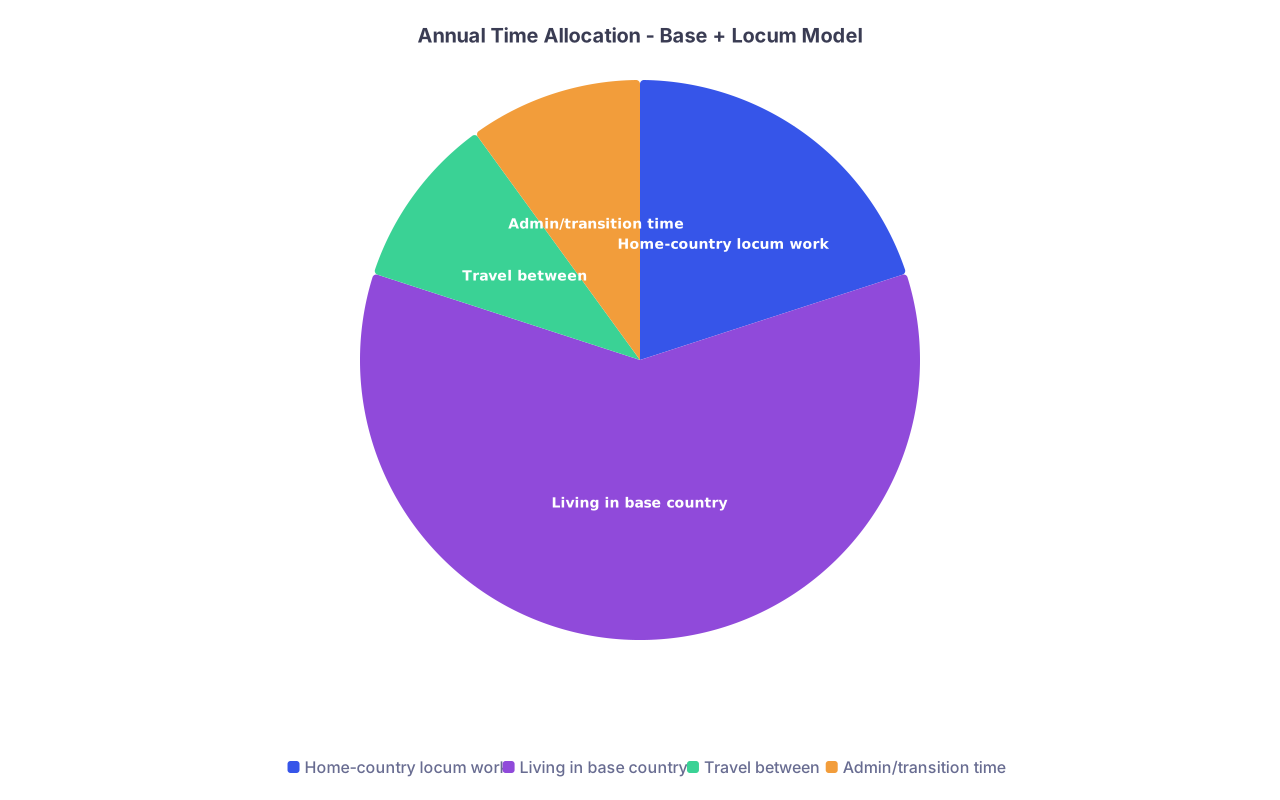
| Category | Value |
|---|---|
| Home-country locum work | 20 |
| Living in base country | 60 |
| Travel between | 10 |
| Admin/transition time | 10 |
What this buys you:
- You compress the soul‑crushing parts of clinical work into sprints.
- You let your lifestyle and spending adapt to a cheaper base so you’re not hemorrhaging cash when off‑contract.
- Your spouse has continuity: same remote job, same income stream.
Step 4: Visa, Tax, and Licensing — The Boring Stuff That Will Wreck You If You Ignore It
If all you do is scroll nomad lists and salary charts, you will get burned. Three landmines:
- Visas / Residency
- Tax residency and double taxation
- Medical licensing rules that forbid cross‑border telemedicine
You don’t need a PhD in any of these, but you do have to respect them.
Visas and Residency
You need a legal status that lets:
- Your spouse work remotely without messing with local labor laws.
- You either work locally as a physician or be clearly allowed to work remotely for a foreign employer.
Common categories:
- “Digital nomad” or “remote worker” visas (Portugal, Spain, some Eastern European states, some Latin American countries).
- Employment-based visas (UAE, Singapore, Thailand for hospital roles).
- Residency by investment, marriage, or ancestry (if you qualify).

| Step | Description |
|---|---|
| Step 1 | Start |
| Step 2 | Reconsider plan or find remote role |
| Step 3 | Countries with physician jobs and expat visas - UAE, Thailand |
| Step 4 | Countries with remote visas and good infrastructure - Portugal, Mexico |
| Step 5 | Check licensing and hospital offers |
| Step 6 | Check remote visas and tax residency |
| Step 7 | Spouse has remote job in strong currency |
| Step 8 | You want local clinical work? |
Do not wing this. Reach out to:
- Immigration lawyers in target country.
- Other physicians already doing what you want (Facebook/WhatsApp groups, specialty networks).
Taxes: You Cannot Ignore This
You need to know:
- Where you are tax resident (often about days in-country, not just passport).
- Whether your home country taxes worldwide income (US does).
- Whether there’s a tax treaty and how to avoid paying twice.
You and your spouse may end up:
- Filing in your home country.
- Possibly filing locally where you live.
- Claiming foreign tax credits or exclusions.
If you’re serious about this, you pay for:
- A cross‑border tax accountant who works with expats and physicians.
- Maybe one consult per year just to make sure you’re not sleepwalking into an audit or huge bill.
Step 5: Infrastructure and Lifestyle Filters (Non‑Negotiables)
Even if money stretches, the move fails if:
- Internet is unreliable → spouse cannot work.
- Schools are bad or unaffordable → kids suffer, or you do not see them because you’re commuting forever.
- Safety is an issue and your daily stress actually increases.
So, put these filters on your target list:
Internet
- Look for cities with strong fiber coverage and multiple ISPs.
- Co-working spaces as backup.
Healthcare Access
- As a doctor, you care about this more than the average expat. You know how bad things can get.
- Even if you are the physician, do not assume you can handle your own emergency care.
Schools (if you have or plan kids)
- International school fees in UAE, Thailand, and many expat-heavy cities are outrageous. Budget for them explicitly.
- In some EU countries, local public schools are fine if you integrate long term.
Time Zone Alignment
- Spouse’s remote job time zone vs. your clinical schedule matters.
- If spouse works US hours and you work mornings in UAE, your evenings might be off-sync. That may be okay or not, depending on your relationship.
Step 6: Shortlist: Where Physician Incomes + Remote Spouse Pay Stretch Furthest
If I had to be blunt and pick scenarios that actually work in the real world, not fantasy blogs:
| Scenario ID | Country Base | Physician Work Model | Spouse Work | Overall Financial Leverage |
|---|---|---|---|---|
| A | UAE | Local hospital specialist | Remote USD | Very High |
| B | Thailand | International hospital + tele | Remote USD | High |
| C | Portugal | Telemedicine/locums abroad | Remote USD | High |
| D | Mexico | Telemedicine back home | Remote USD | Very High |
| E | Eastern Europe | Local or Western contracts base | Remote EUR | Medium-High |
That doesn’t mean others are impossible. But if you want concrete plays with a good track record, start there.
Step 7: How to Actually Move From Idea to Plan
You’re not going to solve this in your head. Do this in stages.
Stage 1: Reality Check (1–2 Weeks)
Sit down with your spouse and answer:
- What are our minimum income needs?
- How mobile is each of our careers, really?
- How often do we want/need to see family back home?
Narrow to 2–3 countries that fit:
- Visa options.
- Language tolerance.
- Time zone compatibility with spouse’s job.
Stage 2: Talk to People Already Doing It (2–4 Weeks)
You will not get this from generic blogs.
- Find:
- “Doctors in UAE” groups.
- “US doctors in Mexico/Thailand/Portugal” groups.
- Remote worker + expat forums for spouses.
Ask specific questions:
- “What’s your after‑tax physician income?”
- “What’s your monthly spend for rent/school/healthcare?”
- “What’s one thing you regret about choosing this country?”
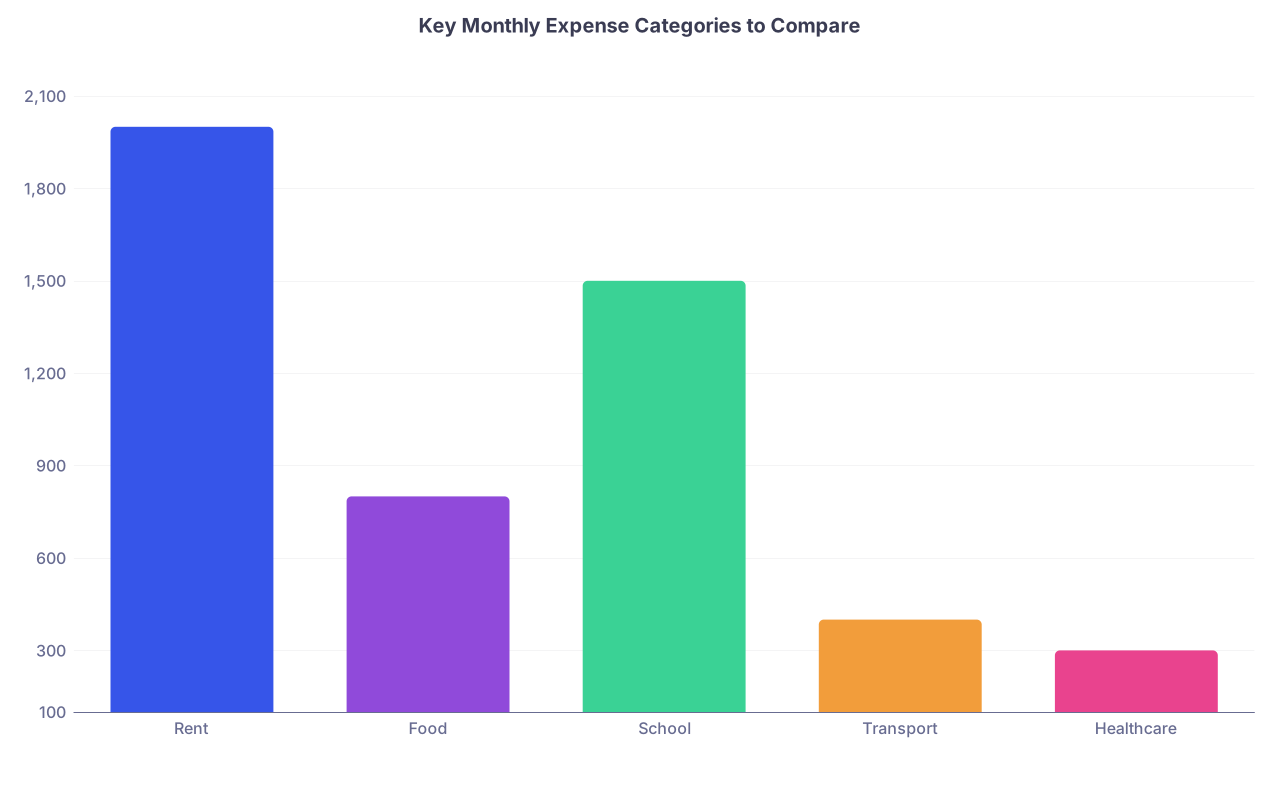
| Category | Value |
|---|---|
| Rent | 2000 |
| Food | 800 |
| School | 1500 |
| Transport | 400 |
| Healthcare | 300 |
(Those numbers are example categories—change them based on actual quotes from people on the ground.)
Stage 3: Pre‑Move Test (1–3 Months)
If at all possible:
- Do a 4–8 week “test run” in your top choice while:
- Your spouse keeps their remote job.
- You explore hospital visits, coworking spaces, apartments, neighborhoods.
You’re validating:
- Internet reliability.
- Daily routines.
- Time zone pain for meetings.
- Whether you actually like being there once the novelty wears off.
FAQ (Exactly 3 Questions)
1. I’m a US-trained physician. Is telemedicine from abroad actually feasible?
Yes, but with caveats. Many US telemedicine companies will insist you:
- Maintain US licensure and DEA where relevant.
- Be physically located in the US or at least not advertise that you’re outside, depending on their policy and insurer rules.
Some are fine with you being abroad as long as:
- Patient is in a state where you’re licensed.
- You’re documenting properly.
- Malpractice coverage explicitly allows providing care while physically outside the US.
You need to:
- Read your telemedicine contract carefully.
- Email them directly and ask, in writing, what their policy is.
- Ensure your malpractice and state boards don’t forbid cross‑border practice (some are vague, some are strict).
Do not assume it is allowed just because “everyone does it.”
2. How much savings rate should we aim for to make a move like this “worth it”?
If your goal is to change countries and accelerate financial independence, you should aim for:
- At least a 40–50% savings rate of combined net income once you’re settled, for a few years.
- That’s aggressive but realistic in UAE, Mexico, Thailand, or with a base + locum model.
If your goal is more lifestyle than savings:
- Even a 20–30% savings rate may be fine, especially if you’re escaping burnout or high‑stress environments.
- Just be honest with yourself. Lifestyle upgrade with zero savings is not “arbitrage.” It is just moving your problems somewhere warmer.
3. Should the physician or the remote spouse’s job drive the decision?
If you try to optimize for both equally from day one, you’ll paralyze yourself. Pick a primary driver.
- If your spouse’s remote job is extremely well paid and stable (e.g., $180k+ USD in tech/finance), I would let their time zone and legal/tax situation lead and then build your medical work around that with telemedicine or locums.
- If your clinical career is the bigger, more stable engine (e.g., you are a cardiologist with excellent offers in UAE or Singapore), then prioritize the best physician offer and treat the spouse’s job as portable as long as time zones and visas allow.
You can revisit this balance in 2–3 years. Careers change. But if you don’t pick a primary driver, you’ll end up with a country that’s mediocre for both of you.
Right now, while this is fresh, do one simple thing:
Open a blank document and write down three specific countries you’d realistically consider. For each, write:
- How I (physician) would earn money there.
- How my spouse would earn money there.
- One clear visa path we’d likely use.
If you cannot fill those three lines for a country, cross it off. Focus only on the ones where you can answer all three. That’s your real starting list.


