

The best cities for innovative clinicians are not the ones paying the highest RVUs. They are the ones where a morning clinic visit can turn into an afternoon product sprint with engineers in the same building.
Let me break this down very specifically. When I say “top MedTech ecosystem,” I am not talking about vague “tech-friendly” vibes. I mean places where you can:
- See real patients in real clinics.
- Walk (or bike) to startups building tools for those same patients.
- Sit on advisory boards, design pilots, join early clinical trials, or even co-found something yourself.
- Have a realistic path to equity, IP, and career movement that goes beyond “extra committee work.”
If you are a clinician who lights up at the idea of clinical work plus innovation, these are the cities where that life is actually possible—not theoretical.
What Actually Makes a MedTech Ecosystem “Good” for Clinicians?
Before naming cities, we need a diagnostic framework. Not “nice place to live,” but “fertile ground for clinician-innovators.”
Here is the minimum viable ecosystem:
Anchor academic medical center or large integrated system
You want:- Strong IRB and clinical research infrastructure.
- A tech transfer office that has signed more than 3 deals this decade.
- Established digital health pilots (remote monitoring, AI triage, etc.).
Local capital and startup density
Specifically:- Active health-focused VCs and angel groups.
- Seed and Series A deals actually closing in your city, not everything outsourced to the coasts.
- An ecosystem of “health tech” meetups, accelerators, and repeat founders.
Regulatory and data pathways that are not a nightmare
- EHR integration teams who have done this before (Epic and Cerner sandboxes, FHIR APIs).
- Legal/compliance departments who understand research protocols and pilots.
- Hospital leadership that has at least one C-suite title with “innovation,” “digital,” or “transformation” in it.
Culture: tolerance for experimentation and non-linear careers
- Clinically active faculty who also have titles like “Chief Medical Officer at [startup].”
- Contract structures that allow fractional FTE or protected innovation time.
- Residency/fellowship programs with “health tech” or “clinical informatics” tracks.
Now, which cities actually hit those marks?
To keep this organized, I will rank ecosystems along a few axes that matter to you as a clinician:
| Factor | Why It Matters for Clinicians |
|---|---|
| Academic/Health Anchor | Access to patients, pilots, and IRB |
| Startup Density | Opportunities for advisory or founding roles |
| Local Health Capital | Chance to scale beyond pilots |
| Data/EHR Openness | Feasibility of real-world validation |
| Lifestyle & Cost | Long-term sustainability of your career |
Now let us talk about where to actually go.
1. Boston–Cambridge: The Default Capital of Health Innovation
If you want density of serious health tech in one walkable area, Boston–Cambridge is still top of the pyramid.
Three reasons it dominates:
- Academic anchors: Mass General Brigham, Brigham and Women’s, Beth Israel Deaconess, Boston Children’s, Dana-Farber, MIT, Harvard. It is almost unfair.
- Biotech + digital + devices blended together: You are not just around “apps.” You are around real FDA-device work, AI diagnostics, genomics, and serious randomized trials.
- Venture money at scale: General Catalyst, Polaris, RA Capital, and a dozen others. Many have explicit digital health and medtech theses.
For a practicing clinician, what this looks like in real life:
You start out as a hospitalist or subspecialist at MGH. A postdoc from MIT shows up, asking for help validating an AI imaging algorithm. The project grows into a startup; you become their clinical lead and co-PI on a prospective study. Three years later, you are an Associate Professor with 0.8 FTE clinical, 0.2 FTE as part-time CMO for the now-Series B company.
That career path actually happens here. I have seen versions of it in oncology, radiology, anesthesiology, cardiology, and pediatrics.
Key features of Boston–Cambridge for clinician-innovators:
- Digital health accelerators: MassChallenge HealthTech, programs tied to MGH and Brigham, MIT’s Hacking Medicine ecosystem.
- Infrastructure: Strong informatics departments, dedicated innovation centers (like Mass General’s MGH Center for Innovation in Digital HealthCare).
- Industry proximity: Medtronic, Philips, and a constant parade of pharma/biotech partners looking to bolt digital products onto trials.
Downside: Cost of living is brutal; clinical comp sometimes lags relative to the West Coast for certain specialties. But if your goal is “I want 10 shots on goal in digital health within 5 years,” Boston is still extremely hard to beat.
2. San Francisco Bay Area: Where Tech Gravity Warps Healthcare
The Bay Area is where software DNA dominates, and healthcare is being forced to adapt around it.
Here, the center of gravity is not always the hospital. It is the startup.
Major nodes:
- Academic/clinical: UCSF, Stanford, Kaiser Permanente, Sutter, big IDNs.
- Tech giants: Google (Verily), Apple Health, Meta (Reality Labs, less clinical but influences haptics/AR), Salesforce.
- Digital-first health companies: Carbon Health, Forward, Omada Health, Virta, Livongo (now part of Teladoc), Notable, etc.
How clinician-innovation actually looks on the ground:
- You can be a 0.7 FTE primary care physician at a digital-first practice and spend 0.3 FTE building care pathways, product specifications, and clinical content for their app.
- Engineers and product managers are down the hall, not across the country.
- You get used to the language of “user stories,” “sprints,” and “release cycles” the same way you got used to SOAP notes.
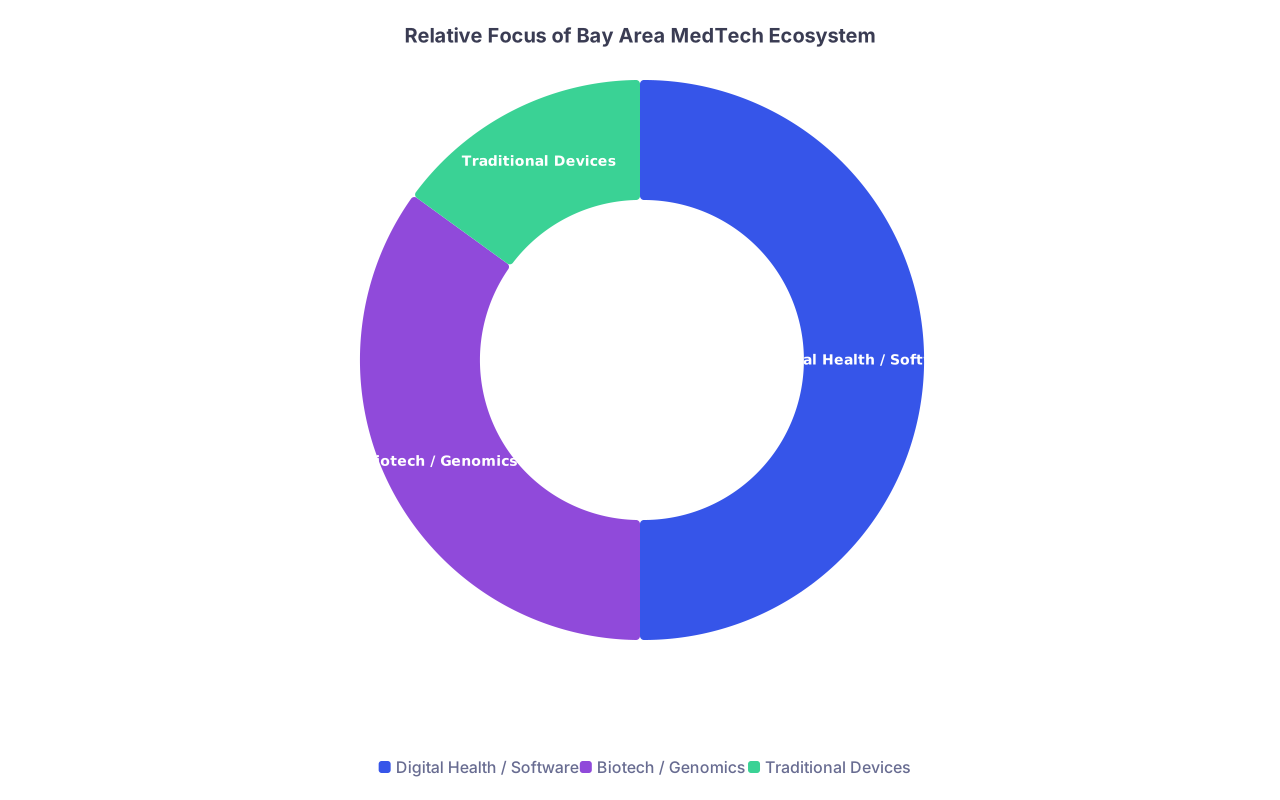
| Category | Value |
|---|---|
| Digital Health / Software | 50 |
| Biotech / Genomics | 35 |
| Traditional Devices | 15 |
If you want to sit between clinical medicine and product, this is your playground.
What the Bay Area does exceptionally well:
- Clinical–product integration: Many digital health companies have clinicians embedded from day one, not as late-stage validators.
- Comp structure: More equity-heavy roles, including clinician founders and first clinical hires with real cap tables.
- Regulatory sophistication: Repeated FDA interactions, many De Novo and 510(k) veterans, in-house regulatory teams.
The catch: Work-life balance and cost of living. Owning a house anywhere close to UCSF or Stanford on a pure clinician salary is a fantasy. Many clinicians here patch together:
- Core academic or group practice role.
- Advisory roles across 1–3 startups.
- Occasional brief consulting for venture funds.
If you like variety and you are comfortable with some chaos, there is no faster place to get “fluent” in health tech as a clinician.
3. New York City: Payers, Providers, and Policy in One Place
New York is not just hospitals and Wall Street. It is also a serious health tech hub with a different flavor: think care delivery innovation, payer-provider hybrids, and population health.
Anchors:
- Academic: NYU Langone, Columbia, Weill Cornell, Mount Sinai, Montefiore.
- Big systems and payers: Northwell Health, NewYork-Presbyterian, Oscar Health, UnitedHealth/Optum presence.
- Startups: Cityblock Health, Zocdoc, Ro, Flatiron (now Roche), K Health, Alma, Cedar, and a rotating roster of early-stage companies focusing on access, billing, behavioral health, and chronic care.
Why NYC matters for clinicians:
- Insurance and policy proximity: Many companies here sit at the payer–provider interface. If you want to impact reimbursement, alternative payment models, and value-based care, New York is where that conversation is constant.
- Diverse patient populations: Every digital health pilot has instant access to a wide range of demographics, languages, and disease burdens. This matters for real-world validation, not just AMIA poster sessions.
The clinician path here often looks like:
- You are a primary care, psych, or internal medicine physician in a large health system.
- You join a health plan’s advisory council for digital chronic care management.
- That leads to part-time work with a startup tackling Medicaid populations.
- Eventually, you shift to a leadership role in a value-based care startup, half clinical, half operational.
NYC’s edge:
- Deep bench of health plans and employer-focused benefits companies.
- Solid venture presence (e.g., Deerfield, a16z NYC presence, local funds focused on health).
- Strong city and state public health apparatus to plug into for scale.
Downside: Hospital bureaucracy can be glacial. Innovation teams inside big NY systems sometimes drown in internal politics. The trick is to pair clinical work in the big systems with external work in smaller, faster-moving startups.
4. Minneapolis–St. Paul: The Quiet Giant of Medical Devices
If you are more interested in hardware, implants, and serious regulated devices than apps, Minneapolis–St. Paul is massively underrated.
Corporate anchors:
- Medtronic (still the 800-pound gorilla).
- Boston Scientific (large presence).
- 3M Health Care.
- A constellation of device manufacturers and contract design firms.
Clinical anchors:
- Mayo Clinic (Rochester, a bit down the road, but tightly connected).
- University of Minnesota.
- Multiple large health systems with strong cardiology and surgery programs.
Here, the typical clinician-innovation path is not TikTok wellness apps. It is:
- You are an interventional cardiologist, electrophysiologist, or surgeon.
- You partner with an internal R&D team on a next-gen device concept.
- You lead first-in-human trials as a PI.
- You may spin out IP with the tech transfer office, co-developing a new catheter, lead, valve, or surgical tool.

This ecosystem is fantastic if:
- You care about FDA approvals, clinical trials, and robust clinical evidence.
- You enjoy long product cycles and deep partnerships with industry.
- You want to be a key opinion leader shaping how devices are used worldwide.
It is weaker if you want to do software-only, direct-to-consumer, or purely virtual care. But for device-heavy specialties—cardiology, EP, vascular, orthopedics, neurosurgery—Minneapolis–St. Paul is extremely high-yield.
Lifestyle: Better cost of living, stable health systems, and less churn than the coasts. You sacrifice some glamour, gain more tangible IP and trial work.
5. Houston: Clinical Volume Meets Space-Grade Engineering
Houston is where absurd clinical volume, serious engineering, and industry ties collide.
Core player: Texas Medical Center (TMC). It is not a hospital; it is an ecosystem: MD Anderson, Baylor College of Medicine, Houston Methodist, Texas Children’s, and more.
What makes Houston different:
- Sheer patient volume: If you want data and high-acuity cases, you will not run out.
- TMC Innovation Factory: There are formal programs specifically designed to pair clinicians with entrepreneurs and tech talent.
- Energy and aerospace engineering talent: Yes, it sounds like a cliché, but NASA, energy sector engineering, and manufacturing all create a deep bench of people who know how to build complex systems at scale.
Clinician-innovation here:
- Many are procedure-heavy specialists (surgical oncology, transplant, interventional, critical care).
- There is a strong pipeline for device and workflow innovation around OR, ICU, and oncology.
- TMCx and other accelerators give you structured routes to pilot and commercialize ideas from bedside frustrations.
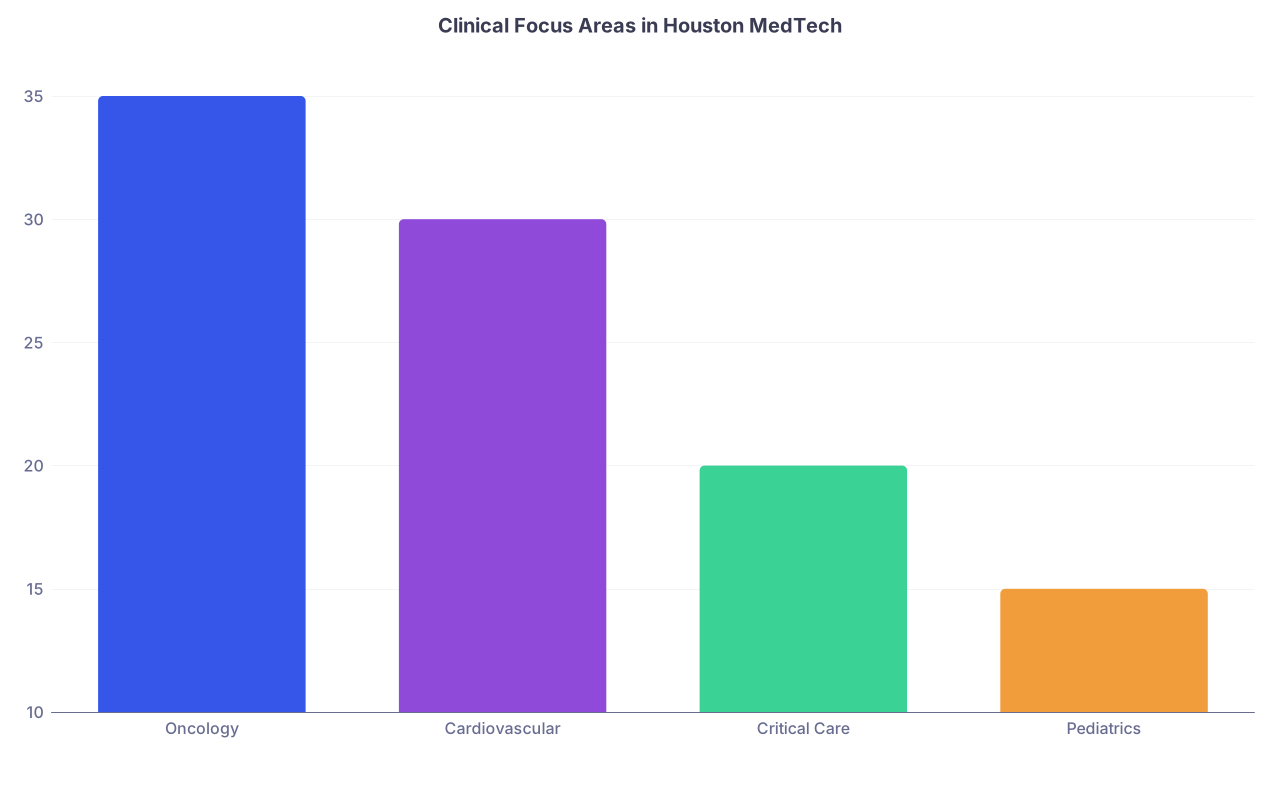
| Category | Value |
|---|---|
| Oncology | 35 |
| Cardiovascular | 30 |
| Critical Care | 20 |
| Pediatrics | 15 |
If you are the person who stares at a piece of equipment in the ICU and thinks, “This could be 10 times better,” Houston will give you both the users and the engineers to fix it.
Downside: Less dense software startup scene compared with SF/Boston. But the infrastructure and institutional support for clinician-inventors, especially in oncology and surgical disciplines, is extremely strong.
6. Seattle: Cloud, AI, and Integrated Care
Seattle’s power is the blend of big tech, integrated health systems, and AI/ML.
Anchors:
- Health systems: UW Medicine, Virginia Mason Franciscan, Swedish, multi-site private groups.
- Tech: Amazon (AWS, Amazon Care legacy impact, One Medical), Microsoft (cloud, AI, healthcare partnerships).
- Research: Fred Hutch, Allen Institute, strong bioinformatics communities.
For clinicians, the advantages are:
- Cloud-native health projects: Many health data platforms and AI tools are built on AWS or Azure, and those teams are here.
- Integrated care models: Groups like Kaiser (nearby regionally), Group Health legacy, and large multi-specialty groups experiment with digital-first pathways.
- AI experimentation: Imaging, NLP on clinical notes, predictive models for readmissions and sepsis.
This is a place where a hospitalist can:
- Participate in designing and validating a predictive model for deterioration.
- Work directly with data scientists who are embedded within the hospital system or co-located at a tech company.
- Spin that work into an external product with appropriate data governance and de-identification.
Seattle is strong for clinicians who:
- Enjoy data science, population health, and large-scale care optimization.
- Are comfortable speaking both “Epic report” and “SQL query.”
- Want to work on tools that can scale nationally through cloud partnerships.
It is weaker if you want heavy consumer marketing or a dense network of digital-health-only startups like SF. But for AI + clinical operations, it is a solid choice.
7. London & Berlin: Europe’s Serious Health Tech Hubs
You cannot talk about medtech ecosystems without recognizing that some of the most interesting clinical–innovation overlaps are in Europe, especially for those who care about regulatory nuance, privacy, and single-payer dynamics.
London
London benefits from:
- The NHS as both a frustration and an enormous sandbox.
- Leading centers like King’s College Hospital, Imperial, UCLH, and Guy’s and St Thomas’.
- Digital health companies like Babylon (turbulent, but influential), Ada Health (cross-border), and numerous smaller AI and telehealth startups.
Clinicians in London often engage via:
- NHS innovation fellowships.
- Academic Health Science Networks (AHSNs) that link hospitals, universities, and industry.
- Trust-based pilots of AI triage, remote monitoring, and patient-facing tools.
The upside:
- Large, relatively unified health system for scale.
- High-quality data sets, if you can get access.
- Strong policy and regulatory community presence.
The pain points: bureaucracy times ten, slower commercialization, and often lower direct financial upside for clinicians compared with the U.S. But if you care about population-wide change and rigorous regulation, London is a compelling base.
Berlin
Berlin brings:
- A thriving software startup culture and comparatively low cost of living (at least relative to London).
- Strong engineering talent, especially in SaaS, AI, and consumer products.
- Emerging health tech with digital therapeutics, remote care, and apps positioned within the German DiGA reimbursement framework.
Clinicians here often link via:
- University hospitals like Charité.
- Spinouts doing AI diagnostics, digital therapeutics, mental health, and chronic disease management.
- Cross-border EU regulatory frameworks.
Berlin is less dominated by big legacy health companies, which makes it friendlier to more radical software-first models.
8. Tel Aviv: Constant Experimentation, Small Geography
Tel Aviv punches far above its weight.
Strengths:
- Extremely dense engineering and cybersecurity talent.
- A long history of medical device innovation and now strong traction in AI imaging, remote monitoring, and digital therapeutics.
- A culture that is blunt, fast-moving, and very comfortable with risk.
Clinicians here tend to:
- Work in major hospitals (Sheba, Ichilov, Hadassah, etc.).
- Collaborate directly with founders on AI diagnostics, image analysis, and home monitoring tools.
- Participate in early-stage pilots that become products marketed globally.
For a clinician who wants short feedback cycles and does not mind some chaos, Tel Aviv is very high-yield. The ecosystem is outward facing, with many companies building for the U.S. and EU from day one.
9. Emerging Ecosystems in North America: Austin, Toronto, and Beyond
There are a few “next wave” cities that are not at Boston/SF density yet, but are very promising for clinician-innovators who want less saturated markets and more room to build.
Austin
Austin has:
- A growing tech scene, including many expats from big coastal companies.
- Dell Medical School, which was built with innovation baked in from day one: value-based care, design thinking, community health.
- A strong culture of startups, meetups, and cross-disciplinary projects.
This is ideal if you want to be early. You will not have 50 health tech companies knocking on your door, but you can quickly become one of the “go-to” clinicians for the ones that do exist.
Toronto
Toronto combines:
- Strong academic centers (UHN, SickKids, Sunnybrook).
- AI strength via the Vector Institute and University of Toronto.
- A growing digital health and biotech scene, plus proximity to U.S. markets.
A clinician here can get deep into machine learning in imaging, predictive analytics, or digital therapeutics with a slightly less cutthroat environment than SF/Boston.
| Category | Examples | Best For Clinicians Who... |
|---|---|---|
| Mature Hubs | Boston, SF Bay, NYC | Want density, many options, fast ramp-up |
| Device Hubs | Minneapolis–St. Paul, Houston | Love procedures, trials, FDA devices |
| AI/Data Hubs | Seattle, Toronto | Enjoy data science and predictive tools |
| European Hubs | London, Berlin | Care about policy, single-payer, DiGA |
| Fast-Rising | Austin, Tel Aviv | Want to be early, more influence |
How to Choose: Matching City to Your Clinical Profile
Now the hard part: choosing.
Your specialty, risk tolerance, and personality matter more than any “Top 10” ranking.
A few concrete matches:
Primary care / internal medicine / family med
- Best ecosystems: Bay Area, NYC, Austin, London.
- Why: Many companies focus on chronic disease, virtual primary care, value-based care, and care pathways where generalists shine.
Psychiatry and behavioral health
- Best ecosystems: NYC, SF Bay, Seattle, Berlin, Tel Aviv.
- Why: Tele-psych, digital therapeutics, and mental health apps are everywhere. You can be clinical lead, content architect, or medical director.
Cardiology, EP, interventional, vascular
- Best ecosystems: Minneapolis–St. Paul, Houston, Boston, Tel Aviv.
- Why: Strong device pipelines, remote monitoring, heart failure and arrhythmia tracking, procedural innovation.
Radiology, pathology, oncology
- Best ecosystems: Boston, SF Bay, Seattle, New York, London, Toronto.
- Why: AI diagnostics, imaging analysis, and precision oncology are hottest here with strong trial infrastructure.
Surgery (general, ortho, neurosurgery)
- Best ecosystems: Minneapolis–St. Paul, Houston, Boston, Tel Aviv.
- Why: Robotics, minimally invasive tools, navigation systems, and peri-op platforms all need real surgeons guiding design.

| Step | Description |
|---|---|
| Step 1 | Clinician |
| Step 2 | Minneapolis or Houston |
| Step 3 | SF Bay or NYC |
| Step 4 | Boston or Seattle |
| Step 5 | London or Berlin |
| Step 6 | Look for device trials and R&D roles |
| Step 7 | Join digital health startups or clinics |
| Step 8 | Integrate with informatics and AI teams |
| Step 9 | Engage with health system innovation arms |
| Step 10 | Primary Interest |
How to Actually Plug In Once You Are There
Moving to a city with a great medtech ecosystem is not enough. You need an entry plan.
Three very practical steps I have seen work repeatedly:
Pick your “anchor home” carefully
Your core clinical job should be:- At an institution with a visible innovation or digital health program.
- With leaders (Chair, Chief, Program Director) who have done industry work themselves.
- Clear on how much FTE you can allocate to non-clinical projects after year 1–2.
If the Chair says, “This all sounds nice, but our priority is RVUs,” you are in the wrong department, even in the right city.
Show up where tech people already are
Not grand rounds. Their spaces:- Local accelerator demo days (TMCx in Houston, MassChallenge in Boston, Plug and Play health events, etc.).
- Health tech meetups, product nights, hackathons.
- Cross-university innovation labs.
You are there not to pitch an idea on day one, but to listen, offer clinical reality checks, and become the “clinician who actually answers emails.”
Start with one deep collaboration, not 10 superficial ones
- Join one startup as a real partner: define product requirements, protocol details, workflow integration.
- Lead one pilot or trial that touches real patients, not just surveys.
- Get one tangible outcome: publication, poster, product launch, or regulatory milestone.
You build credibility in these ecosystems by shipping something that works. Not by collecting advisory titles on LinkedIn.

A Final Reality Check
One blunt truth: many “innovation” roles for clinicians are cosmetic. A token “Medical Director of Innovation” with no budget, no data access, and no protected time is a trap.
Cities with strong medtech ecosystems tend to expose that quickly. Because right down the street there is a startup actually shipping product and paying equity to the clinician who helped design it.
So your job, choosing among these cities, is not just to ask “Is there innovation here?” but:
- Does this city have enough critical mass that if my first role is a bust, I have 3 other serious options within a year?
- Are there visible clinician-innovators 5–10 years ahead of me with careers I would actually want?
- Is there a realistic path to doing both good medicine and good product work without burning out or going broke?
Boston, San Francisco, New York, Minneapolis–St. Paul, Houston, Seattle, London, Berlin, Tel Aviv, Austin, Toronto—each ecosystem answers those questions differently, but they all give you legitimate pathways if you play them correctly.
With those maps in your head, you are ready for the next step: designing your actual career architecture—how to structure your FTE, contracts, IP, and equity so you are not just “the helpful doctor in the room” but a true builder. That is its own conversation, and it comes after you choose your city.


