

The fantasy that “we’ll just match to the same city and everything will work out” is dangerously incomplete.
If you’re in medicine and your partner isn’t easily portable—or they’re in a super location‑dependent job—you’re probably already lying awake thinking: what if I match somewhere they literally can’t work? What if I drag them across the country for my training and destroy their career, our finances, and maybe our relationship in the process?
You’re not being dramatic. This is a real problem. I’ve watched it blow up relationships and crush people who honestly thought love + hard work would magically fix it.
But there are options. They’re just messier and more trade‑off‑heavy than anybody tells you on those cheerful “couples in medicine” panels.
Let’s walk through them without sugarcoating, so you can stop doom‑scrolling and actually make a plan.
First, name the fear: you’re scared your career will trap your partner
You’re not just worried about logistics. You’re worried about the power imbalance.
You: “Match decides my fate. Training is rigid. The hospital doesn’t care who my partner is.”
Them: “My industry has regional hubs / strict licensing / no remote option / family obligations here. I can’t just bounce around.”
You’re secretly asking:
- Are we about to become a one‑career household where mine eats everything?
- Are they going to resent me for years while I ‘follow my dream’ and they start over from scratch?
- If I don’t rank the best program because of them, am I sabotaging my training?
- If I do rank the best program and they can’t work there, am I sabotaging them?
That constant tug‑of‑war between “good doctor” and “good partner” is exhausting. You’re not crazy for feeling like there’s no “clean” option.
But here’s the uncomfortable truth: you’re not choosing between “perfect” and “bad.” You’re choosing between different flavors of sacrifice, and couples who do this well choose their sacrifices intentionally instead of hoping it’ll all sort itself out in March.
Step zero: brutally honest inventory of your partner’s job reality
Before you start gaming out rank lists and job searches, you need clarity on how movable your partner actually is. Not vibes. Facts.
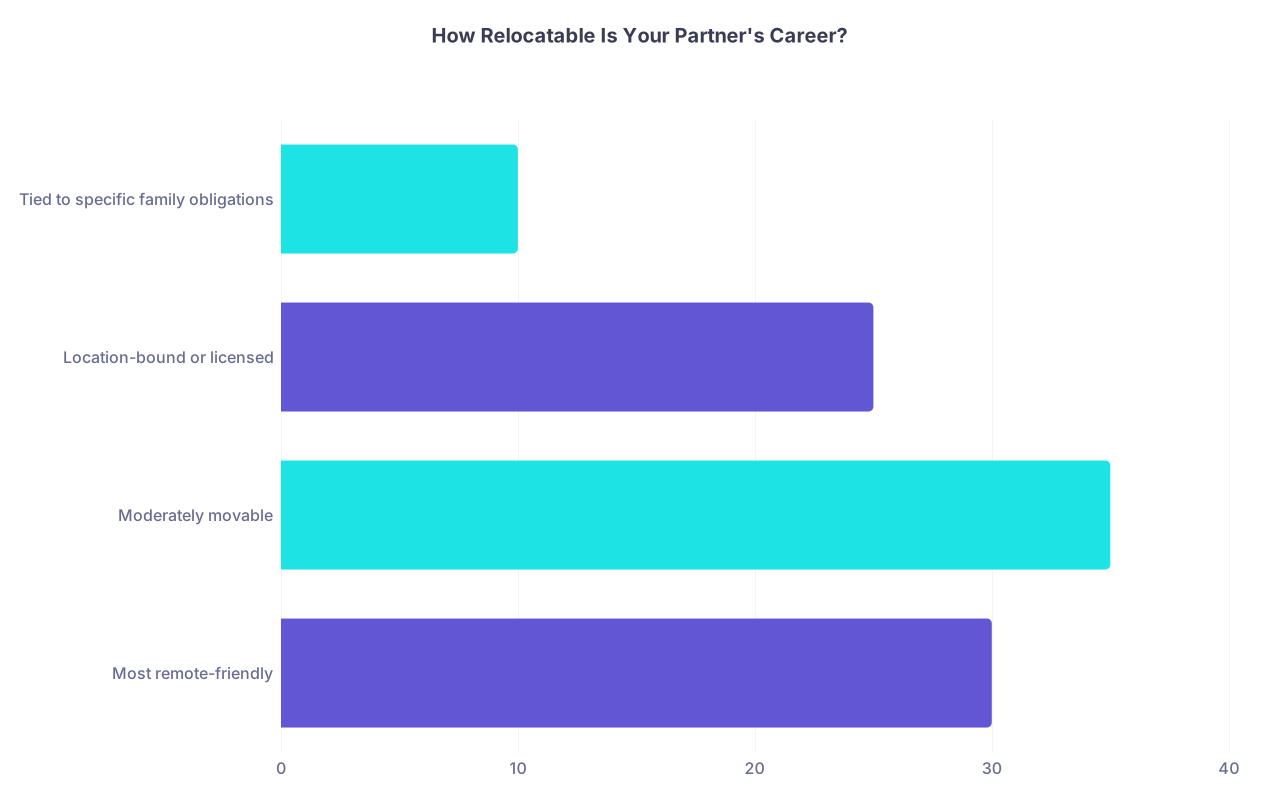
| Category | Value |
|---|---|
| Most remote-friendly | 30 |
| Moderately movable | 35 |
| Location-bound or licensed | 25 |
| Tied to specific family obligations | 10 |
I’d actually sit down and write out:
- What exactly are the hard constraints? Licensing? Union rules? Tenure? Kids? Immigration status? Family caregiving?
- Realistically, how long would a job search take in a new city?
- Worst‑case scenario: if they couldn’t work for 6–12 months, could you survive financially and emotionally?
- Are there remote or hybrid roles in their field that they haven’t fully explored because they never had to?
I’ve watched more than one person discover—under pressure of the Match—that their “totally location‑bound” partner actually could do 100% remote consulting or contract work, they just never had to think that way before.
On the flip side, I’ve also seen people badly underestimate how hard their partner’s licensing or job market will be in a new state. Especially teachers, therapists, lawyers, or highly specialized professionals.
You can’t pick smart options if you don’t actually know the constraints. Have the ugly, very specific conversation now, not after rank lists lock.
The big fork in the road: same city vs long‑distance
This is the first huge decision: are you structuring your life around being in the same place, or structuring around each of you having your best‑fit opportunities, even if that means distance?
Neither is “right.” Both hurt in different ways.

| Step | Description |
|---|---|
| Step 1 | Medical training location |
| Step 2 | Rank programs near partner job |
| Step 3 | Partner searches in match city |
| Step 4 | You match best program |
| Step 5 | Partner stays and you do distance |
| Step 6 | Same city priority |
| Step 7 | Career priority |
Option 1: Prioritize same city, accept some career compromise
This looks like:
- You rank programs more heavily where your partner can realistically work.
- They start job‑hunting in your potential match regions before Match (yes, with lots of “we don’t know yet but here’s the likely timeline” awkwardness).
- You might choose a solid but not elite name because it’s in a real job market for them.
The fear: “Am I tanking my career for them?”
Honestly? In most cases, no. Most residencies will train you well enough to be a competent, employable attending. The giant prestige leaps matter mainly for super‑competitive fellowships or academic careers at the absolute top tier. And even then, there are ways to recover (research, away rotations, networking) if you’re not at the “name” place.
But here’s where you need to be brutally honest with yourself:
If you are gunning hard for something like peds heme/onc at St. Jude or ortho at HSS or neurosurgery anywhere, you’re in a narrower lane. You can’t casually give up top programs without consequences. You can still prioritize cities with multiple strong institutions, but the trade‑off is sharper.
On the flip side, if you’re going into something like family, peds, psych, hospitalist‑heavy IM, EM (in most regions), you have more geographic flexibility. The “top‑5 shiny name vs strong regional program in a real city” decision is often not as catastrophic as it feels at 2 a.m.
Option 2: Prioritize ideal programs, accept possible long‑distance
This is the one people whisper about like it’s relationship death. It’s not. But it’s hard.
This usually means:
- You rank programs purely (or mostly) on your training fit.
- Your partner stays where their job/obligations are, at least initially.
- You accept that you might be flying or driving home on post‑call days and spending major life events on FaceTime.
I’ve watched couples make this work with strict rules: planned visits, non‑negotiable vacations, shared calendars, couples therapy on Zoom. I’ve also watched couples implode because they pretended distance wouldn’t change anything.
If your partner literally can’t move (elderly parents, custody agreements, a once‑in‑a‑lifetime job), this might be the least bad option. But you need to walk into it with your eyes open, not as a vague “we’ll figure it out.”
Concrete options if your partner can’t work where you train
Let’s talk scenarios. The real “what the hell do we do then” ones.
1. They switch to remote or consulting work
This is the most hopeful one. It’s becoming more common, especially post‑COVID.
- Tech/IT, design, some finance, marketing, data, writing, a lot of corporate roles: often can go remote or contract.
- Some lawyers shift to contract review work, compliance, or in‑house roles that allow hybrid or remote.
- Therapists/coaches often move online practice, if licensing cooperates.
The scary part is the transition. It’s uncertain, often a pay cut at first, and it can feel like they’re “giving up” status, benefits, or a clear ladder.
But I’ve seen couples do: “You do your brutal residency. I’ll step sideways into a more flexible but maybe less glamorous version of my career for these 3–7 years. Then we’ll reassess when you’re an attending and we have more leverage.”
That can work, if you both actually agree that this is a time‑boxed sacrifice and not “forever you’re the trailing spouse.”
2. They re‑license or retrain in your state… slowly
For teachers, therapists, social workers, lawyers, certain healthcare roles, the answer might be: yes, you can work there, but only after months of red tape.
That usually means:
- A planned gap (6–12 months) where they might be under‑employed: tutoring, part‑time, gig work, or taking a pay hit.
- You carrying more financial stress initially.
- Them taking the emotional hit of feeling “behind” or “starting over.”
Is this awful? It can be. Especially if they’ve built a strong career where they are now. This is where resentment can creep in: “I blew up my whole career for you to be a resident making 60k and never home.”
That’s why you need to make this trade explicit:
- What’s the realistic timeline for them to get back to full earning potential in the new place?
- What will you do, specifically, to share non‑financial burdens (housework, emotional labor) while they rebuild?
- How long are you willing to live on their reduced income before reconsidering location again?
3. They keep their job… and you do distance for a while
Sometimes the least bad option is not uprooting them at all.
I’ve seen couples do:
- PGY‑1 to PGY‑2 long‑distance, then reassess once you know the program, schedule, and city better.
- “You stay put until you get promoted/vested/finish this project. After that, you’ll look in my city or we’ll plan to meet in the middle as an attending.”
Key thing: long‑distance is not a free time warp. Those 3–5 years count. Career paths diverge, social circles change, habits form. You can definitely survive it—but not if you lie to yourself that it’ll feel just like living together.
If you pick this, treat your relationship like something that actually requires maintenance, not a background process.
Choosing your training city with your partner’s job in mind
Let’s be a bit strategic. Not all residency cities are created equal for partners.
| City Type | Examples | Partner Job Pros | Partner Job Cons |
|---|---|---|---|
| Major Coastal Hub | NYC, Boston, SF | Tons of industries, remote networking, dual‑career norm | Cost of living nightmare, visas/competition |
| Large Diverse Metro | Chicago, Houston, Atlanta | Broad job market, multiple hospitals, lower cost than coasts | Still competitive, traffic/commute strain |
| State Capital / University Town | Madison, Columbus, Raleigh | Government jobs, universities, healthcare | Fewer niche industries, may feel small |
| Smaller City With One Big Hospital | Rochester MN, Hershey PA | Great for you, limited other industries | Tough for location‑bound careers |
| Rural / Regional | Many community programs | Low cost, tight‑knit community | Very few professional options |
In plain language: if your partner needs a non‑healthcare job, big metros and state capitals are kinder. If they’re tied to academia or government, university towns and capitals have more on‑ramps. If they do something niche that only exists in 5 cities? You should probably admit that up front and not rank programs in the middle of nowhere above those hubs.
This is where “best places to work as a doctor” gets complicated. The “best place to train” for you (amazing clinical volume, prestigious name, strong fellowship pipeline) might be a terrible city for your partner’s field. And a “solid but not famous” program in a major metro might net the best combined outcome.
Money and resentment: the ugly part nobody talks about
The emotional disaster scenario usually has a money component. You’re exhausted, underpaid, and not home. They’re either:
- Unemployed or under‑employed in a new city.
- Supporting you on their income while you train.
- Making major sacrifices while your career slowly compounds and theirs stalls.
Resentment feeds on three things:
- Feeling like you didn’t have a real choice.
- Feeling unseen or unappreciated.
- Feeling like the sacrifice is indefinite.
You can’t magic this away, but you can be proactive:
- Make a shared financial plan. Not a vague “it’ll be fine.” A real spreadsheet.
- Name the sacrifices out loud. “I know you’re giving up X, Y, Z for me to do this training. I don’t see that as small.”
- Define review points. “We’re going to sit down every year and ask: Is this still working—for both of us?”
I’ve watched couples last who kept revisiting the deal. I’ve watched others blow up because one person assumed: “Once I’m an attending, you’ll just follow me anywhere forever,” and the other never signed up for that.
How this actually plays out over a career (not just residency)
Zoom out. This isn’t just a 3‑year or 5‑year puzzle. It’s the start of a whole pattern.
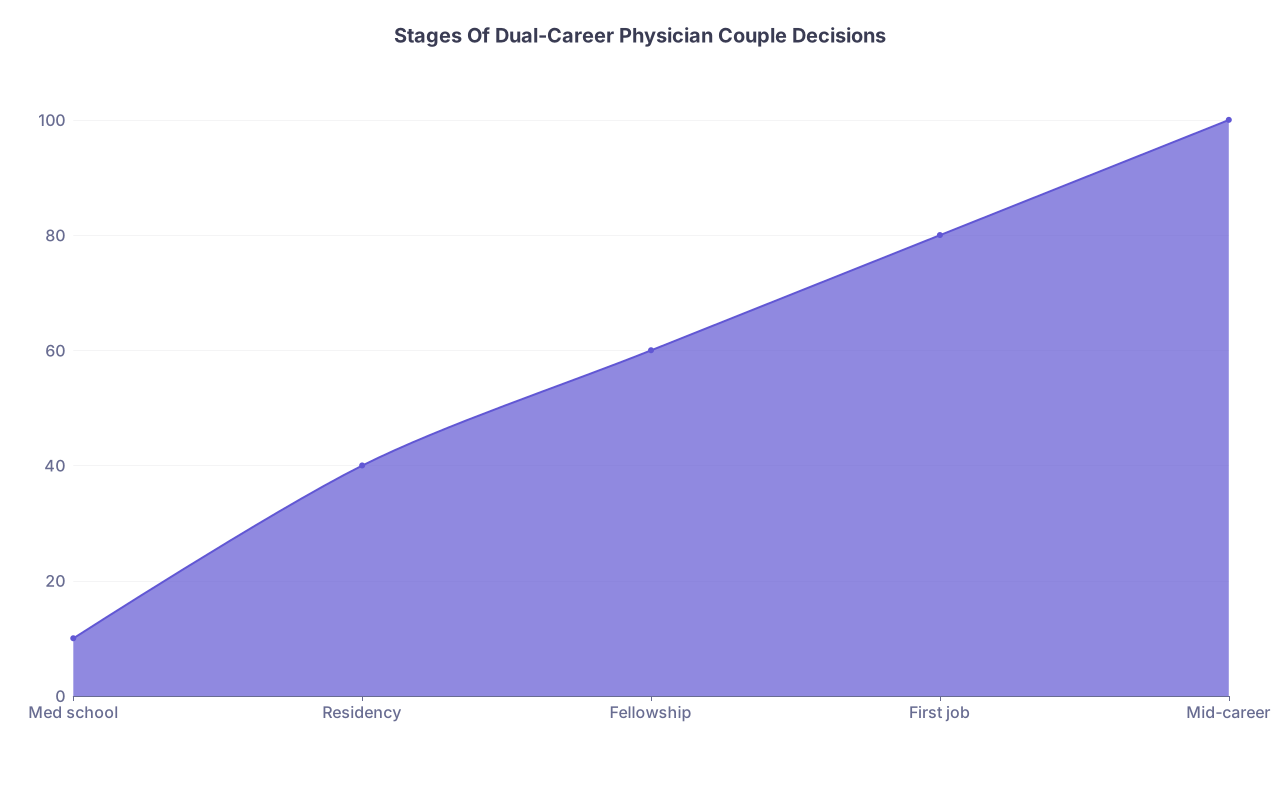
| Category | Value |
|---|---|
| Med school | 10 |
| Residency | 40 |
| Fellowship | 60 |
| First job | 80 |
| Mid-career | 100 |
You’re going to make some version of this choice over and over:
- Fellowship: do you chase the elite program in another state or stay put?
- First job: do you pick the higher‑pay but rural gig or the slightly lower‑pay but big city where your partner can actually work?
- Mid‑career: do you jump to an academic post across the country or stay where your partner’s finally built their network?
If your relationship survives and thrives, it won’t be because you nailed one big decision at Match. It’ll be because you two developed a system for deciding these things together.
Honestly? The couples who do best aren’t the ones who magically get two perfect jobs in one perfect city. They’re the ones who can say, “Okay, you got the better deal this round. Next round, we center you.”
Sometimes that means: “I did residency in your city. Now that I’m an attending with more options, I’ll look in your target markets.” Other times: “You downshifted your job to remote for my fellowship; when I’m done, I’ll target cities where your industry is strongest, even if they’re less sexy for me.”
You’re building a long game, not just surviving training.
Quick reality checks to keep you sane
If your brain is catastrophizing (mine always is), here’s what I’d remind you:
- You are not the first or last physician with a partner who can’t easily move. Programs have seen this before. It’s not a personal failing.
- There is no “perfect” solution where you both get 100% of what you want in the same zip code on the same timeline. Stop holding that as the standard.
- Choosing a program that’s slightly less shiny but in a real job market for your partner is not “ruining your career.” It’s being an adult with more than one priority.
- A period of distance does not automatically mean your relationship is doomed. It does mean you need plans, not wishful thinking.
- You can revisit these trade‑offs. You are not signing a lifetime contract with your PGY‑1 choice.
You’re scared of making The Wrong Move That Breaks Everything. That move does not exist. What exists are trade‑offs you own together vs trade‑offs that happen to you because you refused to choose.
What to actually do today
Not in five months. Today.
- Sit down with your partner and have the excruciating “how movable is your career?” talk—with actual details, not generalities.
- Make three buckets of cities: “good for both careers,” “good for one,” “bad for both.” Notice where your current program list falls.
- Pick your philosophy for this phase: Are we prioritizing same city or best training, knowing the realities? Say it out loud to each other.
Then open your rank list (or your prospective program list) and mark each program: green, yellow, or red for your partner’s job prospects.
FAQ (exactly 4 questions)
1. Should I ever sacrifice a clearly superior program just to be in a better city for my partner?
Sometimes, yes. If the difference is “top‑10 famous name vs strong, well‑respected regional program” and the latter lets your partner actually have a career instead of starting from zero, that can be a rational trade. Where I’d be more cautious is if you’re aiming for a hyper‑competitive subspecialty that genuinely depends on a small set of training hubs. In that case, you might decide this phase is your career‑heavy round, and you commit to centering their career in the next round (fellowship city or first attending job).
2. Is long‑distance during residency basically a relationship death sentence?
No. It’s hard as hell, but not automatic doom. I’ve seen couples make it for 3–5 years with strict structure: standing calls, scheduled visits, clear expectations about communication, and therapy when needed. Long‑distance fails when people treat it like a temporary inconvenience that doesn’t require new habits. If you go that route, assume it will change your day‑to‑day life and plan around that, not against it.
3. What if my partner is already resentful I’m “dragging them around” before I’ve even matched?
That’s a giant blinking warning light, not something to ignore. You need to pause and talk explicitly about whether they actually want this life with you. Not just “I support you in theory,” but: “I understand this means we may move, my career might bend, and I’m choosing that with you.” If they can’t say that—or you can’t accept their limits—it’s better to face that reality now than blow up halfway through PGY‑2 when both of you are exhausted and trapped.
4. How do I know if we should break up over this instead of trying to force it?
Look at patterns, not just geography. If every conversation about your future becomes a battle over whose career matters, if neither of you is willing to ever take a turn being the one who compromises, or if your visions of adulthood (kids? location? money? extended family?) are completely opposite, this isn’t a “city” problem. It’s a compatibility problem. Couples who survive this don’t agree on every detail, but they do share a basic story: “We’re a team. Sometimes your career leads, sometimes mine. We both know we’ll keep rebalancing over time.” If you can’t imagine ever saying that and meaning it, that’s your answer.
Open a blank document right now and write one paragraph about what you want your life to look like at 40—not just your CV. Then hand your partner the laptop and have them write theirs. Put those two paragraphs side by side. That’s the real conversation you need to have before you let a match algorithm pick your city.


