

What if you could keep practicing medicine, use most of what you already trained for in the US, and not drown in a 3‑year re-licensing marathon overseas?
Let’s go straight to it: some countries roll out a practical red carpet for US-trained doctors. Others smile politely, nod, and then tell you to basically redo residency.
You’re probably trying to answer a few concrete questions:
- Where will my US MD/DO + US residency actually be recognized?
- Where will I avoid redoing a full exam series / residency?
- Where can I work in English without being fluent in another language?
Here’s how this really breaks down.
The Shortlist: Easiest Countries for US-Trained Doctors
If you want countries that are relatively straightforward for US-trained physicians (MD/DO + US residency + board certification), these rise to the top:
- Canada
- Australia
- New Zealand
- United Arab Emirates (UAE) – especially Dubai/Abu Dhabi
- Qatar
- Saudi Arabia (for hospital-employed roles)
- Some Caribbean nations
- Singapore (for certain specialties and strong CVs)
“Easy” still means paperwork, exams, and delays. But these countries have:
- Clear pathways for US grads
- Established recognition of ACGME training
- Systems that actually recruit US physicians
Let’s get specific.
Canada: Familiar System, Painfully Slow Process
If you want something that feels like a parallel universe US, Canada is it.
Why it’s relatively easy
Training recognition:
- Royal College of Physicians and Surgeons of Canada (RCPSC) and College of Family Physicians of Canada (CFPC) both have pathways for US-trained physicians.
- Many US residencies are recognized as “substantially equivalent,” especially ACGME-accredited programs.
Language and culture:
- English-speaking (outside Quebec).
- Similar EMR usage, hospital structures, and malpractice culture.
Immigration:
- Physicians are on various provincial shortage lists.
- Provincial recruitment can sponsor work permits; some lead to permanent residency.
The catches
- Licensing steps are slow. 9–18 months from first contact to full practice is common.
- You may need:
- MCCQE1 (though some provinces waive exam requirements for experienced US specialists).
- Certification exams from RCPSC or CFPC if you want full consultant status.
- Provincial variation is huge. Ontario vs. British Columbia vs. Alberta = three different worlds.
| Factor | United States | Canada |
|---|---|---|
| Board recognition | N/A | Often accepts ACGME training |
| Exams required | USMLE/COMLEX | MCCQE, RCPSC/CFPC (often) |
| Process length | N/A | 9–18+ months |
| Language | English | English (French in Quebec) |
Bottom line: Canada is “friendly but bureaucratic.” If you want long-term relocation and are patient, it’s a top pick.
Australia: Probably the Cleanest Pathway for US-Trained Docs
If you asked me “Where is the cleanest structured path for a US-trained physician?” I’d say Australia.
Why Australia works so well
Clear comparability framework:
- Specialist Medical Colleges (e.g., RACP, RACS, RACGP) have pathways for “specialist international medical graduates.”
- US board certification + ACGME training is often classified as “substantially comparable” in many specialties.
Often no repeat residency:
- Instead of full residency, you may do:
- A supervised practice period (6–24 months), and
- Possibly a college exam or assessment.
- Instead of full residency, you may do:
English-speaking, high-income, solid healthcare system:
- Lifestyle is a major draw: major cities, beach towns, less insane RVU grind (in many settings).
Active recruitment:
- Rural and some urban areas actively recruit US/UK/Canada-trained doctors.
- Agencies exist that do only international doctor placement.
The tradeoffs
- Multiple layers:
- Australian Health Practitioner Regulation Agency (AHPRA) registration
- Medicare provider numbers
- College assessment
- Employer sponsorship / visa (often TSS visa)
- Timeframe: 9–24 months is realistic.
- You might accept lower pay initially during supervision, especially in public hospitals vs private work.
Still: in terms of fairness and transparency, Australia is one of the best.
New Zealand: Smaller Market, Similar to Australia
Think of New Zealand as Australia’s quieter cousin with similar rules but fewer jobs.
Why it’s attractive
- English-speaking, great lifestyle, less population pressure.
- Medical Council of New Zealand (MCNZ) recognizes many comparable training systems.
- Vocational registration for specialists can be granted based on US training plus some assessment and (sometimes) supervision.
Friction points
- Fewer positions. Small country, fewer hospitals.
- They favor applicants willing to work in regional/rural areas.
- Process can still be 6–18 months door-to-door.
If you’re okay with a smaller city or rural area and want work-life balance, New Zealand is very realistic.
Gulf Region: UAE, Qatar, Saudi – High Pay, Hospital-Driven
If your priority is income + relatively fast entry more than permanent immigration, the Gulf countries are worth a hard look.
Why the Gulf can be “easier”
Private and semi-private systems actively recruit US-trained docs:
- Cleveland Clinic Abu Dhabi
- Mayo Clinic affiliated centers
- Hamad Medical Corporation (Qatar)
- Large hospital chains in Dubai, Abu Dhabi, Riyadh, Jeddah
Recognition of US training:
- US ABMS board certification is highly valued.
- Often no need to redo residency; you sit their licensing exam (e.g., DHA/DOH/HAAD in UAE, SCFHS in Saudi, QCHP in Qatar).
English-speaking work environment:
- Day-to-day clinical work in major hospitals is largely English-based.
- Documentation and EMRs usually in English.
Compensation:
- Often tax-free or low-tax, with housing allowances, flights, education benefits.
The downsides
- You’re an expatriate worker, not on a typical Western permanent residency track.
- Lifestyle can be heavily dependent on exact city and hospital.
- Credentialing is paperwork-heavy and non-transparent at times.
- Licensure exams can be annoying but are usually passable for someone with solid clinical experience.
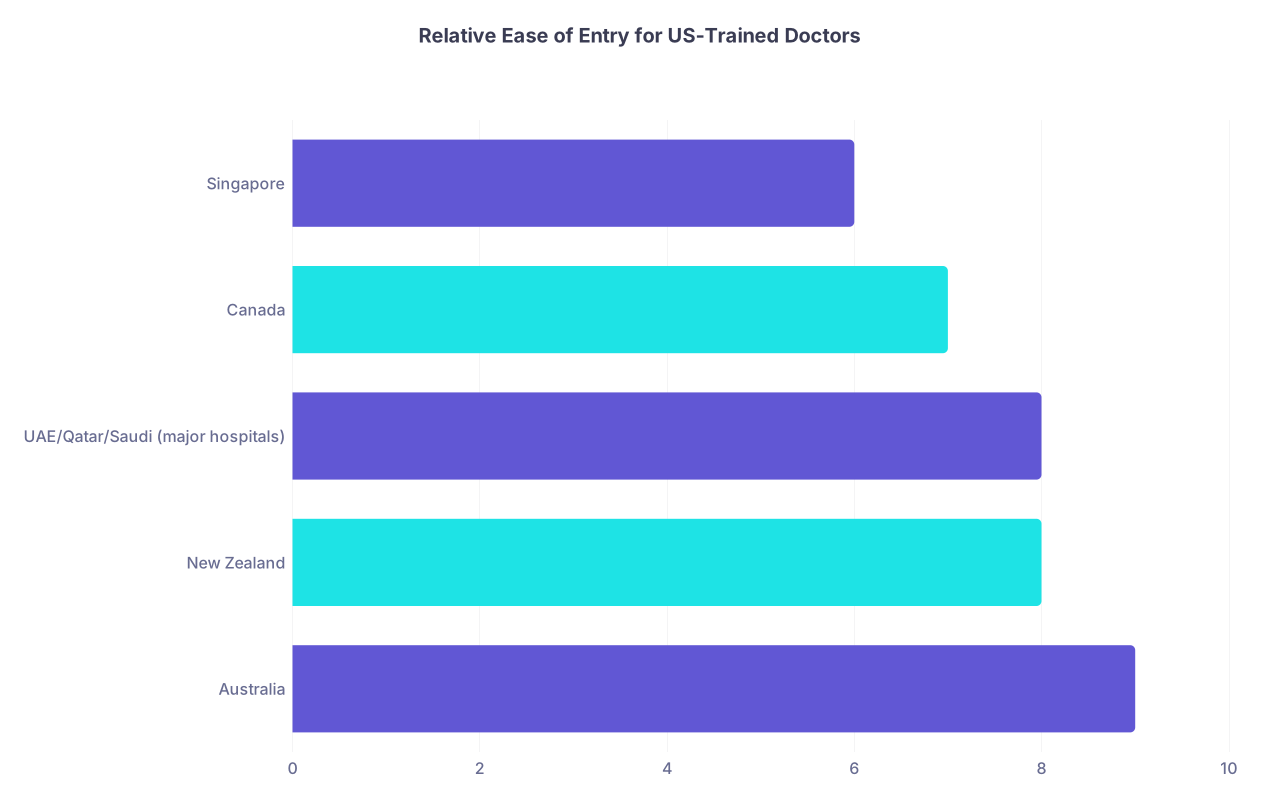
| Category | Value |
|---|---|
| Australia | 9 |
| New Zealand | 8 |
| UAE/Qatar/Saudi (major hospitals) | 8 |
| Canada | 7 |
| Singapore | 6 |
(Scale: 1 = nearly impossible without retraining; 10 = clear, structured pathway that respects US training.)
Singapore: Great System, But Selective
Singapore is attractive: English-speaking, high standard of care, safe, efficient.
But: the door isn’t wide open.
Where Singapore works for US docs
- The Singapore Medical Council has specific lists of “recognized basic medical qualifications” and recognizes certain training institutions and boards.
- US-trained specialists from top programs (especially in-demand specialties) with strong academic/clinical CVs can get conditional and then full registration.
- You’re more likely to succeed if:
- You’re in a shortage area (e.g., some internal medicine subspecialties, anesthesiology, certain surgical fields).
- You’re willing to join public sector first (NUH, SGH, etc.).
The challenges
- Highly competitive. They don’t need to import large numbers of doctors.
- You may be offered more junior titles than your US role.
- Paperwork/committee approval is slow and opaque.
Worth pursuing if you’re high-performing, academic-leaning, and flexible.
Caribbean & Smaller English-Speaking Jurisdictions
A bunch of smaller countries, especially in the Caribbean and some island nations, will accept US training relatively easily. Think:
- Bahamas
- Cayman Islands
- Bermuda
- Some OECS countries (e.g., St. Lucia, Antigua)
- Some Gulf of Mexico / Atlantic territories
Why they’re easier
- Many are used to US-trained doctors staffing hospitals and clinics.
- US board certification + clean license + a job offer often gets you in.
- Work is largely in English, often in private or semi-private setups.
Limitations
- Small markets = few jobs.
- You may end up in a niche/private role with heavy dependence on one employer.
- Long-term career pathways (academia, large health systems) are limited.
This can be ideal for someone wanting a lifestyle move rather than a big-system academic career.
Countries That Are Much Harder (Even If They Look Appealing)
Let’s call out where US docs routinely underestimate the pain.
European Union (especially Western Europe)
Germany, France, Italy, Spain, Netherlands, Scandinavia – amazing places to live. But:
- Language: you usually need fluent local language for licensing and patient care.
- Degree recognition: US MD/DO often doesn’t line up cleanly with EU directives for medical qualifications.
- Training mismatch: Your residency may not be recognized at the specialist level. People get dumped into “assistant doctor” roles or partial retraining.
- Exams and paperwork are extensive.
You can do it. It’s just not remotely “easy” in the usual sense.
United Kingdom (post-Brexit reality)
The UK used to be an easier target: PLAB, GMC registration, maybe CESR for specialists.
Now it’s messier:
- GMC is more restrictive with specialist registration via CESR.
- Training compatibility isn’t always acknowledged.
- Visa policies and NHS pressures make the system more chaotic.
If you’re family medicine / internal medicine and early in your career, it’s not impossible. But it’s nowhere near as straightforward as Australia or the Gulf.
How to Decide Where You Actually Have a Shot
Don’t start with “Which country looks cool?” Start with:
What’s your current status?
- Board certified? Board eligible?
- Specialty? (Some are far more portable than others: FM, IM, anesthesia, EM travel better than very niche subspecialties.)
Do you need:
- Long-term immigration and citizenship potential?
- Or a 3–5 year adventure?
Language limits:
- If you only want to work in English, that cuts most of continental Europe out instantly.
Risk tolerance:
- Are you okay doing a year of supervised practice at slightly lower pay?
- Would you tolerate being “registrar” level with less autonomy?

| Step | Description |
|---|---|
| Step 1 | US-Trained Doctor |
| Step 2 | Consider EU and non English countries |
| Step 3 | Canada or Australia or New Zealand |
| Step 4 | UAE Qatar Saudi Caribbean Singapore |
| Step 5 | Research specialty pathways |
| Step 6 | English Only? |
| Step 7 | Wants Permanent Immigration? |
If you want:
- Permanent relocation + English + decent match to US training:
→ Australia, New Zealand, Canada
If you want:
- High income + faster entry + don’t care about permanent residency:
→ UAE, Qatar, Saudi (major hospitals), select Caribbean nations
If you want:
- Elite, small, hyper-organized system and you have a strong CV:
→ Singapore
Practical Steps to Start (Without Wasting 12 Months on Fantasy)
Pick 1–2 target countries maximum initially.
Go directly to:
- National medical council website (AHPRA, MCNZ, RCPSC, etc.).
- Relevant specialty college (RACP, RACGP, RCPSC, CFPC, etc.).
- Official licensing authority (DHA/DOH/QCHP/SCFHS in the Gulf).
Email or call and ask:
- “I’m a US-trained [specialty], [years experience], ABMS-certified. Which pathway applies to me specifically?”
Talk to someone who’s done it:
- LinkedIn, specialty Facebook groups, physician relocation forums.
- Ask what actually happened vs what the website promised.
Be realistic about timing:
- Assume 12–24 months from “I think I want to move” to actual first day seeing patients.
- Start exams, document gathering, and reference letters early.
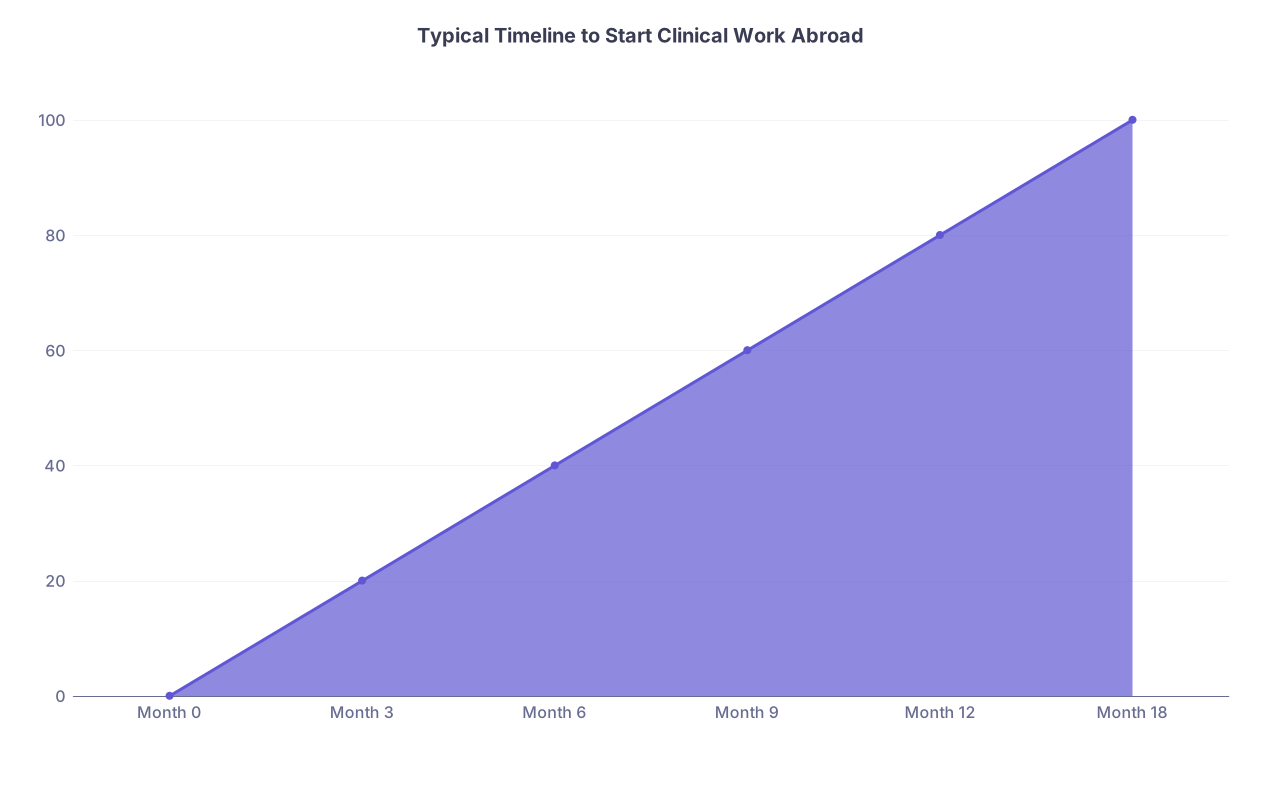
| Category | Value |
|---|---|
| Month 0 | 0 |
| Month 3 | 20 |
| Month 6 | 40 |
| Month 9 | 60 |
| Month 12 | 80 |
| Month 18 | 100 |
(Think of that progression as percentage of the process completed. Most of the visible progress happens late.)
Key Takeaways
- The most realistic “easy-ish” destinations for US-trained doctors: Australia, New Zealand, Canada, Gulf states (UAE/Qatar/Saudi), select Caribbean nations, and sometimes Singapore.
- “Easy” still means exams, paperwork, and 9–24 months of process. But these systems actually recognize US training and actively recruit.
- Don’t chase fantasy: match your specialty, language comfort, and immigration goals to a country’s real pathways, not its tourism ads.
FAQ: Working Abroad as a US-Trained Doctor
1. Do I need to redo residency if I move abroad as a US-trained doctor?
Often no, if you pick the right countries. In Australia, New Zealand, and many Gulf states, US residency + board certification usually leads to a supervised practice period and/or local college assessment rather than full retraining. In much of continental Europe, you’re more likely to face partial or full retraining or downgraded positions.
2. Is Canada or Australia easier for US-trained doctors?
Australia generally has a clearer, more structured specialist assessment pathway and is often more flexible about recognizing US training as “substantially comparable.” Canada is very doable but slower and more fragmented by province, and you may have to take Canadian exams and go through Royal College/CFPC certification. If you want clarity and structure, I’d lean Australia; if proximity to the US and long-term immigration matter more, Canada competes strongly.
3. Can I work abroad right after US residency, or should I get a few years of experience first?
You can go straight after residency, but you’ll have more leverage and an easier time with specialist recognition if you have 2–3 years of post-residency practice and board certification. Many colleges and employers abroad explicitly prefer or require board-certified, not just eligible, physicians.
4. Will I earn as much abroad as in the US?
It depends. Gulf hospital jobs often match or exceed US take-home income when you factor in taxes and benefits. Australia and Canada can be lower on paper than high-earning US private practice, but often come with better work-life balance and less burnout. Caribbean and island roles vary widely and can be modest but come with lifestyle perks. Don’t assume US-level income; run actual numbers with tax and cost of living.
5. What specialties travel best internationally?
Family medicine, internal medicine, anesthesia, emergency medicine, general surgery, pediatrics, and some IM subspecialties travel the best. Hyper niche or highly procedurally dependent subspecialties (some interventional fields, certain advanced surgical subspecialties) can be harder because of infrastructure, procedure volume, or local training differences. But it always comes down to that specific country’s shortage list and college policies.
6. How do I avoid getting stuck in a dead-end or exploitative job abroad?
Do three things: first, talk to at least 2–3 physicians already working in that country and in that institution type (public vs private). Second, insist on a written contract with clear salary, on-call expectations, leave, CME allowance, and termination terms before you move. Third, start with a time-limited contract (2–3 years), keep your US license and board certification fully active, and mentally treat the first stint as a test run, not a one-way door.


