What happens when you realize it’s February, your board exam is in six months, and your “protected” research year has quietly turned into three projects, two grants, and endless revisions?
If you’re in an out-of-track research year and trying to prep for boards, you’re in a weird no-man’s land. You’re not in the clinical grind anymore, but you’re also not a full-time student. Your friends on the regular track are studying together. You’re on Zoom calls arguing about sample sizes and IRB language.
This can go very well. Or very badly. I’ve seen both.
Let’s walk through how to do this deliberately so you do not end up the person who says, “I’ll just knock out boards during my research year,” then fails because the clinical rust + lack of structure ambushed you.
Step 1: Get Honest About Your Board Risk Profile
You cannot plan this year until you admit which bucket you’re in.
| Profile | Prior In-Training | Test Anxiety | Self-Study History |
|---|---|---|---|
| Low Risk | > 75th percentile | Low | Strong |
| Moderate Risk | 25–75th percentile | Moderate | Variable |
| High Risk | < 25th percentile or failed | High | Weak |
Here’s the blunt version:
- Low risk: Solid ITE scores, passed Step/Level on first try with margin, generally good at standardized tests.
- Moderate risk: Middle-of-the-pack ITE, Step/Level OK but not amazing, studying tends to be inconsistent.
- High risk: Below-average ITE, borderline Step/Level or prior fail, high anxiety, or you’ve always needed more time to prep.
If you’re high risk and you treat this like a casual “I’ll do some questions when I can,” you’re gambling with your board certification.
So:
- Pull your last 2–3 ITE reports.
- Look at percentiles, not raw scores.
- Note any red-flag domains (e.g., cardio, ICU, OB, neuro).
- Decide your risk tier. No wishful thinking.
Then tie that to a minimum question volume and resource plan. For example:
- Low risk: 3,000–4,000 board-style questions + one full pass of a high-yield review resource.
- Moderate risk: 5,000–6,000 questions + full content review of weak areas + 2–3 practice exams.
- High risk: 7,000+ questions + structured content course or board review + frequent practice exams and remediation.
You’ll fit that around research, not the other way around.
Step 2: Design a Year Plan Before Your PI Designs It for You
You probably already know this: research expands to fill every available minute. PIs are not thinking about your boards. Some barely remember you have to take an exam at all.
You need a macro plan for the year:
- Board exam month (or latest possible test window you’re comfortable with)
- “Heavy research” seasons (grant deadlines, abstract submissions, major data pulls)
- Personal life anchors (weddings, moving, family events) that might explode your schedule
Lay it out over 12 months, even if it feels obsessive.
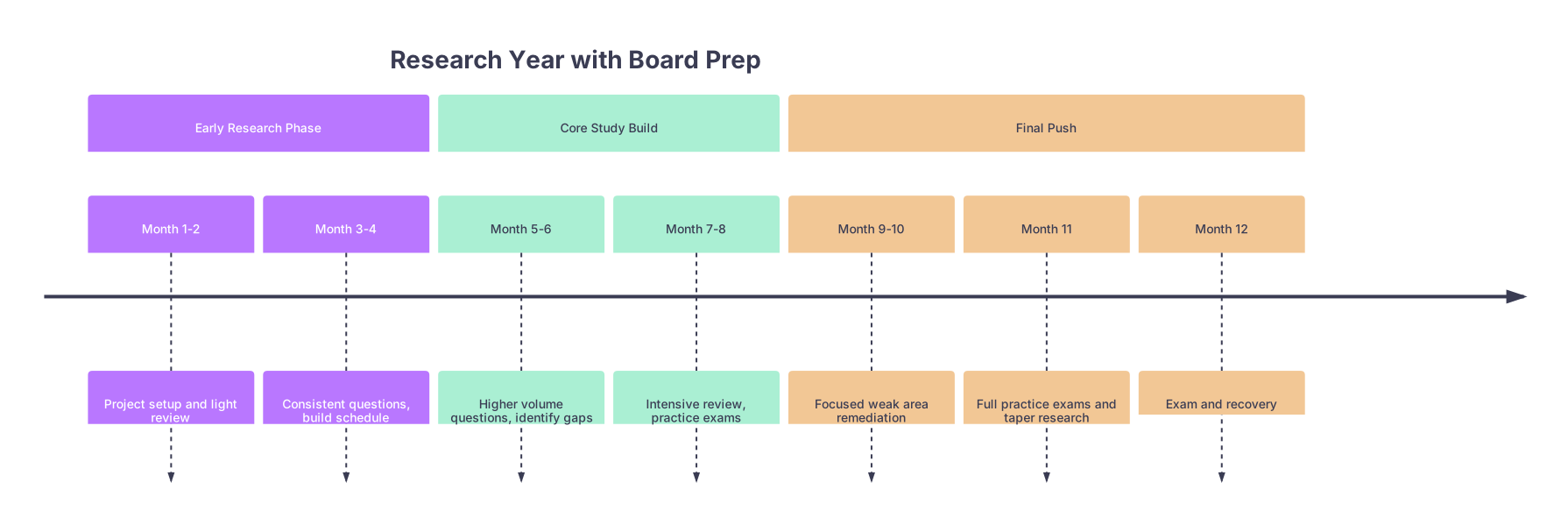
| Period | Event |
|---|---|
| Early Research Phase - Month 1-2 | Project setup and light review |
| Early Research Phase - Month 3-4 | Consistent questions, build schedule |
| Core Study Build - Month 5-6 | Higher volume questions, identify gaps |
| Core Study Build - Month 7-8 | Intensive review, practice exams |
| Final Push - Month 9-10 | Focused weak area remediation |
| Final Push - Month 11 | Full practice exams and taper research |
| Final Push - Month 12 | Exam and recovery |
Then convert that into non-negotiables:
- Board date range: Block off a 4–6 week window where research demands must be lighter.
- Protected days: At least 1 half-day per week that is sacrosanct for board prep. Yes, even in research year.
- Study sprint blocks: 2–3 periods in the year (3–4 weeks each) when you temporarily turn up the study volume.
If you don’t define these, your research team will casually schedule a “quick data meeting” every time you plan to do questions.
Step 3: Build a Weekly Template That Survives Reality
You do not need a minute-by-minute plan. You need a template that can take a punch and still stand.
A reasonable baseline for a research year (full-time research, no clinical):
- 40–45 hours/week research
- 10–15 hours/week board prep
- 1 day off
If you’re high risk for failing, bump the study side up toward 15–20 hours most weeks.
Here’s what a workable week might look like:
- M–F:
- Morning (8–9): 20–25 board questions + quick review
- Daytime: Research work
- Early evening (5:30–7): 60–90 minutes of review or more questions 3 days/week
- Sat:
- 3–5 hours of consolidated board study (mix of questions, reading, and practice).
- Sun:
- Off or very light (20 questions + Anki, then done)
The key mistake people make: they put board study only on weekends and “if I have time” after research. You’ll never “have time.”
You put board blocks in first, then you fit research around it. Like clinic days.
Step 4: Choose Board Resources That Match a Rusty Brain
You’re not in the hospital. You’re not seeing bread-and-butter cases every day. Your recall will degrade faster than you think.
So your resource stack needs to:
- Rebuild fundamentals
- Simulate the board format
- Keep your clinical reasoning alive
For most specialties, that means:
- Primary question bank (the big one everyone uses for your boards)
- Secondary question bank or practice set (if you’re higher risk)
- One main review text/video series (not five)
- Maybe spaced repetition (Anki or similar) if you’re already used to it
Then you do something most people skip: tie your board studying to your research topics when you can.
Working on an ICU outcomes project? Fine. That week:
- Do ICU/critical care sections in your question bank.
- Watch the relevant review videos.
- Read one clinical guideline paper tied to concepts that show up on boards.
That way, the domain you’re reading about for research is also being reinforced for boards. You’re stacking, not splitting.
Step 5: Put Your PI and Program on Notice (Nicely)
You need to say the quiet part out loud: “I am taking my boards during this research year, and I need protected bandwidth.”
Bad version: staying silent, then panicking two months before the exam.
Better version: having explicit conversations early.
You should:
Talk to your program director or APD:
- Confirm the expected exam window.
- Ask what other residents have done successfully in prior research years.
- Clarify if there is any formal protected time for exam prep (some programs will give 1–2 weeks).
Talk to your research mentor/PI:
- “I’m planning to sit for my boards in [month]. I’ll be steadily studying throughout the year, but I’d like to reduce major deadlines and long days for about 4 weeks before the exam. Can we front-load some of the intensive work?”
Put it in email:
- Not as a demand. As a clear plan: “Here’s how I’m organizing my year: boards in [month], intensive prep in [specific weeks], and I’ll aim to hit [research milestones] before then.”
If you never say this, your PI WILL schedule a 3-week analysis crunch the exact month you wanted to take vacation and study.
Step 6: Fight Clinical Rust On Purpose
This is the sleeper problem that catches people:
- You stop pre-rounding.
- You stop writing notes.
- You stop seeing patients.
- Nine months later, you’re staring at questions about pneumonia and DKA and thinking, “I used to know this…”
You’re not weak. You’re deconditioned.
So you build “clinical maintenance” into your year:
- Read one case-based review article per week (e.g., NEJM CPC case, specialty journal case reviews).
- Attend at least 1–2 clinical conferences or M&Ms per month, even as research.
- If allowed, do intermittent clinic sessions or call shifts (within reason, not to the point that they destroy your study time).
And for board prep specifically:
- Do timed blocks, not just tutor mode.
- Force yourself to reason through management steps (“What would I actually do next?”), not just answer recall.
- After a block, for questions you missed, ask: “If I saw this on the floor, what would I actually order/do?” This re-ties the abstract question to a real patient.
Step 7: Handle the Big Peak: The 8–12 Weeks Before Exam
Let me be direct: this period needs to be different. You cannot keep doing “10–15 questions a day” and then suddenly show up ready for boards.
You want a ramp-up phase:
About 3 months out:
- Increase to 40–60 questions/day on most weekdays.
- Add 1 longer block (40–60 questions timed) every week.
- Do one structured content review pass through your weakest systems.
About 6–8 weeks out:
- 1 full practice exam every 1–2 weeks.
- At least one day per week that’s majority board study (e.g., Saturday: 4–6 hours).
- Begin tapering optional research tasks: say “no” to extra analyses, new side projects, last-minute additions.
Final 2–3 weeks:
- You want research to be at 50–70% volume, not 100%.
- Board study should be your primary day-structuring activity, with research fit around it.
- Prioritize:
- Practice exams
- High-yield review of wrongs / weak topics
- Sleep, exercise, and simulated test days
If your PI is still dropping “Can we just squeeze in one more aim?” on you during that last month, you waited too long to set boundaries.
Step 8: Protect Your Brain From Research Burnout
The dirty secret: research years can wreck your focus in a different way. Endless Zooms. Slow feedback loops. The dopamine hit of “refreshing email” instead of focusing on studying.
Common traps:
- “I can’t study until I finish this draft.” (You never finish the draft.)
- “I’m already on my laptop all day; I’ll just study after.” (Your brain is fried.)
- “Let me just check this one email before I start this question block.” (Forty minutes gone.)
Concrete fixes:
- Physically separate board study from research:
- Different browser profile or laptop for questions.
- Different workspace if possible (even a different corner of the room).
- Fixed study start times:
- Example: questions start at 8:00 a.m., no matter what.
- Or: post-lunch 1–2 p.m. is always protected study, then back to research.
- No-email rule during question blocks:
- Airplane mode or website blocker.
- You do one thing: answer questions and review.
And if you notice this pattern—opening the question bank, then immediately flipping to something “urgent”—you have to treat that like a problem to fix, not “just how I am.”
Step 9: Use Metrics Instead of Vibes
You’ll feel like you’re studying “a lot.” That feeling is useless.
Track:
- Total questions completed
- Cumulative percent correct (per topic if available)
- Time per block
- Practice exam scores
Then tie that back to your risk tier.
If you’re:
- High risk and still under 50–55% correct halfway through the year → you need help now (tutor, formal review course, more hours).
- Moderate risk sitting around 60–65% and trending up → probably fine, but tighten up your weak systems.
- Low risk cruising >70% with decent practice exam scores → maintain and don’t get complacent.
You want your last 4–6 weeks to look roughly like:
- You know exactly which 2–3 domains are weakest.
- You have a specific plan to hit them (e.g., 500 cardio questions + 5 hours of dedicated cardio review).
- You’ve taken at least 2–3 full-length, timed practice exams in a realistic environment.
If you’re guessing about your readiness in the final month, you didn’t track enough.
Step 10: If You’re Already Behind, Triage Now
If you’re reading this and thinking, “I’m six months into research year and I’ve done… 300 questions,” you’re not alone. But you don’t get out of the consequences with guilt.
You do this instead:
- Calculate realistic weekly capacity from today to your exam (how many hours, honestly?).
- Translate that into total possible questions and review hours.
- If that total is not enough for your risk tier, something has to give:
- Push the exam to a later window if allowed.
- Reduce research commitments (delegate tasks, step off that extra side project).
- Add weekday evening or early-morning blocks.
- Consider external structure:
- A board review course with a schedule.
- Study partner or small group with shared goals.
- Check-ins with chief/residency leadership if you’re at real risk of failing.
Do not wait until you fail the boards once “to see what happens.” A fail during or right after research year complicates everything: remediation, delayed promotion, extra pressure when you’re back on service.
Quick Comparison: Research Year vs Clinical Year Board Prep
| Factor | Research Year | Clinical Year |
|---|---|---|
| Time Flexibility | Higher | Lower |
| Clinical Exposure | Lower | Higher |
| Risk of Rust | High | Moderate |
| Need for Structure | Very High | High |
| Main Threat | Research creep | Service load |
The irony: research year gives you more theoretical time but demands much more self-control. In clinical year, your day is structured for you. In research year, if you do not build your own rails, you drift.
Visual: How Your Time Might Actually Break Down
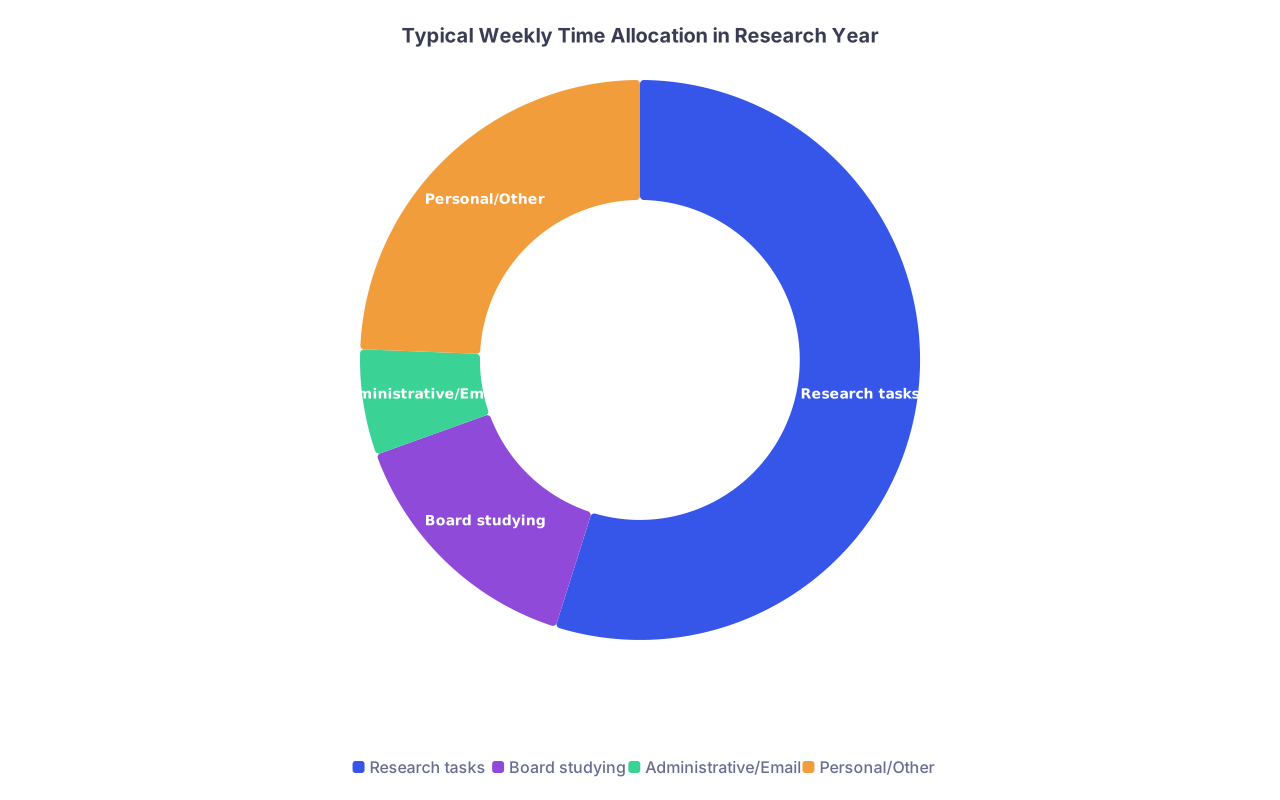
| Category | Value |
|---|---|
| Research tasks | 45 |
| Board studying | 12 |
| Administrative/Email | 5 |
| Personal/Other | 20 |
If you don’t deliberately give board studying a clear slice, “Research tasks” and “Admin/Email” quietly eat it alive.
FAQ (Exactly 3 Questions)
1. Should I take my boards early in the research year or later?
If your clinical skills are already decent and you’re coming directly off wards, taking boards in the first 3–4 months of your research year can be a smart move. Your clinical recall is fresh, and research hasn’t fully expanded yet.
If your ITEs are weak or you barely passed prior exams, you probably need more time to rebuild fundamentals. In that case, it’s safer to take the boards midway to later in the year, but only if you commit to a structured, high-volume plan early. What you cannot do is push the exam late and then “decide to get serious” in the last six weeks.
2. Can I realistically do a big research push and serious board prep at the same time?
Not indefinitely. You can sprint on both for a few weeks, but if you’re trying to hit grant deadlines, crank out multiple manuscripts, and ramp up to 60+ questions/day for months, you’re going to burn out or underperform on one of them.
The solution is sequencing: front-load heavy research phases away from your heaviest study phase. During your final 8–12 weeks before the exam, your research tempo should drop—no brand-new major projects, no unnecessary side analyses, no “can you just help with this random paper.” If your mentor won’t accept that, you need your program leadership involved early, not after you’re already failing practice exams.
3. What if my co-residents in the lab are not studying and think I’m overdoing it?
You’re not taking a group exam. People have wildly different baselines, test histories, and risk profiles. The PGY-3 who got 90th percentile on every ITE and barely studied before crushing boards is not your reference point if you were at 30–40th percentile and anxious.
You can be polite but firm: “I know my test history; I need consistent prep or I’ll be in trouble.” Then stick to your schedule. If others want to work on analyses until 10 p.m. every night, that’s their choice. Your priority is leaving this research year with both stronger CV and a passed board exam, not just a few more lines on your PubMed search.
Open your calendar right now and block two things: your intended exam window and three “study-heavy” weeks in the 3–4 months before it. Those blocks are the skeleton. Everything else in your research year needs to bend around them, not the other way around.