What do you do when you’re supposed to be studying for your boards…but you’re also trying to jump to a different specialty and your whole future feels up in the air?
If that’s you, you’re in one of the most mentally exhausting corners of residency. Your co-residents are just grinding through their question banks, but you’re dealing with:
- A board exam that could make or break your options
- A program switch with uncertain timing
- Rotations that may not match what you actually want to do long term
You don’t get the luxury of “I’ll just see what happens.” You need a plan that keeps doors open.
Let’s walk through what to do if you’re:
- A prelim or transitional year resident aiming for a categorical spot
- A categorical resident trying to switch specialties (IM → anesthesia, surgery → radiology, peds → derm, etc.)
- Someone who might not want to practice in your current field but still has to take that board exam
I’ll talk to you like you’re on call with a cup of bad coffee and 20 minutes between pages. Straight to the point.
Step 1: Get Crystal Clear On Which Boards Actually Matter For You
Before you open a single question bank, you need to know what you’re actually aiming to pass.
Here’s the core question: Which board exam(s) will future programs or jobs care about for your situation?
The answer is not always obvious, and people get this wrong.
Common scenarios
| Scenario | Boards You Must Prioritize |
|---|---|
| Prelim IM → Categorical IM | ABIM (Internal Medicine) |
| Prelim Surgery → Anesthesia | USMLE/COMLEX Step 3 + Anesthesia boards later |
| Categorical IM → Radiology | Step 3 now; Radiology boards later |
| Categorical EM → IM | Step 3 + ABEM if staying EM-adjacent; ABIM later if re-training |
| Prelim/Transitional → Any competitive specialty | Step 3 is non-negotiable; upstream boards depend on where you land |
Here’s how to think about it:
USMLE/COMLEX Step 3
This is the “universal currency.”
Programs switching you into a new specialty (especially at PGY-2 or PGY-3 level) often want Step 3 done. Some flat-out require it before starting.If you haven’t taken Step 3 and you’re switching specialties:
Step 3 is your top exam priority. Full stop.Specialty-specific boards in your current program
Example: You’re a categorical IM resident planning to leave for radiology after PGY-1 or PGY-2.
Are you obligated to finish IM board eligibility? Probably not if you’re leaving early, but:- Some programs/building a backup plan: passing your original specialty boards can give you a safety net.
- But if the switch is certain and you’re early, that might be wasted time and energy.
Licensure vs. long-term practice
Some states will let you get a medical license with just Step 3 and a certain number of accredited training years, even without board certification.
That matters if everything goes sideways and you just need to work as a hospitalist, urgent care doc, or locums.
Bottom line: write down, on paper, what exams you must pass in the next 12–24 months for:
- Licensure
- The switch you want
- A realistic backup plan
Then you’re no longer “studying for boards.” You’re preparing for specific gates.
Step 2: Map the Timeline of Your Switch Against Exam Windows
Your next problem: timing. You are balancing three moving targets:
- Application / transfer / match timing
- Rotation schedule and workload
- Exam registration and test date availability
You need a timeline so you don’t end up with: “Oh, I matched into anesthesia but they require Step 3 before July and all the test dates are gone.”
Do this on a piece of paper or a whiteboard. Do not keep this in your head.
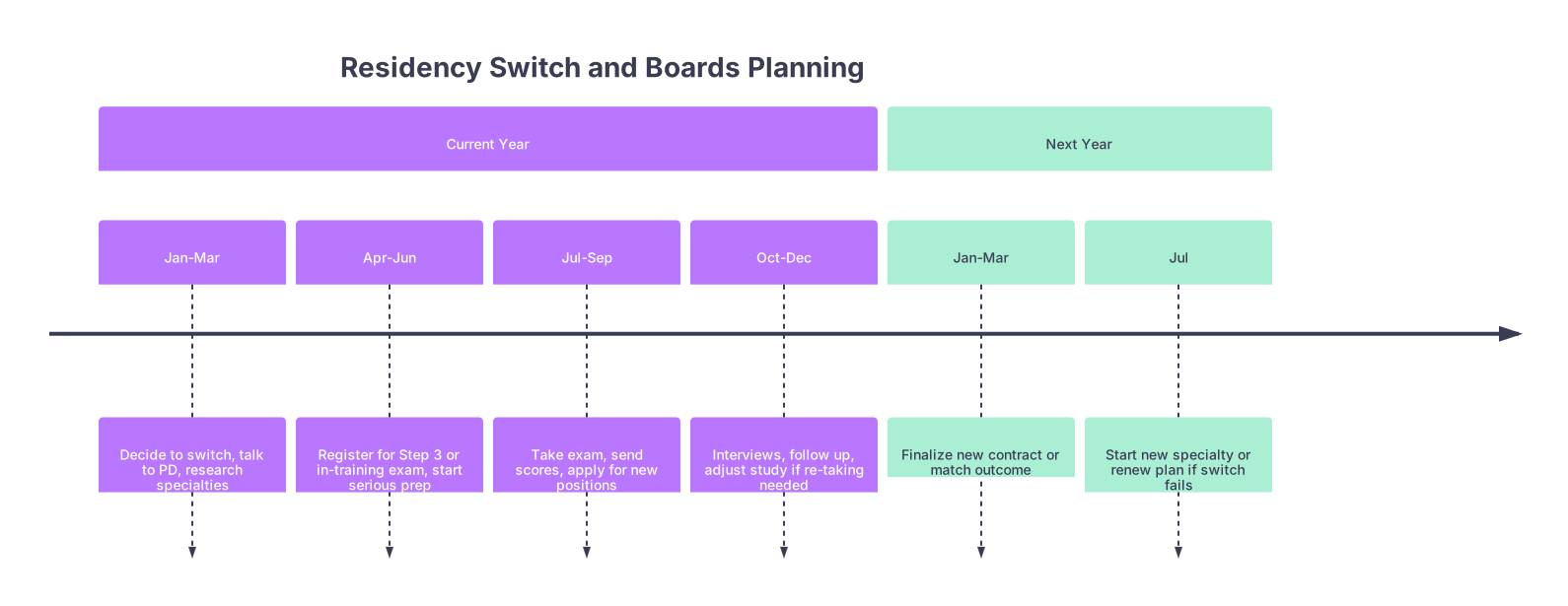
| Period | Event |
|---|---|
| Current Year - Jan-Mar | Decide to switch, talk to PD, research specialties |
| Current Year - Apr-Jun | Register for Step 3 or in-training exam, start serious prep |
| Current Year - Jul-Sep | Take exam, send scores, apply for new positions |
| Current Year - Oct-Dec | Interviews, follow up, adjust study if re-taking needed |
| Next Year - Jan-Mar | Finalize new contract or match outcome |
| Next Year - Jul | Start new specialty or renew plan if switch fails |
Key moves:
Talk to someone who knows the rules
Not Reddit. Not group text.
Email or schedule a short meeting with:- Your current program director or associate PD
- The GME office
- A trusted senior resident who has actually switched or seen it done
Concrete questions to ask:
- Do I need Step 3 completed to leave or transfer?
- Are there deadlines from the hospital/ACGME side for exam completion?
- Do you recommend I still take the in-training exam or specialty board preps?
Look at actual exam registration windows
For Step 3, some testing centers book out months in advance in big cities.
For specialty boards, there are strict windows and fees for late registration.Overlay this with your “worst” rotations
If you know January is 28 days of nights in the MICU, that is not your exam month.
Prelim gen surg with trauma nights? Same deal.
Pick a realistic test month. If you’re switching and need scores before a July 1 start, you want the exam at least 2–3 months before that.
Step 3: Decide Your Strategy On Your “Old” Specialty Content
You’re in a weird limbo. You’re training in one field while mentally leaving for another.
You have to decide:
How much do I still care about being excellent in this specialty? Or are we in “competent and safe while I get out” territory?
I’m going to be blunt: you cannot be all-in on both your old and your new specialty while also surviving 80-hour weeks. You have to choose a balance.
Three realistic stances you can take
Maximize exit options, minimize sunk cost
You focus on Step 3 and the basics needed not to harm patients.
You largely ignore deeper specialty boards/in-depth study in the field you’re leaving.
This is common in prelim years or people absolutely certain they’re out.Build a serious backup plan
You study enough to be board eligible or board certified in your original field, while still preparing to switch.
Harder, but huge safety net.
Example: IM PGY-2 trying for cardiology or radiology but still wants ABIM as backup.Commit to the switch and accept partial “mediocrity” in your current field
You pass in-training exams, don’t look incompetent, but you’re not gunning for chief resident or top percentile in-training scores.
Most people in misery during residency actually land here but never say it out loud.
Pick one. Explicitly.
Then your board prep plan becomes much clearer.
Step 4: Build a Study Plan That Survives Real Resident Life
The fantasy: 3 hours a day of studying, complete question banks, pristine Anki decks.
The reality: You’re answering pages, calling consults, crashing post-call, half-zoning out over dinner.
So you build for the actual life you have.
Non-negotiable rules
Daily minimum, not daily maximum
Your goal isn’t “4 hours a day.” Your goal is:
“Even on my worst day, I will do X.”
For most residents, X = 10–20 high-quality questions with explanations or 30 minutes of targeted reading.Make your default tool a question bank
For Step 3 or specialty boards, questions are king.
Books are support, not the core.Integrate study with work, not after work only
Use natural gaps:- Waiting for radiology reads
- Sitting through slow sign-outs
- Short lulls at the nurses’ station
5 questions here, 5 questions there, adds up.
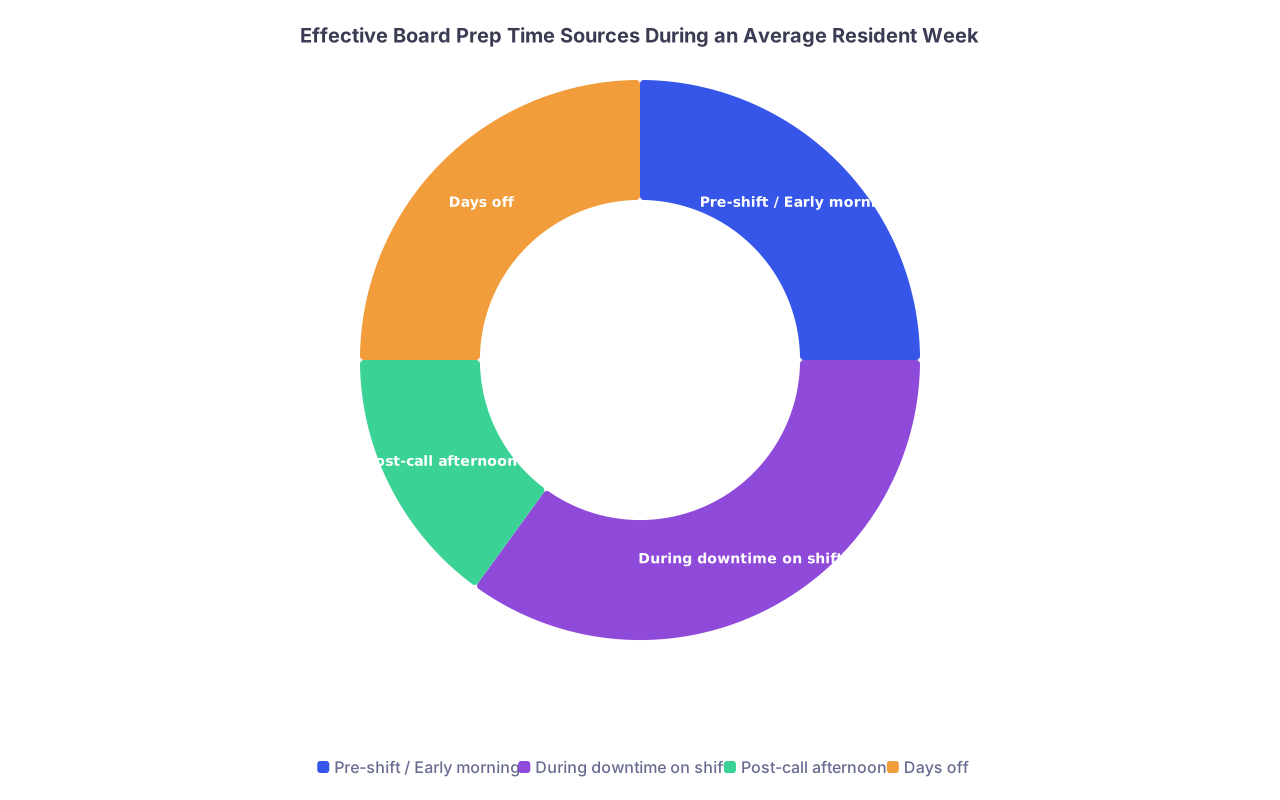
| Category | Value |
|---|---|
| Pre-shift / Early morning | 25 |
| During downtime on shift | 35 |
| Post-call afternoon | 15 |
| Days off | 25 |
Concrete sample plan: Step 3 while on busy wards
Let’s say you’re on a rough medicine month, Q4 call.
Your realistic weekly structure:
- Work days: 10–12 questions in the morning before work, 10–20 during micro-breaks or right after sign-out
- Post-call days: 0–10 questions, light review only
- Golden weekend / day off: One 40-question block + review
You’d aim for something like:
- Weekly total: 150–200 questions
- 3-month horizon: 1,800–2,400 questions → enough to get through a full bank and review weak areas once
That’s what it looks like for most residents who actually pass. It’s not glamorous. It’s relentless, small chunks.
Step 5: Align Your Study Content With Your Target Future Field
If you’re switching, there’s a temptation to throw yourself into your new specialty’s content immediately. Boards don’t care about your feelings.
You have to earn your way into that field with the boards you’re taking now.
But you can be smart and make your current studying feed your future.
Example: IM prelim → Anesthesia
Your immediate priority: Step 3 and not drowning on wards.
But anesthesia programs will like that you understand:
- Cardio-renal physiology
- Vent management
- Perioperative medicine
So when you’re studying Step 3, you:
- Don’t blow off pulm/vent questions
- Pay attention to fluids, pressors, shock physiology
- Use IMF/CCM teaching moments as “proto-anesthesia” learning
Example: Surgery PGY-1 → Radiology
You still must be safe and pass Step 3 or ABSITE (if your program cares).
But radiology loves:
- Strong imaging fundamentals
- Understanding of indications and contraindications
So when you’re on trauma or gen surg nights:
- Look at the CTs yourself before reading reports
- Ask radiology residents to show you classic findings
- When studying Step 3, actually review imaging-based questions in detail; don’t just memorize “CT with contrast” as the answer.
You can turn your miserable “wrong” specialty year into a future-aligned year if you deliberately link what you’re doing now to where you’re going.
Step 6: Manage Your Program Politics While You Study
There’s the studying. Then there’s the politics.
Switching specialties is emotionally heavy and can be politically sensitive. Some PDs are great and supportive. Others feel betrayed. I’ve seen both.
This matters because your environment will affect your ability to study for boards.
Here’s how to protect yourself:
Decide when to go public with your plans
Telling your PD early can get you support and letters.
It can also get you labeled “checked out” in some places.If your PD is reasonable and has a track record of helping transfers: tell them early.
If they have a history of punishment or guilt-tripping? You might delay until you’ve passed Step 3 and lined up some external mentors.Do not let your performance tank while you’re plotting an exit
Word travels. Programs you’re trying to switch into will quietly call your PD, chiefs, or attendings.
If the story is: “Smart, a bit burned out but very responsible,” that’s fine.
If it’s: “They mentally checked out, cut corners, or argued constantly,” that will kill some opportunities.Use electives strategically
If you get any choice in your schedule:- Put intensive board prep during easier outpatient or consult months
- Use away rotations or electives in your target specialty both for networking and for letters
Step 7: Handle the Mental Side: Identity Crisis + Exam Pressure
Let’s be honest. This isn’t just logistics. It’s identity-level stress.
You’re probably thinking some version of:
- “Did I just waste years of my life?”
- “If I fail this board exam, I’m stuck.”
- “Everyone else seems to have a straight path and I’m the one bouncing.”
Studying while your brain is spiraling is brutal. So you need some basic mental scaffolding.
Accept that this year is going to feel inefficient
You will learn stuff you won’t use.
You will study content for a specialty you’re leaving.
You will feel behind compared to people who committed early.That doesn’t mean you’re wrong. It means you’re mid-course correction. Those are always messy.
Shrink your time horizon during the worst rotations
When you’re on nights or ICU and trying to study:- Don’t think in “I need to learn all of Step 3 content.”
- Think in “I need to get through these 10 questions before bed.”
Micro-goals keep you from mentally quitting.
Have one person who knows the full story
Ideally:- Another resident who switched
- A mentor in your target specialty
- Someone outside your program if your local culture is punitive
You need at least one person you can text, “I think I should just give up and stay where I am,” and have them respond with reality, not panic.
Step 8: If You Fail An Exam While You’re Switching
It happens. And when it happens mid-switch, it feels catastrophic. It’s not automatically fatal, but it does change your strategy.
If you fail Step 3 or a major in-training/board exam while trying to switch:
Pause and gather facts before you panic
- How many attempts are allowed for your state licensure?
- How do programs in your desired specialty generally view repeats?
- Is it a single-point miss, or a serious gap?
Rebuild trust with data
You’ll need something concrete that says, “I’m not careless or incapable, I fixed the problem,” like:- Strong score improvement on repeat
- Excellent in-training performance later
- Strong letters explicitly stating your clinical competence
Tighten your schedule and get systematic
You lose the right to “I’ll just wing it with questions” after a fail.
You’ll need:- A structured content-based resource (e.g., Step 3 or board review book/course)
- A written schedule
- Regular self-testing with NBME or practice tests
Step 9: When You’re Unsure You’ll Successfully Switch
This is the hardest place: you’re studying for boards, you want to switch, but you don’t have an offer, and competition is stiff. Derm, radiology, ortho, anesthesia, EM, certain fellowships—it’s not guaranteed.
You need a dual-track strategy:
Stabilize your current path
Study enough that:- You pass your in-training and any boards required
- You do well enough that, if you’re “stuck” in this specialty, your career isn’t dead
Take shot after shot on your new path
- Apply broadly
- Network with faculty in the new specialty
- Publish or do small projects if you can squeeze them in
- Be realistic, not defeatist: competitive doesn’t mean impossible
Set personal decision checkpoints
Something like:- “If I don’t have serious interest/offers by X date, I’m going to commit to being excellent in my current field and stop scattering my energy.”
This isn’t quitting. It’s choosing not to live in limbo forever.
Putting It All Together: A Concrete 6-Month Action Plan
Let’s say you’re a PGY-1 prelim IM thinking of switching to anesthesia. You haven’t taken Step 3 yet. You’re 6 months into the year, and applications for PGY-2 anesthesia will open in a few months.
A realistic 6-month plan could look like this:
Month 1:
- Decide: Step 3 is top priority.
- Talk to a trusted senior, maybe APD.
- Register for Step 3 with a test date about 3–4 months out.
- Start 10–15 questions a day, no days off, even post-call (but lighter).
Month 2–3:
- Increase to 150–200 questions/week.
- Track weak areas; do quick reviews from a Step 3 book or concise videos.
- Reach out to anesthesia department: shadow, express interest, ask about transfer options.
Month 4:
- Take 1–2 self-assessments. If scores are reasonable, keep test date. If awful, use results to target weak blocks.
- Do a full-length practice test on a golden weekend.
- Start polishing CV, talk to anesthesia PD or faculty about letters.
Month 5:
- Take Step 3.
- Then shift to: refining your story for why you’re switching, getting letters lined up, and continuing clinical excellence so your current PD can honestly support you.
Month 6:
- Use score (ideally strong) as part of your pitch.
- Apply for anesthesia PGY-2 spots or off-cycle positions.
- Keep up a maintenance level of question work so the knowledge doesn’t evaporate if interviews are delayed.
That’s what a real, messy but effective pivot looks like: constant movement on both the exam side and the career side, grounded in what you can actually do during 60–80 hour weeks.
You’re not just “studying for boards” anymore. You’re steering a moving train onto a different track while the train is on fire half the time and you’re also covering four cross-cover pagers.
It feels chaotic now, but this is just one phase. With a clear idea of which exams matter, a timeline that respects your rotation reality, and a brutally honest study plan, you can get through this transition without burning every bridge behind you.
Get your next exam on the calendar. Sketch your six-month plan on paper. Once that’s in place, the next question becomes how to tell a compelling story for your new specialty in applications and interviews—but that’s a problem for the next chapter of your journey.