
The usual rank list advice breaks down the moment your partner matches into a different specialty.
Most people still try to treat it like a solo puzzle. Wrong. You are now playing a two-board chess game where every move on your board shifts the pieces on theirs. If you keep pretending this is a standard “what’s my dream program” exercise, you will both suffer for years.
Here is how you fix it—step by step—so you do not blow up your relationship or your careers.
Step 1: Get Ruthlessly Clear on Your Actual Constraints
Do this before you look at a single program website. Otherwise you will fall in love with places that were never viable.
You have two layers of constraints:
- Hard constraints – non-negotiable realities
- Soft constraints – preferences you can bend if needed
Sit down together with one sheet of paper and write these out. Not on your phone. Not in your head.
Hard constraints (decisions first, feelings later)
Examples I see all the time:
- Visa status
- One of you needs a J-1 sponsor, the other needs H-1B
- Some specialties (e.g., neurosurgery, derm) are far more H-1B-resistant
- Licensing / exams
- One of you barely passed Step 1/2 → hyper-competitive academic programs may be unrealistic
- One of you is unmatched/reapplying → needs broad net, including prelims/transitional years
- Program availability
- Your partner’s specialty simply does not exist in some cities (think rad onc, neurosurg, urology, ENT, ophtho)
- Some specialties have 1–2 programs in a city, others have 10+
- Geography you absolutely cannot do
- Legal issues, custody arrangements, or critical family medical needs
- You must be within X miles of a specific person/facility
Write them in black and white. If a place fails a hard constraint for either of you, it is off the table. No “but the research is so good” exceptions.
Soft constraints (ranked, not all equal)
Common ones:
- Proximity to family
- Cost of living
- Desire for big city vs mid-size vs rural
- Weather
- Academic vs community training
- Prestige / fellowship prospects
- Lifestyle (call schedule, malignant vs humane culture)
Now here is the key move: rank your soft constraints individually, then combine.
- Each of you ranks your top 5 soft constraints from 1–5 (5 = critical, 1 = nice to have).
- Compare lists. Anywhere you both put a “5” becomes a joint priority.
- Anywhere one of you put a 5 and the other put a 3 or less → flagged as “discussion territory.”
You are not trying to be “fair.” You are trying to be honest about trade-offs so later decisions make sense.
Step 2: Map Your Joint Geography Realistically
A lot of couples skip straight to programs. That is backwards. You must pick cities/regions where both specialties are viable first.
Make a short-list of regions where:
- Both specialties exist in the same city, or
- They exist in adjacent cities with commutable distance (usually ≤ 60–90 minutes max, and only if transport is realistic)
Then categorize each region into one of four buckets:
| Region Type | Description | Example Scenario |
|---|---|---|
| A | Ideal for both | Big metro with multiple strong programs in both specialties |
| B | Strong for you, acceptable for partner | Your dream field has many options; partner has 1–2 decent programs |
| C | Strong for partner, acceptable for you | Reverse of B |
| D | Neutral / last resort | Both have few or weaker options; used to expand safety net |
You now have a geography-first framework. That matters because:
- You are trying to maximize the chance of landing in the same region, not just matching individually.
- Your specialties will have very different program densities. IM vs neurosurgery is a different world than IM vs family med.
Step 3: Understand the Specialty-Specific Asymmetry
When you are in different specialties, your leverage is not equal. One of you is in a market with dozens of positions per city; the other may be fighting for 1–2 spots.
You have to explicitly recognize that or you will build a fantasy rank list.
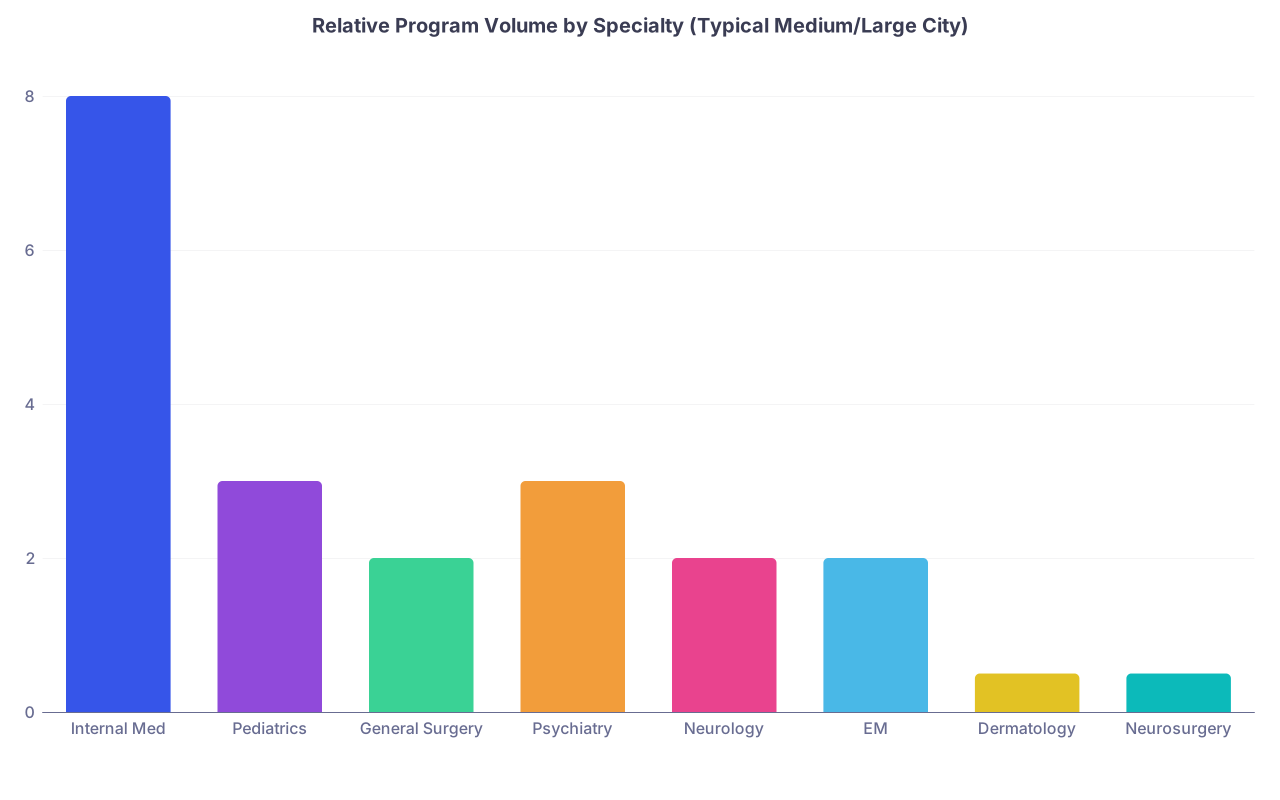
Here is how this usually shakes out across common pairings:
| Category | Value |
|---|---|
| Internal Med | 8 |
| Pediatrics | 3 |
| General Surgery | 2 |
| Psychiatry | 3 |
| Neurology | 2 |
| EM | 2 |
| Dermatology | 0.5 |
| Neurosurgery | 0.5 |
Interpretation:
- Internal Medicine, Psych, Peds → high-volume, more flexibility
- EM, Gen Surg, Neuro, OB/GYN → moderate options, still constrained
- Derm, Neurosurgery, ENT, Urology, Ophtho, Rad Onc → hyper-limited, often 1 program per city
So if you are IM and your partner is neurosurgery, do not kid yourself:
You will bend more than they will if staying together is the priority. Because you can.
Be adults about this:
- Identify which specialty is bottlenecked (fewer total positions / programs).
- Agree that the bottleneck specialty sets the core city list.
- The higher-volume specialty uses its flexibility to find the best options within that core list.
That is the only rational way to do it.
Step 4: Build a Joint Centered Rank Strategy (Not Two Random Lists)
You do not just make separate rank lists and pray. You design an integrated plan.
You have three broad patterns to pick from:
Pattern 1: Aggressive “Same City or Bust” Strategy
Used when:
- You are in a long-term serious relationship / marriage.
- Distance is a true last resort.
- Both specialties have at least moderate options in a few shared cities.
Core idea: You intentionally rank same-city pairings as high as possible, even if one partner sacrifices some prestige.
Structure it like this:
- Identify top 3–5 cities where both of you can live with the training quality.
- Within each city:
- Both of you rank all acceptable programs in that city fairly high.
- The more flexible specialty ranks weaker programs in that city above stronger programs elsewhere, up to whatever your agreed sacrifice line is.
- Only after exhausting your “together cities” do you:
- Add “partner great / you acceptable” solo options.
- Then pure solo safeties.
This is what I see couples do successfully when, for example, IM + EM, IM + Psych, Psych + Peds, etc.
Pattern 2: Balanced “Together-Preferred but Career-Protective” Strategy
Used when:
- One or both specialties are very competitive.
- The weaker candidate risks not matching if they sacrifice too much.
- Relationship is committed, but both of you care a lot about specific career goals.
Core idea: You front-load strong together options, but you do not tank either career for togetherness.
Practically:
- You each build your solo ideal list first (as if you were single and rational).
- You overlay geography, mark where overlap is possible.
- You move overlapping “same-city” options up on each list, but not necessarily to the very top.
- You agree on a “floor”:
- Example: “I will not rank any program below X on my list just for geography; if we have no overlap above that, we accept possible distance.”
This is more nuanced but much safer when one of you is in a bottleneck specialty and also not a superstar applicant.
Pattern 3: “Career-First, Reunite Later” Strategy
Used when:
- One specialty has nearly zero geographic flexibility (neurosurgery, ENT, urology in some regions).
- One partner is already matched (the situation you are in).
- The relationship is strong but both of you are realistic: failing to match is worse than 1–2 years apart.
Core idea: You prioritize your best match fit, with secondary attention to proximity to your partner, and then plan concretely for reunification (fellowship, transfer, job).
In your specific case—your partner is already matched in another specialty—Pattern 3 is often the default, modified by Pattern 1 or 2 depending on your field and competitiveness.
Step 5: If Your Partner Is Already Matched – Redefine the Game
This changes everything. They are now a fixed point. You are the variable.
So stop thinking “Couples Match.” Start thinking:
“How do I maximize my career outcome within a radius of my partner’s program, and what is our tolerance for distance if that fails?”
Step 5A: Define the radius
You need clear distance bands, not vague promises.
Create driving-time bands from your partner’s hospital:
- Band 1: 0–30 minutes (true same-city)
- Band 2: 30–90 minutes (commutable but tiring)
- Band 3: 90–240 minutes (weekend relationship, not daily)
- Band 4: Flight required
Write on paper:
“We are aiming primarily for Band X; we consider Band Y acceptable if required; Band Z is emergency option only.”
Then map programs in your specialty into these bands.
Step 5B: Rank logic when partner is fixed
General rules that work in practice:
If your specialty has plenty of nearby programs:
- Rank the best-fit programs within Bands 1–2 very high, even if there are slightly more prestigious options in other cities.
- Only leave the region for truly exceptional programs that materially change your trajectory (e.g., top-5 IM aiming for cards/onc vs a weak community spot near partner).
If your specialty is competitive / limited near them:
- Keep 1–2 realistic programs near partner at the top if they are not career-killers.
- Then quickly pivot to high-quality programs anywhere that you would be proud to train at, even if they are far.
If there are zero viable programs near partner:
- They are a fixed point. You build a pure solo list for yourself with mild geographic weighting for cheaper flights/shorter trips, but you do not sabotage your match to chase proximity that does not exist.
This is where people get emotional and irrational. The acid test:
“If we break up mid-residency, would I still be glad I ranked this program here?”
If the answer is no, you are letting the relationship override baseline career self-respect.
Step 6: Get Granular – Program Research with Two Sets of Eyes
Here is where the “practical” actually happens.
You should not just look at your side. You both evaluate both specialties in each potential shared region. That forces you to see the trade-offs clearly.
Use a simple shared spreadsheet and score programs with a few key columns (not 30; that is analysis paralysis):
For each program (your specialty):
- Training quality (board pass rates, fellowship match for your interests)
- Culture (resident word-of-mouth, malignant vs supportive)
- Workload (call schedule, scut load)
- Proximity to partner (Band 1–4)
- Your competitiveness fit (reach / match / safety)
For each program (their specialty, already matched):
- Stability (are they likely to stay or try to transfer?)
- Call and vacation flexibility (how much actual time together you will get)
- City lifestyle for both of you (safety, cost, social support)
Then talk through real-world scenarios:
- “If I match at Program A, your call schedule + mine means we see each other X days / month.”
- “If I match at Program B, you get top-tier training but I am at a borderline malignant place. Are we both okay with that trade?”
Make it that concrete.
Step 7: Use a Clear Decision Framework to Order Your List
You now have data. Time to turn it into an actual rank order.
Here is a straightforward framework that works for most couples in your situation:
- Tier 1 – High-quality + reasonable proximity
- Programs you would be genuinely happy to train at and are Band 1–2 distance from your partner.
- Tier 2 – Career-excellent but distant
- Truly strong programs (for your goals) that are Band 3–4.
- Tier 3 – Acceptable training + excellent proximity
- Slight quality sacrifice but still acceptable training near partner.
- Tier 4 – Safety nets
- Programs that are not ideal but protect you from going unmatched.
Then:
- Sort within each tier by personal preference.
- Decide where Tier 2 (great career, far away) intersects with Tier 3 (mediocre career, near partner). That intersection is where values become real instead of theoretical.
A common rational pattern:
- Several Tier 1s (best blend of career + proximity)
- Very strong Tier 2s (do not sacrifice your entire future for proximity)
- Selected Tier 3s (you are willing to take some hit to be together)
- Broad Tier 4 safety net
Step 8: Face the Emotional Landmines Directly (Instead of Accidentally)
I have watched couples self-destruct over this process because they never actually said the hard stuff out loud.
Have this conversation explicitly:
- “What is worse for us: 1–3 years apart or one of us doing residency in a place we actively dislike?”
- “If one of us ends up much happier with their program than the other, are we both okay with that?”
- “If we end up in different cities, what is our minimum plan for visits?”
- X visits / month
- Who travels more (and who pays)
- “If either of us absolutely hates our program, what is the plan B?”
- Targeted transfer? After PGY-1? Fellowship reunification?
Write your answers. Not because you will stick to them perfectly, but because it forces honesty now rather than resentment later.
Step 9: Lean on Reality, Not Magical Thinking
Common traps I see:
- “I will just transfer later close to you.”
Reality: transfers are rare, political, and less available in hyper-competitive specialties. - “We can couples match unofficially even though you are already matched.”
No. You cannot game the algorithm. You can only coordinate geography and priorities. - “If I go to a weaker program near you, I can still get any fellowship I want.”
Sometimes true, often not. Look at actual fellowship match lists, not vibes. - “Long distance will be fine; we already did 6 months apart.”
Residency long-distance is a different animal: random call, nights, weekends, limited vacation.
Anchor yourself to numbers and known outcomes when possible.
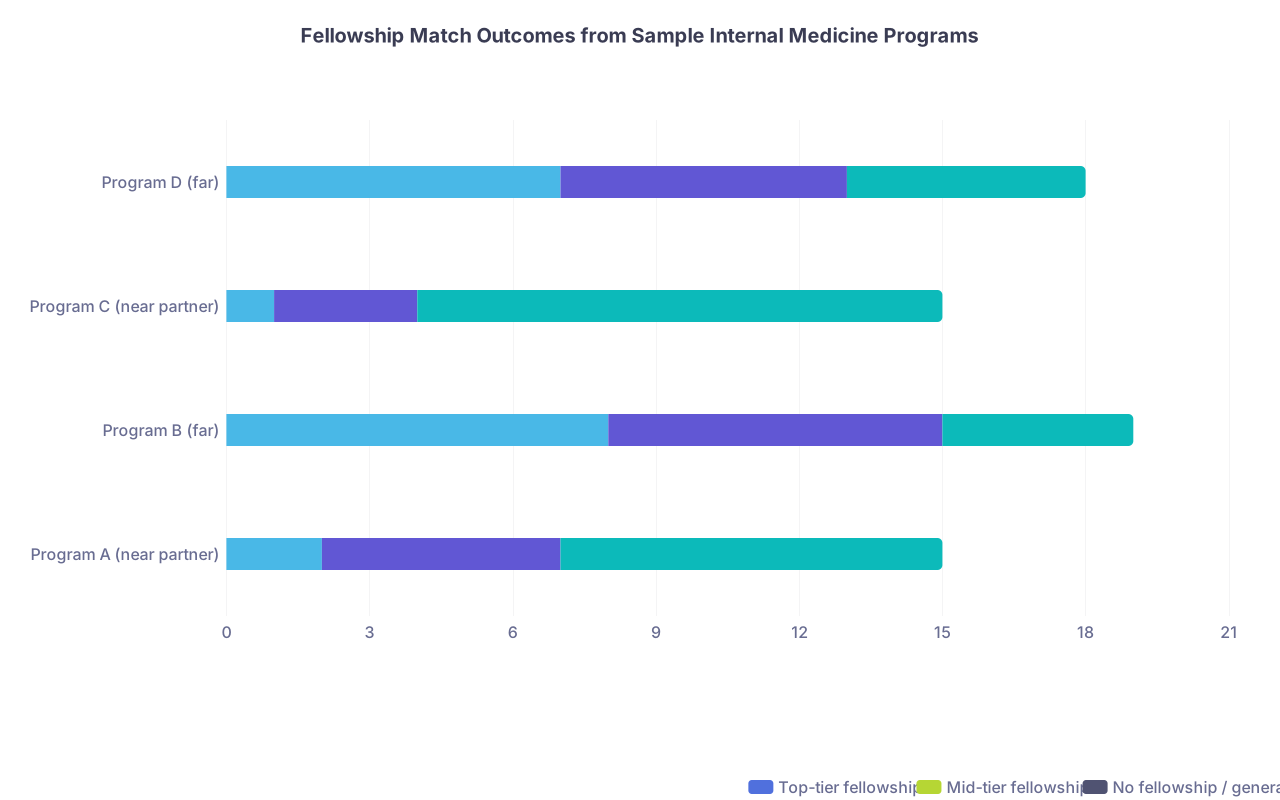
For example, look at fellowship match data for programs you are considering:
| Category | Top-tier fellowship | Mid-tier fellowship | No fellowship / general |
|---|---|---|---|
| Program A (near partner) | 2 | 5 | 8 |
| Program B (far) | 8 | 7 | 4 |
| Program C (near partner) | 1 | 3 | 11 |
| Program D (far) | 7 | 6 | 5 |
This kind of comparison often sobers people up. You see in black and white the cost of picking a weak training environment.
Step 10: Turn Plans into Concrete Logistics (If You Might Be Apart)
If you accept that distance might happen, do not leave it as a fuzzy “we will make it work.”
You need a concrete system:
- Schedule alignment
- Sync vacation request timelines.
- Pre-plan at least 1 major trip per year before you even start.
- Communication
- Agree on a default pattern: brief daily call? Long weekly video call?
- Be realistic—no one has energy for 2-hour nightly FaceTime after 28-hour calls.
- Money
- Budget for travel. Not in theory; literally line item in your monthly budget.
- Decide who absorbs more cost if salaries differ.
Think of it like a second residency: your “relationship residency.” It needs structure or it will fail by default.
Example Scenario Walkthrough
To make this less abstract, here is a typical setup:
- Partner A: Matched already in General Surgery in City X (large academic center).
- Partner B: Applying to Internal Medicine this cycle.
Reality check:
- City X has:
- 1 large academic IM program
- 1 community IM program
- Nearby region (2-hour radius) has:
- 3 other IM programs in smaller cities
- 4 more in larger metro Y (3 hours away, requires car or occasional flights)
Process:
- B identifies:
- Academic Program X-IM (same hospital as partner) – strong, moderate competitiveness.
- Community Program X-IM – mid-tier, decent but not stellar.
- Within 2–3 hours:
- Several solid but not elite IM programs.
B’s rank list might rationally look like:
- Academic Program X-IM (Tier 1: excellent + same city)
- Academic Program Y-IM (Tier 2: very strong, 3 hours away) 3–5. Other strong programs in larger cities, 3–4 hours away (Tier 2)
- Community Program X-IM (Tier 3: acceptable + same city) 7+. Safety IM programs nationwide (Tier 4)
Why not put Community X-IM at #2 “for love”? Because if the gap in training quality and fellowship prospects between Community X and the other Tier 2 programs is large, B should not throw away their long-term career for proximity—especially when they already have the same city at #1.
This is the kind of disciplined thinking you want.
Visual: Process Map for Building Your Rank List as a Couple

| Step | Description |
|---|---|
| Step 1 | Define hard constraints |
| Step 2 | Map joint geography |
| Step 3 | Identify bottleneck specialty |
| Step 4 | Choose strategy pattern |
| Step 5 | Score programs in shared regions |
| Step 6 | Build tiers by career and proximity |
| Step 7 | Draft individual rank lists |
| Step 8 | Stress test for worst case |
| Step 9 | Finalize lists and logistics |
Frequently Asked Questions
1. How much should I sacrifice my own career goals to stay near my already-matched partner?
You should not sacrifice core training quality. That means:
- Do not choose programs with repeated board failures, toxic culture, or terrible reputations just to be close.
- Some sacrifice in prestige (top-10 → top-40) is reasonable if the training is still solid and aligns with your goals.
- If your dream path requires elite fellowship (e.g., academic cardiology, surgical oncology), you must ensure your residency program actually produces those outcomes. Use fellowship match lists to guide this.
The line is individual, but the principle is constant: stay together where it does not ruin either person’s foundation. If “near partner” equals “borderline unlivable program,” that is too far.
2. What if my partner’s program is in a city with zero programs in my specialty?
Then you are not choosing between “together vs apart.” You are choosing between “both of us have careers” and “one of us does not match.” That is not a real choice.
In that case:
- Build your rank list as a solo applicant with mild geographic bias toward cheaper flights or drivable distances.
- Focus on getting the best possible training you can. Strong training buys you more geographic freedom later (fellowship, jobs).
- Plan explicitly for how to converge later:
- You apply for fellowship near them or in a city with options for their job.
- They look for post-residency jobs in your fellowship city.
Do not contort your list into unsafe choices for a proximity that literally cannot happen.
3. Should we tell programs about our situation during interviews?
You can, but do it strategically.
Good uses:
- Mentioning a partner already training in the city as a strong geographic tie. Programs like to hear you have real reasons to stay.
- Clarifying that you are committed to the region long-term, which can help at community programs.
Bad uses:
- Sounding like you will be miserable if you are not accepted there because of your partner. That reads as desperation.
- Pressuring them for special treatment. Programs cannot coordinate with others the way a formal couples match allows.
Phrase it calmly: “My partner is currently a PGY-1 in general surgery at Hospital X, so I am particularly interested in staying in this area long-term.”
4. How do we handle it emotionally if we end up in different cities despite all this planning?
You treat it like another demanding rotation: not ideal, but structured.
Concrete steps:
- Give yourselves 1–2 weeks to feel angry, sad, whatever. Do not immediately blame each other or the rank decisions unless one of you truly ignored the agreed plan.
- Revisit your original written priorities and remind yourselves: “We chose this because we valued X and Y.” That helps reduce regret spirals.
- Build a 6–12 month “recalibration plan”:
- Schedule your first several visits before residency starts.
- Recheck transfer possibilities at 6–12 months (without obsessing weekly).
- Start mapping fellowship or job options that could reunite you.
Emotionally, the couples who survive this are the ones who treat it as temporary and attack it with the same planning they used for boards. Vague hope fails; concrete systems carry you.
Open your draft rank list right now and ask this:
“For my top 5 choices, if my relationship ended tomorrow, would I still be glad I ranked them this way?”
If the answer is no for more than one or two programs, you have work to do tonight.