
Your score is low. Your career is not ruined.
The mistake most students make after a disappointing Step score is picking a specialty out of fear instead of strategy. That is how people end up bitter in a field that never fit them. You are going to do the opposite.
This is not about “settling.” This is about playing the board-score game like an adult: clear‑eyed, tactical, and still aligned with who you are and how you like to practice medicine.
Step One: Stop Letting The Score Run The Room
Let me be blunt. Program directors care much less about why your score is low than about what you are doing about it and whether you picked the right lane afterward.
So your first move is not to panic-apply to every “noncompetitive” specialty. Your first move is to:
- Clarify what actually fits you.
- Map that against the current reality of competitiveness.
- Build a targeted, credible plan that makes sense on paper and in person.
Quick Reality Check: Where You Actually Stand
You need a brutally honest snapshot, not hand‑waving optimism.
- USMLE Step 2 CK or COMLEX Level 2 is now the key metric in many fields.
- “Low” is contextual:
- 220–230 USMLE or equivalent: below average, but workable for many core specialties.
- Sub‑220: you must be very intentional; some doors close, but not all.
- For DO with COMLEX only: some MD programs quietly filter; plan around this.
, Family Med](https://cdn.residencyadvisor.com/images/articles_svg/chart-relative-competitiveness-of-major-specialties-9837.svg "Relative Competitiveness of Major Specialties")
| Category | Value |
|---|---|
| Dermatology | 95 |
| Plastic Surgery | 90 |
| Orthopedic Surgery | 88 |
| Radiology | 80 |
| Emergency Med | 65 |
| Internal Med | 55 |
| [Psychiatry](https://residencyadvisor.com/resources/choosing-medical-residency/torn-between-psych-and-neuro-a-structured-framework-to-choose-wisely) | 50 |
| Family Med | 45 |
The right interpretation of this chart: some specialties are effectively off the table with a low board score unless you have unicorn-level connections or a miraculous upward trend. Others remain very attainable if you are smart about geography and program type.
Step Two: Define What Actually Fits You (Before You Compromise)
Picking “whatever will take me” is the fastest route to burnout. You need a basic self‑profile that does not revolve around your test performance.
Write down clear answers (no essays) to these:
Do you like continuity or episodic care?
- Continuity: you remember patients’ kids’ names, you like long‑term relationships.
- Episodic: you like solving acute problems and then moving on.
Procedures: love, tolerate, or hate?
- Love: procedural clinics, minor procedures, ICU lines, scopes.
- Tolerate: LPs, joint injections, pap smears.
- Hate: “If I never hold a needle again, I am fine.”
Setting preference:
- Outpatient clinic dominant
- Inpatient / wards / ICU
- Mix of both
Lifestyle tolerance:
- Willing to do nights/weekends regularly
- Need more predictable daytime work
- Fine with grind now for flexibility later
Patient population:
- Kids, adults, pregnant patients, geriatric, mental health, underserved, etc.
Now match patterns, not perfect specialties yet. Examples:
- “Continuity + low‑intensity procedures + outpatient + all ages” → strongly points toward Family Medicine.
- “Episodic + adrenaline + tolerates chaos” → Emergency Medicine or ICU‑heavy Internal Medicine.
- “Continuity + adults + likes complexity and thinking” → Internal Medicine or Psychiatry.
Once you have that rough shape, then you overlay the competitiveness and your score.
Step Three: Know Which Doors Are Still Solidly Open
Let us walk through core specialties that remain realistic with low or below‑average board scores and how to tactically choose within them.
1. Family Medicine: Not A Consolation Prize, A Versatile Weapon
If you like:
- Variety (peds, OB, adult, geriatrics)
- Outpatient clinic, some procedures
- Broad practice options after residency
Then Family Medicine can actually be a power move, not a fallback.
Where board scores matter less:
- Community programs
- Rural and semi‑rural residencies
- Programs in less “desirable” locations (Midwest, Deep South, smaller cities)
Where board scores start to bite:
- Big coastal academic centers
- Programs with heavy OB or sports medicine pipelines (more applicants)
Tactics that work:
- Do sub‑internships (“audition rotations”) at target FM programs, especially in smaller markets.
- Show clear commitment to primary care in your application: clinic volunteering, FQHC or free clinic work, continuity clinic passion.
- Get strong narrative letters from family physicians who can say:
“May not test well, but this student is already functioning at intern level in clinic.”
2. Internal Medicine: The Thinking Person’s Safety Net
A lot of high‑achievers with lower scores end up in IM and do very well. Why? Because the field values:
- Broad knowledge
- Clinical reasoning
- Professionalism and work ethic
And many programs, outside of hyper‑competitive academic centers, are very reachable with a low or below‑average board score.
Key point: Program type matters more than the label “IM.”
| Program Type | Typical Score Pressure | Academic Focus |
|---|---|---|
| Top University Academic | Very High | Heavy |
| Mid-tier University Affiliated | Moderate | Moderate |
| Large Community with Fellowships | Moderate | Selective |
| Community, No Fellows | Lower | Minimal |
| Rural / Regional IM | Lowest | Low |
If your Step 2 is low, lean hard toward:
- Community, community‑university hybrid, and regional programs
- Places that do not send 70% of grads into cardiology and GI
Then use residency to build your way into what you want:
- If you want cardiology or GI with a low Step: you must crush residency, do significant research, and probably aim for mid‑tier fellowships, not celebrity programs.
- If you want hospitalist or primary care: most doors remain open as long as you complete a solid IM program.
Tactical moves:
- Draft a geographically broad list: do not just apply Northeast or West Coast.
- Highlight any life ties to less competitive regions (grew up there, family nearby, previous work).
- Push for faculty advocates to reach out to programs you care about.
Step Four: Fields Where Low Scores Hurt Less Than You Think
Some specialties are quietly more forgiving if your application story matches the field.
3. Psychiatry: Relational, Growing, And Still Accessible
Psych is more competitive than it used to be, but it is not dermatology. Strong fit plus good letters can offset mediocre boards.
You fit Psych if:
- You enjoy long conversations.
- You are curious about stories, trauma, social context.
- You are not bored by 45‑minute medication visits or therapy‑adjacent work.
Where your score matters less:
- VA‑affiliated programs
- Community psych residencies
- Programs in less trendy cities and states
What matters more:
- Evidence that you understand psychiatric patients and like them:
- Inpatient psych rotation performance
- Working at crisis centers, suicide hotlines, substance use programs
- Letters from psychiatrists who can say: “This person talks to our patients like they matter.”
Do not try to “sell” psych as your passion if your entire CV is trauma surgery club, ortho research, and nothing mental health. Programs smell that a mile away.
4. Pediatrics: Mission‑Driven, Not Test‑Score Obsessive
Peds cares deeply about your ability to:
- Communicate with families
- Show patience and warmth
- Work in teams
Scores still matter, but they rarely gatekeep as aggressively as surgical subspecialties.
Better odds at:
- Community peds programs
- Children’s hospitals in less competitive regions
- Programs with strong primary care or general peds focus rather than high‑flight subspecialty research
Tactics that change outcomes:
- Show consistent child‑focused work: camps for kids with chronic disease, tutoring, school health, pediatric clinics.
- During rotations, be visibly present and kind: sit at kid’s eye level, explain to parents clearly, help nurses without being asked.
- Ask attendings explicitly: “Would you feel comfortable writing a very strong letter of recommendation?” If they hesitate, move on.
Step Five: Fields Where You Must Be Extra Tactical, Not Delusional
There are specialties you can still reach with lowish scores, but you must be very surgical in how you go about it.
5. Emergency Medicine: Not Dead, But No Longer “Easy”
EM used to be wide open with average scores. That is no longer the case in the big coastal or academic centers.
Where you still have a shot:
- Community EM programs, especially in the Midwest, South, Central regions
- 3‑year programs not in tourist cities
- Newly accredited residencies
What will make or break you:
- Standardized letters of evaluation (SLOEs) from EM rotations. Weak SLOEs hurt more than your Step number.
- Demonstrated resilience and teamwork; EM chiefs ask, “Do I want this person in my pod at 3 a.m.?”
- Willingness to cast a wide net geographically and not fixate on lifestyle cities.
If your score is very low, have a serious backup plan (FM, IM, or transitional year with a strategy). Do not go all‑in EM with no safety net.
6. Anesthesia / PM&R / Neurology: Middle‑Ground Specialties
These sit in the “it depends heavily on program and year” category.
You can still match with below‑average scores if:
- You have clear, early commitment to the field: research, electives, faculty mentors.
- You avoid the ultra‑desirable programs and regions.
- Your letters explicitly address your clinical performance and reliability.
Example:
Anesthesia with a 225:
- Risky for top university programs.
- Very workable for community and smaller academic centers, especially if you rotated there and impressed people.
PM&R with a low board score:
- Look for programs with strong rehab hospitals but less brand‑name fame.
- Emphasize sports, MSK, neuro, or disability‑related volunteer work.
This is where that score becomes one variable, not the defining one.
Step Six: Do Not Ignore This Lever – Geography
You want to win with a low score? Get over any fantasy of only applying to San Diego, Boston, or Seattle.
Program location is one of your biggest hidden levers.
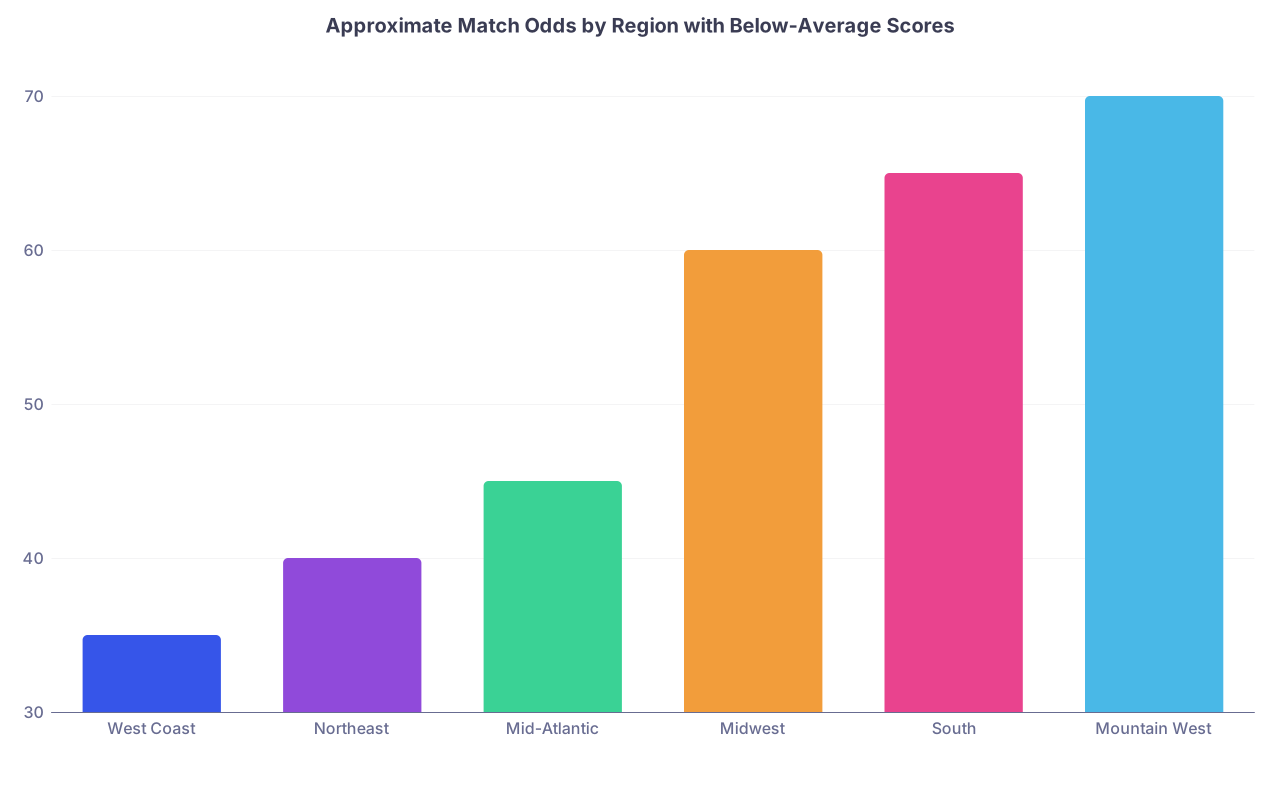
| Category | Value |
|---|---|
| West Coast | 35 |
| Northeast | 40 |
| Mid-Atlantic | 45 |
| Midwest | 60 |
| South | 65 |
| Mountain West | 70 |
Interpreting that simply: if you are flexible about region, your odds jump.
Practical geographic strategy:
Over‑apply to:
- Midwest
- Rural South
- Smaller cities in Mountain West
Right‑size your coastal expectations:
- Apply to a handful of realistic programs near family or where you have genuine ties.
- Do not dedicate half your applications to New York and California.
Tell a coherent story about location:
- “I grew up in a small town and want to return to a similar community.”
- “My partner’s family is in X state; we plan to settle there long term.”
Programs in less flashy locations actually care more about people who will stay. That is your angle.
Step Seven: Double Down On The Non‑Score Variables
Your board score is one line in a file. You need to make the rest of the file so strong that the number looks like an outlier, not the headline.
Clinical Performance: Your Real Currency Now
You cannot have:
- Low score
- And “meets expectations” or “borderline” clinical evaluations
- And generic letters
That combination sinks you.
Your targets:
- Top‑tier clinical comments on core rotations in your target specialty.
- Concrete language like:
“One of the best students I have worked with this year,”
“Functioned at the level of a sub‑intern,”
“Outstanding with complex patients and families.”
How you get there:
- Show up early, leave when work is done, not when the student group leaves.
- Volunteer to present, call consults, update families.
- Ask residents quietly: “What do the best students on this rotation do differently?”
Letters Of Recommendation: Make Them Heavyweight
A single heavyweight letter can neutralize a 10‑point score deficit.
You want letters from:
- Faculty who know you very well.
- Preferably program or clerkship directors in your chosen field.
- People who have watched you manage real patients and can vouch for your reliability.
If you suspect a letter will be lukewarm, skip it. Better three strong letters than four with one weak link.
Step Eight: Rewrite Your Story – Not Your Score
You cannot erase a low Step 1 or Step 2. You can control how it is framed.
What you do:
If there is a genuine reason, use the “adversity” or “academic difficulty” prompt to briefly explain:
- Medical illness, family crisis, late diagnosis of ADHD, etc.
- Then pivot: what changed after that? Tutoring others? Better scores on shelf exams? No excuse without a concrete evolution.
Emphasize your upward trajectory:
- Better shelf scores than Step?
- Strong clinical comments after the exam?
- Any later standardized test that went better (Step 2 vs Step 1, COMLEX 2 vs 1)?
Make your personal statement about fit, not fear:
- Why this specialty makes sense for who you are.
- 1–2 specific patient stories that show how you operate clinically.
- Brief nod to the score only if you need to contextualize; do not center it.
Step Nine: Example Tactical Paths That Actually Work
Let me lay out a few realistic “paths” I have seen work for students with low scores.
Scenario A: 215 Step 2, Loves Patient Relationships, Average Pre‑Clinicals
Tactical choice:
- Prioritize Family Medicine and Psychiatry.
- Apply to 70–90 programs, heavy on Midwest / South.
- Do two FM sub‑Is in different regions.
- Get 2 FM letters + 1 Psych or IM letter.
Outcome I have seen: matched FM at a solid community program, later did a sports medicine fellowship, now practicing in a mid‑size city doing exactly what they wanted.
Scenario B: 225 Step 2, Strong IM Rotations, Loves Complexity
Tactical choice:
- Apply broadly to Internal Medicine.
- Target community and regional academic centers.
- Do sub‑Is at two realistic IM programs. Do not chase the top‑10 name.
- Use letters from IM faculty who say “best student of the year.”
Outcome: matched IM at a regional university program, became chief resident, matched cardiology fellowship despite original low-ish score.
Scenario C: 210 Step 2, Strong Psych Rotation, History of Mental Health Advocacy
Tactical choice:
- Go all‑in on Psychiatry with a broad geographic net.
- Apply to 70+ programs, with heavy emphasis on VA, Midwest, and South.
- Show consistent psych involvement: hotline, advocacy groups, research if possible.
- Letters from two psychiatrists and one IM or FM physician.
Outcome: matched Psych at a VA‑heavy program in a smaller city. Now doing an addiction fellowship.
Step Ten: Guard Against The Two Big Mistakes
The two errors I see over and over:
Chasing prestige in the wrong specialty with the wrong score.
You are not going to backdoor your way into Ortho at a top academic center with a 215. Continuing to believe you can “interview your way in” is denial, not strategy.Over‑correcting into a specialty you secretly hate.
A low score should narrow realistic options, not wipe out your preferences entirely. You can usually find something in the intersection of “fits me” and “will actually take me.”
Your job is to live in that intersection. Not in fantasy land. Not in martyrdom.

| Step | Description |
|---|---|
| Step 1 | Low Board Score |
| Step 2 | Match Fit to Less Competitive Fields |
| Step 3 | Clarify Preferences on Rotations |
| Step 4 | Target Community and Regional Programs |
| Step 5 | Increase Safety Fields and Program Count |
| Step 6 | Maximize Clinical Performance and Letters |
| Step 7 | Craft Application Story and Backup Plan |
| Step 8 | Know Your Clinical Fit? |
| Step 9 | Geography Flexible? |
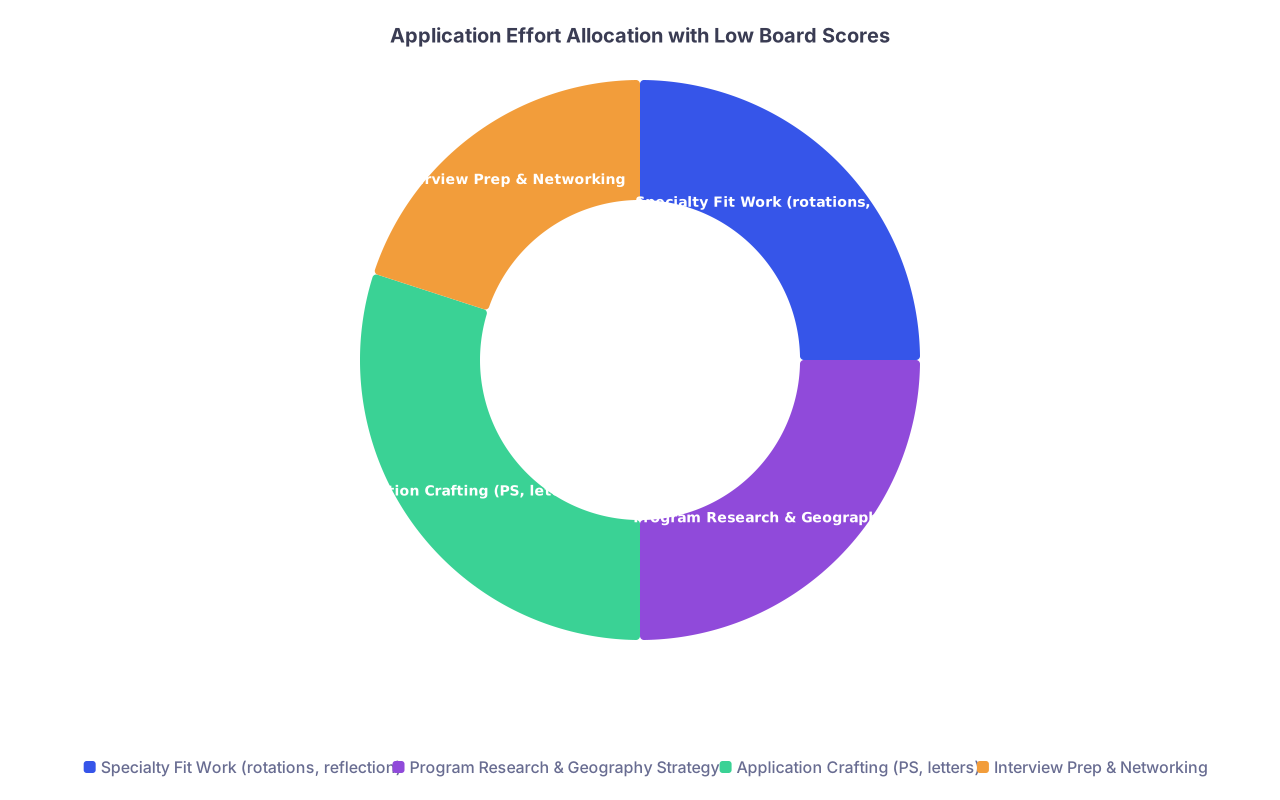
| Category | Value |
|---|---|
| Specialty Fit Work (rotations, reflection) | 25 |
| Program Research & Geography Strategy | 25 |
| Application Crafting (PS, letters) | 30 |
| Interview Prep & Networking | 20 |
The message of that chart: fixing your situation is far more about execution than about the number on the score report.

FAQs
1. Should I take a research year to “fix” a low board score?
Usually, no. A research year does not erase a poor Step score, and in primary care–oriented fields (FM, IM community, Psych, Peds) it is often overvalued by students and undervalued by programs.
You should strongly consider a research year only if:
- You are dead‑set on a moderately competitive specialty (Anesthesia, PM&R, EM in top markets), and
- You can secure meaningful research with real mentors and realistic publication/abstract outcomes, and
- Your clinical evaluations are already strong, so research is adding to a solid base, not trying to compensate for multiple weaknesses.
If your goal field is Family Medicine, General IM, Psych, or Peds, your time is almost always better spent:
- Improving clinical performance
- Building relationships at realistic programs
- Expanding geographic range
- Retaking Step 2 or COMLEX 2 only if you and your advisors believe you can significantly outperform your prior score
2. Is it ever smart to apply to a very competitive specialty “just to see,” with a low score?
If you need a straight answer: almost always no.
Throwing 15–20 applications at Dermatology, Ortho, or ENT “just in case” with a clearly noncompetitive score does three bad things:
- Wastes money and energy you should put into realistic programs.
- Signals to some PDs (who see your application patterns) that you are not fully committed to the specialty you claim to want.
- Sets you up for emotional whiplash when the results are exactly what the numbers predicted.
The exception: if you have a genuinely unique asset in that field—years of relevant research with multiple first‑author papers, major national presentations, or a very strong mentor who actively advocates for you—then a limited, targeted shot at a small set of programs can be reasonable.
Everyone else? Pick the specialty that fits you and that will actually take you, then commit to becoming excellent in it. That is how you build a career you do not regret.
Key points to walk away with:
- A low board score narrows options; it does not end your career. Tactical specialty choice plus geography flexibility gives you leverage again.
- Your best moves now are clinical excellence, heavyweight letters, and a coherent story that aligns who you are with a realistic field.
- Stop chasing prestige or fantasy specialties. Aim for the intersection of “fits how I like to practice” and “will realistically rank me,” then execute hard inside that lane.