
You are not “undecided.” You are data-poor and using the wrong filters.
Most medical students who say “I like everything” are doing one of three things:
- Confusing “I find this interesting” with “I want this life.”
- Judging specialties from the best days instead of the normal days.
- Letting fear of closing doors keep every door technically open.
You can fix all three. Systematically. In a few weeks of focused work.
This is the playbook I give students who are stuck at the “maybe IM, EM, peds, psych, anesthesia, neuro, OB, and surgery… I do not know” stage and need a short, realistic list before it tanks their fourth year and residency applications.
We are going to move from “I like everything” to:
- A 2–3 specialty shortlist.
- A clear “why” for each.
- A plan to test them quickly and honestly.
Step 1: Stop Asking “What Do I Like?” and Start Asking “What Costs Am I Willing To Pay?”
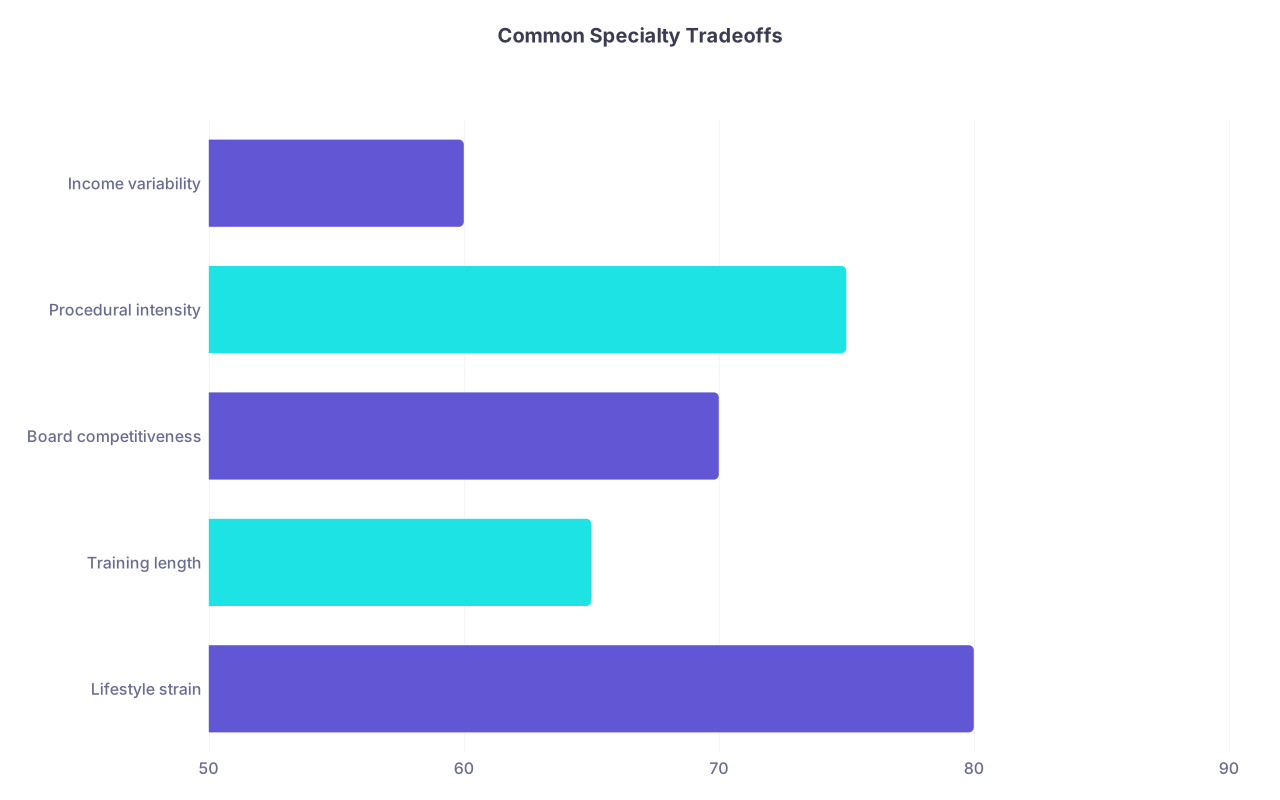
| Category | Value |
|---|---|
| Lifestyle strain | 80 |
| Training length | 65 |
| Board competitiveness | 70 |
| Procedural intensity | 75 |
| Income variability | 60 |
Liking a rotation is cheap. Living the specialty for 30 years is expensive.
The core question is not “What is interesting?” Almost everything in medicine is interesting if you see it done well. The core question is:
“What trade‑offs am I actually willing to live with?”
Start by rating these six domains for yourself, not for each specialty:
- Control over schedule
- Tolerance for long training
- Need for procedures / hands-on work
- Need for longitudinal relationships
- Ambition for high compensation
- Tolerance for chaos and interruptions
Do this fast, gut-level. For each domain, rate importance 1–5 (5 = non‑negotiable):
- Control over schedule: __ / 5
- Tolerance for long training (fellowships, 6–7+ years): __ / 5
- Need for procedures: __ / 5
- Need for continuity of care: __ / 5
- High income priority: __ / 5
- Tolerance for chaos (codes, ED, traumas, constant paging): __ / 5
If everything is “4 or 5,” you are not being honest. Force at least two domains to be low (1–2). Real life has constraints; so does residency.
You just defined your values baseline. We will use this to cut options, not add them.
Step 2: Make a Brutally Simple Screening Table
You do not need a 20‑column spreadsheet. You need a blunt instrument.
Start with the main “big bucket” specialties. Ignore subspecialties and fellowships for now.
| Specialty | Lifestyle Control | Procedures | Continuity | Training Length* |
|---|---|---|---|---|
| Internal Med | Medium | Low-Med | High | Medium |
| General Surg | Low | High | Medium | Long |
| Pediatrics | Medium | Low | High | Medium |
| Psychiatry | High | Low | High | Medium |
| EM | Medium-High | Med-High | Low | Medium |
| Anesthesia | Medium | High | Low | Medium |
*Training length = core residency only, not counting optional fellowships.
Now add 3–6 specialties you are actually considering. Do not list 15; that is procrastination in table form.
Example if you “like everything”:
- Internal Medicine
- Pediatrics
- Emergency Medicine
- Psychiatry
- Anesthesiology
- General Surgery
- OB/GYN
- Neurology
Write them down and roughly rate the same four domains. Use “High / Medium / Low,” not numbers. This is not a grant proposal.
You are not trying to be perfectly accurate. You are trying to see patterns and obvious mismatches.
Immediate cuts: specialty vs values mismatch
Compare your personal values baseline (Step 1) to this table.
Concrete examples:
If you rated control over schedule = 5 / 5 (non‑negotiable):
- You should be very skeptical of: General Surgery, OB/GYN, any surgical subspecialty.
- You probably tolerate EM shifts more than chronic random pages on call.
If you rated need for procedures = 1 / 5:
- Be honest: why are you “considering” surgery, EM, OB, anesthesia? Curiosity from a cool rotation ≠ lifelong fit.
If you rated longitudinal relationships = 4–5 / 5:
- You are probably not going to be happy in EM, anesthesia, radiology, pathology. You might enjoy them on rotation. Different question.
Your first goal: move from 8–10 options down to 4–5 maximum.
You are allowed to say, “I really like watching surgery, but I am not willing to live that call schedule or that training length.” That is not cowardice. That is adult decision‑making.
Step 3: Sort Specialties by “Type of Day,” Not Disease List
Most students compare specialties by:
- Pathology (“cardio is cool”)
- Patient population (“I like kids”)
- Rotation vibes (“attendings were nice”)
This is how people end up realizing in PGY‑2 that they hate call, hate pre‑rounding, and hate clinic, in that order.
Instead, break each specialty down into how you actually spend the day:
- How much time:
- In clinic vs wards vs OR vs ED vs procedure suite?
- Talking vs doing?
- With patients vs with computers?
- How often:
- You are interrupted.
- You carry pager responsibility.
- You are responsible for emergencies.
Here is a useful mental shorthand:
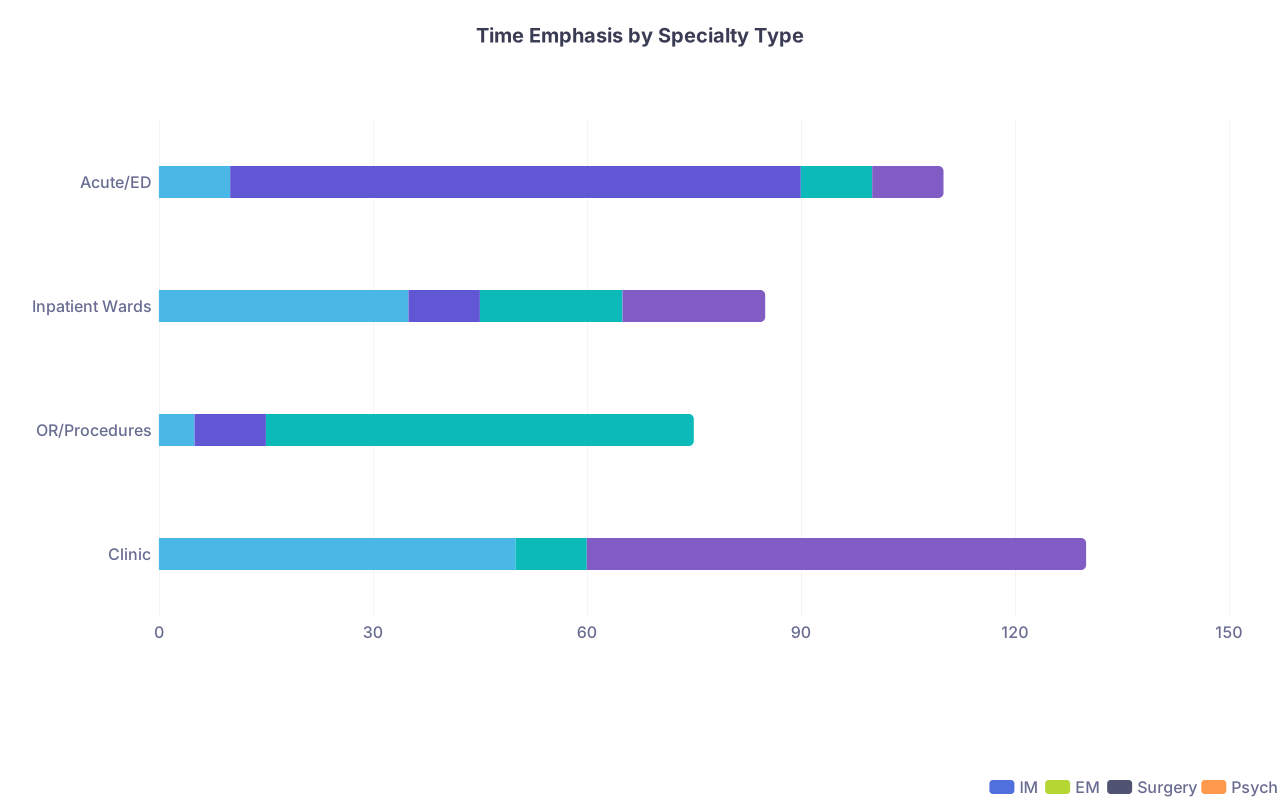
| Category | IM | EM | Surgery | Psych |
|---|---|---|---|---|
| Clinic | 50 | 0 | 10 | 70 |
| OR/Procedures | 5 | 10 | 60 | 0 |
| Inpatient Wards | 35 | 10 | 20 | 20 |
| Acute/ED | 10 | 80 | 10 | 10 |
Do a 5–10 minute reality check for each of your remaining 4–5 specialties:
- Google “[Specialty] resident day in the life.”
- Ask one resident from that field:
“If you had to describe a completely average Tuesday, hour by hour, how would it look?”
Then write a 3–4 line description for each specialty you are still considering:
“Typical EM day: 8–10 hour shifts, mix of low acuity and critical patients, constant switching tasks, lots of short interactions, procedures, frequent adrenaline spikes, no follow‑up.”
“Typical psych day: mostly scheduled outpatient visits, 30–60 minute conversations, med management, some inpatient consults, heavy documentation, low procedures, emergencies rare but intense.”
When you compare these day‑descriptions side‑by‑side, you will often realize, “Right, I am not actually built for 25 back‑to‑back emotionally heavy conversations a day,” or “I thought I liked chaos, but I like control.”
This often cuts another one or two specialties.
Step 4: Run the “Can I Do This On My Worst Days?” Test
Here is where people get badly misled:
Rotations show you the best 10–20% of the job. Conferences. Interesting cases. Attendings on decent sleep.
You need to ask a darker question:
“On my worst, most drained, mildly sick, under‑slept day… can I still do this job safely and not hate myself?”
This is where personality and temperament matter more than Step scores.
Three scenarios to imagine for each specialty still standing:
2 a.m. reality
- EM: chest pain + trauma + sepsis back‑to‑back, with 8 other patients boarding.
- Surgery: called from sleep to manage post‑op hemorrhage.
- Psych: involuntary admission of a violent patient.
Are you energized by this? Neutral? Dreading it?
Bureaucracy day
- IM: 25‑patient clinic day with EHR fighting you and 10 prior auths.
- Peds: frustrated parents, vaccine hesitancy debates.
- Neurology: complex work‑ups, tons of documentation, minimal quick “fixes.”
Emotional fallout
- OB: intrauterine fetal demise.
- EM: coding a child unsuccessfully.
- Onc (via IM): telling a 40‑year‑old with young kids they have metastatic disease.
No specialty escapes hard days. But the flavor of difficulty differs.
Where you get into trouble is when the hardest, most common stressors of the field line up directly against your deepest weaknesses.
- If you emotionally crumble every time someone else is angry at you, EM and surgery are going to be a bloodbath.
- If you get bored with repetitive visits and chronic disease management, primary care will grate on you.
- If conflict with families unravels you, peds and OB might be tough.
Write down, for each specialty:
“Worst‑day flavor for this field: _______”
Then circle the ones that feel barely tolerable. Cross out the one that feels unbearable.
Step 5: Use a Simple Decision Flow Instead of Endless Rumination
Time to stop “thinking about it” and actually make cuts.
Here is a decision flow that forces clarity:

| Step | Description |
|---|---|
| Step 1 | Start - 4 to 5 options |
| Step 2 | Eliminate specialty |
| Step 3 | Keep on shortlist |
| Step 4 | Rank by gut fit and competitiveness |
| Step 5 | Cut lowest ranked until 2 to 3 left |
| Step 6 | Shortlist ready |
| Step 7 | Values mismatch? |
| Step 8 | Hate typical day? |
| Step 9 | Worst-day intolerable? |
| Step 10 | More than 3 left? |
You are aiming for 2–3 specialties on your shortlist, not 5–6. Why?
- Away rotations.
- Letters of recommendation.
- Personal statement alignment.
- Interview season sanity.
You can dual‑apply (IM + EM, Peds + Psych, etc.), but you cannot seriously pursue 5 fields without being mediocre in all of them.
If you truly still have more than three that pass all your filters, then it is time to use the one tool students weirdly avoid: competitiveness reality check.
Step 6: Let Competitiveness Help You, Not Paralyze You
This is where honesty beats magical thinking.
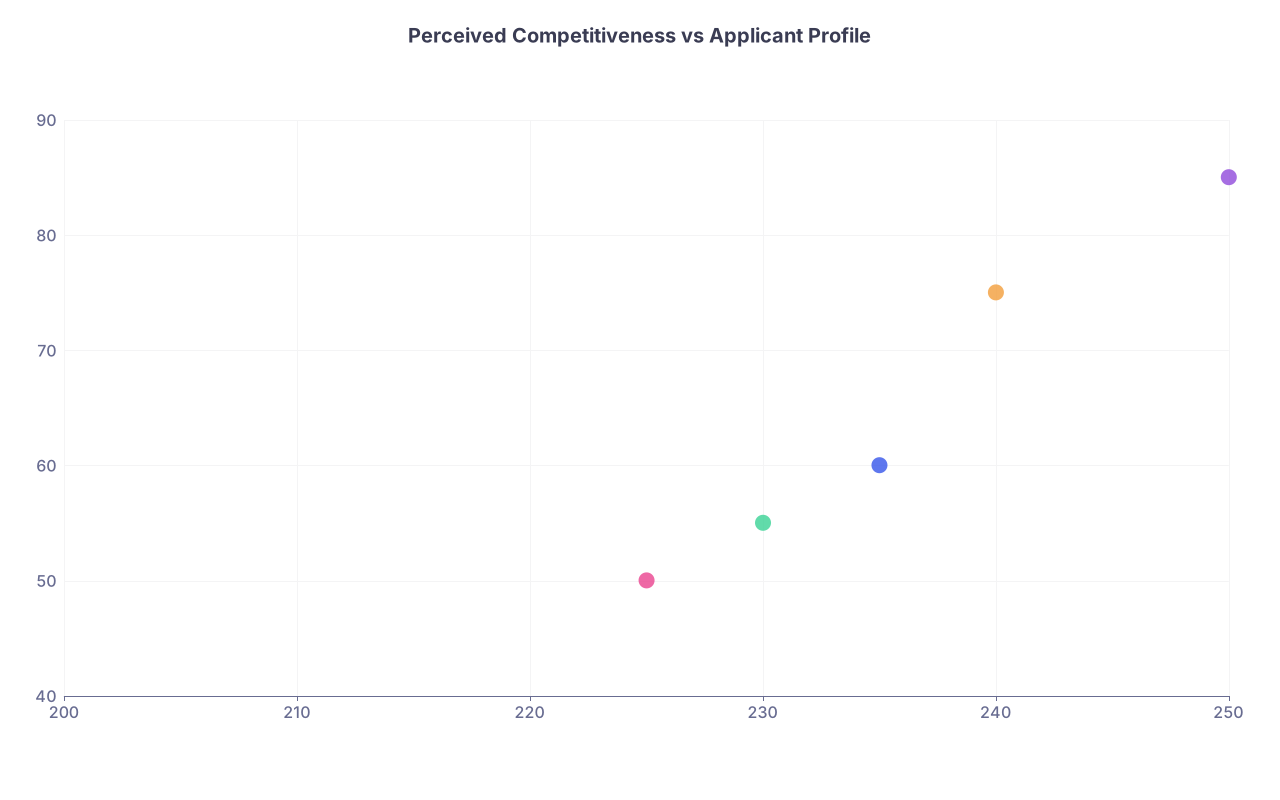
| Category | Value |
|---|---|
| You | 235,60 |
| Derm | 250,85 |
| Neurology | 230,55 |
| General Surgery | 240,75 |
| Psych | 225,50 |
On one axis: your objective profile. On the other: typical matched resident in that field.
Key variables:
- Step 2 CK score (or equivalent exam performance)
- Class rank / AOA / school reputation
- Research in the specialty
- Strong specialty‑specific letters
- Red flags (fails, leaves of absence, professionalism concerns)
If your scores and CV are well below the median for a highly competitive specialty, it can still be your top choice. But it probably should not be your only choice.
So if your shortlist is:
- Dermatology
- Plastic Surgery
- Ortho
And your Step 2 CK is 225 with minimal research, you are not “undecided.” You are “avoiding reality.” You will need at least one more realistic specialty in the mix.
Use this in your favor:
- If you love IM and cardiology but are marginal for cards fellowship: choose IM, aim high, accept some subspecialties might be long shots but IM itself is broad.
- If you like EM and IM equally, but your application is much stronger for one, that is a legitimate tiebreaker.
Competitiveness should not choose your life for you. It should break ties and prevent obvious catastrophes.
Step 7: Test Your Shortlist With 3 Fast Experiments
At this point you should have 2–3 specialties left.
Now you stop thinking and start stress‑testing.
1. Shadow like a skeptic, not a tourist
Arrange one focused day in each specialty where you:
- Follow a senior resident, not just attending clinics.
- Ask them to show you:
- Sign‑out.
- Pre‑rounding or pre‑op routines.
- How they manage pages / consults.
- How they document.
Your questions should not be “What do you like about X?” Everyone has polite answers.
Ask:
- “What parts of this job do you secretly dislike but tolerate?”
- “If your kid wanted to go into your field, what would you warn them about?”
- “On the days you regret this choice, what is happening?”
Write down the answers. Do not over interpret in real time. Patterns will hit you later.
2. Do a 48‑hour thought experiment
Pick one specialty from your shortlist. For the next 48 hours:
- Every time you encounter something in your day (clinical or personal), quietly think,
“Imagine I am definitely going into [specialty]. How does that feel?”
You will notice one of two things:
- A sense of relief and focus. Doors closing, stress drops.
- Or low‑grade dread and mental “bargaining” (“Well maybe I can still…”).
Then repeat with the next specialty. This is a cheat code to get your subconscious to stop hiding.
3. Write the “email from PGY‑2 me”
For each specialty, spend 10 minutes writing a one‑page email from “future you,” PGY‑2 in that field, to “current you.”
Include:
- What you like about the day‑to‑day.
- What is harder than expected.
- What you miss from other specialties.
- Why you are still glad you chose it (or why you regret it).
If you stall out after 3 sentences for one field, and write a full page instantly for another, your brain just told you the answer.
Step 8: Commit To a Shortlist and Plan Your Fourth Year Around It
Indecision has a cost. You pay for it in:
- Weak letters.
- Misaligned electives.
- Vague personal statements.
- Panicked dual‑applications without strategy.
Once you have your shortlist (2–3 specialties), you need a concrete plan:
| Timeframe | Rotation | Target Specialty |
|---|---|---|
| July | Home Sub-I Medicine | IM |
| August | EM Away Rotation | EM |
| September | MICU | IM |
| October | EM at Home Program | EM |
| November | Research / Elective | Both |
Principles:
- Do at least one strong home rotation in each shortlisted field early in the year.
- Secure 2–3 letters in your primary specialty, plus at least one strong general letter.
- If dual‑applying:
- Make one your “primary” and the other your “safety / alternative,” or
- Choose adjacent specialties that share skills (IM + EM, Peds + Psych).
Be explicit with mentors about your shortlist and how you are thinking. “I like everything” gets you generic advice.
“I am choosing between EM and IM, and here is why I am conflicted” gets you real guidance.
Common Traps That Keep You Stuck at “I Like Everything”
Trap 1: Confusing enjoyment with identity
You can enjoy OR days and still not be a surgeon.
Ask yourself:
- When I introduce myself in 10 years, does “[Specialty] doctor” feel like my identity, or just my job?
- Can I picture colleagues in that field as “my people”?
If you feel like a tourist in their world, pay attention.
Trap 2: Overweighting one superstar attending
You saw one legendary attending in a field and fell in love with their version of the job. Good. Take the inspiration. Then look around.
Every specialty has that one unicorn who bends the rules of normal practice. Do not base a 30‑year career on the one person who beat the odds.
Trap 3: Letting guilt drive your choice
Typical lines:
- “My school is strong in X, I would be wasting that advantage.”
- “My family thinks I would be a great [prestigious specialty].”
- “I already did research in this field, so I should commit.”
No. Sunk costs are sunk. The goal is a sustainable, satisfying career, not maximizing the ROI of a third‑year summer project.
Trap 4: Hiding behind “I will choose after Step / after this rotation / after ERAS opens”
That is not strategy. That is avoidance.
Create hard deadlines:
- By the end of [month], I will narrow to 4–5.
- By the end of [next month], I will narrow to 2–3 and tell my advisor.
Then hold yourself to them like exam dates.
Quick Visual: The Logic of Narrowing

| Step | Description |
|---|---|
| Step 1 | All Specialties |
| Step 2 | Filter by values and tradeoffs |
| Step 3 | 4 to 5 realistic options |
| Step 4 | Analyze typical and worst days |
| Step 5 | 2 to 3 strong fits |
| Step 6 | Test with shadowing and thought experiments |
| Step 7 | Primary choice plus backup |
This is not mystical. It is a sequence of cuts based on values, reality, and evidence from your own reactions.
If You Are Still Completely Stuck
If you have done all of this and still genuinely cannot choose, you are usually in one of these situations:
You are burned out and everything feels equally “meh.”
- Fix: Take actual rest, talk to someone, and come back to this when you are not in survival mode. Half of “I like everything” is actually “I do not feel much strongly right now.”
You are terrified of regret and want a zero‑risk decision.
- Fix: Accept that there is no specialty without tradeoffs. Pick the one whose downsides you can live with, not the one with the prettiest upside.
You are overthinking identity (“Real [specialty] people are like X, I am not fully X”).
- Fix: People are messy. There are introverted surgeons and funny radiologists and empathic pathologists. Focus on the work, not the stereotype.
At some point, you pick. Then you build a life that works around that pick.
Two‑Minute Summary
- Stop asking “What do I like?” and ask “What costs am I willing to pay?” Filter specialties by your values, not just interest.
- Collapse your list to 2–3 specialties using: values mismatch, typical day structure, worst‑day tolerance, and competitiveness reality.
- Test that shortlist aggressively with resident conversations, thought experiments, and targeted rotations, then commit and structure your fourth year around your choice.