The myth that there’s a magic “safe” number of psych programs to rank is wrong. What actually keeps you safe is matching your application strength to the right number and type of programs.
You’re not asking “How many?”
You’re really asking: “What number of psych programs lets me sleep the night before Match Day without wanting beta blockers?”
Let’s answer that.
The Short Answer: Most People Need 10–15. Some Need 20+.
Here’s the bottom line first.
For categorical psychiatry in recent NRMP data:
- A typical US MD senior with no major red flags is reasonably safe ranking 10–15 psych programs
- US DO seniors often land in the 12–18 range
- IMGs (especially non‑US IMGs) usually need 20–25+ psych programs to feel “safe”
- If you have red flags (low Step scores, gaps, remediation, prior unmatched), add 5–10 more beyond what your group usually needs
That’s the real-world, “I’ve watched people match and not match” answer.
But—and this is crucial—raw number isn’t enough.
Fifteen reach programs is less safe than eight solid realistic ones plus four true backups.
So you need two things:
- The right ballpark number for your profile
- The right mix of program competitiveness
We’ll walk through both.
Step 1: Know Your Category (It Changes Everything)
You can’t copy your classmate’s rank length if they’re in a different bucket than you.
| Applicant Type | Reasonably Safe Range | Risky Low Range |
|---|---|---|
| US MD (no red flags) | 10–15 | ≤ 8 |
| US DO (no red flags) | 12–18 | ≤ 10 |
| US-IMG | 18–25 | ≤ 15 |
| Non-US IMG | 20–30 | ≤ 18 |
US MD Senior – Average Strength
Who you are:
Step 2 in the low–mid 240s, decent but not crazy research, a couple psych letters, mostly passes with a few HPs/Honors, normal number of interviews (say 10–14 invites).
For you:
- 10–12 programs ranked = “I’ll probably match”
- 13–15 programs = “I’d be surprised if I didn’t match”
- 8 or fewer = I’ve watched people not match from this situation
US DO Senior – Average Strength
Reality: psych is pretty DO-friendly, but some big-name academic places quietly lean MD.
Typical DO with solid Step 2/Level 2, a psych rotation or two, and 10–14 interviews:
- 12–15 ranks = decent safety
- 16–18 = solidly safe if programs are well chosen
- 10 or fewer = you’re playing with more risk than you need
IMGs (US and non‑US)
I’ve seen strong IMGs match psych nicely. I’ve also seen good IMGs not match with 10–12 interviews because they ranked too few or only “dream” places.
Rule of thumb:
- US-IMG: aim for 18–25 ranked if you have that many interviews
- Non‑US IMG: aim for 20–30 ranked, especially if many are community programs
- Fewer than 15 programs ranked as an IMG = not where you want to be
If your interview count is lower than these numbers, then your rank length is capped by reality. In that case, the focus shifts to: “Don’t leave any program you’d tolerate off your list.”
Step 2: Use Your Interview Count to Decide Rank Length
Here’s the blunt truth: you can only rank where you interviewed.
So the core question becomes: “Given my number of psych interviews, what rank length feels reasonably safe?”
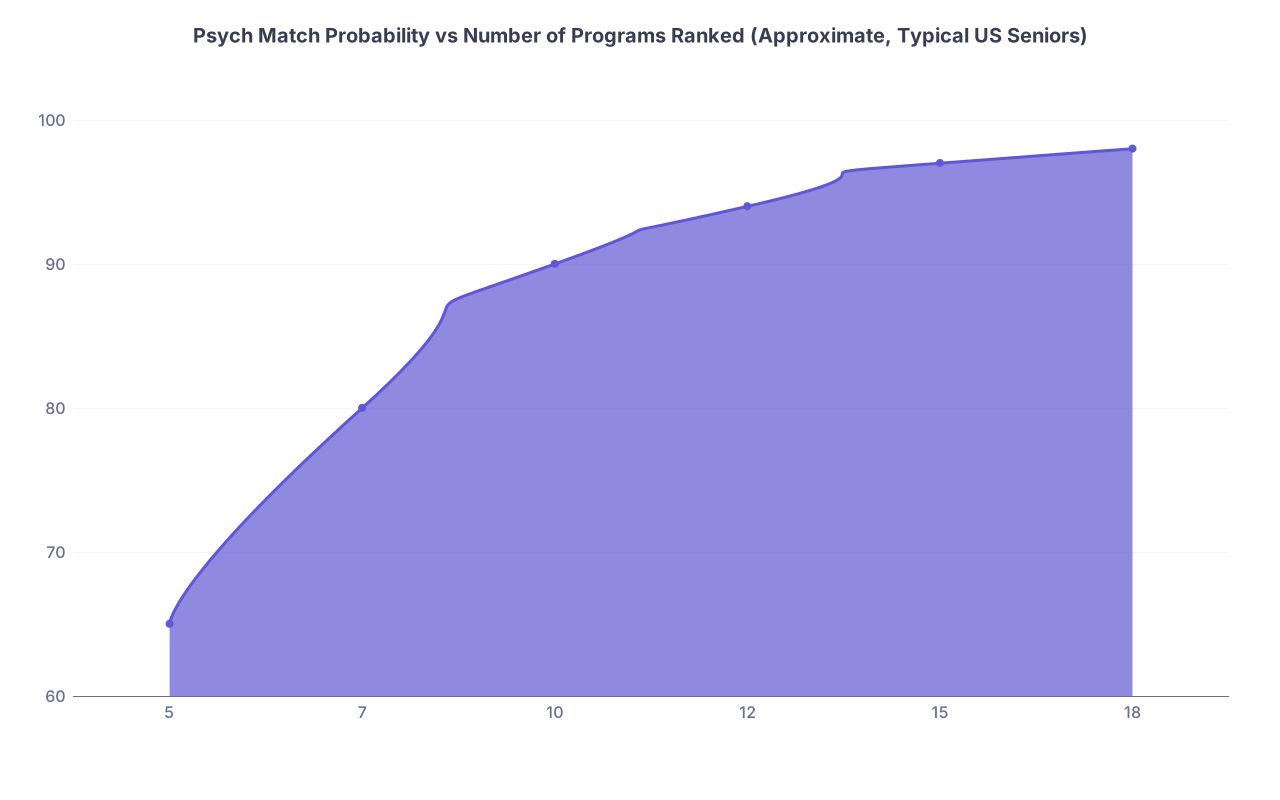
| Category | Value |
|---|---|
| 5 | 65 |
| 7 | 80 |
| 10 | 90 |
| 12 | 94 |
| 15 | 97 |
| 18 | 98 |
These numbers aren’t exact from a single NRMP table, but they track with the trend: the first 10–12 programs give you the biggest jump in safety. After that you’re mostly polishing the odds.
If You Have 5–7 Interviews Total
- You should rank every single program unless it’s truly toxic
- There is no “comfortably safe” number in this range, just “as good as it’s going to get”
- Your strategy: maximize other specialties’ SOAP options and seriously consider a backup plan
If You Have 8–10 Interviews
For psych, most average US seniors with 8–10 well-chosen interviews are in okay shape.
- Rank all of them
- You’re in that ~90%+ match-likelihood band if you’re not severely below average
- Add prelim/TY backups only if you’re ready to pivot to a different specialty
If You Have 11–15 Interviews
This is the sweet spot for many psych applicants.
- Rank all programs unless there’s a serious “I will be miserable” situation
- Typically, 11–13 ranked = safe enough for most US MD/DOs without red flags
- For IMGs: still try to rank 15+, especially if many are competitive metro programs
If You Have 16+ Interviews
You’re not “flexing” by leaving a bunch off. You’re just thinning your safety net.
- Rank everything you’d realistically attend
- Cutting low-tier programs that you’d still accept makes no sense unless you truly would rather go unmatched than go there
Step 3: Your Application Strength Changes the Math
Two candidates can both rank 12 psych programs and have totally different risk.
You have to be honest about where you land.

You’re Relatively Strong for Psych If:
- Step 2 CK ≥ 250 (or COMLEX 2 very high)
- Honors or HP in psych and IM rotations
- Psych research, poster or two, solid psych letters
- 12–20 interviews, including some academic places
For you:
- 10–12 ranks is usually fine
- 13–15 gives you psychological comfort
- Your main decision is preference order, not “Will I match?”
You’re Solid/Average If:
- Step 2 CK ~ 225–245
- Mix of pass/HP, maybe one remediation-free story
- Some psych exposure but not a research star
- 8–14 interviews, mostly mid-tier/community
For you:
- Aim for 12–15 ranked if you can
- Don’t overcut low-tier programs that you’d still attend
- Reality: you probably match somewhere in your top 8–10
You’re More Vulnerable If:
- Step 2 below ~220, or big Step 1/COMLEX failures
- Gaps in training, LOA, professionalism concerns, remediation
- Very few interviews (≤7)
- Prior unmatched attempt
For you:
- Rank every single program that’s not truly dangerous/toxic for you
- If you somehow have 10+ interviews, aim for 15–20 ranks if there are different tracks (categorical, prelim, combined, etc.)
- And be proactive about SOAP/backup specialty; don’t pretend the risk isn’t there
Step 4: Mix of Programs Matters More Than People Admit
Five Harvard/MGH/UCSF‑tier programs is not safer than ten mid-tier university + community programs in cities you’ve barely heard of.
You want a spread.
| Tier / Type | Example Count | Comment |
|---|---|---|
| Reach academic | 2–3 | Big names, heavy research |
| Mid-tier university | 4–6 | Bread-and-butter backbone |
| Strong community | 3–5 | Good match “floor” |
| Geographic stretch backup | 1–3 | Places you’d still accept |
If your list is:
- 80% ultra-competitive coastal programs
- All in one hyper-competitive region
- Or all in one city like NYC or LA
…then 15 ranks may not be as “safe” as you think. Programs all fish from the same pool and may rank you similarly.
I like to see:
- At least 2–3 programs where you clearly exceed their usual stats
- Several where you’re right in the middle
- Reaches as a minority, not the bulk of your list
Step 5: Don’t Get Cute Out of Fear or Ego
Two classic mistakes I’ve watched in psych:
“I’d rather go unmatched than go there.”
Then March comes. The same person is in SOAP trying to get a worse program in a worse location because their ego made decisions for them in February.If you truly mean it, fine. But be very honest. Would you really rather delay your life another year than do four years in a less-cool city with solid training?
Cutting “safety” programs to force a better outcome.
The algorithm doesn’t reward risk-taking like that. It just increases your chance of ending up with no program at all.
You don’t game the algorithm. You just help it by ranking:
- Every program you interviewed at
- In your real order of preference
- As long as you’d actually go there
That’s it. No special tricks. The “trick” is not underestimating your risk.
A Simple Framework: What You Should Do
Here’s a quick decision flow that covers 90% of psych applicants:

| Step | Description |
|---|---|
| Step 1 | Count psych interviews |
| Step 2 | Rank all, high risk |
| Step 3 | Rank all, moderately safe if average strength |
| Step 4 | Rank all, most US MD DO safe |
| Step 5 | Rank all except places you would never attend |
| Step 6 | Interviews 0 to 5 |
| Step 7 | Interviews 6 to 10 |
| Step 8 | Interviews 11 to 15 |
| Step 9 | Interviews 16 plus |
Then layer your category on top:
- US MD/DO average strength: try to rank 10–15+
- US-IMG: aim for 18–25
- Non‑US IMG: 20–30 if possible
- Any red flags: add 5+ to what your group usually needs
Practical Tips While You’re Building the List

Don’t leave blanks.
If you have 12 interviews, you should not end with a rank list of 7 unless multiple places were genuinely unsafe or unethical.Separate fear from fit.
“I didn’t vibe with the PD” is normal. “They ignored racist behavior” or “forced duty hours violations” is a different category—and that can justify omitting.Geography matters, but not as much as you think.
Four years goes fast. A city you never considered may become home. An “amazing” city with a malignant program is a miserable trade.Check historic fill rates.
If a psych program routinely struggles to fill, that’s a safety net for you. Not glamorous, but often great training and a strong floor.Don’t overfit to one faculty’s compliment.
“We’d love to have you here” gets said a lot. It’s not binding. Don’t rank fewer programs because someone flattered you over Zoom.
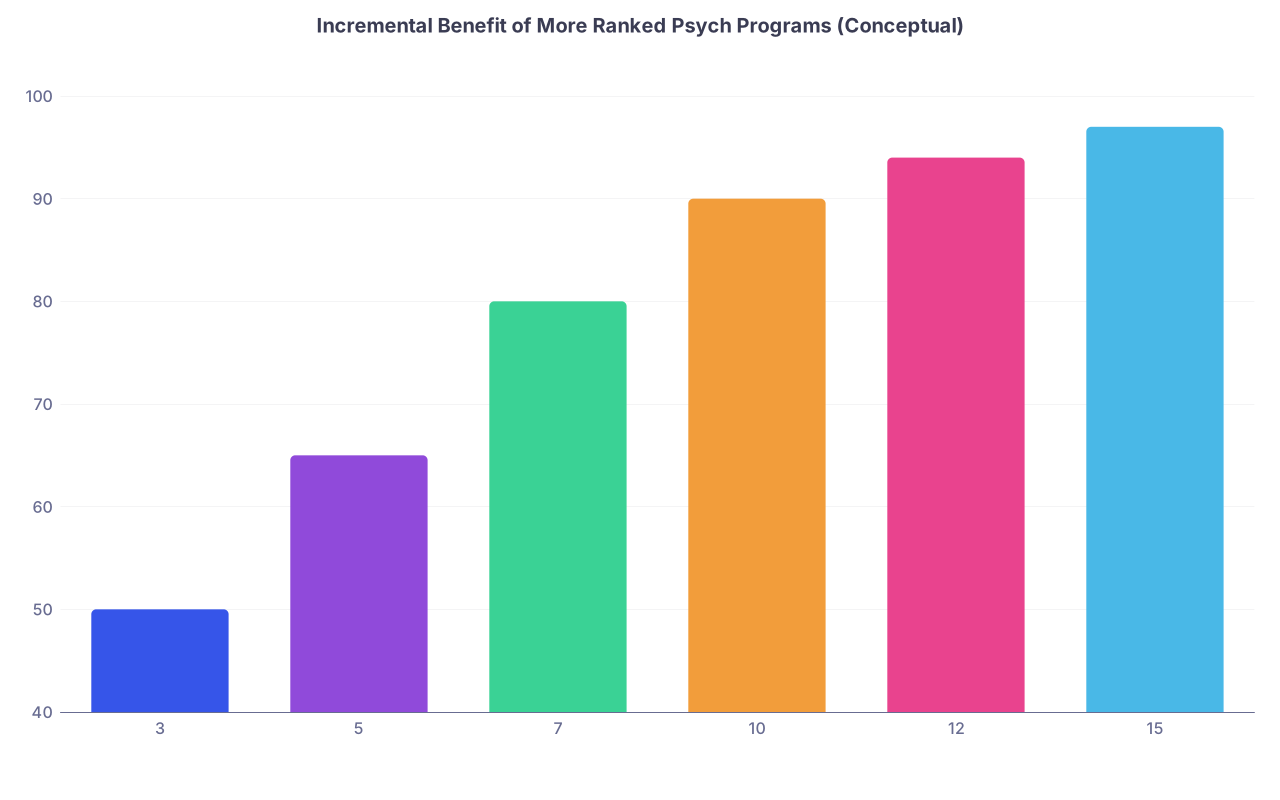
A Quick Visual: How Psych Safety Grows with More Programs
This is why I keep pushing you above 10–12 programs when you can:
| Category | Value |
|---|---|
| 3 | 50 |
| 5 | 65 |
| 7 | 80 |
| 10 | 90 |
| 12 | 94 |
| 15 | 97 |
Massive gains from 3 → 7 → 10.
Smaller, but still meaningful, gains from 10 → 12 → 15.
So if you’re sitting at 10 and thinking “Do I really need to rank those last two?”
Yes. You probably do.
FAQs: Psych Rank Lists and “Feeling Safe”
1. Is there any truly “safe” number of psych programs to rank?
No. There’s no 100% guarantee unless you have an insane number of interviews and a world-class application. But for an average US MD/DO psych applicant, 10–15 well‑chosen programs gets you into “I’d be surprised if I didn’t match” territory.
2. Should I ever leave a program I interviewed at off my rank list?
Only if you genuinely would rather not match than go there. That means extreme issues: major duty hour abuse, clear mistreatment culture, clear safety concerns. Mild discomfort, boring location, or “meh” vibes are not good reasons to throw away a safety program.
3. I’m an IMG with only 8 psych interviews. What should I do?
Rank all 8. You don’t have the luxury to trim. Then get aggressive about SOAP planning and realistic backup options. With 8, you can match, but you’re not “safe.” The strategy is “maximize every single chance” rather than “optimize comfort.”
4. Does ranking prelim or TY programs help my psych match chances?
Not for a categorical psych spot. Those help you if you’re willing to do a prelim year, then reapply or pivot. They don’t boost your odds of matching psych this cycle. Your psych safety only comes from categorical psych programs on your list.
5. If I have 12 interviews but only loved 6 places, can I just rank those 6?
You can, but it’s a bad idea if you care about matching. You don’t need to “love” every program. You just need to be willing to train there. Rank all 12 unless a place was truly unsafe/unacceptable. You can grow to like “OK” programs; you can’t grow a residency out of thin air if you don’t match.
Key points to walk away with:
- Most average US MD/DO psych applicants should rank 10–15+ programs; IMGs usually need 20–25+ if possible.
- Rank every program you’d actually attend, in true preference order—don’t get cute or try to game the algorithm.
- Your mix of programs (reach vs realistic vs safety) often matters more than squeezing out a precise “magic number.”