
You are not “undecided.” You are trying to choose between two demanding, high-stakes careers with incomplete information. That is not indecision. That is a systems problem. So let us fix the system.
You are going to stop “vibing it out” and start running a structured decision process. Psychiatry vs neurology is one of those deceptively tricky forks: lots of overlap on the surface, totally different day-to-day realities and personalities underneath.
This is the framework I use when students come to me torn between psych and neuro. It is not fluffy self-reflection. It is a series of concrete tests, timelines, and reality checks that lead to an actual decision you can defend.
Step 1: Strip Away the Myths — See the Core Job Profiles
First move: get rid of the marketing language and how attendings describe their “passion.” Cut to what you actually do most days.
The Core Daily Work: Psych vs Neuro
Forget training for a second. Look at the attending endpoint. That is the job you are really choosing.
| Dimension | Psychiatry | Neurology |
|---|---|---|
| Main tool | Conversation + meds | Exam + imaging + meds |
| Time with each pt | Longer visits (20–60+ min) | Shorter (10–30 min typical outpatient) |
| Bread and butter | Depression, anxiety, bipolar, psychosis | Stroke, seizures, neurodegeneration, headaches |
| Emergencies | Agitation, suicidality, psychosis | Stroke codes, status epilepticus, acute neuro |
| Objective data | Limited, symptom-driven | Heavily imaging/lab/exam driven |
| Procedures | ECT, infusions, ketamine, TMS (optional) | LPs, EMG, Botox, EEG interpretation (common) |
Now ask yourself one ruthless question:
If you banned me from doing one of these for a year, which would I miss more:
- the psychiatric interview and longitudinal talking work?
- or the neuro exam, imaging puzzles, and acute neuro codes?
Answer that honestly. Do not dress it up. Your gut response is already a strong prior.
The Personality Fit Snapshot
Generalizations, yes. But they exist because they are usually right.
Psych tends to attract people who:
- Can sit with distress and ambiguity without needing a “fix” right away
- Are satisfied with slow, nonlinear progress
- Enjoy long-term relationships and listening more than talking
- Are willing to tolerate severely impaired functioning and lack of clear biomarkers
Neuro tends to attract people who:
- Enjoy pattern recognition and anatomy-based reasoning
- Like pairing a structured exam with imaging and objective findings
- Get energy from acute, time-sensitive decisions (stroke, status)
- Are comfortable saying “we do not have a cure, but we can explain what is happening”
You can force yourself against type for a while. You cannot fake it for 30 years.
Step 2: Run the “Workday Simulation” — Not the Fantasy Version
Daydreams about “helping people with the mind” or “solving brain mysteries” are useless. You need to see how your week actually looks in each specialty.
Build a Concrete Weekly Schedule for Each Path
Sit down and sketch two sample weeks, three years out of residency, for jobs you could realistically land where you want to live.
You are going to build something like this for each:
| Time | Psychiatry (Outpatient) | Neurology (Outpatient, General) |
|---|---|---|
| 8–9 am | Charting, refill requests, inbox | Review imaging, labs, inbox |
| 9–12 pm | 3–6 follow-up visits | 8–10 short follow-up visits |
| 12–1 pm | Lunch + calls with therapists | Lunch + review MRIs, call PCPs |
| 1–4 pm | 2 new patient intakes + 2 follow-ups | 1–2 new patients + 6–8 follow-ups |
| 4–6 pm | Notes, prior auth, coordination of care | Notes, prior auth for meds/infusions, calls |
Now make a similar one for inpatient / consult:
Psych inpatient week:
- Morning: team rounds focusing on behavior, safety, meds, social situation
- Day: admit interviews, family meetings, capacity assessments, legal issues, med adjustments
- On-call: new psych consults, suicidality, agitation, restraints
Neuro inpatient week:
- Morning: pre-round on acute strokes, seizures, ICU patients
- Team rounds focusing on neuro exam changes, imaging, labs, plan
- Day: consults for altered mental status, new deficits, seizures; LPs; family meetings about prognosis
- On-call: stroke codes, tPA/thrombectomy decisions, ICU calls
Write it down. Then do this:
Exercise:
Read each “sample week” out loud to yourself. For each line, rate your visceral reaction: +1 (energizing), 0 (neutral), -1 (draining). Tally each specialty.
Whichever week gets less negative tallies is probably your better long-term environment.
Step 3: Use a Structured Rotations Framework (Not Just “What Felt Good”)
Your core clerkships and electives are your trial run. But raw impressions are noisy: attending personality, team culture, random call days, one awful patient. You need a filter.
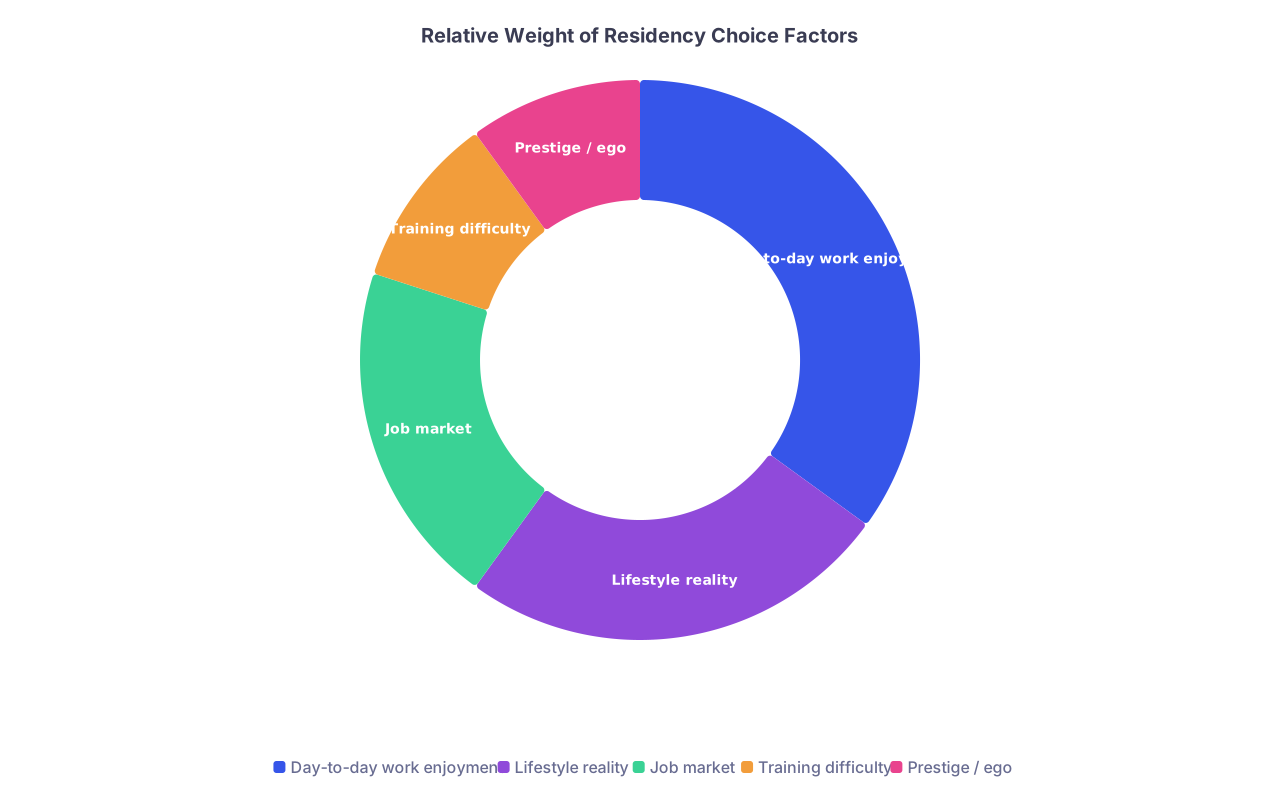
| Category | Value |
|---|---|
| Day-to-day work enjoyment | 35 |
| Lifestyle reality | 25 |
| Job market | 20 |
| Training difficulty | 10 |
| Prestige / ego | 10 |
The Four-Box Rotation Debrief
After each psych and neuro experience (core rotation, consult month, sub-I, elective), sit down and fill out this four-box grid. No prose. Just bullets.
- Tasks I enjoyed
- Tasks I disliked
- Moments I felt competent / “good at this”
- Moments I felt drained / “wrong fit”
Examples from real students:
Psych rotation:
- Enjoyed:
- Long diagnostic interviews
- Family meetings about suicidality
- Adjusting meds and seeing clear improvement over a week
- Disliked:
- Chronic, minimally improving patients
- Constant documentation about capacity and legal issues
- Felt strong:
- De-escalating agitated patients with conversation
- Drained:
- Prolonged disorganized interviews where history is unreliable
- Enjoyed:
- Localizing lesions from exam + MRI
- Running to stroke codes and giving tPA
- Clear linear thinking: symptom → lesion → diagnosis
- Disliked:
- Delivering bad news in progressive degenerative diseases
- “Nothing to offer” clinic visits beyond symptomatic management
- Felt strong:
- Fast, structured neuro exams under pressure
- Drained:
- Follow-up visits with minimal change and high disability
Look for patterns over at least two separate exposures to each specialty. One psych month versus one neuro consult month is not enough data.
The “Bad Day” Test
Think of your worst day on each:
- Psych: maybe a violent patient, an inpatient suicide, or 3 hours in the ED with an acutely psychotic patient who will not talk.
- Neuro: maybe two massive strokes back-to-back, both with bad outcomes, or a night of status epilepticus and ICU chaos.
Ask yourself:
On my worst psych day, did the nature of the work still feel meaningful even if awful?
On my worst neuro day, same question.
You are not choosing the specialty whose best days you loved. You are choosing whose worst days you can stand.
Step 4: Map Training Path, Lifestyle, and Salary Without Lying to Yourself
You know both are four-year residencies. But the path and post-training reality diverge in important ways.

Training Realities: Psych vs Neuro
Psychiatry residency
- Call often more manageable than surgical fields, but can be heavy in ED psych consults depending on program
- Emotional load is high: suicidality, trauma, severe mental illness, aggression, burnout risk if you do not have boundaries
- Procedures minimal unless you seek them (ECT, ketamine, TMS)
- Board exams more concept/DSM-driven than strict anatomy
Neurology residency
- Call can be intense: stroke codes, ICU consults, nights where you never sit down
- Cognitive load is high: complex differentials, need for rapid decision-making with incomplete data
- Procedural opportunities standard (LP) plus optional (EMG, Botox, etc.)
- Boards and daily work lean heavily on neuroanatomy, pathophysiology
Ask yourself bluntly: Which kind of fatigue do you tolerate better—emotional or cognitive? Neither is “easier.” They are just different poisons.
Lifestyle and Compensation: Actual Numbers, Not Rumors
No, psychiatry is not the “easy lifestyle” and neurology the “terrible lifestyle.” Both can be tuned by practice setting. But the averages look roughly like this in the U.S. (as of recent surveys; adjust by your country):
| Factor | Psychiatry | Neurology |
|---|---|---|
| Typical full-time hours | 40–55/week | 50–60/week |
| Call in private practice | Often minimal or phone-only | Variable, sometimes hospital-based |
| Median compensation | Competitive (upper mid physician) | Competitive (similar ballpark) |
| Scope for part-time work | High | Moderate to high (esp. outpatient) |
Numbers shift year to year, but broad reality: both are solid, both are flexible. You will not go broke doing either. That should not be your main tie-breaker.
The real lifestyle differences:
Psych:
- More remote / telehealth-friendly
- Easier to build a practice with predictable hours
- Less tied to acute hospital coverage (unless you choose C-L or inpatient-heavy)
Neuro:
- Acute care (stroke) ties you to hospital systems more
- Some subspecialties (neurohospitalist, stroke) are shift-based and can be surprisingly lifestyle-friendly
- Others (epilepsy, neuromuscular) blend clinic and procedures nicely
Step 5: Use a Scoring Matrix — Then Listen When You Try to Cheat It
You are going to score psych and neuro across specific dimensions. Not 20. You will game it. Keep it lean.
Use a 1–5 scale (1 = strongly unfavorable, 5 = strongly favorable) for each specialty on each dimension.
Suggested dimensions:
- Enjoyment of core daily tasks
- Fit with my personality and interpersonal style
- Tolerance for “downsides” (worst days, hardest cases)
- Long-term lifestyle fit (hours, call, practice setting)
- Intellectual satisfaction (how interesting the thinking is)
- Emotional sustainability (do I burn out from this type of suffering?)
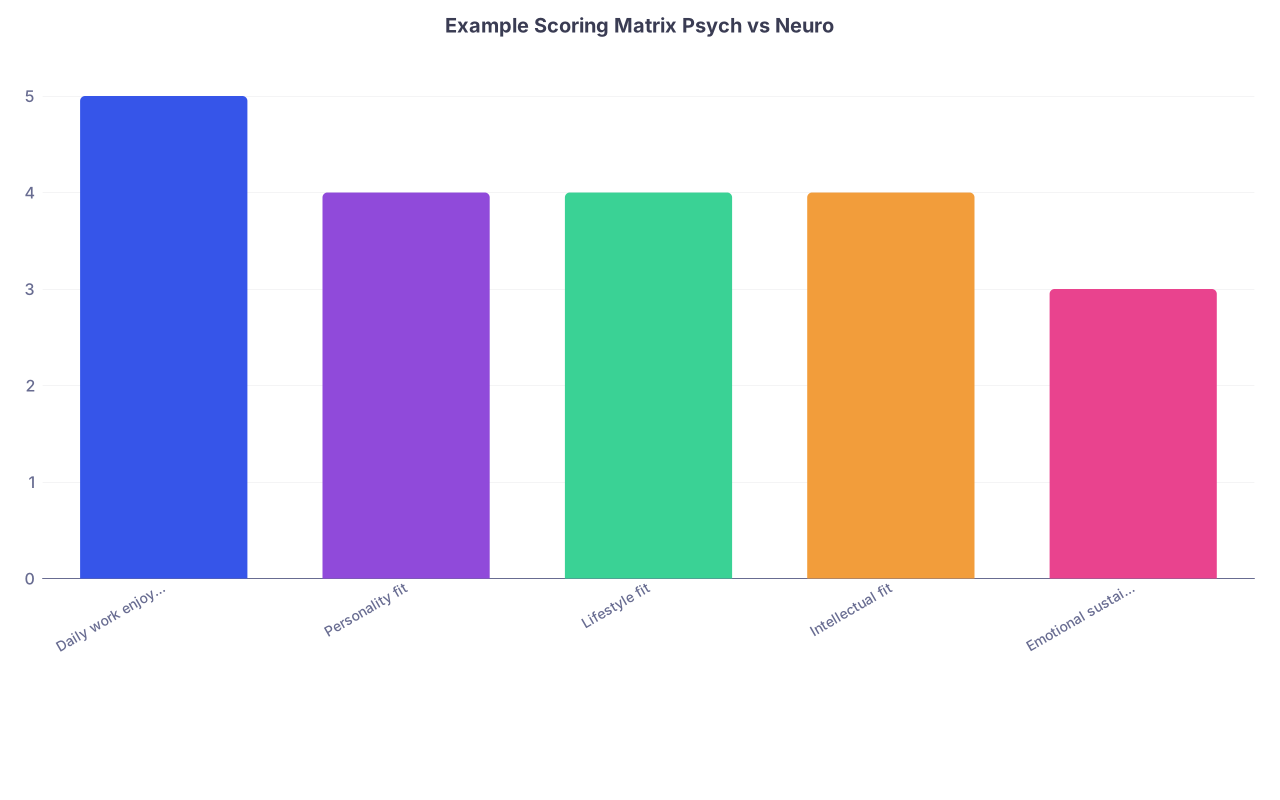
| Category | Value |
|---|---|
| Daily work enjoyment | 5 |
| Personality fit | 4 |
| Lifestyle fit | 4 |
| Intellectual fit | 4 |
| Emotional sustainability | 3 |
Do this twice:
- Once alone, without overthinking.
- Once after talking to at least one attending and one senior resident from each specialty at your home institution.
Then look for one thing: where do you feel tempted to fudge the numbers?
Example I have seen too many times:
- Student clearly rates:
- Psych: 5 for emotional sustainability, 4 for daily work enjoyment
- Neuro: 3 for emotional sustainability, 5 for intellectual fit
- Then they start “correcting” scores to make them closer, because they are afraid of regretting the path they are leaning toward.
When you find yourself justifying why a 3 is “really more like a 4,” stop. The discomfort is telling you what you already know.
Step 6: Stress-Test Each Future — Shadowing and Short Trials
If you are still stuck after all this, you need new data, not more thinking. That means:
Targeted shadowing
- 1–2 days each with:
- An outpatient psychiatrist
- An inpatient psychiatrist or C-L psychiatrist
- A general neurologist
- A neurologist who does acute stroke/ICU or EMG/headache
- 1–2 days each with:
Mini-project or case review in each
- For psych: join a resident or attending reviewing a few complex cases, sit in on treatment team meetings (with permission).
- For neuro: attend stroke case review, EMG reading session, or neuroimaging review session.
You are not just observing. You are asking yourself:
- Could I see myself doing this on a random Tuesday for the next 20+ years?
- When I imagine giving this type of bad news, which feels more bearable?
- Whose charting do I hate less?

| Step | Description |
|---|---|
| Step 1 | Self review of interests |
| Step 2 | Rotation debriefs |
| Step 3 | Scoring matrix |
| Step 4 | Plan applications |
| Step 5 | Targeted shadowing |
| Step 6 | Revisit scoring matrix |
| Step 7 | Apply to one primary + 1-2 prelims or dual apply |
| Step 8 | Clear preference? |
| Step 9 | Still conflicted? |
If, after targeted exposure, you are still 50/50, you are not broken. It just means both are genuinely good fits. That is the best “problem” to have.
Step 7: Make a Concrete Application Strategy (Including If You Are Still Torn)
There are three basic outcomes:
- You lean clearly psych.
- You lean clearly neuro.
- You are still genuinely 50/50 and match risk is a real concern.
If You Lean Psych
Actions:
- Prioritize:
- Strong psych letters (psych attendings over generic IM letters)
- A psych-related project (QI, case report, brief research) if still early enough
- On your CV and in your personal statement, emphasize:
- Interest in longitudinal care, complexity of mental illness, collaborative care models
- Any behavioral health work: crisis line, inpatient psych volunteering, community mental health
Plan:
- Apply psychiatry categorically.
- If you are nervous about competitiveness, you can throw in a few transitional year / prelim medicine applications, but this is rarely necessary if your application is reasonably solid for psych.
If You Lean Neuro
Actions:
- Prioritize:
- Neuro letters (ideally from a program director or well-known faculty)
- Performance on neuro electives, consult services, stroke service
- Highlight:
- Comfort with acute decision-making, enthusiasm for neuroanatomy, interest in imaging and exam
Plan:
- Apply neurology categorically.
- Prelim medicine year is often built into neuro programs, but understand if your programs require you to rank prelim spots separately.
If You Are Truly Torn at Application Time
I have seen this work, and I have also seen it fail when done sloppily.
Options:
Pick one primary and live with the risk
- Hardest emotionally, cleanest practically.
- You commit: “I am a psychiatry applicant,” for example, and go all in.
Dual apply (Psych + Neuro) with a disciplined approach
- Only if:
- You can produce two coherent personal statements that do not read like generic “I like the brain and people” filler.
- You can obtain at least 1–2 strong letters tailored to each field.
- You accept that:
- Interview season will be hellish.
- You must decide before rank list which specialty you want more, because you cannot ethically say “this is my top choice specialty” at both psych and neuro interviews with a straight face.
- Only if:
Apply to one specialty plus a small number of prelim or TY years
- Example: Apply neurology primarily, but include a few transitional year programs as safety.
- Then, if disaster strikes and you do not match neuro, you still continue clinical training and can re-apply more competitively.
Whatever you choose, set a decision deadline:
“I will make my final specialty decision by [date] before ERAS opens / before rank list time.”
Then backdate:
| Date | Milestone |
|---|---|
| Aug 1 | Final specialty decision for ERAS |
| Jul 1 | Complete final round of shadowing |
| Jun 15 | Finish updated scoring matrix + mentor meetings |
| Jun 1 | Schedule meetings with psych and neuro PDs |
Having a date forces you to treat this as a decision problem, not just a chronic anxiety hobby.
Step 8: Gut Check with People Who Actually Know You
Last filter before you commit: external reality.
Who to ask (brief, focused conversations):
- One psych attending who has seen you on the wards
- One neuro attending who has seen you clinically
- One resident in each field who you trust to be blunt
- A non-physician who knows you well (partner, close friend)
Ask each of them variations of the same two questions:
- “From what you have seen of me, where do you think I would thrive more: psychiatry or neurology, and why?”
- “What worries you about me doing [psych/neuro] long-term?”
You are not outsourcing the decision. You are collecting data. If three independent people all say “You are absolutely a [psych/neuro] person,” and their reasoning matches your own internal scoring, pay attention.
Step 9: Commit, Then Stop Second-Guessing
At some point, the cost of indecision is worse than the cost of an imperfect choice.
Facts:
- Psych and neuro are both growing, stable fields.
- Both allow subspecialization, academic careers, outpatient-focused practices, and a lot of flexibility.
- Either way, you will spend four years learning skills that translate well: diagnostic reasoning, patient communication, chronic disease management.
Once you choose:
- Rewrite your story as “I am going into X because…”, not “I almost did Y but…”
- Pour your energy into becoming excellent at the specialty you picked, not into fantasy parallel lives.
- If you truly misjudged, there are pathways to switch early in residency; it is not easy, but it is not impossible.
The students who end up miserable are not the ones who picked psych instead of neuro or vice versa. They are the ones who picked nothing, drifted, and let fear write their story.
The Short Version: What You Actually Need To Do
Model the real job, not the idea.
Write out a sample week as an attending in psych and in neuro. Rate your reaction line by line. That will tell you more than reading another Reddit thread.Score it, then respect the numbers.
Use a simple scoring matrix for daily work enjoyment, personality fit, lifestyle, intellectual and emotional fit. When you catch yourself trying to fudge a score to protect your ego, stop. Your first numbers are usually right.Collect targeted data, set a deadline, and decide.
Do brief, focused shadowing in both fields, talk to attendings who know you, and schedule a decision date. Make the call, commit your application strategy to that choice, and move forward instead of orbiting the same anxiety forever.