

Most specialty regret by PGY-2 isn’t about scores or prestige. It’s about personality mismatch you tried to ignore.
I’ve watched it play out too many times: a brand‑new intern shows up beaming in July, proud to have “matched their dream specialty.” By the middle of PGY-2, they’re quietly asking about transferring programs, switching specialties, or just “surviving until I can do something else.” Their CV was flawless. Their personality–specialty fit was not.
Let me be blunt: if you choose a specialty that fights your natural temperament every day, you will burn out faster than your co-residents, no matter how “competitive” or “impressive” the field looks on paper.
This is the mistake you need to avoid.
The Lie You’re Being Sold About Choosing a Specialty
You’re being quietly trained to think picking a specialty is mostly about:
- Your Step scores
- Your class rank / AOA
- How “strong” your letters are
- How “competitive” you are
- Lifestyle vs. money
Those matter. But they’re not what breaks people by PGY-2.
The residents I’ve seen unravel weren’t “too dumb for the field” or “not hard-working enough.” They were in the wrong ecosystem for who they are:
- Quiet, detail-oriented introverts forced into high-stimulation, nonstop crisis environments
- Big-picture people stuck in microscopic, perfectionist procedural worlds
- Emotionally sensitive folks marinating in constant tragedy without enough recovery time
- People who need closure trapped in perpetual uncertainty and follow-up chaos
The tragedy: most of them had red flags in med school. They just overrode them.
“Everyone says I’d be great at surgery.”
“Derm is a once-in-a-lifetime opportunity.”
“IM keeps everything open; I’ll figure it out later.”
You’re not a generic applicant dropped into a random box. You’re a specific nervous system, attention style, and emotional profile. If you ignore that, PGY-2 will be your wake‑up call—and it won’t be gentle.
Common Personality–Specialty Mismatches That Blow Up by PGY-2
Let’s walk through some real patterns I’ve seen. If you recognize yourself in the “wrong fit” column, take that seriously now—when it’s reversible.
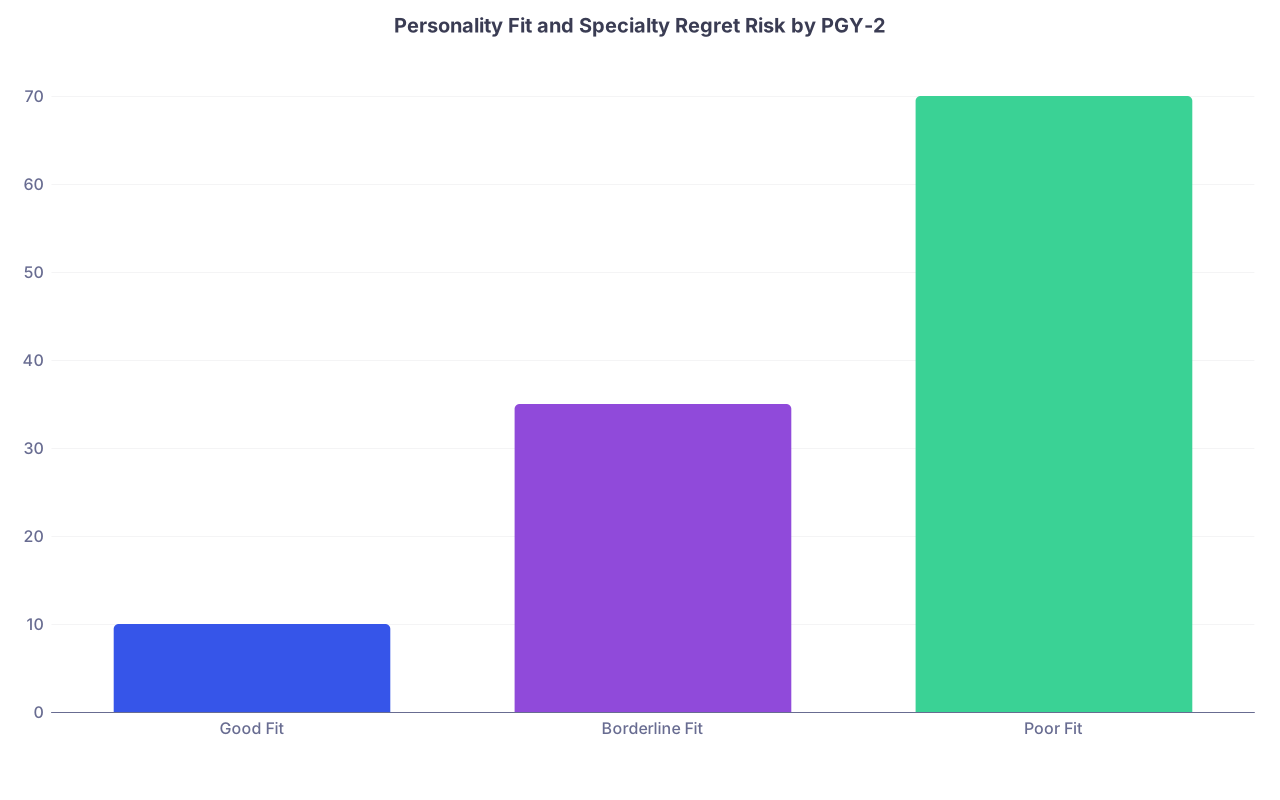
| Category | Value |
|---|---|
| Good Fit | 10 |
| Borderline Fit | 35 |
| Poor Fit | 70 |
This is not rigid psychology. It’s pattern recognition from watching hundreds of trainees.
1. ER Personality in a Clinic Specialty (and Vice Versa)
A classic disaster:
You choose family med or outpatient IM because it’s “lifestyle” and “broad.”
But you’re wired like an ED doc: you love acute, decisive problems, hate long-term follow-up, and get bored with chronic disease management.
By PGY-2 you’re:
- Dreading every 20‑minute follow‑up for HTN/DM/HLD
- Secretly jealous of your ED rotations because “at least stuff happens”
- Feeling trapped by the endless, messy continuity of care and documentation
- Checking EM job boards “just to see what’s out there”
Flip side: the contemplative, relationship-oriented med student who chooses EM for the “lifestyle” and “3 shifts a week.” They want time to think, build relationships, follow patient stories.
By PGY-2 they’re:
- Emotionally exhausted by the constant alarm state
- Hating the whiplash of never seeing how anything turns out
- Feeling like a cog in a rapid triage machine, not a physician
- Fantasizing about clinic days on their IM or peds rotations
If you love longitudinal relationships, EM will likely grate on you. If you crave clean endpoints and fast decisions, heavy clinic specialties will suffocate you.
2. Procedural Obsession vs. Procedural Aversion
Some people are just… happiest with tools in their hands. Needles, scopes, wires, ports, trocars. They like immediate results.
Others find procedures mildly tolerable at best and anxiety‑provoking at worst.
Common mistake:
Choosing a highly procedural field because it’s prestigious or “hands-on” when procedures actually drain you.
I’ve seen med students force themselves into surgery or IR because:
- “I like anatomy, so I’ll learn to like the OR.”
- “Surgeons are respected. I’ll adapt.”
By PGY-2 they’re:
- Dreading OR days
- Constantly nauseous with performance anxiety before cases
- Fixated on minor errors for days
- Depressed but telling themselves “I just need to toughen up”
On the flip side, I’ve seen thoughtful, technically-inclined students talk themselves out of procedural fields because they feel guilty about not doing something more “intellectual” like heme/onc or cards. They land in IM, then by PGY-2:
- They’re begging to do every LP, paracentesis, central line
- They sign up for every procedure clinic
- They’re restless in pure cognitive rotations, under-stimulated and bored
Your reaction to procedures on rotations is not a fluke. It’s data. Ignore it and you’ll pay for it later.
3. Need for Control vs. Tolerance of Chaos
Here’s one that wrecks a lot of high-achievers:
If you are someone who:
- Needs predictability
- Hates last-minute changes
- Wants clear plans and closure
- Gets very anxious when things are open-ended
…then certain specialties will feel like trying to practice medicine inside a hurricane.
Fields that skew toward chaos and unpredictability:
- Emergency Medicine
- Trauma surgery / acute care
- OB triage
- Hospitalist medicine in certain settings
Fields that skew toward control and predictability:
- Dermatology
- Pathology
- Radiology
- Elective-heavy surgical practices (once you survive training)
I’ve seen meticulous, control‑oriented med students talk themselves into EM because “the hours are good and it’s shift work.” By PGY-2 they’re shaking 20 minutes into a shift when:
- 3 sick patients arrive at once
- Their carefully planned algorithm falls apart
- They’re constantly interrupted and can’t complete a thought
They’re not weaker. They’re mis‑placed.
The Subtle Red Flags You Probably Ignored in Clerkships
During third year, your mind is loud: grades, evals, shelf exams, that attending who might write you a letter. Your gut is quieter—but it’s usually more honest.
Here are the red flags I’ve heard students casually mention… and then completely dismiss.
“I like the field, but I hate the people in it.”
Listen to that. Not because every surgeon is the same or every psychiatrist has identical personalities. But each specialty self-selects a certain culture.
If you consistently think:
- “I feel stupid every time I ask a question on this rotation, even when I know I’m prepared.”
- “The humor here is… not my style. At all.”
- “Everyone seems okay with a level of intensity that I find suffocating.”
…don’t just tell yourself, “Residency will be different.” It might not be. And even if your program is better, the field tends to preserve its norms.
“I love clinic days on this rotation… but not the OR” (or vice versa)
You’d be amazed how many people ignore this.
I’ve watched students who lit up on clinic days, loved talking to patients, enjoyed solving diagnostic puzzles—and then tried to convince themselves they were “fine” in the OR because they liked the idea of being a surgeon.
That “fine” becomes misery at 4:30 am as a PGY-2 prepping for another 12‑hour case.
The reverse: students who were bored to tears in clinic but found themselves fully engaged hours deep into a case. Then picked non‑surgical fields out of fear of competitiveness. They regret it later.
“I feel like a different person on this rotation”
That’s not fluff. That’s data.
I’ve heard:
- “On psych, I actually slept better and felt less anxious.”
- “On OB, my heart rate never dropped below 100 the entire month.”
- “On radiology, I got weirdly depressed being alone so much.”
By the way: your mind will try to rationalize all of those as circumstantial. “It was just that attending.” “It was just that hospital.” Sometimes that’s true. But if it happens repeatedly in the same kind of environment, that’s personality–specialty fit screaming at you.
How PGY-2 Exposes the Personality Mismatch You Covered Up
Why PGY-2 specifically? Because by then:
- The novelty is gone.
- The institutional support is thinner than as an intern.
- You’re expected to function more independently.
- The hours and responsibility have accumulated.
Whatever mismatch was a mild itch in PGY-1 becomes a rash in PGY-2.

| Step | Description |
|---|---|
| Step 1 | Med Student Ignores Red Flags |
| Step 2 | Matches Into Wrong-Fit Specialty |
| Step 3 | PGY-1: Adrenaline and Novelty |
| Step 4 | PGY-2: Higher Responsibility |
| Step 5 | Chronic Stress and Fatigue |
| Step 6 | Resentment, Burnout, Regret |
| Step 7 | Consider Switching or Leaving |
Patterns I’ve seen in PGY-2 regret cases:
- Escalating dread before certain rotations, not just generic tiredness
- Resentment toward co-residents who seem fine doing the same work
- Fantasizing constantly about other specialties
- Googling “how to switch residencies” at 2 a.m. on call
- Emotional numbness or random angry outbursts
And the worst part? Many of these residents knew during M3 that they were forcing the fit. They just thought they could “power through.”
You can grind through studying for Step 1. You can’t grind through a 3–7 year mismatch with who you are.
The Traps Med Students Fall into When Ignoring Personality Fit
You’re not stupid. You’re under pressure. That’s when people make predictable, avoidable errors.
Here are the most common ones.
Trap 1: Confusing “I like learning about this” with “I like doing this all day”
Loving a subject in a textbook ≠ loving how that specialty actually functions minute to minute.
- You can love neuro and hate neurology clinic.
- You can find cardiology fascinating and despise rounding on 18 CHF exacerbations.
- You can love pathophysiology but hate actual pathology workflow.
Ask yourself:
If I had to live a normal Tuesday in this specialty for the next 25 years, not a highlight reel, would I be content or crushed?
Trap 2: Letting other people’s admiration steer your choice
Med students soak up external validation like oxygen. Attendings, residents, family, classmates: they all love to project their fantasies onto you.
“I could totally see you as a surgeon.”
“You’re too smart not to at least try for derm.”
“You’d be wasting your talents in [insert ‘less prestigious’ field].”
I’ve watched brilliant, reflective, non-confrontational students march straight into malignant surgical or competitive subspecialty environments because everyone around them was excited for them. Meanwhile their own internal monologue was:
“I’m not sure I actually want this life.”
If your primary excitement about a field is other people’s reaction when you say it out loud, that’s not a specialty choice. That’s branding.
Trap 3: Overvaluing “keeping doors open”
IM as a placeholder. Preliminary surgery “while I decide.” Transitional years as perpetual limbo.
Look, some people genuinely need time, and IM is a wonderful home for explorers. But “keeping doors open” becomes a trap when:
- You never actually ask which doors you want
- You use it to avoid facing your real preferences
- You land in a specialty whose baseline workflow doesn’t suit you
I’ve met PGY-2s in IM who were clearly surgeons at heart, or radiologists, or psychiatrists—but they were still telling themselves, “I’ll figure it out later.” Meanwhile the clock is ticking and their options shrink.
Trap 4: Reducing everything to “lifestyle”
Med students love to talk “lifestyle” like they’re all amateur health economists. Clinic hours, no nights, lots of vacation—problem solved, right?
Wrong.
You can have a “lifestyle” specialty and still be miserable if your daily work fights your personality. I’ve seen:
- A social, extroverted, team-oriented student choose radiology for lifestyle, then spiral into loneliness and regret
- A highly sensitive, emotionally permeable student choose heme/onc because “outpatient and good hours” then drown in grief and complex family dynamics
Lifestyle is how long and when you work. Personality fit is how it feels while you’re working. They’re not substitutes.
A Brutally Honest Self-Assessment You Should Do Now
You don’t need a 100‑question psychometric inventory. You need unflinching answers to a few questions.
Take 10 minutes and write, not just think, your answers.
When have I felt most “myself” on rotations?
Not impressed. Not praised. Myself. Which rotations? Which settings? Which tasks?What kind of stress exhausts me the most?
- Fast, acute, time‑pressure decisions?
- Long, emotionally heavy conversations?
- Endless paperwork and documentation?
- Social conflict and confrontation?
Different specialties live in different stress profiles. Match accordingly.
How much do I actually need long-term relationships with patients to feel satisfied?
Some people don’t need that at all. Some people absolutely do. Don’t lie to yourself in either direction.Do I get energy from being around people at work or from being left alone to think?
Introvert vs. extrovert isn’t everything. But it sure matters if you sign up for a hyper-social clinic specialty when you really want quiet, or vice versa.How did I feel about nights and weekends on call?
Not the idea of them. The lived experience. Some specialties will always have more of this. If you became a shell of yourself after a week of nights, be careful with certain choices.
Now compare your answers to the typical realities of the specialties you’re considering.
| Tendency | Often Better Fit |
|---|---|
| Likes acute decisions, closure | EM, Anesthesia, Surgery |
| Likes long-term relationships | IM, FM, Peds, Psych |
| Enjoys solo, focused work | Path, Rads, Derm |
| Craves procedures | Surgery, Anesthesia, IR |
| Avoids confrontation/conflict | Psych, Rads, Path |
This table isn’t destiny. But it’s a sanity check.
How to Reality-Test Your Personality Fit Before You Match
Med students often do “research” on specialties by reading forums, watching YouTube, and asking one enthusiastic attending. That’s how you get biased, idealized versions of fields.
You need to deliberately expose yourself to the worst parts of a specialty and see how your personality reacts.
Here’s how, without blowing up your schedule.
1. Ask residents targeted, uncomfortable questions
Not “do you like your specialty?” That’s useless.
Ask:
- “What kind of person does poorly in this field?”
- “Who in your class is struggling the most, and why?”
- “If you had to pick a different specialty today, what would it be?”
- “What part of this job makes you think, ‘I’m not built for this’?”
The answers will tell you more about personality fit than any brochure or PD talk.
2. Pay attention on your worst call nights—not just your best days
People love to judge specialties by their best moments. That’s fantasy.
On your most miserable call in a field you’re considering, ask:
- Am I miserable because I’m tired, or because this work fundamentally grates against who I am?
- If this kind of night happened 2–3 times a week for years, would I adapt or crumble?
If your answer is “I’d wither,” pay attention.
3. Shadow in off-hours and unglamorous settings
Don’t just see clinic on “interesting case” days or OR time with the nicest attending.
Ask to:
- Sit in on a psych emergency intake shift at 2 a.m.
- Follow an internist doing endless discharge summaries on a slammed Friday
- Shadow a radiology resident at 3 p.m. when the ED is sending non-stop CT requests
Where does your internal response land on the spectrum from “this is rough but okay” to “get me out of here right now”?
4. Test-run administrative and documentation tolerance
Half of modern medicine is documentation and admin garbage. Different specialties have different flavors of it.
If charting and inbox management make you want to throw your laptop, think twice before heavy outpatient specialties. If constant interruptions and reactive pages break your concentration, watch out for certain inpatient roles.
You can’t avoid the admin, but you can choose which flavor of pain you’re more willing to live with.
The Cost of Getting This Wrong (and Why You Shouldn’t Just “Tough It Out”)
Let me kill a toxic myth: “You can survive anything for a few years.”
No. You can survive it, sure. But at what cost?
Residents who force their personality into the wrong specialty often:
- Develop anxiety or depression they never had before
- Start to resent medicine as a whole, not just their field
- Lose confidence, because constant mismatch feels like constant failure
- Withdraw from friends and family because they’re always drained
- Start talking about “leaving medicine” when they might have thrived in another field
I’ve seen PGY-2s sobbing in call rooms, saying, “I loved med school. I don’t recognize myself anymore.” They didn’t suddenly become weak. They chose a path that was never going to fit them.
Could they switch? Sometimes, yes. But it’s:
- Logistically hard
- Financially painful
- Emotionally devastating
And even when it works, they look back and say the same thing: “I knew during third year. I just didn’t want to admit it.”
What You Should Do Today
Do not wait for some magical “clarity” to appear right before ERAS. Clarity comes from brutally honest observation and deliberate testing, not wishful thinking.
Here’s your next move:
Open a blank document and make three columns: “Rotations/Settings,” “How I Actually Felt,” and “Why.” Fill it out for every major experience you’ve had so far—good and bad. Then circle every row where you felt most like yourself and most at home in your own skin.
That’s your starting map.
Now, look at the specialties you’re considering and ask one hard question for each:
“If I woke up as a PGY-2 in this field—on my worst rotation, after a string of nights—would this feel like a hard season in the right life, or the wrong life entirely?”
Answer that honestly. Don’t make the mistake of ignoring personality fit now and discovering regret when you’re already deep into PGY-2.


