The biggest lie people tell about surgical residency is that “you can have it all if you just prioritize.”
You can’t. Not all at once. And that’s exactly why you’re freaking out about missing family milestones.
You’re not being dramatic. You’re asking the right, brutal question:
“If I choose surgical residency, what will it actually cost me with my family?”
Let’s talk about that without the sugar-coating, but also without the doom spiral you’re probably stuck in at 2 a.m.
What “Missing Milestones” Really Looks Like in Surgery
You’re probably imagining the worst-case montage:
You miss every birthday. You’re scrubbed in while your kid says their first word. You forget your partner’s face. Everyone resents you.
That’s the nightmare reel. I run that reel in my own head too.
Here’s the more honest version of what missing milestones in surgical residency usually looks like:
You will miss stuff.
Not everything. But enough that it will sting.
You might:
- Be stuck on a case while your sibling blows out birthday candles on FaceTime.
- Leave your own kid’s first-day-of-school breakfast early because your attending wants you there at 5:15 a.m. not 5:30.
- Be on trauma call the weekend your cousin has their wedding you said you’d “try to make.”
But you’ll also:
- Be at the hospital scrolling through a video your partner just sent of your kid taking three wobbly steps in the living room—and you’ll watch it ten times in a row in the call room.
- Get out unexpectedly early one day and make it to a school play or a soccer game and feel like you just stole time from the universe.
- Be physically exhausted, but still stay up an extra 30 minutes at home because those are literally the only 30 minutes you get that day with your people.
The worry isn’t imaginary. The fear that you’ll turn around and your relationships will be rubble—that’s what keeps a lot of us up at night.
But here’s the part premed forums and glossy brochures don’t explain: there’s a difference between missing an event and missing a relationship. Surgical residency threatens both—but not in the same way, and not to the same degree for everyone.
How Different Surgical Specialties Hit Your Family Life
“Residency is hard” means nothing. Some surgical paths are basically time-theft on steroids.
Here’s a rough reality snapshot you can hang your brain on:
| Specialty | Weekly Hours | Weekend Call Frequency | Lifestyle Intensity |
|---|---|---|---|
| General Surgery | 70–80+ | q2–4 early on | Very High |
| Orthopedic Surg | 70–80 | q3–4 | Very High |
| Neurosurgery | 80–90+ | q2–3 | Extreme |
| ENT (Otolaryng.) | 60–75 | q4–6 | High |
| Plastics | 65–80 | Variable | High |
No, this isn’t exact. Every program is its own beast. But directionally? This is the vibe.
If you’re already panicking about missing family stuff, you need to be blunt with yourself:
- Neurosurgery with three young kids and zero local support? That’s not just “hard.” That’s a marriage-stress test, a mental health test, and a logistical nightmare all rolled into one.
- General surgery at a malignant, big-name academic powerhouse where the culture is “residents don’t need a life”? You’ll miss a lot, including sleep and probably anniversaries.
- ENT or plastics at a mid-sized, slightly more humane program? Still rough. But you might actually see your family while the sun is up occasionally.
None of these options are “family friendly” in the normal-person sense. You’re choosing between “brutal but manageable with good support” and “borderline unsustainable.”
That’s why this decision can’t just be “I like the OR.” It has to be:
Do I like the OR enough to miss this much of my people’s lives? And what’s non-negotiable for me?
The Milestones You’re Afraid of Missing (And How Often That Really Happens)
Let’s break down the things looping in your head.
1. Birthdays, holidays, and big celebrations
You will miss some. Period.
- PGY-1 and PGY-2 are usually the worst. You have the least control. You take the crummiest call schedules.
- Family will do Thanksgiving on a Thursday; you’ll be post-call and half-awake or you’ll be rounding.
A lot of residents I’ve seen develop a coping strategy:
Holidays become “flexible.” They do “fake Christmas” on a random Tuesday. They do birthday dinners the week after. It hurts at first, especially if your family is very calendar-attached. But many adapt.
What breaks people isn’t just missing the day. It’s feeling like they’re always the exception, always the one dialing in on Zoom from a call room while everyone else is around a table.
2. Partner milestones: anniversaries, promotions, breakdowns
These are sneakier and sometimes more painful than missing a kid’s soccer game.
- You’re on call on your anniversary. Again.
- Your partner gets a huge promotion and wants to celebrate, and you’re too tired to stay awake during dinner.
- They go through a rough patch mentally and you’re physically there maybe 15% of the time.
This is where resentment can creep up. Not necessarily because you missed an event, but because they feel like they’re living life alone while you live at the hospital.
3. Kid milestones: first steps, first words, school events
This one hits the hardest emotionally, and it’s exactly what you’re catastrophizing about.
Will some people scrub out of every important event? Honestly, yes. Some attendings are supportive; some are “the case comes first, period.”
But kids don’t only have one “big day.” They have hundreds of tiny, recurring “big days” that aren’t on a calendar:
- Random Tuesday night cuddles
- Goofy bedtime stories
- The 5-minute chaotic breakfast before you run out the door
You’ll probably miss some “firsts.” You’ll definitely miss a lot of bedtimes. But you won’t miss everything unless the situation is toxic and you never fight for any boundaries at all.
Red Flags and Green Flags When You’re Choosing a Program
Your fear isn’t just about “surgery.” It’s about ending up trapped in a program that makes a hard situation unbearable.
So when you’re looking at programs, you’re not just asking, “Will I be trained well?” You’re asking, “Will I still have a life that resembles a human’s?”
Here’s where to be nosy and borderline aggressive with your questions.
Watch what residents say—and what they don’t say
On interview day or second looks, you want to figure out: are their lives only hospital stories, or do families show up in the conversation?
Good sign:
- You hear, “My PD was actually great about me going to my kid’s recital when I asked three months ahead.”
- People mention partners by name. Someone jokes about going to their kid’s soccer game across town on their golden weekend.
- There are residents with kids who don’t look completely hollowed out.
Bad sign:
- Residents keep saying “it’s manageable” but never give specific examples of seeing family.
- Nobody mentions kids or partners unless you specifically ask, and then it gets awkward.
- You hear phrases like “surgery is your family here” or “your personal life will still be there after residency.” Translation: we own you.
How Often Will You Actually See Your Family?
Let me put numbers to what your brain is trying to feel.
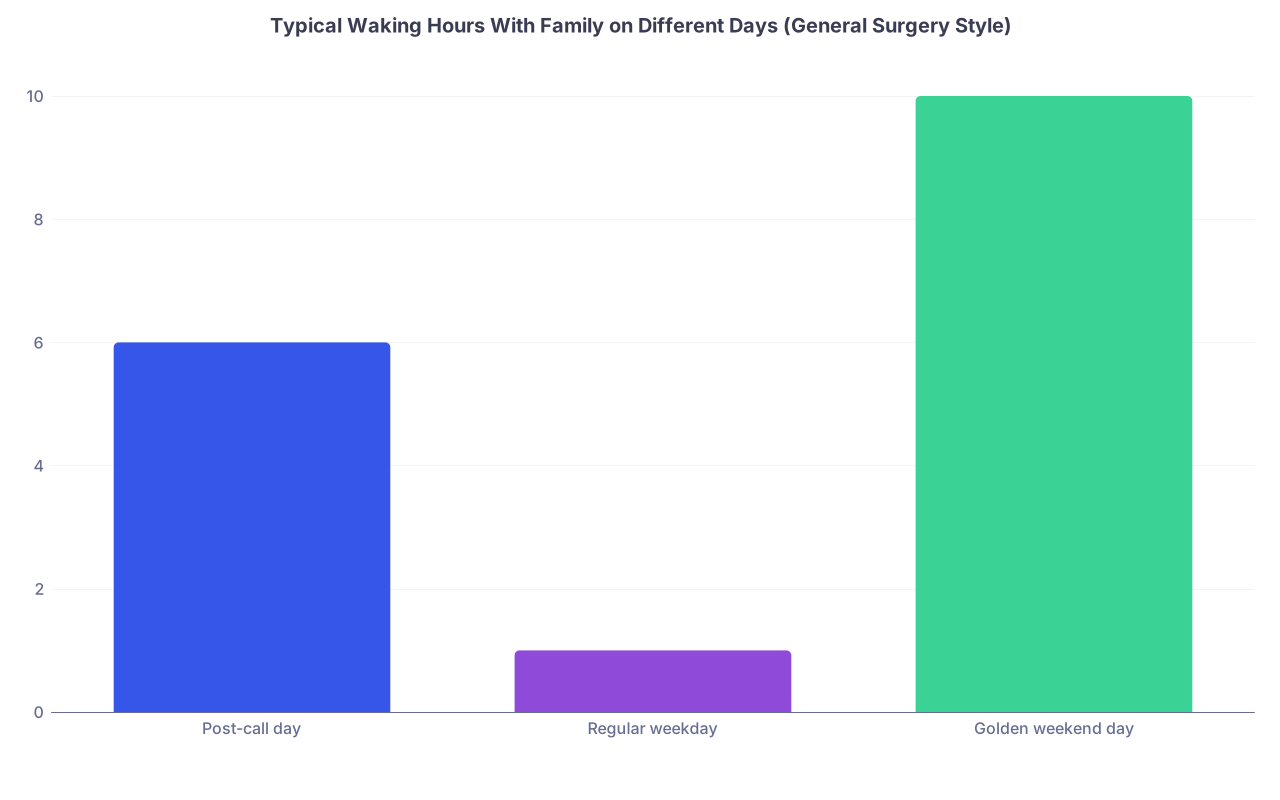
| Category | Value |
|---|---|
| Post-call day | 6 |
| Regular weekday | 1 |
| Golden weekend day | 10 |
Here’s the rough pattern I’ve seen over and over:
- Regular weekdays: You might get 0–2 waking hours at home. Think 30 minutes in the morning, 30–60 at night if you’re lucky.
- Call days: Maybe none. Your “interaction” is a text you answer in the stairwell.
- Post-call: Some programs actually let you go home mid-morning. Those days can be gold.
- Golden weekends: These can feel almost normal—until you remember they’re rare.
It’s not that you’ll never see your family. It’s that your time with them will be compressed and fragile. Small things going wrong—case runs late, trauma comes in, attending wants an extra add-on—can destroy your one hour that day.
That instability is what drives a lot of the anxiety. You can’t plan milestones with the same confidence civilians can.
Questions You Need to Ask Yourself (Even If They Make You Cringe)
You’re not wrong to be scared. The mistake is pretending you can love surgery “enough” that it magically fixes the cost. Passion doesn’t erase guilt.
Here’s the part no one wants to say out loud:
You’re going to disappoint someone. Either your program occasionally, or your family occasionally, or yourself often.
So the real question is: who are you willing to disappoint sometimes?
Ask yourself:
- If my kid cries because I missed something, can I live with that if I truly did everything I reasonably could?
- If my partner sometimes feels second to my training, are we strong enough and honest enough to work through that?
- If I walk away from surgery to protect my future family time, will I quietly resent that choice in 10 years?
There are no clean answers. Just trade-offs you can live with and trade-offs you can’t.
And yes, you’re allowed to say, “The cost feels too high for me.” That’s not weakness. That’s clarity.
Concrete Things You Can Actually Do About This (You’re Not Completely Powerless)
You can’t change ACGME rules or magically make a malignant attending kind. But you’re not a total victim either.
You can:
- Rank programs where residents with families exist and aren’t all on the brink of divorce.
- Ask explicitly on interview day, “How has the program supported residents with kids or major family responsibilities?” and watch the body language.
- Talk with your partner or family now, in ugly detail, about what the next 5–7 years might look like. Not the Instagram version. The real “I might miss Christmas three years in a row” version.
- Decide on a few non-negotiables. Maybe it’s “I will be physically present for my child’s surgery, period,” or “I will go to at least one major event per year even if I have to burn all my goodwill.” Then you fight for those. Hard.
You won’t control everything. But you can avoid walking into the worst-case scenario blind.
A Quick Reality Check: Will You Regret It Either Way?
Here’s the messed up truth I’ve watched over and over:
- Some people choose surgery, miss milestones, and regret it.
- Some choose a “lighter” specialty, go to every school play, and still lie awake at night wondering if they walked away from the OR they loved.
You are choosing a regret profile. There is no door with zero pain behind it.
The goal isn’t “no regret.” That’s fantasy.
The goal is: when the regret shows up, it’s at a volume and in a direction you can live with.
If you’d feel dead inside walking past the OR forever, that matters.
If you’d feel sick to your stomach missing yet another family moment while you’re stapling skin at 10 p.m., that matters too.
Neither version of you is wrong. They’re just different priorities.
FAQ (The Stuff You’re Probably Still Thinking About)
1. Is it “selfish” to choose a surgical residency if I know I’ll miss family events?
Not automatically. It’s selfish if you lie to your family about what’s coming or refuse to hear their fears. It’s selfish if you use residency as an excuse to never show up emotionally even when you could. But choosing demanding training, being honest, and working like hell to protect small moments? That’s not selfish. That’s complicated and human.
2. Are there actually “family friendly” surgical programs or is that just marketing?
“Family friendly” is often oversold. No surgical residency is 40 hours a week with yoga breaks. But some places are actually humane: they honor post-call days, they don’t tolerate abuse, leaders visibly protect resident time when they can. The litmus test: ask current residents, “Would you tell a close friend with kids to come here?” If they hesitate or dodge, you have your answer.
3. What if my partner already seems hesitant about surgery—should that be a deal-breaker?
It’s not a deal-breaker, but it’s a red flashing light that you need a brutal, honest conversation now—not after the Match. Hesitation is normal. Silence and resentment are what destroy relationships. Walk them through sample weeks. Ask what they’re most scared of. Tell them what you’re most scared of. If you can’t have that conversation now, residency pressure will only make everything worse.
4. Will things get better after residency, or is this just my forever life if I choose surgery?
They usually get different, not magically easy. Early attending life can be intense, but you generally have more control over your schedule, job choice, call, and where you live. A community hospital general surgeon with partners who share call is very different from a fresh trauma attending at a major academic center. If you can hang on during residency and then deliberately choose a job with your family in mind, the “I miss everything” feeling often eases a lot.
Open a note on your phone right now and write two short lists:
- The top three family moments you absolutely refuse to miss if you can help it.
- The top three reasons you’re drawn to surgery in the first place.
Look at those six things. If they feel like they can coexist—even uneasily—it might be worth pushing through the fear and choosing surgery carefully. If they feel like they’re fighting to the death on the page, that’s your sign to step back and rethink before you commit to a path that will hurt more than it has to.