
The idea that your core general surgery rotation should magically “click” for you is nonsense.
For a lot of students, it does not. The hours are brutal, the culture is abrupt, and half the time you are holding retractors and trying not to pass out. That does not automatically mean you should never touch an operating room again. But it also does not mean you should “tough it out” and apply to surgery because you liked anatomy in M1.
You need a structured reassessment. Not vibes. Not panic. A real diagnostic workup of why the rotation felt off and what to do before ERAS locks you in.
This is the playbook.
Step 1: Separate the Rotation from the Specialty
First fix: stop treating one clerkship as the definitive referendum on your entire career.
I have seen students write off surgery because:
- They had one malignant chief
- They were at an understaffed community hospital
- They scrubbed mostly on 10-hour ex-lap marathons and zero lap choles
- They were on nights the entire time and never saw clinic
You would not diagnose sepsis off one low blood pressure reading. Do not diagnose your career off one bad month.
Ask yourself six very specific questions and write down the answers. Not in your head. On paper or screen.
Environment vs content
- Did you hate the work environment (yelling, disorganization, hierarchy)?
- Or did you hate the actual work (procedures, rounding, peri-op care)?
Clinic vs OR
- On days you were mostly in clinic, how did you feel by 5 p.m.?
- On days you were mostly in the OR, how did you feel when you got home?
Pre-op and post-op
- Did pre-op planning, risk discussions, and post-op management interest you?
- Or were they just the price you paid to be allowed into the OR?
Fatigue vs dread
- Being tired is normal.
- Did you feel “this is hard, but I care”? Or “this is hard and I do not care at all”?
Acute vs chronic
- Did acute surgical problems (perforated viscus, bowel obstruction, trauma) engage you?
- Or did you find yourself far more intrigued by chronic, longitudinal medical management?
Would a different team change everything?
- If you could replay the rotation with a kind, teaching-focused attending and a healthy culture, do you suspect your experience would be mildly better or fundamentally different?
If your honest answers show:
- Content was interesting, environment was toxic → you reassess context, not necessarily specialty.
- Content was boring or repulsive, environment was fine → you seriously reconsider surgery.
- Both were bad → surgery is probably not your home, but you still do a careful second pass (more on that).
You are not deciding yet. You are categorizing the failure mode.
Step 2: Diagnose What Exactly Didn’t Click
Now you get more granular. Vague “I didn’t click” is useless. You need a problem list.
Break your experience into specific domains:
- Cognitive work
- Technical work
- Culture
- Lifestyle
- Identity fit
Then you label each as:
- Green: energizing / meaningful
- Yellow: tolerable / neutral
- Red: draining / unacceptable
Cognitive Work
This is the thinking part.
Examples of general surgery cognitive tasks:
- Evaluating acute abdomen in the ED
- Managing sepsis secondary to intra-abdominal infection
- Interpreting post-op labs and imaging
- Perioperative risk assessment
- ICU-level post-op management in some rotations
Ask yourself:
- Did evaluating sick, unstable patients feel like a worthwhile challenge or just chaos?
- Did you like the decisiveness: “This needs the OR now” vs “Medicine admission for workup”?
- When you were reading about surgical topics (e.g., SBO, pancreatitis, hernias), were you engaged or zoning out?
If cognitive work was green or yellow, that is a point in favor of at least giving surgery a fair second look. If it was solid red, repeatedly, that is significant.
Technical Work
This is the hands-on side.
Be brutally honest:
- When you got to tie knots, suture skin, hold the camera: did that feel satisfying?
- Did you find yourself watching the surgeons’ hand movements, even if you were tired?
- Or were you mostly watching the clock, even with interesting cases?
Plenty of students like watching surgery but hate doing it. That distinction matters.
If procedures were the only bright spot in your day, that tells you something. If even that did not move the needle, general surgery as a career is likely a poor fit.
Culture
You experienced one snapshot of one institution’s general surgery culture.
List specific behaviors you saw:
- How did attendings respond to mistakes or I-don’t-know answers?
- How did residents talk about their work at 2 a.m.?
- Was there teaching, or mostly scut with occasional “good job”?
- Did you see any residents with kids, hobbies, or lives outside the hospital?
Then ask:
- What did I assume was “just surgery” that might actually be “just this program”?
Talk to residents in other hospitals, or even at your same place but on different services (e.g., colorectal vs trauma vs breast). Culture variation is real. I have watched students hate a trauma month then love a breast surgery elective with a completely different team.
Lifestyle
Now be explicit about lifestyle:
- Waking up at 4–4:30 a.m.
- Long OR days + notes + consults
- Weekends and nights
- Constant pages and interruptions
You are allowed to care about this. You are not weak for wanting to see your future family.
But you must differentiate:
- “This is unsustainable for me forever”
vs - “This is brutal as a student with no control or efficiency.”
Residents move faster, have more leverage over their workflow, and are not stuck waiting three hours for something you could not control.
Still, if your deep reaction is: “I do not ever want a life shaped around the OR schedule,” you should believe that.
Identity Fit
This one sounds fuzzy, but it is not.
Did you see anyone on the service where you thought, “I could be like that in 10–15 years and not hate my life”?
- Attending style
- Non-surgical interests
- Personality types
If the honest answer is no—across the board—that is a serious data point. Sometimes it is not about the tasks; it is about the tribe.
Step 3: Compare Surgery Against Other Specialties You Liked
You are not choosing in a vacuum. You’re comparing.
Make a simple side-by-side. Something like this:
| Factor | General Surgery | Alternative (e.g., IM, EM, Anesthesia) |
|---|---|---|
| Enjoyment of day-to-day | 1–10 | 1–10 |
| Tolerance of hours | 1–10 | 1–10 |
| Interest in content | 1–10 | 1–10 |
| Fit with attendings | 1–10 | 1–10 |
| Long-term lifestyle | 1–10 | 1–10 |
Do not overthink the numbers. Go with gut scores. Then look at the spread.
If you are giving:
- Surgery: lots of 3–5 scores
- Another specialty: lots of 7–9 scores
Do not ignore that.
Also, pay attention to why you liked the other specialties:
- Was it because you finally got to sleep?
- Or because the clinical reasoning and patient population actually fit you better?
Those are different stories.
Step 4: Collect Outside Data Before You Decide
Your experience is one data point. You need a few more, quickly and strategically.
1. Targeted Conversations
Talk to three groups. Ask pointed questions, not “Do you like surgery?”
A. Senior general surgery residents (PGY-3+).
Ask:
- “What did you hate about surgery as a student that turned out to be just the student role, not the job?”
- “What is the most honest downside you would tell your sibling if they were considering general surgery?”
- “What makes someone miserable here even if they are technically good?”
B. General surgery attendings you respect.
Ask:
- “What did you underestimate when you chose surgery?”
- “Which residents here do poorly, even if they have strong scores?”
- “If you could go back, would you choose it again—and why specifically?”
C. Residents in fields you are considering instead (IM, EM, Anesthesia, etc.).
Ask:
- “What pulled you away from surgery, if you ever considered it?”
- “What tradeoff did you consciously accept by picking your field?”
You are not collecting pep talks. You are collecting patterns.

| Step | Description |
|---|---|
| Step 1 | You reassessing |
| Step 2 | Senior Surgery Residents |
| Step 3 | Surgery Attendings |
| Step 4 | Residents in Other Fields |
| Step 5 | Identify real downsides |
| Step 6 | Understand long term reality |
| Step 7 | Clarify tradeoffs |
| Step 8 | Refine decision |
2. Get Another Surgical Exposure (But Short and Focused)
If you are seriously undecided, do not base your decision on one month.
Options:
- A 2-week subspecialty elective (e.g., colorectal, surg onc, MIS, breast)
- A trauma or acute care surgery week if you mostly saw elective cases before
- A day-in-the-life shadowing with a community general surgeon in clinic + OR
This is not about padding your CV. It is a diagnostic test.
Specific things to look for:
- Do you feel any spark when you are allowed to do more than retract?
- Does a different team or setting change your perception?
- How do you feel driving home after 3–4 consecutive days in the OR?
If a second exposure with a good team still feels flat or miserable, that is powerful evidence.

Step 5: Analyze the “I Could Suffer Through It” Trap
A lot of high-achieving students fall into this: “I did not enjoy it much, but I could grind it out. I can handle hard things.”
Of course you can. That is how you got here. But it is the wrong question.
The real question is:
“Could I live this life for 10+ years and not become bitter, unhealthy, or burned out?”
Run your honest answers through three stress tests.
Stress Test 1: Worst-Case Nights
Picture this: 24-hour call, three emergent cases overnight, no sleep. Someone crashes at 5 a.m. You are still the person the nurse calls.
How do you feel about that scenario?
- If part of you feels: “It would be awful, but there is meaning in it,” surgery may still be on the table.
- If you feel only dread and zero sense of purpose, that is not just fatigue talking. That is misalignment.
Stress Test 2: The Middle 5 Years
Forget the end state of being an attending with a tailored practice. Think about PGY-2 to PGY-6.
- Rotating services
- In-house call
- Board studying
- Constant OR learning curve
If you knew your average day for 5 years would look roughly like your hardest gen surg days—would you still choose it?
Stress Test 3: You at 45
You are 45, a general surgeon. You are no longer proving yourself; you are established. Clinic, cases, occasional emergencies, lifestyle shaped around O.R. block time.
Do you see a version of yourself there that you respect?
If all three stress tests feel off, stop trying to rationalize your way into surgery just because you can survive it.
Step 6: Decide What You Actually Want From Your Career
Strip away labels like “surgeon” or “internist.” List the core elements you want in your work.
Common dimensions:
- Degree of procedural work
- Acuity level (how sick, how unstable)
- Continuity of care (episodic vs long-term relationships)
- Balance of clinic / OR / inpatient
- Cognitive vs hands-on emphasis
- Predictability of schedule
- Team environment vs independent work
Now rank these: Must-haves, Nice-to-haves, Not important.
Example:
- Must-have: Some procedural work, variety, team-based environment
- Nice-to-have: Predictable schedule, minimal clinic
- Not important: Longitudinal continuity
Then look at which specialties realistically match.
Here is a simplified snapshot:
| Specialty | Heavy Procedures | High Acuity | Longitudinal Care | Lifestyle Predictability |
|---|---|---|---|---|
| General Surgery | Yes | High | Low | Low |
| Surgical Subspecialty (e.g., Breast) | Yes | Medium/Low | Medium | Medium |
| EM | Some | Very High | None | Medium |
| Anesthesia | Yes | High | None | Medium/High |
| IM | Minimal | Variable | High | Medium/High |
If what you really want is:
- Hands-on work
- Sick patients
- Team-based fast decisions
- But you hated pre- and post-op continuity…
You might end up happier in EM or anesthesia than in general surgery.
Step 7: If You Still Think Surgery Might Be Right
Let us say your honest review comes back like this:
- You liked the anatomy, pathophysiology, and procedures.
- You hated being a peripheral, powerless student.
- The culture was not great, but you see possible better versions elsewhere.
- You are tired, not repelled.
Then you do not bail on surgery yet. You tighten your reassessment and plan for a deliberate test run.
Here is what to do before you hit “submit” on ERAS:
Schedule a positive-control elective.
Put yourself with a known good teaching surgeon or subspecialty with a reputation for sane culture.Ask to be used, not tolerated.
Tell the resident: “I am trying to decide about surgery. Please give me honest feedback on whether my temperament and performance seem like a fit.”Track your internal signals.
For 1–2 weeks, note daily:- Did I feel any sense of flow in the OR?
- Did I learn something that I wanted to read about later?
- How miserable was I on a 0–10 scale when my alarm went off?
Get frank feedback.
Ask attendings directly:- “Do you think I would be a good fit for general surgery?”
- “If I were your kid, would you recommend or discourage this path for me?”
You want real answers, not politeness.
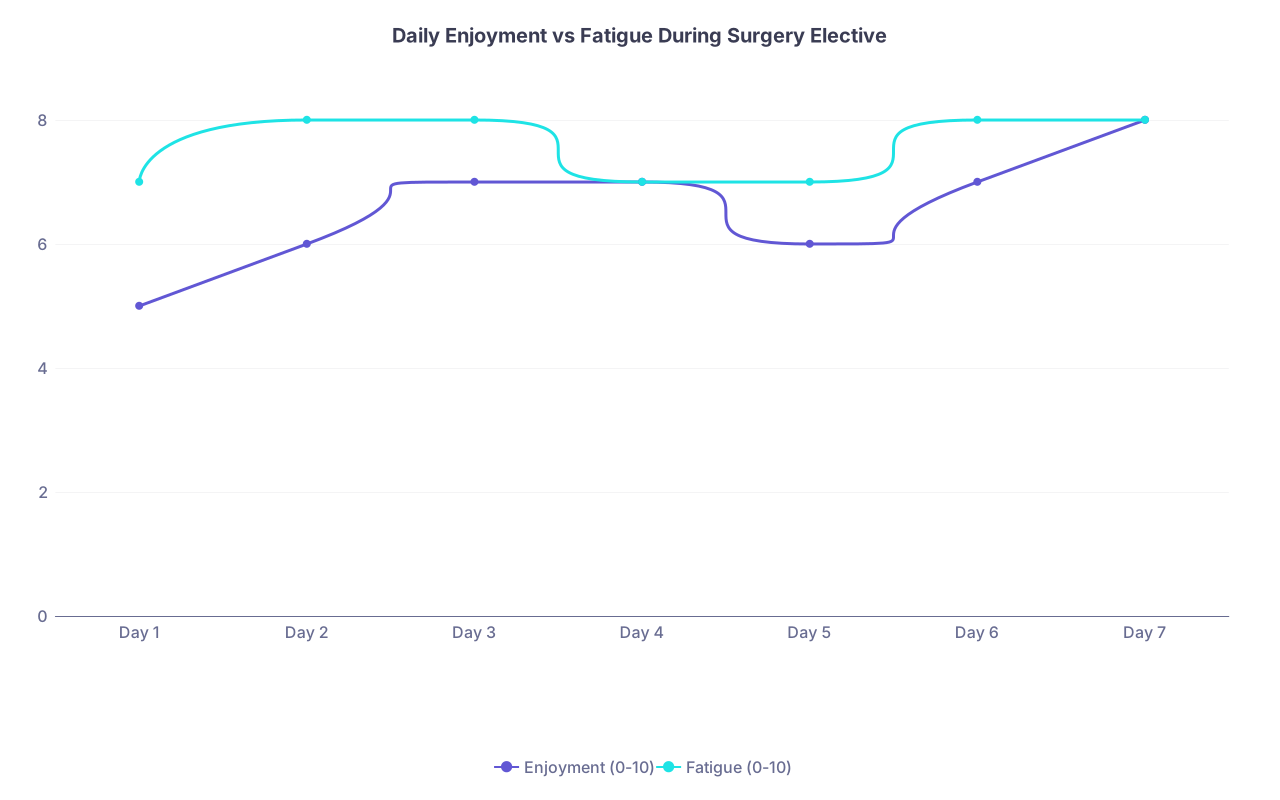
| Category | Enjoyment (0-10) | Fatigue (0-10) |
|---|---|---|
| Day 1 | 5 | 7 |
| Day 2 | 6 | 8 |
| Day 3 | 7 | 8 |
| Day 4 | 7 | 7 |
| Day 5 | 6 | 7 |
| Day 6 | 7 | 8 |
| Day 7 | 8 | 8 |
If after that, your enjoyment line never rises while fatigue stays sky-high and you feel mentally checked out, the data are loud. Believe them.
Step 8: If You Decide Surgery Is Not For You
Then stop apologizing for that.
Plenty of excellent students reach this conclusion. The mistake is not deciding against surgery. The mistake is dragging your feet and giving yourself too little time to build a strong application in the field that actually fits.
Concrete steps:
Name your new target field quickly.
Do not float indefinitely. Commit to internal medicine, EM, anesthesia, radiology, whatever fits your honest analysis.Reframe the narrative for yourself.
“I am too weak for surgery” is garbage.
A better frame: “I did a real stress test, and the day-to-day reality of general surgery did not match my values or energy. I am choosing a field where I will actually thrive.”Document the decision process.
Write 1–2 pages (private) on how you came to this choice. Not for programs. For you. It will stabilize your confidence and help you speak clearly in interviews when asked, “Did you consider surgery?”Build signal quickly in the new field.
- Do an elective or sub-I in that specialty
- Get at least one strong letter there
- Engage with residents and faculty to understand expectations
Prepare honest, calm interview answers.
You will be asked about your surgical experience, especially if it is prominent on your CV. Your script might be:- “I enjoyed the acuity and procedures of general surgery, but during my rotation I realized that the long-term lifestyle and the specific day-to-day tasks did not fit me as well as I expected. When I rotated in [target specialty], I found that the blend of [X, Y, Z] aligned much better with how I work and what I want my practice to look like. That is why I am committed to [specialty].”
Confident. Specific. No drama.

Step 9: Watch for Red-Flag Motivations Either Way
Here are the reasons to not choose general surgery:
- “I want people to think I am hardcore.”
- “I liked trauma in TV shows.”
- “I am afraid my family will see me as less of a doctor if I pick something else.”
- “I already told everyone I wanted to be a surgeon.”
And here are the reasons to not run away from general surgery:
- “I felt useless as a student, so I must hate the field.”
- “The hours on my rotation were bad, so all surgery must be impossible.”
- “One attending humiliated me, so I am clearly not cut out for this.”
- “I am female / non-traditional / have a family, so I probably cannot do surgery.” (Wrong. You just need a program that does not live in 1975.)
If any of those are driving your choice, pause. Clean up the thinking, then decide.
Step 10: Put It All Together in a Simple Decision Framework
You do not need a 20-page spreadsheet. You need a clear framework that gets you off the fence.
Use this structure:
My top 3 career non-negotiables are:
General surgery meets these by:
- Non-negotiable 1: Yes / No – evidence: ______
- Non-negotiable 2: Yes / No – evidence: ______
- Non-negotiable 3: Yes / No – evidence: ______
My top 2 alternative specialties are:
Compared head-to-head, my energy and interest scores are:
(Use a simple 1–10 scale like earlier.)My gut reaction when I picture myself as a PGY-3 in each field:
- Surgery: sentence or two
- Alt 1: sentence or two
- Alt 2: sentence or two
Based on evidence + gut, I will:
- Apply general surgery
- OR apply [alternative specialty]
- OR take one more very specific elective before [date] and then commit
Set a concrete deadline for that last option. Indecision forever is not a strategy.

| Step | Description |
|---|---|
| Step 1 | General surgery rotation did not click |
| Step 2 | Strongly reconsider surgery |
| Step 3 | Schedule focused elective |
| Step 4 | Consider applying surgery |
| Step 5 | Pick alternative specialty |
| Step 6 | Apply to surgery with eyes open |
| Step 7 | Content interesting? |
| Step 8 | Second exposure with good team? |
| Step 9 | Still unhappy? |
The Bottom Line
Three points to walk away with:
- One rough general surgery rotation is a data point, not a verdict. Diagnose whether you hated the content, the role, or the culture before you decide.
- Use structured reassessment—second exposures, targeted conversations, and honest stress tests—to see if surgery aligns with your non-negotiables and long-term life.
- If general surgery is wrong for you, own that choice early and pivot decisively; if it is right, apply with clear eyes about the sacrifices you are actually willing to make.