The belief that you “need” to match at your own med school to do surgery is wrong—and it is quietly hurting a lot of students’ decisions.
Let me be blunt: matching at your home institution can help in some specific situations, but it is not the golden ticket people make it out to be. Plenty of strong applicants do not match at their med school and end up in excellent surgical programs. Plenty of weaker applicants do match at home and then tell a neat story about “fit” that ignores the real reasons.
You deserve the real breakdown, not the hallway gossip.
What the Data Actually Shows About Matching “At Home”
First, let’s anchor in numbers instead of vibes.
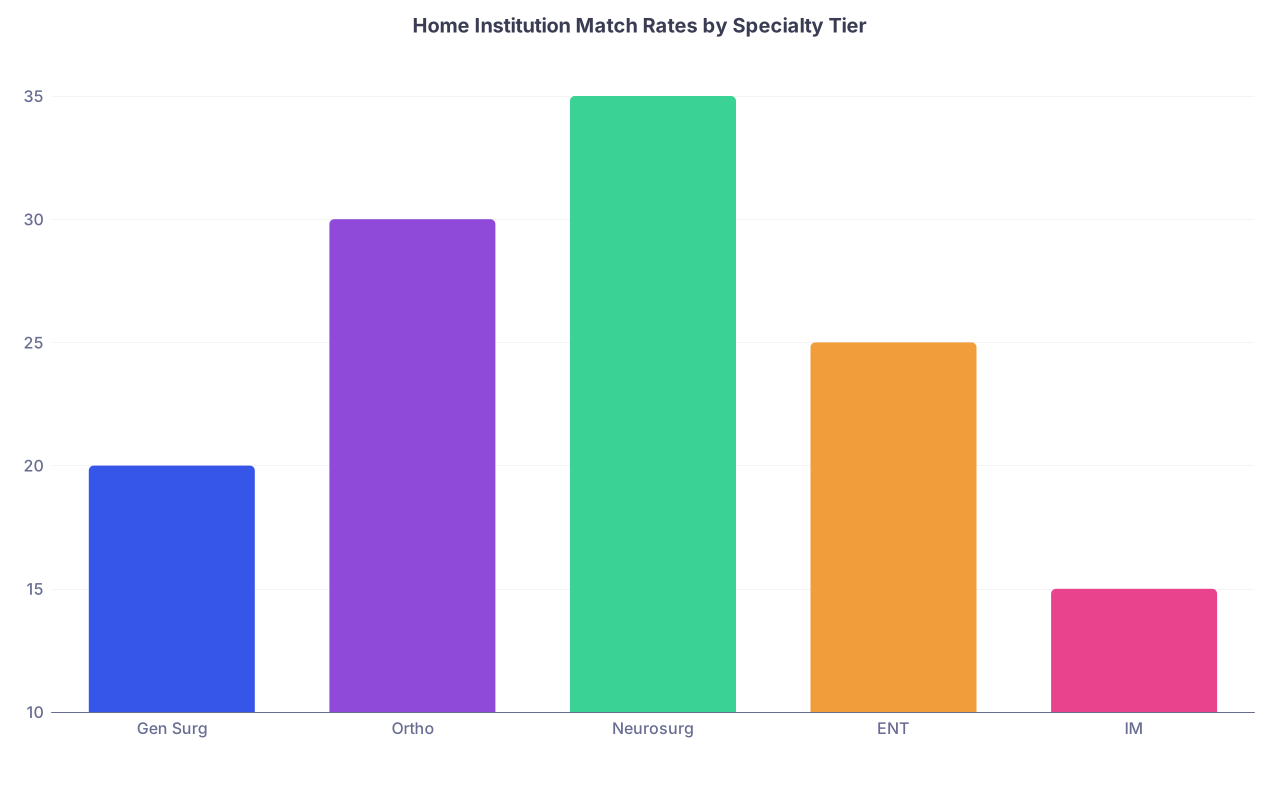
Several NRMP and program-level analyses have shown that home institution matches are common, but not destiny.
Typical patterns (varies by year and study, but this is the ballpark):
| Category | Value |
|---|---|
| Gen Surg | 20 |
| Ortho | 30 |
| Neurosurg | 35 |
| ENT | 25 |
| IM | 15 |
Rough translation: for general surgery, something like 1 in 5 residents matched at the same school where they went to medical school. For more competitive surgical subspecialties (ortho, neurosurg, ENT), it can be closer to 1 in 3.
That means two things simultaneously:
- Matching at home is common enough that you should understand how it works.
- Matching away is more common than staying.
If you talk to a PGY‑2 in general surgery who says, “Everyone just stays where they went to med school,” that’s survivorship bias. They’re standing in a program that, by definition, sees their own students more often and remembers those who stayed.
What you do not see on social media is the quiet majority of surgical residents who came from somewhere else, had zero family connection to the city, and simply matched where their application was strongest.
Now, general surgery specifically. The NRMP’s “Charting Outcomes in the Match” and program surveys paint a consistent picture over years: surgical PDs care about your clinical performance, letters, and USMLE/COMLEX profile a lot more than the name on your diploma or whether it matches their hospital’s stationery.
Why Programs Like Their Own Students (and When That Matters)
Let’s not pretend there’s no home-field advantage. There is. But it’s narrower and more conditional than students think.
Programs like their own students because:
- They’ve seen you on their wards, in their ORs, at 2 a.m. when the ED is dumping patients.
- They know how hard you actually work, not just what an MSPE “summary” claims.
- They’ve watched you function in their specific chaos: their EPIC templates, their call structure, their attendings.
I’ve heard attendings say this explicitly on selection committees: “We know what we’re getting with our own students.”
That’s not a mystical preference for the school logo. It’s risk management.
But here’s the part nobody writes on Reddit: that same familiarity cuts both ways.
If you were mediocre on your home general surgery rotation, phoned in notes, acted annoyed during scut, or got tepid evaluations? Matching at home can become harder, not easier. You’re no longer a polished application with glowing narrative; you’re the student they remember needing to be chased for consult notes.
At that point, an away program that’s only seeing your best behaviors on a visiting rotation might rate you higher than your own department.
So the actual rule looks more like this:
- If you genuinely excelled and were noticed on your home service, matching there becomes plausibly easier.
- If you were invisible, or worse, a known problem, matching there may be harder than at a place that only sees your paper file and a single sub‑I.
The dumb myth is: “Home school always favors its own.”
The real version is: “Home school favors its own good students and absolutely remembers its own bad ones.”
Do Programs Expect You to Want to Stay?
This part’s more subtle, and it depends a lot on the culture of your department.
Some departments quietly assume: if you’re serious about surgery and you like us, you’ll rank us highly. They won’t say it out loud, but they notice if their strongest students do zero general surgery sub‑Is in-house and disappear for an ortho or plastics tourism tour.
Others honestly do not care whether you stay or go; they pride themselves on being “neutral” with their students and are more interested in whether you match well somewhere. I’ve seen this especially at big-name academic centers that get 800+ applications a year. Their residents already come from everywhere, and they won’t bend the rank list much for their own students unless those students are truly elite.
Where applicants get burned is misreading that culture:
- Student thinks: “I have to show I’m trying to stay, so I’ll rank them #1 even though the vibe was off and the hours were brutal.”
- Meanwhile, program thinks: “We like them, but they’re mid‑pack; if they come, great, if not, no big deal.”
You’ve just distorted your rank list based on a one-sided assumption.
Here’s a more honest frame:
Programs care that you match safely and that they fill their own spots with people who will not quit or implode. Whether those people all come from in-house or from 20 different schools is mostly secondary.
The Real Levers That Matter More Than “Home vs Away”
If you’re aiming for general surgery (or surgical subspecialties), your match odds move way more with these things than with whether you stay at your med school:
- Your clerkship and sub‑I performance in surgery
- Strength and enthusiasm level of your letters (especially from surgeons)
- USMLE Step 2 CK / COMLEX Level 2 scores
- Your reputation as a worker and teammate
- Your interview performance and professionalism
Home program familiarity touches some of those, but it doesn’t override them.
I’ve watched this exact scenario:
- Student A: Home med student, barely outstanding, a couple of lukewarm comments on rotation (“solid but quiet,” “needs to take more ownership”), average Step 2.
- Student B: Outside student who did a killer sub‑I there, took ownership of consults, read on cases, impressed both the junior and senior residents, strong Step 2.
On a rank list, I’ve seen B jump ahead of A at that same program. The committee will literally say: “B was a rockstar on their sub‑I. A was… fine. Let’s go for B.”
So no, the patch on your short white coat doesn’t guarantee preference.
What If You Actually Don’t Want to Stay?
Here’s where conventional advice gets almost malicious.
Students are told, “Don’t burn bridges. Always act like you’d be honored to stay.”
Fine. Don’t torch the place. But you’re allowed to be honest with yourself.
There are completely valid reasons not to stay for surgery:
- Toxic department culture you’ve seen up close
- Geographic needs (partner, kids, health, visa constraints)
- Mismatch in case volume or academic interests
- You simply want a fresh start elsewhere
The myth says: “If you do not show your home program tons of love, they’ll tank you and word will spread.”
The actual reality: if you act professionally, work hard on service, and do not make dramatic pronouncements about “never staying here,” they’ll generally support you. They look better when their grads match well nationally, not just locally.
Program directors talk to each other, yes. But what they say is usually about your work ethic, your integrity, and whether your letters match your behavior. Not “this student betrayed us by matching in Chicago instead of staying in-house.”
If you truly do not want to stay:
- Still treat your home rotations as real auditions. They’re watching.
- Collect strong letters if you can; a supportive letter from a home surgeon helps anywhere.
- You do not need to declare, “You’re not in my top three.” Keep it simple: “I’m very open geographically and exploring a range of programs.”
That’s enough.
When You Should Seriously Consider Matching at Home
Let’s flip the script. There are times when staying put is the sharp, strategic move—even if your ego wants a shiny new city.
The “stay home” strategy makes particular sense if:
You’re a strong but not superstar applicant
Mid‑250s Step 2, solid honors, good but not famous research. Your home program knows and likes you. You gel with the residents. You want a broad general surgery education. In that scenario, ranking your home program highly is smart risk management.Your home program is very competitive nationally
Think top‑tier academic surgery departments. Sometimes the hardest place to match from the outside becomes quite accessible from the inside if you’ve built strong relationships and crushed their sub‑I. Suddenly you’re being ranked above external applicants with similar stats because you’re a known quantity.You have real-life constraints
Partner career, childcare, caregiving responsibilities. Staying put might give you more support and stability, which absolutely affects your performance as a resident. Ignoring that, just to say you “went away,” is not brave; it is shortsighted.
The key is choosing home because it aligns with your training and life—not because someone told you you “should” want it.
Away Rotations vs Home: What They Actually Signal
A lot of anxiety swirls around sub‑Is. Students ask, “If I do away rotations, will my home program think I’m leaving them?” Or, “If I don’t do a home sub‑I, am I dead there?”
Here’s how programs usually interpret it:
Doing at least one home general surgery sub‑I
Signals you’re taking surgery seriously. Lets the department see your senior-level performance. Generally a good idea if you’re considering surgery at all.Doing away sub‑Is both at brand-name and mid-tier places
Signals you’re exploring options, seeing different systems, and showcasing yourself where you’re interested. This is normal, not disloyal.Doing zero home surgery sub‑Is, but 3 away subs in other cities
This can raise eyebrows at home if they thought you were leaning toward them. But it’s not fatal; it just makes them rely more on third-year evals and word-of-mouth.
I’ve sat in discussions where someone said, “They didn’t do a home sub‑I here—were they not interested?” But if the file is strong and the letters are good, and they interviewed well, they’re still ranked. It’s a data point, not a dealbreaker.
The Numbers Game: Where Matching at Home Helps Most
Let’s make this less abstract. Imagine four simplified applicant profiles targeting general surgery:
| Profile | Academic Strength | Home Program Impression | Home Match Edge |
|---|---|---|---|
| A | Strong | Strong | Significant |
| B | Strong | Weak/Unknown | Minimal |
| C | Average | Strong | Moderate |
| D | Weak | Weak | Negative |
You can guess who benefits most from staying:
- Profile A and C are where a home program really helps. Good-to-strong students who are known and liked.
- Profile B doesn’t benefit much; they’re better off leveraging national strength.
- Profile D may literally be better off elsewhere; the home faculty already has reservations.
None of this requires you to match at your med school. It just means if you do have that combo of strengths and relationships, don’t discount the home program for superficial reasons.
How to Actually Decide: A Sanity Checklist
Forget the folklore. When you’re building your rank list, the “Should I stay?” question should reduce to something like this:
- Would I be proud to train here if it were not my home school?
- Do I trust the people (residents + faculty) I’d be in the trenches with?
- Does the case mix and structure align with how I want to practice?
- Have they treated their current residents decently—backed them during crises, not just lip service?
- Am I ranking them high because I want to, or because I’m scared not to?
If you can honestly say:
- “Yes, I like the training”
- “Yes, I respect these people”
- “No, I’m not just scared of leaving”
…then ranking your home program high is rational.
If not, you’re forcing yourself into a five-to-seven-year commitment out of superstition.
A Quick Visual: Home vs Away Outcomes Over Time
Just to drive home that the world is bigger than your school’s walls:
| Category | Value |
|---|---|
| Home Med School | 22 |
| Same State Different School | 18 |
| Out-of-State | 50 |
| International | 10 |
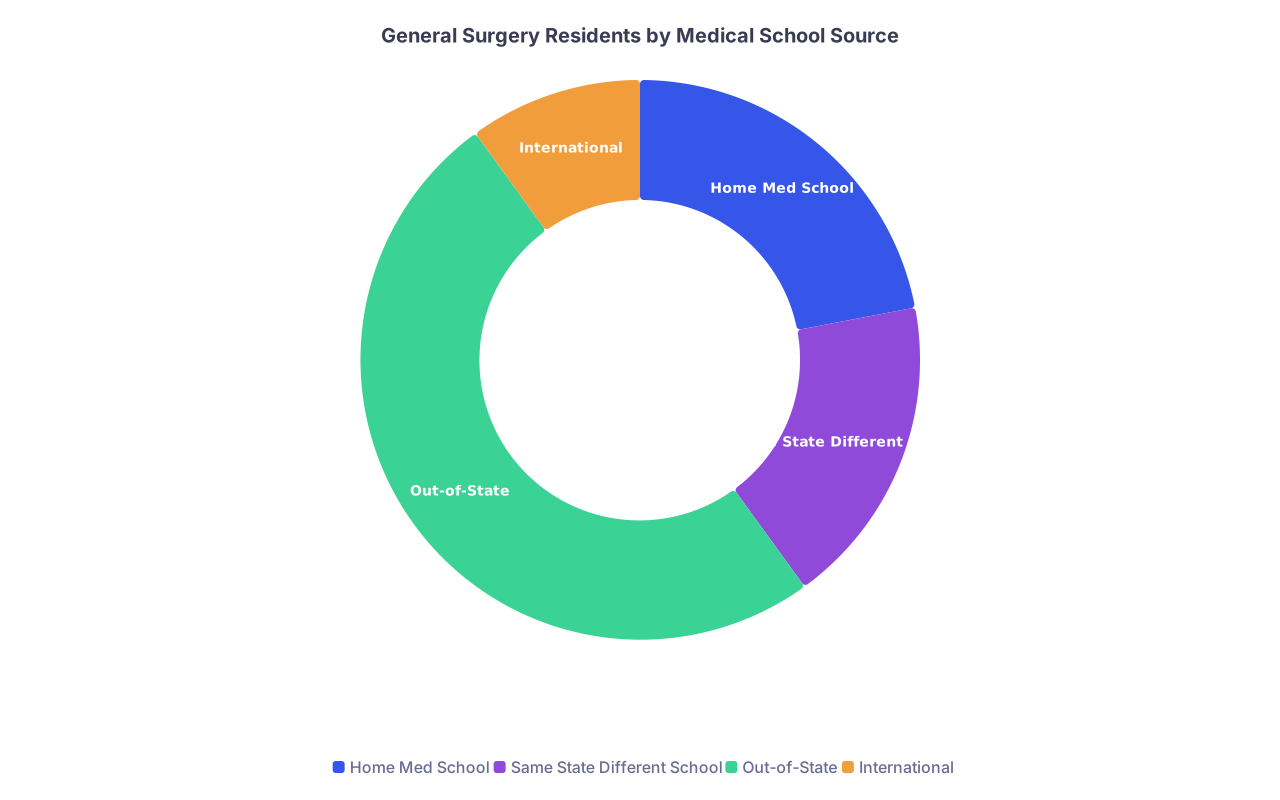
Half or more of general surgery residents at many programs come from out of state. A decent chunk from entirely different regions. The match is built on mobility.
The fact that you trained at Hospital X is an input, not a verdict.
Common Missteps That Come From Believing the Myth
I’ve watched capable students shoot themselves in the foot because they swallowed the “must match at home” myth whole.
Patterns I see:
- Over-ranking a mediocre-fit home program for “safety,” then regretting it for years.
- Neglecting to build relationships or perform well on away rotations because they assume “home will catch me.”
- Avoiding honest self-assessment (“My home program wasn’t that impressed with me”) and not doing the harder work of strengthening letters and performance elsewhere.
The uncomfortable truth: sometimes your home program is right about you not being their top match. That doesn’t mean you’re doomed in surgery; it means you should work on the parts of your profile that actually matter nationally instead of clinging to the logo.

| Step | Description |
|---|---|
| Step 1 | Strong performance at home |
| Step 2 | Rank home in top tier |
| Step 3 | Rank home appropriately or lower |
| Step 4 | Weak or mixed performance at home |
| Step 5 | Focus on away rotations and broader list |
| Step 6 | Like culture and training |
Final Reality Check
Let me strip this down to what actually matters.
- You do not need to match at your med school to get a good surgery residency. Most general surgery residents don’t.
- Matching at home is helpful only if you’re genuinely strong there and want to stay; it doesn’t save a weak file and can even hurt you if your reputation is poor.
- Rank your home program based on fit, training, and how they’ve treated you—not on superstition that they’ll punish you for leaving or that your career depends on staying.
The badge on your med school ID opens doors. It does not chain you to one.