High-Risk Airway Experience in ENT: Program Features That Actually Matter
You are standing in a crowded SICU room at 2:17 a.m. A septic obese patient with head and neck cancer is desatting on BiPAP, has a rock-hard neck, floor-of-mouth swelling, and an airway that absolutely nobody wants. Anesthesia is paging you. Your attending is 20 minutes away. The question in your head is not “What’s the algorithm?”
The question is: “Have I actually done this before, or am I about to practice on this patient for the first time?”
That feeling—that gap between what you have “seen” and what you have personally done—is exactly why your high‑risk airway exposure in residency matters. And most applicants underestimate how variable it is between ENT programs.
Let me walk through what actually matters if you care about being truly competent with dangerous airways by the time you finish residency. Not in the brochure sense. In the “it’s 3 a.m. and anesthesia is looking at you” sense.
First: What “High-Risk Airway” Really Means in ENT
Before you judge programs, you need a clear picture of what kind of airways you’re talking about. Not all “airway experience” is created equal.
High-risk airway in ENT usually means at least one of the following:
- There is a high chance of failure with standard laryngoscopy or even video laryngoscopy.
- Loss of spontaneous ventilation could be catastrophic.
- Surgical airway is not “Plan D”; it is baked into Plan A or B.
Concretely, this includes:
- Massive head and neck tumors: supraglottic, transglottic, fixed cords, tracheal deviation, prior radiation.
- Ludwig’s angina and deep neck space infections with floor-of-mouth elevation.
- Airway trauma: laryngeal fractures, penetrating neck trauma, tracheal disruption, inhalational injury.
- Post-op disasters: neck hematoma after thyroid/parathyroid, free flap failures with airway compromise.
- Severe subglottic/tracheal stenosis where intubation is not straightforward and extubation is risky.
- Pediatric nightmares: epiglottitis-like pictures, subglottic stenosis, craniofacial anomalies, airway hemangiomas, TEF/tracheal rings.
If a program tells you: “We get a lot of airways” but 90% of that is straightforward OR intubations that anesthesia handles while you stand in the back, that is not the same thing.
You are looking for ownership of high-risk airways and repetition of hard cases. Not one off “cool” cases scattered across five years.
The Core Question: Who Owns the Airway in This Hospital?
This is the single most important structural feature. Everything else builds on it.
In some hospitals, particularly strong ENT / H&N / trauma centers, the culture is:
“Difficult airway? Call ENT early.”
In others:
“Difficult airway? Anesthesia and Trauma team will handle it; ENT comes if we are already at ‘can’t intubate, can’t ventilate.’”
Those are two completely different training environments.
Here is what you want to pin down when you talk to residents and faculty:
Who gets called first for:
- Deep neck space infections with airway concerns?
- Floor-of-mouth / Ludwig’s?
- Suspected upper airway obstruction in the ED?
- Unstable neck hematoma on the floor?
- Awake trachs for head and neck cancer patients?
- Tracheal stenosis with stridor?
Does ENT have a formal role in the hospital’s “difficult airway response team”?
- Is there an actual difficult airway pager that ENT carries?
- Or do you just get occasional pages “if someone thinks to call ENT”?
For airway trauma (blunt/penetrating neck, laryngotracheal trauma):
- Is ENT the default consultant?
- Or does trauma + anesthesia generally handle them, with ENT only assisting if something is obviously surgical?
If anesthesia “owns” almost every aspect of the difficult airway—planning, execution, and follow-up—and ENT is peripheral, your training will be limited. You will still see airways. You just will not run them.
At strong ENT airway centers, residents will casually say things like:
- “Yeah, the ED calls us for almost all neck infections.”
- “We staff the trauma airway pager with anesthesia.”
- “Awake trachs are basically us with anesthesia backup, not the other way around.”
You want that.
Case Mix and Volume: What Actually Builds Skill
Seeing 5 insane cases in 5 years is not enough. You forget. You lose the edge. Skill in high-risk airway comes from:
- Repetition of common-but-hard scenarios
- Progressive autonomy
- Variation across anatomy, pathology, and patient profiles
Think about volume on three axes: overall airway volume, high-risk subset, and pediatric vs adult.
1. Overall Airway Volume
You want a program where:
ENT is consulted early and often for airway concerns from:
- ED
- ICU
- Medical/surgical floors
- Outside hospitals (transfer center)
There is a meaningful number of:
- Surgical tracheostomies (open, not just percutaneous by intensivists)
- Awake tracheostomies
- Cricothyrotomies (hopefully uncommon, but you at least want realistic exposure)
A busy tertiary/quaternary ENT program will typically have residents who say things like:
- “We take call Q3 and I probably see 1–2 real airway problems per week as a junior.”
- “You will absolutely get sick of deep neck infections by PGY-3.”
If they say:
“We do a fair number of trachs, mostly elective in the OR, not too many emergent airways,”
translate that as: “You may finish residency still nervous in a crashing airway.”
2. High-Risk Subset: Not Just Any Trach
Ask about:
Awake tracheostomies per year:
Not every program tracks this, but residents know. You want to hear numbers that sound like “a few per month” at the service level, not “I saw 3 in my residency.”Deep neck infections:
- Do they get boarded early?
- Are awake intubations or awake trachs routine for severe cases?
- Is ENT involved in that decision every time?
Airway stenosis (subglottic, tracheal):
- Is there an airway reconstruction faculty?
- Are you doing endoscopic dilations, scar resections, tracheal resections?
- Or do they ship everything to thoracic surgery or outside centers?
Programs with real airway reputations (you know the names: Iowa, Mayo, Vanderbilt, UPMC, etc.) will have a dedicated subset of attendings whose practice is basically “hard airways all the time.”
3. Pediatric vs Adult Airway
Some ENT residents finish strong on adult airways but feel borderline with kids, or vice versa.
Ask concretely:
- Does the program have a standalone children’s hospital or dedicated peds ENT service?
- Who manages:
- Pediatric subglottic stenosis?
- Airway hemangiomas?
- Craniofacial airway obstruction?
- Are pediatric tracheostomies (especially in medically fragile kids) done by ENT or pediatric surgery? And how many?
You do not need massive numbers of epiglottitis or pediatric emergent airways (thank you vaccines and modern medicine), but you do want:
- Multiple pediatric trachs
- Experience with microglottic/subglottic airways
- At least some chance to be primary surgeon in a truly scary pediatric airway case—as senior, not as wide-eyed PGY-2.
Call Structure: Where You Actually Learn to Make Decisions
High-risk airway judgment does not come from conferences. It comes from call. How call is structured directly impacts your growth.
Here are the real questions to ask:
As a junior:
- Are you in-house taking primary ENT call?
- Are you present in the ED/ICU for airway cases or just phone triage?
- Do attendings come in for every airway, or do they supervise selectively?
As a senior:
- When do you start taking higher-level or home call where you make the first major decision (OR vs bedside vs watchful waiting)?
- Do you personally run the discussion with anesthesia and ICU?
Interaction with anesthesia:
- Are there joint airway rounds or protocols?
- Is anesthesia happy to let ENT lead in upper airway obstruction?
- Or do they often bypass ENT entirely unless there is frank surgical need?
If a PGY-4 at that program tells you:
- “For most airway cases, I am physically there, I talk to anesthesia, I decide with my attending how to proceed, and I run the PGY-1 or 2 through the steps,”
you are in a good place.
If they say:
- “We are around, but anesthesia usually manages the airway and we come in afterward,”
then you are in a spectator program, not an operator program.
Faculty Expertise: Does the Program Have True Airway People?
You need to distinguish between:
- A general ENT program where everyone occasionally touches airways
vs - A program with actual airway experts whose referrals are coming from multiple states.
Look for:
Fellowship-trained complex airway / laryngology / head and neck surgeons whose practice obviously centers on:
- Stenosis
- Recurrent respiratory papillomatosis with airway compromise
- Laryngeal trauma
- Laryngeal framework surgery
- Chronic tracheostomy, T-tube, stents
A strong head and neck oncologic service with:
- High volumes of advanced laryngeal/hypopharyngeal tumors
- Routine awake airways for big tumor resections
- Coordinated surgical and oncologic care
If the faculty lineup includes at least one or two surgeons that every resident identifies as:
- “Our airway person”
- “The person everyone calls for impossible airways,”
you will get exposure that smaller, more generalist programs just cannot match.
Simulation and Formal Airway Curriculum: Helpful, but Not the Main Course
Simulation is not a substitute for real cases, but it is a very useful force multiplier.
You are looking for something beyond “we have a once-a-year airway sim day.”
Good programs have:
A structured difficult airway curriculum:
- Yearly or semi-annual sessions on:
- Awake fiberoptic intubation
- Video laryngoscopy in distorted anatomy
- Cricothyrotomy (open and percutaneous)
- Emergency tracheostomy under time pressure
- Yearly or semi-annual sessions on:
Multidisciplinary sim with:
- Anesthesia
- ED
- ICU nursing
- Respiratory therapy
So you practice not just the technical piece, but:
- Who calls whom.
- What language you use.
- Where the cric kits are.
- How fast OR responds.
This matters. In real life, miscommunication kills people as often as technical incompetence.
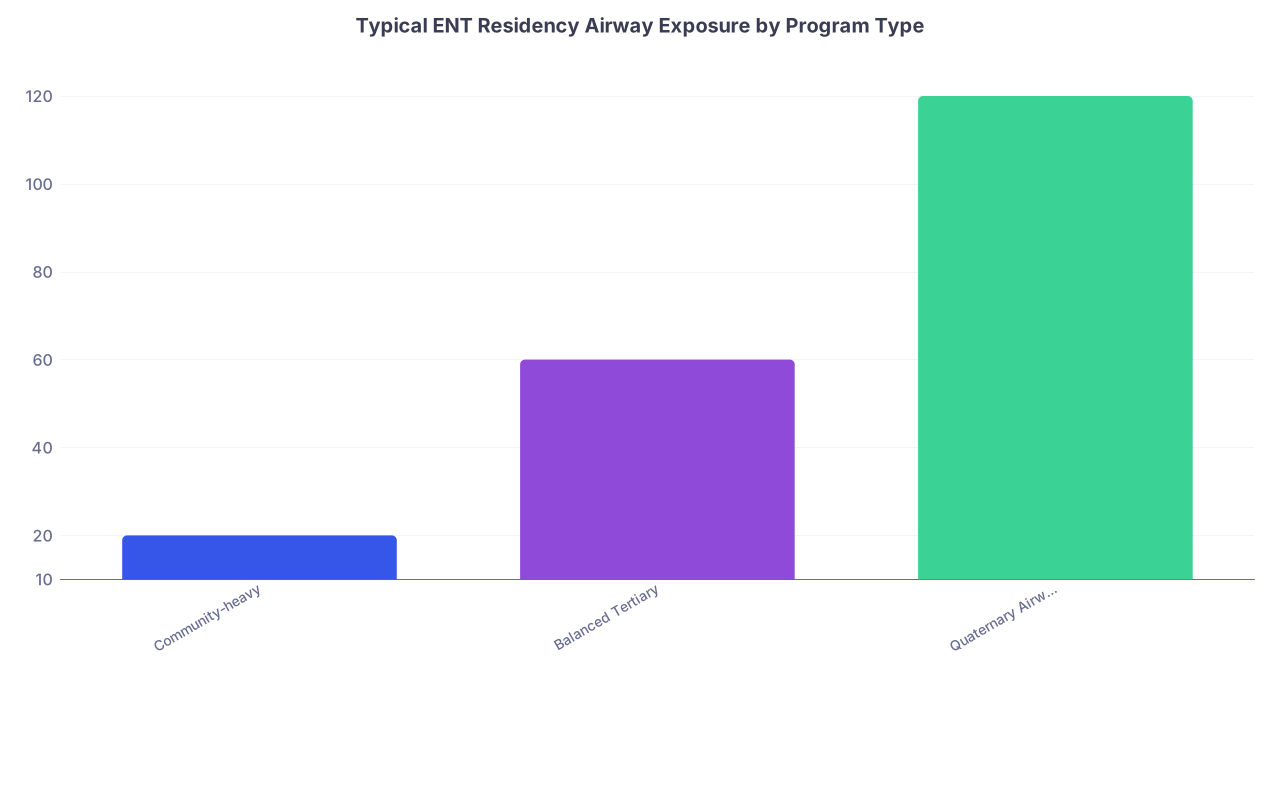
| Category | Value |
|---|---|
| Community-heavy | 20 |
| Balanced Tertiary | 60 |
| Quaternary Airway Center | 120 |
This is a rough conceptual comparison, but the pattern holds: dedicated airway centers give you a different volume and complexity curve.
Objective Structural Clues a Program Has Strong High-Risk Airway Exposure
You cannot trust only what people say on interview day. Everyone describes their program as “busy,” “high volume,” and “strong clinically.” Meaningless.
You need structural indicators. Things that are hard to fake.
Here are key features that correlate strongly with robust airway training:
| Feature | Strong Signal |
|---|---|
| Level 1 trauma center | Yes, with ENT on trauma team |
| Dedicated head & neck oncology | High volume, large tumors routinely |
| Transfer center patterns | Regular airway transfers from outside |
| Separate children’s hospital | ENT heavily involved in peds airways |
| Difficult airway team | ENT has formal role / pager |
A few patterns I see repeatedly in graduates who are genuinely comfortable with nasty airways:
- Their hospital is a Level 1 trauma center where ENT is actively involved in facial and laryngotracheal trauma.
- They have a busy head & neck service doing complex resections and reconstructions weekly.
- ENT is clearly part of the hospital’s difficult airway infrastructure: either co-managing or leading upper airway obstruction.
- They have a children’s hospital that does at least a modest volume of pediatric trachs and airway reconstructions.
If a program is community-heavy, minimal trauma, no real head & neck volume, and ENT has no airway pager—your airway experience will predictably be thin.
Patient Mix and Referrals: Are You the Destination or the Detour?
Here is a question most applicants never ask, but should:
- “What kinds of airway cases get transferred in versus transferred out?”
That one sentence tells you a lot.
If they say:
- “We get referrals from 3–4 hours away for airway stenosis, complex tracheostomy problems, and big neck infections…”
you are at a destination center. Good.
If they say:
- “We mostly manage our own patients; for crazy airways they sometimes get sent to [bigger academic center nearby]…”
then you are training at the place that loses the hardest stuff to someone else. Guess where you will not learn to manage them.
Similarly, ask:
- “How often does ENT say ‘we need to transfer this patient out for airway management’?”
If residents can recall multiple cases, that is a red flag for your training (and frankly for institutional capability).
Resident Autonomy: Are You Holding the Scope or Watching the Scope?
You can be flooded with airway cases and still graduate shaky if you mainly observe and retract.
The progression you want looks roughly like this:
PGY-1:
- Present on airway cases, help with set-up, basic laryngoscopy, start learning fiberoptic.
- Watch senior and attending make decisions; start to understand risk stratification.
PGY-2–3:
- Perform more of the technical work:
- Direct and video laryngoscopy under attending supervision.
- Fiberoptic intubations in stable but challenging cases.
- Open trachs in controlled settings.
- Participate in the planning of awake vs asleep, OR vs bedside, etc.
- Perform more of the technical work:
PGY-4–5:
- Lead the decision-making under attending back-up:
- You decide: “We are not inducing this patient asleep.”
- You coordinate with anesthesia and ICU.
- You are primary surgeon/fiberoptic operator for complex airways.
- You run juniors through easier components while you manage the dangerous parts.
- Lead the decision-making under attending back-up:
When you talk to residents, listen for phrases like:
- “As a chief, I am the one who…”
- “I usually run the airway plan by the attending but I propose the strategy first…”
- “By PGY-4, you are the primary surgeon on almost all emergent trachs unless it is truly insane.”
If seniors sound like scribes—“I help, but the attendings usually run the airway”—that is not where you want to be.
What Not to Overweight: Shiny but Low-Yield Features
Applicants get distracted by certain features that sound related to airway but do not reliably translate into real competence.
Here is what I would not over-prioritize:
Tons of elective OR intubations:
- Great, you can watch 500 easy intubations. Anesthesia can train CRNAs for that. It does not by itself make you good at an obstructing supraglottic tumor on 100% NRB.
Simulation centers with beautiful equipment but minimal scheduled airway training:
- Fancy mannequins do nothing if you only touch them during orientation week.
Programs boasting “we see everything” without numbers:
- If they cannot give you at least ballpark counts (e.g., “we probably do 40–50 trachs per year, X% emergent, Y% peds”), assume the volume is modest.
Big name alone:
- Some brand-name institutions are fantastic for research and advanced oncologic surgery but are oddly weak in actually letting residents run critical airways.
How to Extract the Truth on Interview Day
You will not get honest, useful information from formal presentations. Everyone has the same slides: “High volume, great training, fantastic airway experience.”
You have to ask residents very specific questions, off to the side.
Use questions like:
- “In the last 6 months, how many airway cases made you sweat a little? What were they, and what was your role?”
- “Who manages most deep neck space infections here—ENT or medicine/anesthesia with ENT on standby?”
- “How many awake trachs have you personally performed, and by what PGY year did you first do one as the main surgeon?”
- “Do you ever get called for crashing patients in the ED with airway issues? What happens then?”
- “Are there any airway cases you feel under-prepared for as you approach graduation?”
And then shut up and let them talk.
Pay attention to:
- How fast they answer (if they have to think hard, volume may be low).
- Whether they describe specific cases or speak in vague generalities.
- Whether seniors sound genuinely confident or quietly uneasy.
Residents at strong programs will often have a slightly jaded, calm tone about terrible airways. That is what you want. “Yeah, we see some gnarly stuff, but you get used to it.”
Tradeoffs: You Cannot Maximize Everything
You probably will not find a program that is:
- Top-tier research
- Lifestyle cushy
- Massive operative volume
- Elite airway exposure
- In your favorite city
- Near your partner’s job
…all at once.
If high-risk airway competence is genuinely a priority for you—maybe you want to do laryngology, airway reconstruction, or just be “the person” for airway problems in a smaller community—you need to be willing to pay for that in other currencies:
- More call
- Sicker patients
- NICU/PICU overnight issues
- More time in ICUs and EDs, not just in the clean, predictable OR
You are trading sleep and comfort for skill. That is a fair trade early in your career. Much harder to fix later.
Decision Heuristic: How to Weigh Airway When Ranking ENT Programs
If you care about airway competence, use a simple framework.
Rank programs higher if they:
- Have clear structural markers:
- Level 1 trauma
- Busy head & neck
- Children’s hospital
- ENT on difficult airway team
- Residents can easily describe:
- Multiple recent hard airway cases
- Their specific role and progression over residency
- Seniors sound:
- Calm, not boastful, when talking about dangerous airways
- Honest about what still makes them nervous (everyone has something), but overall comfortable
Rank programs lower if:
- ENT is mostly reactive: called late when things are already spiraling.
- Anesthesia or trauma clearly “owns” most airway decisions with ENT as a procedural consultant only.
- Residents have a hard time recalling personal involvement in awake airways, emergent trachs, or deep neck infection airways.
If two programs are otherwise similar for you—city, culture, operative volume—use airway ownership as a tiebreaker. It is that important.

| Step | Description |
|---|---|
| Step 1 | Evaluate ENT Program |
| Step 2 | Lower airway training priority |
| Step 3 | Moderate airway training |
| Step 4 | Strong airway training |
| Step 5 | ENT on difficult airway team |
| Step 6 | Head and neck + trauma volume |
| Step 7 | Resident autonomy on call |
One More Reality Check: Your Future Practice
You might think: “I am going into community general ENT. I will not see crazy airways.” That is naive.
Here is what actually happens:
- You will get called to the ED by a panicked hospitalist for “stridor in a neck mass patient” where there is no on-site anesthesia who is comfortable with awake fiberoptic.
- A post-thyroidectomy hematoma will roll into your small hospital at 11 p.m.—and you are the only surgeon in-house.
- A trach from a nursing home will dislodge in a patient with no recognizable neck anatomy.
- A pediatric airway with a foreign body will arrive, and pediatric anesthesia is “on their way.”
At that point, you will not care which program had the better research day or nicer resident lounge. You will care if your hands know what to do, because you have done something like this fifty times before, not once in a sim lab.
Key Takeaways
- Do not confuse “we see a lot of OR intubations” with high-risk airway training. You want ownership of deep neck infections, tumors, trauma, and emergent trachs, not just electives.
- Look for structural signals: Level 1 trauma, strong head & neck, children’s hospital, ENT on the difficult airway team, and being a destination (not a detour) for airway referrals.
- On interview day, push past the marketing. Ask residents for specific recent airway cases and their role. If seniors sound calm and competent about scary airways, you are probably in the right place.