Pediatric Exposure in General Surgery Residencies: What Numbers to Look For
It is late January. You are staring at two interview offers: one big-name academic general surgery program and one mid-tier university hospital. The first has “pediatric surgery” listed as a 4‑week PGY‑3 rotation. The second has a full children’s hospital across the street, talks vaguely about “strong pediatric exposure,” and then moves on to tout their transplant volume.
You want real pediatric exposure. Either because you are already thinking about pediatric surgery fellowship, or because you do not want to feel lost the first time a 2‑year‑old with intussusception is rolled into your community ER call room five years from now.
Here is the question you actually need answered: what hard numbers should you be looking for to judge pediatric exposure in a general surgery residency?
Let me break that down specifically.
Step 1: Understand the Pediatric Surgery Baseline for General Surgery
Before you start hunting numbers, you need a realistic frame.
General surgery residency is not pediatric surgery fellowship. You are not going to graduate as a high‑complexity pediatric surgeon. What you should expect from a good general surgery program is:
- Solid comfort with common pediatric surgical emergencies.
- Enough operative experience to feel safe operating on straightforward pediatric cases in a community setting.
- Adequate exposure to even the rare stuff so you know what you do not know—and when to transfer.
The ABS case log reality
The American Board of Surgery (ABS) sets pediatric case minimums for general surgery residents. These change slightly over time, but the pattern is consistent: the required minimum is low. And it stays low.
A ballpark to know:
- Total pediatric cases required for general surgery: usually in the range of 50–70 cases over the entire residency.
- Within that, only a subset must be “major” cases.
- Neonatal index cases (e.g., congenital diaphragmatic hernia, TEF/EA, NEC operations) are not strictly required in large numbers for a general surgery graduate.
This is not enough for true comfort if you want real pediatric competency. Hitting the ABS minimum just means “barely acceptable.” Programs love to say, “Our grads easily exceed minimums.” That is meaningless without numbers.
If a program cannot tell you their average graduating pediatric case numbers, that is a yellow flag already.
Step 2: Core Numbers You Should Demand
There are five major quantitative buckets you should be thinking about:
- Duration and structure of pediatric rotations
- Pediatric operative case volumes (per resident)
- Breadth of pediatric pathology and age range
- Night/weekend pediatric exposure
- Presence of a free‑standing children’s hospital or robust pediatric service
We will go through each. With actual thresholds.
1. Pediatric Rotation Time: Weeks Matter, but Structure Matters More
Most programs will quote you a total number of “peds weeks.” You need to push beyond the raw number to what those weeks actually look like.
Minimums vs realistic targets
Here is a rough framework:
Absolute floor (barely acceptable):
8 weeks total of dedicated pediatric surgery across PGY‑2 to PGY‑4.Reasonable exposure:
12–16 weeks total.Strong exposure (especially if you are fellowship‑curious):
20+ weeks, distributed over at least two different years of training and with graded responsibility.
If a program says “we have a peds rotation,” and it is a single 4‑week month in PGY‑2 or PGY‑3, that is weak. You will be a glorified intern, scut‑heavy, and will not have the senior role where you actually make decisions.
Look for this breakdown
Ask specifically:
- How many total weeks on pediatric surgery across all five years?
- In which PGY years? (You want it spread: one junior year block and at least one senior block.)
- Are any peds weeks electives or all core? (Elective time is vulnerable to being stolen for research/match games.)
A robust pattern might look like:
- PGY‑2: 6–8 weeks pediatric surgery
- PGY‑3 or PGY‑4: 6–8 weeks pediatric surgery as a senior or midlevel
- Optional PGY‑4/5 elective: another 4–8 weeks at the children’s hospital or external peds site
If all the peds time is front‑loaded as early‑PGY and there is no senior‑level peds chief month, that is a problem if you care about real leadership experience on a pediatric team.
2. Pediatric Case Volume: Concrete Numbers You Should Hear
You care about resident‑level numbers, not hospital‑level.
Programs love saying, “We have a high‑volume children’s hospital—over 10,000 cases per year.” That tells you nothing about what one resident sees.
For pediatric exposure in a general surgery residency, here is roughly what I would consider:
Barely adequate:
70–100 pediatric cases logged by graduation.Solid:
120–150 pediatric cases per graduate.Strong (for a general surgery pathway):
150–200+ pediatric cases, with a good mix of bread‑and‑butter and some complexity.
And then you split that into categories you actually care about.
Key categories you want numbers on
Do not just ask “How many pediatric cases do grads log?” Ask:
- Total pediatric cases per graduating chief over last 3–5 years (average and range).
- Number of pediatric index cases as surgeon junior vs surgeon chief.
- Exposure to neonatal cases and emergent pediatric surgery.
Here is how I would press them:
“Over the last 3 classes, what is the average number of pediatric cases per graduate?”
“Roughly how many of those are cases where the resident is surgeon chief versus assistant?”
“Do your residents get primary surgeon experience on appendectomies, pyloromyotomies, and usual pediatric emergencies, or are those mostly done by fellows?”
If they cannot answer with numbers, or they hand‑wave—“Oh, plenty”—you take that as a negative data point.
To visualize realistic target bands:
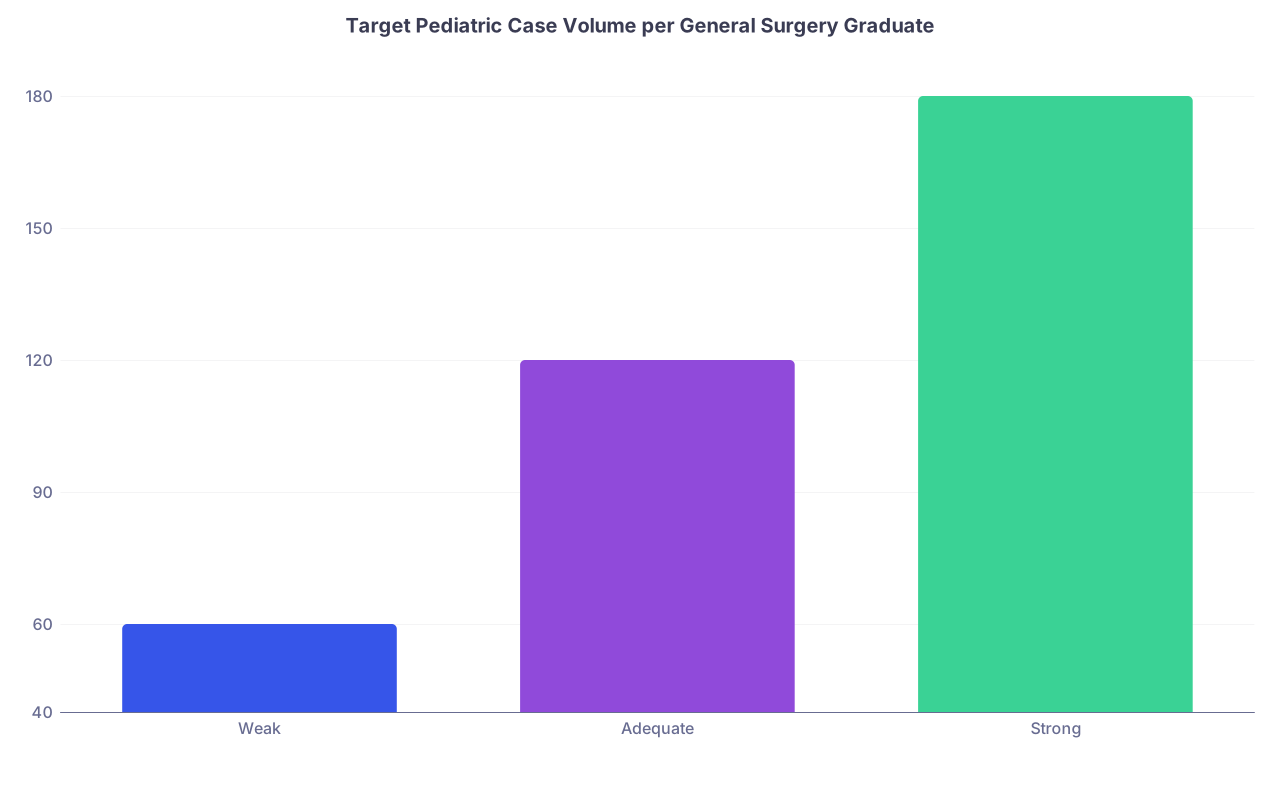
| Category | Value |
|---|---|
| Weak | 60 |
| Adequate | 120 |
| Strong | 180 |
This is not from a single dataset; it is a reasonable conceptual range. Below 60–70? You will feel thin. Above ~180 as a general surgery resident? That usually signals a very strong pediatric environment or heavy pediatric elective use.
3. Pathology Breadth and Age Range: Numbers Behind the Label
“Pediatric surgery” can mean very different things.
One program’s “pediatric surgery rotation” is 90% adolescent appendectomies at a community hospital. Another’s is neonatal ECMO, CDH repairs, and TEF/EA at a level I children’s hospital.
You cannot tell from the brochure. You need to interrogate the pathology profile.
Age distribution
Ask directly:
- What proportion of your pediatric cases are under age 5?
- How many neonatal (under 30 days) operating room cases does a typical general surgery resident participate in?
If all the stories you hear on interview day are about 14‑year‑olds with cholecystitis and 16‑year‑olds with trauma, it is basically “small adult surgery.” Helpful, but not real pediatric surgical depth.
If they say:
- “Our general surgery residents average 10–20 neonatal OR cases,”
that is a much richer pediatric experience.
Bread‑and‑butter case types
You want decent numbers in:
- Appendectomy (open and laparoscopic)
- Pyloromyotomy
- Inguinal hernia/hydrocele repairs in kids
- Undescended testis (orchiopexy)
- Intussusception reductions (operative and radiologic)
- Simple bowel obstruction, Meckel’s, malrotation/volvulus repairs (even a few)
For a general surgeon, feeling comfortable with these is the goal. You do not need to be doing multiple esophageal atresia repairs, but if you never see one, that speaks to how deep the pediatric program really is.
If you are fellowship‑oriented, you raise your bar and push hard on congenital and neonatal volume; if not, you mainly care about strong bread‑and‑butter and at least some rare exposure.
4. Night and Weekend Pediatric Exposure: Where Real Learning Happens
You do not really learn pediatric emergencies at noon on a Tuesday in a populated OR block. You learn them at 2 a.m. when the ED calls about a 6‑month‑old with bilious emesis.
So you need to understand:
- Who covers pediatric surgery overnight?
- Are general surgery residents in that coverage line, or is everything shunted to a pediatric surgery fellow?
Here is the pattern to listen for.
Ideal structure for learning
- General surgery resident (PGY‑2 or PGY‑3) is the in‑house or home‑call first responder for pediatric surgical consults at night.
- Pediatric surgery attending is on home call; fellow may or may not be present.
- The general surgery resident at least sees and evaluates pediatric ED consults, even if the attending or fellow scrubs the case.
Programs where the general surgery residents “never get called for kids” are convenient for your sleep, but terrible for your training.
What to ask
I would ask:
- “On call, who evaluates pediatric surgical consults in the ED—the general surgery resident, a pediatric fellow, or directly the pediatric attending?”
- “Do general surgery residents scrub pediatric emergencies overnight, or are they typically bumped by fellows?”
- “Can you estimate how many pediatric emergencies a typical PGY‑2/3 sees in a month of call?”
If all the pediatric action happens in a siloed team that bypasses general surgery residents entirely, you are not going to develop real confidence with acute pediatric presentations.
5. Does a Children’s Hospital Actually Help You? Only If You Get Access
Every program pitches “We have a children’s hospital.”
The question is: who actually works there? And who gets the cases?
Key structural variables
You want answers to:
- Is it a free‑standing children’s hospital or just a few pediatric beds inside a general hospital?
- How many pediatric surgery faculty are there?
- Are there pediatric surgery fellows? If so, how many?
- Do general surgery residents rotate at the children’s hospital, or does the peds department have their own trainees (pediatric residents, fellows) who take essentially all the action?
A fellow‑heavy environment can be fantastic if you still get cases and evaluate consults. It can also be a black hole where you round on the floor and write notes while the fellows do every meaningful case.
| Program Type | Peds Rotation Time | Fellows Present | Typical Gen Surg Resident Peds Cases |
|---|---|---|---|
| Community, no children's hospital | 4–8 weeks | No | 40–80 |
| University, shared children's ward | 8–12 weeks | Maybe | 80–120 |
| University with free-standing CH | 12–20+ weeks | Yes | 120–200+ |
The last row is where you want to be if you are even half‑thinking about pediatric surgery fellowship. But only if the residents actually get in the room.
6. How to Extract Real Numbers from Programs (Without Sounding Like a Statistician)
Programs are used to getting soft questions: “Describe the pediatric experience here.” That invites fluff.
You will get much better data with very specific, number‑oriented questions. For example:
- “For your last 3 graduating classes, what is the average number of pediatric cases in the ABS logs per graduate?”
- “How many weeks of pediatric surgery are mandatory, and how many are elective?”
- “During a typical pediatric surgery month, how many days per week are residents in the OR versus clinic or floor?”
- “Do your residents hit ABS pediatric minimums by PGY‑4, or is it mostly back‑loaded?”
- “Can you give a ballpark number of pyloromyotomies, pediatric appendectomies, and inguinal hernia repairs the average graduate has done as primary surgeon?”
Good programs know these numbers. Or at least ballparks. If they provide a handout with case log medians by category (a few do), that is even better.
Here is a simple reality: if a program has strong pediatric exposure, they are proud of it and can quote numbers without needing to dig for 10 minutes. If they wave it away—“Oh yeah, we do lots of kids”—that usually means the numbers are mediocre.
7. Special Scenario: You Are Serious About Pediatric Surgery Fellowship
If pediatric surgery fellowship is even a 30% chance in your mind, your bar for pediatric exposure is higher. You need depth and you need letters from pediatric surgeons who have watched you actually operate and make decisions.
What you should look for:
- 20+ weeks of pediatric surgery total.
- At least one senior‑level pediatric rotation where you act as the primary resident or “mini‑chief.”
- Clear pathway for a dedicated pediatric surgery research year (often 2 years) with peds faculty.
- A track record of sending graduates to pediatric surgery fellowships in the last 5–10 years.
You do not necessarily need 300 pediatric cases logged. But you do need meaningful operative volume, significant time in the pediatric OR, and strong peds mentorship.
A sample “fellowship‑friendly” structure:
- PGY‑2: 8 weeks core pediatric surgery
- PGY‑3/4: 8 weeks core pediatric surgery with more autonomy
- PGY‑4/5: 4–8 weeks elective pediatric surgery (often out‑rotation at a high‑volume children’s hospital)
- 1–2 years of research with pediatric surgery faculty in between PGY‑3 and PGY‑4

| Step | Description |
|---|---|
| Step 1 | PGY1 |
| Step 2 | PGY2 Core Peds 8w |
| Step 3 | PGY3 General/Trauma |
| Step 4 | Research with Peds Faculty |
| Step 5 | PGY4 Senior Peds 8w |
| Step 6 | PGY5 Chief Peds Elective 4-8w |
| Step 7 | Pediatric Surgery Fellowship |
If a program has never matched anyone into pediatric surgery in the last decade, you are pushing a rock uphill. Not impossible. But you will build everything yourself.
8. Red Flags and Common Traps in Evaluating Pediatric Exposure
You will hear the same lines over and over on the interview trail. Some are harmless fluff; some are real warning signs.
Here are a few I pay attention to.
Red flags
“We meet all ABS pediatric minimums.”
That is the lowest bar they could possibly quote. It often means they barely scrape by.“We do a lot of adolescent surgery; they are basically adults.”
Translation: you are not seeing many tiny kids or neonates.“We have a very strong pediatric service with several fellows, so things run very smoothly.”
Smooth for whom? If you do not hear in the same breath that residents get primary cases and ED consults, assume you are a note‑writer.“Our pediatric exposure has improved a lot recently; we are still working on formalizing it.”
Could be positive. Could also mean it is not stable or guaranteed during your 5 years.“Residents can get more pediatric cases if they are proactive.”
Usually means the baseline structure is weak; you are relying on hustle and goodwill rather than a designed curriculum.
Words you actually want to hear
- “Our residents average around 130–160 pediatric cases at graduation.”
- “You will do a dedicated pediatric rotation early and then come back as a senior where you run the team.”
- “General surgery residents see all pediatric surgery consults overnight first, and we involve fellows as needed.”
- “We have sent 1–2 residents to pediatric surgery fellowship in the last 5 years.”
Those phrases, plus a free‑standing or robust children’s hospital, are a very good sign.
9. How to Compare Programs Side by Side
You are going to end up with a messy spreadsheet or notes from interviews. Here is a simple way to structure comparison for pediatric exposure between programs.
| Feature | Program A | Program B | Program C |
|---|---|---|---|
| Total peds weeks (core+elect) | 8 | 14 | 22 |
| Avg peds cases per graduate | 70–90 | 120 | 180+ |
| Neonatal OR exposure | Minimal | Moderate | High |
| Fellows present | No | Yes | Yes |
| Gen surg sees ED peds consults | Sometimes | Yes | Yes |
Now you can interpret:
- Program A: Barely sufficient pediatrics for ABS; not good if you care about kids.
- Program B: Solid exposure; reasonable for most general surgeons.
- Program C: Strong environment; potentially fellowship‑feeder if research and mentorship align.
A simple way to sanity‑check yourself is to imagine graduating from each program and being the only surgeon on call at a community hospital when a 3‑year‑old with appendicitis and a 1‑month‑old with bilious vomiting walk in. Do you feel fundamentally comfortable in that scenario based on the training numbers and structure you see?
If the answer feels like “probably not,” move that program down your rank list.
10. Where Case Logs and Reality Diverge
One last nuance: ABS case logs are self‑reported. They are subject to:
- Over‑counting assist cases as “surgeon junior” when your role was marginal.
- Logging every minor port placement as a separate case.
- Wide variation in how honest or careful residents are with logging.
So even when you see numbers, you keep some skepticism.
That is why I put more weight on:
- Structure: How many weeks are you physically assigned to pediatric surgery, and at what level?
- Authority: Are you the one called for consults, writing operative plans, presenting to attendings?
- Repetition: Do you repeatedly do core pediatric operations or just see one of each?
Still, the numbers give you a baseline. You should not ignore them; you just should not worship them.
To round this out, think about the volume you really need to feel comfortable doing routine pediatric cases independently later:
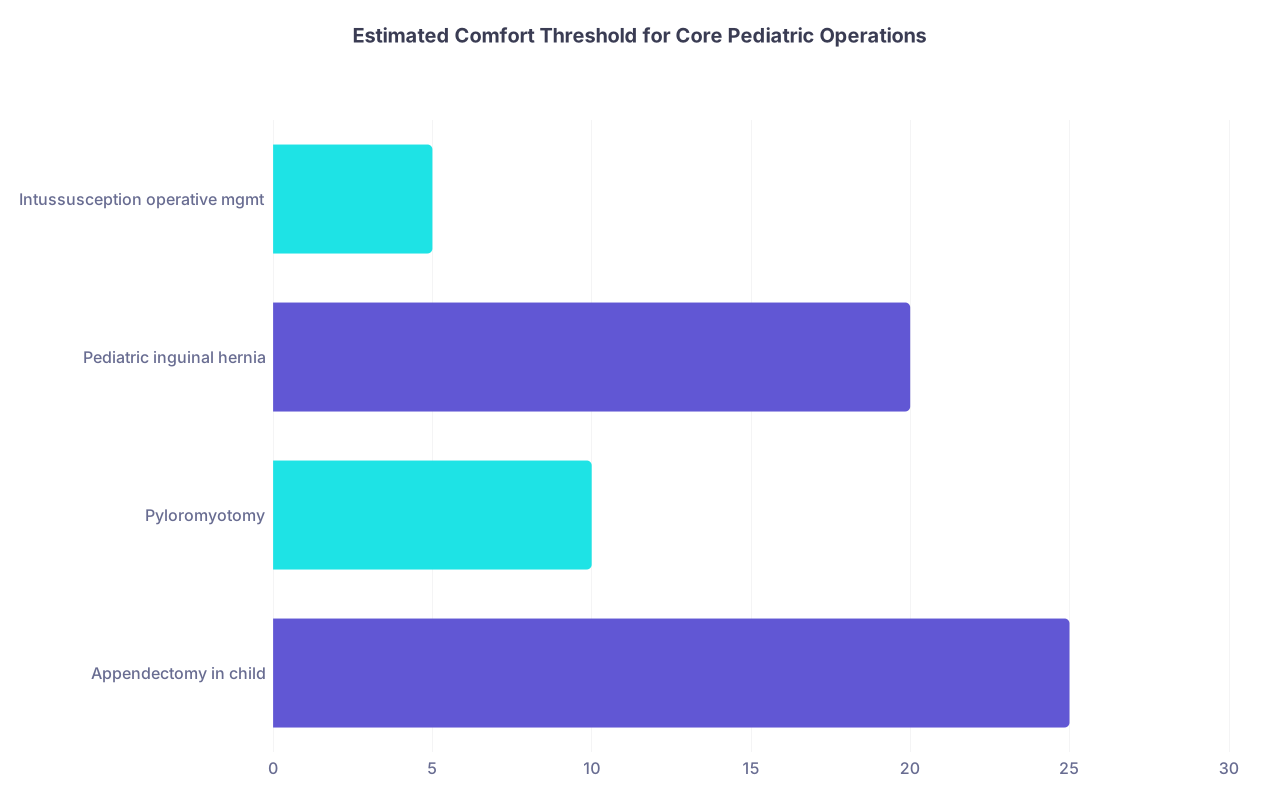
| Category | Value |
|---|---|
| Appendectomy in child | 25 |
| Pyloromyotomy | 10 |
| Pediatric inguinal hernia | 20 |
| Intussusception operative mgmt | 5 |
These are approximate comfort thresholds, not Board rules. Less than that and you will always feel a little uneasy. Much more and you start to feel like you have actual depth.
FAQs
1. How many weeks of pediatric surgery do I really need in a general surgery residency?
If you want baseline comfort and are not planning a pediatric fellowship, I would aim for at least 12 weeks total of dedicated pediatric surgery, with exposure spread across junior and senior years. Eight weeks can technically “work,” but those grads often feel thin. If you have any interest in pediatric surgery long‑term, 20+ weeks plus elective options is where you should aim.
2. Are pediatric surgery fellows bad for general surgery resident exposure?
Not inherently. Fellows are a problem only when they completely displace residents from the OR and consults. In a well‑run program, fellows handle the most complex cases, take some overnight burden, and still leave plenty of bread‑and‑butter pediatric cases and decision‑making for general surgery residents. You judge this by asking specifically who sees ED consults and who is primary surgeon on common pediatric operations.
3. What if my top‑choice program has weak pediatric exposure but is strong in other areas?
Then you decide how much you care about pediatrics. If you see yourself in a large adult‑only practice or a highly sub‑specialized field such as HPB, weak pediatric exposure may be tolerable. If you are planning to work in a community setting where kids will absolutely show up, or you are even mildly pediatric‑curious, consistently weak pediatric training should make you very uneasy, no matter how shiny the rest of the program is.
4. Can I make up for weak pediatric exposure with electives later?
Sometimes. You can stack a couple of pediatric electives in PGY‑4 or PGY‑5, or arrange an away rotation at a children’s hospital. But this is always second‑best compared with a program that structurally values pediatrics from day one. Electives get squeezed by service needs, research timing, and fellowship application pressures. I treat “I will fix it with electives” as a partial solution, not a full one.
5. Do case log numbers really matter for fellowship applications in pediatric surgery?
Yes, but they are only one piece. For pediatric surgery fellowship, programs look hard at your research with pediatric surgeons, letters from pediatric faculty, interview performance, and institutional reputation. However, if your case log shows very low pediatric volume and you have almost no real pediatric OR experience, it will be obvious. Programs know you will struggle to function as a pediatric fellow without adequate baseline exposure.
6. If I want to be a community general surgeon, how high should I set my pediatric exposure bar?
You do not need crazy numbers, but you should not accept the bare minimum. I would target a residency where you log at least 120 pediatric cases, with repeated primary surgeon experience in pediatric appendectomy, pyloromyotomy, inguinal hernia repair, and evaluation of common ED consults. You want enough exposure that, five years out, you can safely handle routine pediatric emergencies and know exactly which higher‑risk kids you must transfer to a tertiary center.
Key points to keep in your head:
- Do not be fooled by “we have a children’s hospital” or “we meet ABS minimums.” Demand specific numbers: total peds weeks and average pediatric cases per graduate.
- Strong general surgery pediatric exposure looks like 12–20+ weeks of peds, 120–180 cases logged, clear ED consult responsibility, and at least some neonatal and complex pediatric experience.
- If pediatric surgery fellowship is even on the horizon, choose a program that not only has high pediatric volume, but also gives you senior‑level responsibility and direct mentorship with pediatric surgeons.